Key Drivers of Soil Microbial Community Composition: From Foundational Principles to Biomedical Applications
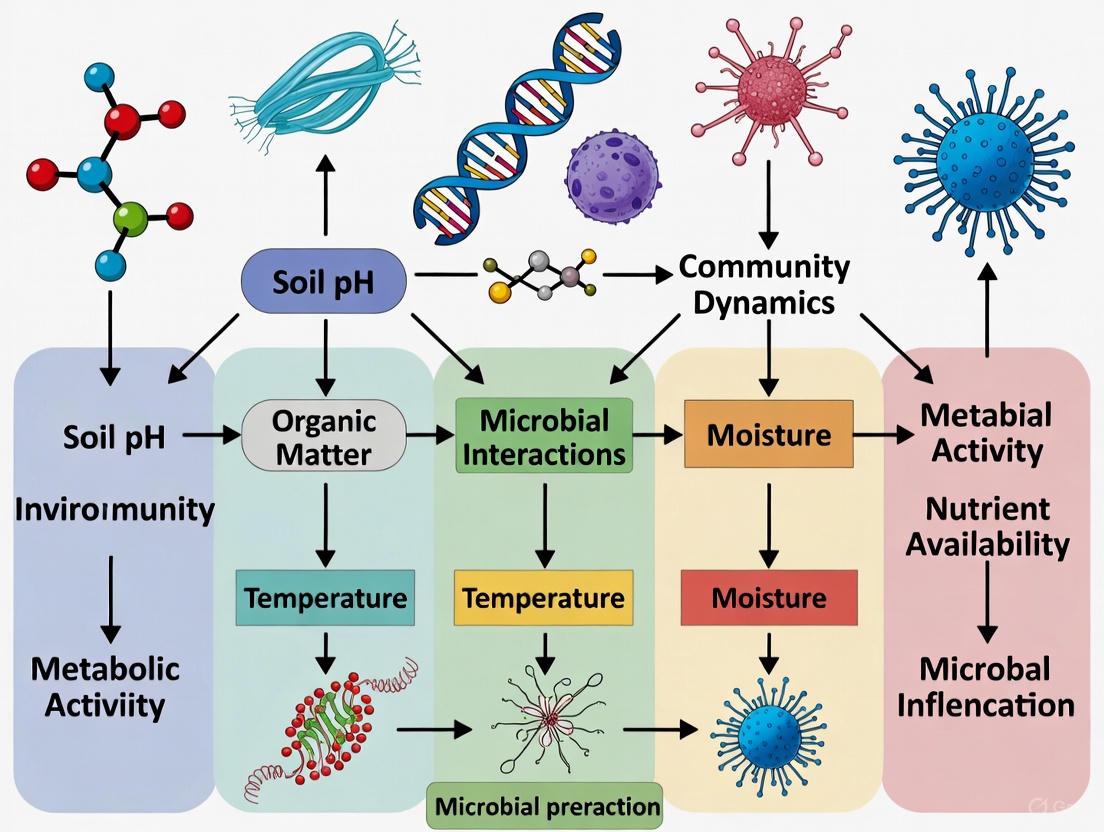
This article synthesizes current research on the complex factors governing soil microbial community composition, a field with profound implications for ecosystem health and biomedical discovery.
Key Drivers of Soil Microbial Community Composition: From Foundational Principles to Biomedical Applications
Abstract
This article synthesizes current research on the complex factors governing soil microbial community composition, a field with profound implications for ecosystem health and biomedical discovery. We explore the hierarchical influence of soil properties, from energy sources and environmental stressors to plant interactions. The content details advanced methodological approaches for community profiling, analyzes common disturbances like drought and monoculture, and presents comparative validation of agricultural management practices. Aimed at researchers and drug development professionals, this review highlights how understanding soil microbiomes can inform strategies for ecosystem restoration and provide novel insights into microbial ecology relevant to human health.
The Hierarchical Framework of Soil Microbiome Drivers: Energy, Stress, and Host Interactions
The soil microbiome, a complex assembly of bacteria, archaea, fungi, and other microorganisms, is a fundamental component of terrestrial ecosystems, driving critical processes from organic matter decomposition to nutrient cycling [1] [2]. Understanding the factors that shape the structure and function of these communities remains a central challenge in microbial ecology. While numerous studies have identified correlations between various environmental attributes and microbial composition, the incredible complexity of soil systems, with thousands of taxa coexisting in microhabitats separated by micrometers, makes identifying causative relationships particularly difficult [1]. This complexity is further compounded by the interplay of spatial and temporal scales, which influences the relative importance of different drivers.
To address this challenge, we propose a hierarchical model that ranks environmental and edaphic attributes based on their importance to the fundamental physiological needs of soil microorganisms. This framework moves beyond simple correlation-based analyses to provide a mechanistic understanding of community assembly, enabling more accurate predictions of microbial responses to environmental change and more targeted manipulations for agricultural and ecosystem management. By systematically organizing drivers according to ecological principles, this model offers researchers a structured approach for designing experiments, interpreting data, and building predictive models of soil microbial ecology.
The Hierarchical Framework for Microbial Drivers
The proposed hierarchical model ranks drivers based on their fundamental importance to microbial survival, growth, and function, while simultaneously accounting for the influence of spatial and temporal scales. This framework recognizes that while all factors can influence microbial communities, they do not contribute equally to community assembly processes.
Theoretical Foundation and Ranking Principles
The model organizes drivers into four primary tiers based on microbial physiological requirements:
Tier 1: Energy Supply - Factors that supply energy, including organic carbon quality/quantity and electron acceptors (especially oxygen), represent the most fundamental determinants of microbial presence and activity [1]. These resources directly fuel metabolic processes and establish the basic potential for microbial growth in a given habitat.
Tier 2: Environmental Effectors - Abiotic conditions that create the physical and chemical context for microbial life, including pH, salt concentration, drought stress, and toxic chemicals [1]. These factors determine whether a habitat is suitable for microbial persistence by imposing physiological constraints on survival.
Tier 3: Macro-organism Associations - Biological interactions with plants (including their seasonality), animals, and soil fauna that modify the soil environment and provide specialized niches [1]. These associations often mediate resource availability and microhabitat formation.
Tier 4: Nutrients - Essential elements required for biomass synthesis, with nitrogen and phosphorus typically being most critical, followed by other micronutrients and metals [1]. While essential, these factors often become limiting only after energy and habitat requirements are satisfied.
This hierarchy is visually summarized in the following diagram, which illustrates both the ranking and the interconnections between driver categories:
The Dimension of Scale in Driver Hierarchy
The relevance of specific drivers varies considerably across spatial and temporal scales, creating a dynamic context for the hierarchical model. At larger spatial scales (field to regional), factors influencing soil formation—parent material, climate, vegetation, and topography—create variation in soil type and physicochemical properties that fundamentally shape microbial composition [1]. In contrast, at smaller spatial scales (aggregate to millimeter), distinct environments vary in terms of organic matter quality, pH, pore geometry, and redox potential, creating microhabitats that support different microbial communities [1].
Temporal scale similarly influences driver importance. Persistent populations that have long adapted to soil conditions form a stable community core, while dynamic populations respond to seasonal fluctuations, resource inputs, or disturbance events [1]. This temporal dynamic was demonstrated in a three-year biodiversity experiment where microbial response to plant composition strengthened over time, while response to plant species richness weakened [3].
Quantitative Evidence Supporting the Hierarchy
Relative Contributions of Different Driver Classes
Research across diverse ecosystems has quantified the relative importance of the hierarchical driver categories. A comprehensive study of tropical soils found that bacterial community composition had a strong relationship to edaphic factors (70-80% similarity within communities), while archaeal and fungal communities showed weaker relationships (40-50% similarity) [4]. More specifically, the study identified distinct sets of edaphic factors that best explained variation for each microbial domain:
Table 1: Edaphic Factors Explaining Microbial Community Variation
| Microbial Group | Most Explanatory Edaphic Factors | Variance Explained |
|---|---|---|
| Bacteria | Total carbon, sodium, magnesium, zinc | Strongest correlation |
| Fungi | Sodium, magnesium, phosphorus, boron, C/N ratio | Moderate correlation |
| Archaea | Set 1: Sulfur, sodium, ammonium-NSet 2: Clay, potassium, ammonium-N, nitrate-N | Weakest correlation |
These findings demonstrate the tiered hierarchy in action, with carbon resources (Tier 1) featuring prominently for bacteria, while nutrients (Tier 4) and effectors like sodium (Tier 2) appear across domains but with varying importance.
Precipitation as a Cross-Cutting Environmental Effector
As a key environmental effector (Tier 2), precipitation regimes demonstrate how hierarchical drivers operate across ecosystems. A three-year biodiversity experiment found that precipitation manipulations (50% vs. 150% of ambient) drove significant differentiation in all microbial groups studied [3]. The direction of response, however, varied by functional group: oomycete and bacterial diversity increased with 150% precipitation, while arbuscular mycorrhizal and saprotroph fungal diversity decreased [3].
The influence of precipitation operates across temporal scales, with long-term patterns (30+ years) creating legacy effects on soil physiology and microbial assemblages [2]. Forests exposed to higher precipitation over decades showed positive correlations between total organic carbon, total nitrogen, extracellular enzyme activities, and phospholipid fatty acids content, though microbial diversity paradoxically decreased [2]. This demonstrates how a Tier 2 environmental effector (precipitation) can influence Tier 1 factors (energy resources like organic carbon), creating complex interactions across hierarchical levels.
Table 2: Microbial Responses to Precipitation Manipulation
| Microbial Group | Response to Increased Precipitation | Experimental Context |
|---|---|---|
| Oomycetes | Diversity increased | 3-year biodiversity experiment [3] |
| Bacteria | Diversity increased | 3-year biodiversity experiment [3] |
| Arbuscular Mycorrhizal Fungi | Diversity decreased | 3-year biodiversity experiment [3] |
| Saprotroph Fungi | Diversity decreased | 3-year biodiversity experiment [3] |
| Overall Microbial Biomass | Positive correlation with TOC, TN, EEAs, PLFA | 30-year precipitation gradient [2] |
| Microbial Diversity | Negative correlation with precipitation | 30-year precipitation gradient [2] |
Plant Associations as Biological Drivers
The influence of plant associations (Tier 3) demonstrates how biological interactions modify microbial communities. Research has shown that plant species richness can generate increases in microbial diversity, with different plant species selecting for distinct microbiomes through root architecture, exudates, and other functional traits [3]. This relationship, however, is time-dependent, as demonstrated by experiments showing that microbial differentiation in response to plant family and species composition strengthened after three growing seasons compared to responses after the first year [3].
The critical importance of an intact soil microbiome for plant establishment was further demonstrated through gamma-irradiation experiments, which found that microbiome dysbiosis severely reduced canola shoot and root growth, despite preserved soil physicochemical properties [5]. This highlights the reciprocal nature of plant-microbe interactions and their placement in Tier 3 of the hierarchy.
Methodologies for Studying the Driver Hierarchy
Community Profiling and Typing Approaches
Characterizing microbial communities across different hierarchical drivers requires sophisticated profiling and typing methodologies. Common approaches include:
Amplicon Sequencing: Targeted amplification of taxonomic marker genes (16S rRNA for prokaryotes, ITS for fungi) followed by high-throughput sequencing [4] [6]. This approach provides detailed compositional data but limited functional information.
Phospholipid Fatty Acid Analysis (PLFA): Extraction and analysis of membrane phospholipids to characterize functional groups within microbial communities [7]. This method provides information on viable biomass and broad functional groups but limited taxonomic resolution.
Community Typing Techniques: Statistical approaches for identifying distinct microbial communities, including:
- Unsupervised clustering methods (hierarchical clustering, K-means)
- Dimensionality reduction techniques (PCA, PCoA)
- Model-based approaches (Dirichlet Multinomial Mixtures) [8]
The experimental workflow for implementing these techniques typically follows a structured pathway from sampling through data analysis:
The Scientist's Toolkit: Essential Research Reagents and Materials
Implementation of these methodologies requires specific research reagents and tools, particularly for nucleic acid-based approaches:
Table 3: Essential Research Reagents for Soil Microbiome Studies
| Reagent/Material | Function | Example Application |
|---|---|---|
| DNA Extraction Kits (e.g., DNeasy PowerSoil) | Efficient lysis of diverse microbial cells and purification of inhibitor-free DNA | Standardized extraction from soil matrices [5] |
| PCR Primers (515F/806R, ITS1F/ITS4) | Target-specific amplification of taxonomic marker genes | 16S rRNA amplification for bacterial communities; ITS for fungal communities [4] |
| Illumina Sequencing Chemistry | High-throughput sequencing of amplicon libraries | MiSeq 600 cycle v3 kits for community profiling [6] |
| Quantitative PCR Reagents | Absolute quantification of specific taxonomic or functional groups | Pathogen abundance (e.g., Verticillium dahliae, pathogenic Streptomyces) [6] |
| PLFA Standards & Solvents | Extraction and identification of membrane phospholipids | Microbial biomass estimation and functional group characterization [7] |
| GSK-843 | GSK-843, MF:C19H15N5S2, MW:377.5 g/mol | Chemical Reagent |
| KeIKK5 | KeIKK5, MF:C20H21N3O3, MW:351.4 g/mol | Chemical Reagent |
Research Implications and Future Directions
The hierarchical model for soil microbial drivers has significant implications for both basic research and applied management. By providing a structured framework for understanding microbial community assembly, it enables more targeted manipulations of soil ecosystems for agricultural productivity, conservation, and climate change mitigation.
In agricultural contexts, understanding driver hierarchies can inform management practices that optimize crop production through microbiome management [6]. The recognition that microbial communities are shaped by identifiable hierarchies of factors provides a roadmap for designing cropping systems, rotation strategies, and soil amendments that foster beneficial microbial assemblages.
Under climate change scenarios, the hierarchical model helps predict how microbial communities—and the functions they mediate—may respond to altered precipitation patterns, temperature regimes, and atmospheric composition [7] [2]. Research in mountain ecosystems has demonstrated how microbial community composition and associated nutrient cycling processes vary with altitude and aspect, providing insights into how these systems may respond to global warming [7].
Future research should focus on quantifying interaction effects between driver tiers, incorporating temporal dynamics more explicitly into the hierarchy, and linking specific driver combinations to microbial functional traits and ecosystem processes. The integration of multi-omics approaches—combining metagenomics, metatranscriptomics, and metabolomics—will be particularly valuable for moving beyond correlation to mechanistic understanding [2].
The hierarchical model for soil microbial drivers presented here offers a structured framework for understanding the complex interplay of factors that shape soil microbial communities. By ranking drivers according to their fundamental importance to microbial physiology and acknowledging the modifying influence of spatial and temporal scales, this approach provides researchers with a powerful tool for designing experiments, interpreting data, and predicting microbial responses to environmental change.
The evidence from diverse studies consistently supports the proposed hierarchy, with energy resources (Tier 1) and environmental effectors (Tier 2) generally exerting stronger influences than biological associations (Tier 3) and nutrients (Tier 4), though with important context-dependent variations. As research in soil microbial ecology continues to advance, this hierarchical framework provides a foundation for building more predictive models of microbial community dynamics and developing more targeted approaches for managing soil ecosystems in a changing world.
In soil and other environments, microbial community composition and function are governed by the availability of two fundamental resources: organic carbon for energy and electron acceptors for respiration. The interplay between these resources dictates the metabolic pathways employed by microorganisms, ultimately shaping the ecosystem's biogeochemical functioning. This review examines the primacy of organic carbon and oxygen availability in regulating microbial energy dynamics, with a specific focus on how the limitation of terminal electron acceptors (TEAs) influences community structure and function in soil environments. Understanding these relationships is crucial for predicting ecosystem responses to environmental changes, such as deoxygenation and organic matter input, and for harnessing microbial capabilities in bioremediation and bioenergy applications.
Core Principles of Energy and Electron Flow
Organic Carbon as the Energy Source
Organic carbon (Corg) compounds, derived from plant exudates, decaying biomass, or anthropogenic inputs, serve as the primary energy source for heterotrophic microorganisms in soil. Through catabolic reactions, microbes oxidize these compounds, generating electrons that are transferred through an electron transport chain to a terminal electron acceptor. The type of Corg—whether labile (e.g., simple sugars, organic acids) or recalcitrant (e.g., humic substances, lignin)—significantly influences the rate of energy generation and the microbial taxa capable of its utilization [9].
The Electron Acceptor Hierarchy
Microorganisms utilize electron acceptors in a sequence based on the energy yield of the corresponding redox reaction, following the thermodynamic hierarchy of O2 > NO3- > Mn(IV) > Fe(III) > SO42- > CO2 [9]. Oxygen (O2), as the most energetically favorable TEA, supports aerobic respiration. When oxygen is depleted, anaerobic microorganisms sequentially utilize alternative TEAs. The availability of these acceptors is a critical factor determining microbial community composition and metabolic output, including the ratio of carbon dioxide (CO2) to methane (CH4) released [10].
Table 1: Energy Yields of Key Respiratory Pathways
| Respiratory Pathway | Terminal Electron Acceptor | Relative Energy Yield (per glucose) | Key Microbial Groups |
|---|---|---|---|
| Aerobic Respiration | O2 | High (Highest) | Diverse aerobes |
| Denitrification | NO3- → N2 | High (~99% of aerobic) | Pseudomonas, Paracoccus |
| Dissimilatory Nitrate Reduction to Ammonium (DNRA) | NO3- → NH4+ | Medium (~64% of aerobic) | Shewanella, Geobacter |
| Metal Reduction | Fe(III) → Fe(II), Mn(IV) → Mn(II) | Medium | Shewanella, Geobacter |
| Sulfate Reduction | SO42- → H2S | Low | Desulfovibrio |
| Methanogenesis | CO2 → CH4 | Low (Lowest) | Methanobacterium, Methanoregula |
Microbial Community Composition and Metabolic Adaptations
Community Shifts Along Oxygen Gradients
The transition from oxic to anoxic conditions creates distinct ecological niches, leading to profound shifts in microbial community composition. In surface layers of peatland soils, communities are dominated by Acidobacteriota, Actinomycetota, and Proteobacteria, which include many aerobic chemoorganoheterotrophs [10]. In contrast, deeper anoxic layers show a predominance of Thermoproteota (archaea), Chloroflexota, and Verrucomicrobiota, which are specialized for anaerobic metabolisms [10]. This stratification is a direct response to TEA availability and organic matter quality.
The Role of Exoelectrogens and Interspecies Interactions
A key functional group in anaerobic soils are exoelectrogens—microorganisms capable of Extracellular Electron Transfer (EET). Model organisms like Shewanella oneidensis MR-1 and Geobacter sulfurreducens can transfer electrons derived from Corg oxidation directly to insoluble extracellular acceptors such as Fe(III) and Mn(IV) oxides, or even to electrodes in microbial fuel cells (MFCs) [11] [12]. This capability allows them to access electron acceptors that are inaccessible to other microbes.
The introduction of an exogenous exoelectrogen like S. oneidensis MR-1 into an iron mine soil community can significantly alter the population dynamics, enhancing the electrochemical activity of the entire consortium [11]. In one study, co-culture with MR-1 increased the relative abundance of Pelobacteraceae while decreasing Rhodocyclaceae, resulting in a higher maximum power density (195 ± 8 mW/m²) compared to the native soil community alone (175 ± 7 mW/m²) [11]. This demonstrates how specific microbial inoculations can be used to steer community composition and function towards desired outcomes, such as enhanced power generation or bioremediation.
Experimental Evidence and Data Synthesis
Quantitative data from controlled experiments provides critical evidence for the interactions between carbon, electron acceptors, and microbial communities. The following table summarizes key findings from recent studies.
Table 2: Quantitative Data from Microbial Community and Electron Acceptor Studies
| Study System / Condition | Key Measured Variable | Result / Value | Implication for Community/Function |
|---|---|---|---|
| MFC: Iron mine soil + S. oneidensis MR-1 (Co-culture) | Maximum Power Density | 195 ± 8 mW/m² | Interspecies interaction enhances electroactivity [11] |
| MFC: Iron mine soil alone | Maximum Power Density | 175 ± 7 mW/m² | Baseline performance of native community [11] |
| MFC: S. oneidensis MR-1 alone | Maximum Power Density | 88 ± 8 mW/m² | Pure culture less effective than mixed community [11] |
| S. baltica culture (Suboxic, High NO3-) | C:N Loss Ratio (Denitrification) | ~2.0 | Nitrate availability compensates for O2 lack; N loss [9] |
| S. baltica culture (Suboxic, Low NO3-) | C:N Loss Ratio (DNRA) | ~5.5 | Alternative anaerobic pathway; N retention [9] |
| SPRUCE Peatland (Depth: 100-175 cm) | Read Recruitment to MAGs | 67.4 - 67.7% | High representation of deep peat anaerobes in genomic library [10] |
Methodologies for Investigating Microbial EET and Community Dynamics
Enrichment and Analysis of Electroactive Biofilms
Protocol: Microbial Fuel Cell (MFC) Setup for Soil Biofilms [11]
- Reactor Configuration: Construct two-chambered electrochemical fuel cells, typically from glass, with a proton exchange membrane (e.g., Nafion-117) separating the anode and cathode chambers.
- Electrode Preparation: Use carbon paper or cloth (e.g., 3 cm x 3 cm) as electrodes. Clean them via sequential ultrasonic cleaning in acetone and deionized water.
- Inoculation and Medium: Inoculate the anode chamber with the soil sample or microbial culture in a defined anaerobic medium (e.g., DM medium). The cathode chamber contains a catholyte, often 50 mmol/L potassium ferricyanide in a phosphate buffer.
- Operation: Connect the electrodes via an external resistor (e.g., 1000 Ω) and operate the MFC at a constant temperature (e.g., 25°C). Anaerobic conditions in the anode are maintained by sparging with nitrogen gas.
- Data Collection: Monitor voltage across the resistor daily using a data acquisition card. Calculate current and power density using Ohm's law. Perform electrochemical analyses like cyclic voltammetry (e.g., at 10 mV/s) to characterize electron transfer mechanisms.
- Post-experiment Analysis: After operation, analyze biofilms on the anode using scanning electron microscopy (SEM) for morphology and 16S rRNA gene sequencing (e.g., Illumina HiSeq of the V4 region with primers 515F/806R) for community composition.
Investigating Electron Acceptor Limitations in Culture
Protocol: Continuous Culture with Oxygen and Nitrate Gradients [9]
- Culture System: Establish a continuous culture system with a facultative anaerobic bacterium (e.g., Shewanella baltica) and a defined labile carbon source (e.g., glucose).
- Variable Manipulation: Test a gradient of oxygen concentrations, from fully oxic to suboxic (<5 µmol Lâ»Â¹). Cross this with variations in the availability of alternative electron acceptors, specifically high and low concentrations of inorganic nitrogen (nitrate/nitrite) relative to the carbon source.
- Monitoring and Sampling: Continuously monitor and document dissolved oxygen. Regularly sample the culture to measure key parameters.
- Key Analyses:
- Carbon and Nitrogen Uptake/Loss: Quantify dissolved organic carbon (DOC) uptake, particulate organic carbon (POC) production, and nitrogen loss to establish C:N loss ratios, which indicate the dominant respiratory pathway (e.g., denitrification vs. DNRA).
- Growth Efficiency: Calculate Bacterial Growth Efficiency (BGE) as the ratio of bacterial production to bacterial carbon demand.
Diagram 1: Pathway determination by resources.
The Scientist's Toolkit: Key Research Reagents and Materials
Table 3: Essential Materials for Investigating Electron Transfer and Microbial Communities
| Category / Item | Specific Example(s) | Function / Application |
|---|---|---|
| Electroactive Microbes | Shewanella oneidensis MR-1, Geobacter sulfurreducens | Model exoelectrogens for studying EET mechanisms, co-culture experiments, and bioelectrochemical system inoculation [11] [12]. |
| Bioelectrochemical Systems | Microbial Fuel Cell (MFC), Microbial Electrolysis Cell (MEC) | Apparatus to cultivate electroactive biofilms, study EET, and apply it for power generation or remediation of heavy metals [12]. |
| Electrode Materials | Carbon paper, carbon cloth; CNF/Mn—Co, rGO/PANI-modified anodes | Serve as solid electron acceptors/donors. Modified anodes enhance conductivity and EET rate, improving system performance and microbial tolerance to toxins [11] [12]. |
| Electron Mediators & Shuttles | Humic acids, Biochar | Act as redox-active molecules that can shuttle electrons between microbes and distant electron acceptors, accelerating EET rates [12]. |
| Conductive Minerals | Pyrite (FeS₂), Magnetite (Fe₃O₄), other Iron Oxides | Serve as insoluble electron acceptors in anaerobic respiration. Can participate in abiotic-biotic coupled reduction of contaminants like Sb(V) and Cr(VI) [12]. |
| Molecular Biology Kits | Microbial Genomic DNA Extraction Kit (e.g., SunShineBio) | Extract and purify metagenomic DNA from complex environmental samples like biofilms on anodes for subsequent 16S rRNA sequencing [11]. |
| Sequencing Primers | 515F (5'-GTGCCAGCMGCCGCGGTAA-3'), 806R (5'-GGACTACVSGGGTATCTAAT-3') | Target the V4 hypervariable region of the 16S rRNA gene for high-throughput Illumina sequencing and community analysis [11]. |
| 10-Deacetylpaclitaxel 7-Xyloside | 10-Deacetylpaclitaxel 7-Xyloside, MF:C50H57NO17, MW:944.0 g/mol | Chemical Reagent |
| NSC23925 | NSC23925, CAS:1977557-97-3, MF:C65H84N10O11, MW:1181.4 g/mol | Chemical Reagent |
Implications for Soil Research and Bioremediation
The principles governing energy and electron acceptors directly influence strategies for managing soil microbial communities. The ability of exoelectrogens to reduce heavy metals via EET is being harnessed for bioremediation. For instance, coupled systems like constructed wetlands-MFCs (CW-MFCs) have demonstrated removal efficiencies exceeding 90% for Cu, Pb, Zn, and Cd [12]. The manipulation of electron acceptor availability, such as by adding organic carbon to drive the reduction of contaminants like Cr(VI), represents a powerful approach to in situ remediation.
Furthermore, the resilience of peatland microbial communities to warming, as observed in the SPRUCE experiment, suggests that the metabolic versatility of these communities allows them to adapt their activity without drastic taxonomic shifts [10]. This finding is crucial for predictive models of soil carbon cycling under climate change.
Diagram 2: Conceptual research framework.
The dynamics of organic carbon and electron acceptors are foundational to understanding and predicting the structure and function of soil microbial communities. The primacy of oxygen availability, and the subsequent cascade of alternative electron accepting processes when oxygen is depleted, creates a complex metabolic landscape that shapes community composition. Advances in genomic techniques and bioelectrochemical systems have illuminated the critical role of specialized microbes, such as exoelectrogens, and their interspecies interactions. Integrating these principles into soil research provides a robust framework for addressing pressing environmental challenges, from climate change feedbacks to the development of novel bioremediation technologies. Future work should focus on elucidating the EET mechanisms of non-model electroactive microorganisms and translating laboratory findings into predictable field-scale applications.
{#context} This whitepaper examines three critical environmental stressors—pH, salinity, and drought intensity—as defining factors shaping soil microbial community composition, structure, and function. The content is framed within the context of a broader thesis on soil research, providing technical depth and methodological insights for researchers and scientists. {#context}
Soil microbial communities are fundamental drivers of ecosystem functioning, regulating processes from nutrient cycling to plant health. Understanding the forces that shape these communities is a primary objective in microbial ecology. Among the most influential factors are the abiotic environmental stressors of soil pH, salinity, and drought intensity. These stressors act as powerful filters, selecting for microbial taxa with specific functional traits and ultimately determining community assembly and resilience [13] [14]. This technical guide synthesizes current research to elucidate the mechanisms through which these stressors exert their influence, providing a foundational resource for ongoing soil research and the development of microbial management strategies.
Drought Intensity
Microbial Response Mechanisms and Community Shifts
Drought stress, characterized by prolonged water deficit, alters the soil physical habitat and imposes significant osmotic stress on microorganisms. The primary microbial survival strategies involve the reallocation of carbon resources towards the production of osmolytes (e.g., trehalose, ectoine, and proline) to maintain cellular turgor pressure, the formation of protective biofilms, and a potential shift to dormancy [15] [13]. These mechanisms are energetically expensive, often leading to trade-offs where resources are diverted from growth and enzyme production to stress tolerance [15].
These physiological responses scale to the community level, causing measurable shifts in composition. Actinobacteria and other Gram-positive bacteria are frequently reported to be more resistant to drought due to their thicker, more rigid cell walls, often becoming enriched in dry soils [16] [13]. In contrast, Gram-negative bacteria like some Pseudomonadota are often more sensitive and may decline in relative abundance [16]. The fungal response is complex; some studies indicate that fungi, with their hyphal networks that can access water in small soil pores and adaptations like melanized cell walls, exhibit greater resistance to drought than bacteria [17] [18]. However, this is context-dependent, with other studies showing strong fungal responses to extreme events [17].
Table 1: Microbial Functional Traits and Trade-offs Under Drought Stress
| Functional Trait | Representative Indicators | Response to Drought | Resource Implication |
|---|---|---|---|
| Stress Tolerance (S) | Osmolyte production genes; Trehalose synthesis | Increases [15] | High carbon cost |
| Resource Acquisition (A) | Extracellular enzyme activity (e.g., phosphatases, β-glucosidase) | Decreases [19] [13] | Reduced nutrient mining |
| High Yield (Y) | Growth rate; Carbon use efficiency | Decreases [15] | Energy diverted to maintenance |
Legacy Effects and Ecosystem Implications
A critical concept in drought microbiology is the legacy effect, where past exposure to water stress alters how soil microbiota respond to future droughts. Soils with a history of low precipitation harbor microbial communities that are functionally adapted to dry conditions, which can persist for months and even mitigate the negative physiological effects of subsequent droughts on plants [16]. Research on a native wild grass (Tripsacum dactyloides) showed that soil microbiota with a low-precipitation legacy altered the expression of plant genes related to transpiration and intrinsic water-use efficiency, thereby enhancing plant drought tolerance [16]. However, this protective effect was not observed for maize, indicating plant species-specific outcomes [16].
The intensity of drought is a key determinant of its long-term impact. Mild droughts may allow microbial communities to return to their baseline composition after rewetting. In contrast, severe or extreme droughts can cause shifts in bacterial and fungal community composition that persist for months after the drought ends, indicating a potential for irreversible change [20] [17]. These legacy effects can disrupt key ecosystem functions, including the cycling of carbon and nitrogen, with significant implications for soil fertility and overall ecosystem stability [19] [18].
Diagram 1: Microbial Drought Response Pathway. This flowchart illustrates the cascade from drought stress to ecosystem-level outcomes, highlighting the role of physiological and community-level microbial adaptations.
Soil Salinity
Compositional and Functional Adaptations
Soil salinity imposes both osmotic stress, which dehydrates microbial cells, and ionic stress, which can disrupt enzyme function and be toxic at high concentrations. Unlike drought, which can show variable diversity responses, salinity is a dominant filter and a key driver of consistent shifts in microbial community composition, significantly reducing microbial activity and potential enzyme function [14]. While bacterial richness may not always show a significant decline, the community structure undergoes a profound reorganization.
Microbial communities in saline soils exhibit distinct co-occurrence network patterns, showing stronger dependencies between species, which suggests a shift towards more specialized and interdependent communities as a coping mechanism [14]. Furthermore, microbial groups capable of producing compatible solutes (e.g., glycine betaine) and maintaining ion homeostasis are selected for. Over time, this leads to the enrichment of salt-tolerant microbial lineages, resulting in a community with a distinct functional potential adapted to the saline environment [14].
Table 2: Experimental Overview of Salinity and Drought Studies
| Stress Factor | Experimental Design | Key Measured Parameters | Major Finding |
|---|---|---|---|
| Salinity | Field survey of coastal agro-ecosystems; soils categorized as non-, mild-, and severe-salinity [14] | Soil EC, pH, SOC; Bacterial 16S sequencing; Microbial activity via microcalorimetry | Salinity is a major driver of community composition; Labile C addition alleviates salt restriction on microbial activity. |
| Drought Intensity | Outdoor grassland mesocosm experiment with increasing drought intensity levels [20] | Bacterial & fungal community composition (sequencing); Potential extracellular enzyme activity | Severe drought shifts community composition with effects persisting 2 months after rewetting; Plant community traits mediate the response. |
| Drought & Resources | Field manipulation of drought and carbon availability across land uses [15] | Metagenomics; Microbial biomass C; Respiration; Stress tolerance bioassays | Drought increases microbial allocation to stress tolerance; Added carbon enables greater expression of stress tolerance under drought. |
Mitigation Through Carbon Amendment
A critical insight from recent research is that the negative effects of salinity on microbial activity are not solely due to toxicity but are also linked to resource limitation, particularly carbon. Sparse plant growth in saline soils leads to low organic matter inputs, further constraining microbial energy supplies [14]. Microcalorimetric studies demonstrate that while salinity prolongs the lag time of microbial communities (delaying the onset of activity), the addition of labile organic amendments like glucose can greatly alleviate salt restrictions [14]. Once activated with sufficient carbon, the microbial communities in saline soils can exhibit high growth rates, revealing a significant potential for restored ecological function with appropriate management.
Research Reagents and Methodologies
This section details key reagents, tools, and methodologies essential for investigating microbial community responses to environmental stressors, providing a toolkit for experimental design.
Table 3: Essential Research Reagent Solutions and Methodologies
| Reagent / Method | Primary Function / Rationale | Technical Application Notes |
|---|---|---|
| Power Soil DNA Isolation Kit (Qiagen) | Standardized extraction of high-quality genomic DNA from diverse soil types, critical for downstream sequencing. | Used in both salinity [14] and drought [18] studies to ensure comparative metagenomic and amplicon analysis. |
| 515F/806R Primers | Amplification of the 16S rRNA gene V4 region for profiling bacterial and archaeal community composition. | A standard for bacterial diversity studies; used in salinity [14] and drought [18] research. |
| ITS7/ITS4 Primers | Amplification of the fungal ITS2 region for fungal community profiling. | Essential for parallel analysis of the fungal kingdom, as in clonal oak drought studies [18]. |
| Isothermal Microcalorimetry | Direct, continuous measurement of microbial metabolic heat output in soil samples. | Used to assess microbial growth kinetics and response to glucose amendment in saline soils [14]. |
| Metagenomic & Metatranscriptomic Sequencing | Unbiased analysis of the functional potential (genes) and actual activity (mRNA) of the entire microbial community. | Key for identifying drought-enriched traits (e.g., osmolyte synthesis) and legacy effects [16] [15]. |
| Hot Water/Cold Water Extraction | Quantification of labile (easily decomposable) and bioavailable soil organic carbon (CWC) and nitrogen (HWC, HWN). | Used to link soil carbon pools to microbial activity and drought response [18]. |
Representative Experimental Protocol: Analyzing Drought Legacy on Soil Microbiota
The following workflow, derived from a 2025 Nature Microbiology study, provides a robust methodology for investigating precipitation legacy effects on soil microbial communities and their functional consequences for plants [16].
- Site Selection and Soil Collection: Identify a steep natural precipitation gradient. Collect soil cores from multiple sites along the gradient, ensuring representation of low- and high-precipitation histories. Record site characteristics (e.g., mean annual precipitation, temperature, vegetation type).
- Conditioning Phase (Experimental Perturbation): Subject collected soils to a controlled factorial experiment.
- Factors:
Precipitation Legacy(field condition) xConditioning Watering(drought vs. well-watered) xHost(unplanted vs. planted with a model grass). - Duration: Conduct over a significant period (e.g., 5 months) to allow for community adjustment.
- Factors:
- Molecular Analysis:
- DNA Extraction: Use a standardized kit (e.g., PowerSoil Kit) on all samples.
- Shotgun Metagenomic Sequencing: Sequence all samples to assess taxonomic composition and functional gene potential. Assemble contigs and annotate genes using databases like KEGG and GO.
- Variant Analysis: Map reads to reference genomes of key bacterial taxa to identify precipitation-associated genetic variants.
- Plant Response Assay:
- Plant Growth: Grow target plant species (e.g., a native grass and a crop like maize) in the conditioned soils.
- Drought Challenge: Expose plants to an acute drought stress.
- Physiological Monitoring: Measure plant physiology (e.g., water-use efficiency, transpiration rate).
- RNA Sequencing: Perform RNA-Seq on plant roots to identify differentially expressed genes in response to soil microbiota history.
- Data Integration: Correlate microbial community and metagenomic data with plant physiological and transcriptomic outcomes to establish mechanistic links.
Diagram 2: Legacy Effect Study Workflow. This diagram outlines the key phases in an experimental investigation of microbial legacy effects, from soil collection through to data integration.
The stressors of drought intensity, salinity, and pH are powerful determinants of soil microbial community structure and function. Drought triggers trade-offs where microbes allocate carbon to survival over growth, with consequences for nutrient cycling. The intensity of drought and the historical legacy of water stress are critical in determining whether changes are transient or persistent. Salinity acts as a dominant filter, restructuring communities and suppressing activity, though this can be mitigated by carbon addition. Understanding the distinct and interactive mechanisms of these stressors provides a predictive framework for managing soil microbial communities to enhance ecosystem resilience in a changing global climate.
The intricate relationships between plants and soil microorganisms form a critical nexus governing ecosystem health, agricultural productivity, and global biogeochemical cycles. Within this complex web of interactions, plant vegetation and root traits serve as primary determinants shaping microbial community structure and function in soil environments. This technical whitepaper synthesizes current research on the mechanisms through which plant hosts modulate their associated microbiomes, framing these interactions within the broader context of factors influencing microbial community composition in soil research. A growing body of evidence demonstrates that plant functional traits, including root architecture, exudation profiles, and microbial interaction capabilities, selectively filter soil microorganisms, thereby driving community assembly processes [5] [21]. Understanding these plant-mediated selection mechanisms provides crucial insights for harnessing plant-microbe interactions to enhance agricultural sustainability, ecosystem resilience, and soil health.
Core Mechanisms of Plant-Mediated Microbial Modulation
Root Morphological and Architectural Traits
Root system architecture profoundly influences microbial habitat availability and heterogeneity in the rhizosphere. Plants with larger root systems and more extensive branching create greater surface area for microbial colonization and more diverse microhabitats through increased exudate gradients and niche partitioning [5]. Research on canola (Brassica napus L.) genotypes with contrasting root sizes demonstrated that a large-rooted genotype (NAM37) outperformed a small-rooted genotype (NAM23) in microbiome-intact soils, but this growth advantage disappeared in microbiome-disrupted irradiated soils [5]. This indicates that intrinsic root traits and the native soil microbiome interact dynamically to determine plant fitness, rather than root size alone conferring advantage.
Root thickness also differentially influences microbial communities, with thinner roots typically favoring bacterial colonization while thicker roots promote fungal communities, including symbiotic mycorrhizal fungi [21]. These morphological characteristics determine the physical architecture of the microbial habitat and influence resource distribution patterns.
Table 1: Root Morphological Traits and Their Effects on Microbial Communities
| Root Trait | Effect on Microbial Communities | Experimental Evidence |
|---|---|---|
| Total root length and branching | Creates heterogeneous microhabitats; increases microbial diversity and functional complexity | Large-rooted canola genotype (NAM37) showed growth advantage only in microbiome-intact soils [5] |
| Root thickness | Thinner roots favor bacteria; thicker roots promote fungi | Observation across potato cultivars; thinner roots with higher nitrogen availability favored bacteria [21] |
| Below-ground biomass | Positively correlates with microbiome interactive trait (MIT) scores | Field study of potato cultivars showed association between MIT scores and below-ground biomass [21] |
| Root-to-shoot ratio | Reflects resource allocation to microbial interactions | Pesticide application eliminated variation in root-to-shoot ratio among potato cultivars [21] |
Root Exudation and Chemical Signaling
Root exudates comprise a complex blend of primary and secondary metabolites that serve as chemical signals and nutrient sources for soil microorganisms. These chemical communications govern microbial attraction, colonization, and community assembly in the rhizosphere. Primary metabolites such as sugars and organic acids preferentially enrich bacterial taxa including Proteobacteria and Actinobacteria, while fatty acids favor Firmicutes [21]. Secondary metabolites play more specialized roles in microbial modulation; for instance, benzoxazinoids from maize attract Chloroflexi bacteria [21], while coumarins from Arabidopsis thaliana inhibit abundant Pseudomonas species [21].
The spatial and temporal patterns of root exudation create chemical gradients that guide microbial colonization and activity. Transcriptomic analyses in cucumber (Cucumis sativus L.) revealed that rhizosphere restructuring activates plant-microbe interaction pathways including sugar metabolism, nitrogen metabolism, and aromatic compound degradation [22]. In contrast, native rhizosphere with higher microbial load resisted restructuring and favored metabolic pathways that preserve microbial stability, such as cell wall and signal molecule biosynthesis [22].
Plant Genotype and Microbiome Interactive Traits
Plant genotypes exhibit considerable variation in their capacity to interact with and shape microbial communities, a concept formalized as Microbiome Interactive Traits (MIT) [21]. These traits include root length, root biomass, root exudates, and the associated rhizosphere microbial community, which collectively shape dynamic plant-microbiome interactions and impact plant development [21]. Potato cultivars with higher MIT scores generally exhibited higher below-ground biomass in field conditions regardless of management treatment [21].
Plant breeding history influences MIT capabilities, as selective breeding has often diminished genetic diversity and weakened plants' ability to influence their microbiome, disrupting beneficial interactions [21]. Modern cultivar development programs are increasingly considering microbiome interaction capabilities alongside traditional agronomic traits to enhance plant resilience and reduce dependence on chemical inputs.
Environmental and Management Factors Modifying Plant-Microbe Interactions
Agricultural Management Practices
Agricultural management practices significantly alter plant-microbe relationships by modifying both the soil environment and plant physiology. Conventional management relying on chemical inputs can disrupt microbial interactions, while biological approaches enhance inter-kingdom microbial connections [21]. Research on potato cultivars demonstrated that agricultural treatments had a stronger influence on rhizosphere microbiome composition than cultivar differences, with fungal communities responding more strongly to treatments than bacterial communities [21].
Fertilizer and pesticide applications particularly impact microbial communities, with fertilizer and fertilizer-pesticide combinations causing the greatest dissimilarity from control bacterial communities, while pesticide and fertilizer-pesticide treatments most affected fungal communities [21]. These management-induced shifts in microbial composition can feedback to influence plant health and productivity.
Table 2: Agricultural Management Effects on Plant-Microbe Interactions
| Management Practice | Effect on Microbial Communities | Impact on Plant-Microbe Interactions |
|---|---|---|
| Biological management (microbial consortia) | Enhances inter-kingdom microbial interactions | Improves plant performance; strengthens beneficial microbial networks |
| Chemical fertilizer | Shifts bacterial community composition | Reduces microbial diversity; disrupts functional relationships |
| Pesticides | Strongly affects fungal communities | Eliminates variation in root-to-shoot ratio among cultivars |
| Combined fertilizer-pesticide | Causes greatest dissimilarity from control communities | Disrupts both bacterial and fungal components of microbiome |
Soil Disturbance and Dysbiosis
Soil disturbances that induce microbial dysbiosis significantly alter plant-microbe interactions. Gamma irradiation of soil, which effectively reduces microbial load while preserving soil physicochemical properties, dramatically inhibits plant early growth, reducing shoot fresh mass by 8-10 fold and root fresh mass and length by 3-13 fold [5]. This growth suppression correlates with depletion of potentially beneficial taxa (e.g., Sphingomonas, certain Fusarium and Gibberella species) and enrichment of detrimental taxa (e.g., Mucilaginibacter, Leifsonia, and Trichoderma atrobrunneum) [5].
Moist heat treatment that reduced resident soil bacterial abundance by 96.4% resulted in 78% recovery after planting, which promoted plant growth and health by restructuring the rhizosphere microbiome and activating plant-microbe interaction pathways [22]. This demonstrates the resilience of soil microbial communities and their capacity for recovery following disturbance, with plants playing a crucial role in facilitating this recovery.
Abiotic Stress Factors
Drought intensity represents a significant abiotic factor that shapes soil microbial community structure and functioning, with effects that persist after re-wetting [20]. Increasing drought intensity markedly shifts bacterial and fungal community composition, with severe droughts causing changes that persist long-term, while mild drought effects are more transient [20].
Plant community composition and functional traits mediate microbial responses to drought stress. Leaf dry matter content and leaf nitrogen concentration explain significant variation in bacterial and fungal community composition during and after drought [20]. Similarly, plant community functional group abundance (grass:forb ratio) influences microbial responses to drought stress [20], highlighting how vegetation characteristics buffer microbial communities against environmental stressors.
Experimental Approaches and Methodologies
Microbial Load Modulation Experiments
Moist heat treatment (MHT) protocols provide a controlled approach to investigating how microbial load reduction affects plant-microbe interactions. The following methodology was used to assess microbial load modulation in cucumber systems [22]:
- Soil Treatment: Apply moist heat treatment to soil to reduce resident bacterial abundance (achieving 96.4% ± 0.9% reduction)
- Planting and Monitoring: Plant Cucumis sativus L. in treated and untreated soils
- Microbial Analysis: Perform relative and quantitative rhizosphere microbiome profiling at multiple time points
- Transcriptomic Analysis: Assess plant gene expression responses to microbial inoculation in different soil conditions
- Phenotypic Assessment: Evaluate plant growth parameters and health indicators
This approach demonstrated that MHT-induced dysbiosis promoted plant growth by restructuring the rhizosphere microbiome and activating plant-microbe interaction pathways, while native rhizosphere with higher microbial load resisted restructuring [22].
Genotype Comparison Studies
Evaluating plant genotypes with contrasting root traits under different soil microbiome conditions provides insights into plant-microbiome interactions:
- Genotype Selection: Identify genotypes with contrasting root traits (e.g., large-rooted vs small-rooted canola genotypes) [5]
- Soil Treatments: Apply gamma irradiation (50 kGy minimum dose) to create microbiome-disrupted soils while preserving soil physicochemical properties [5]
- Experimental Design: Establish rhizoboxes with controlled bulk density (1.16 g cmâ»Â³) and irrigation protocols [5]
- Sampling: Collect unplanted soil, rhizosphere soil, and root samples at designated time points (e.g., 14 days post-transplant) [5]
- Microbial Profiling: Extract DNA and perform amplicon sequencing of bacterial and fungal communities [5]
- Growth Assessment: Quantify root length using WinRHIZO Tron software and measure shoot and root biomass [5]
This methodology revealed that the growth advantage of large-rooted genotypes depends on an intact soil microbiome, as both genotypes performed equally poorly in irradiated soils [5].
Microbial Inoculation Studies
Investigating how specific bacterial inoculants influence plant-associated microbiomes:
- Strain Isolation and Selection: Isolate endophytic bacteria from host plants (e.g., Artemisia species) and characterize for plant growth-promoting traits (phosphate solubilization, nitrogen fixation, pathogen antagonism) [23]
- Seed Inoculation: Surface-sterilize seeds, immerse in bacterial suspensions (OD600=1.0, ~10⸠CFU mLâ»Â¹) for 3 hours with gentle shaking [23]
- Experimental Setup: Sow treated seeds in sterilized pots with autoclaved soil under controlled greenhouse conditions [23]
- Harvest and DNA Extraction: Harvest plants at early vegetative stage (20 days, BBCH stages 11-19), surface-sterilize tissues, extract DNA [23]
- Microbial Community Analysis: Perform high-throughput sequencing (e.g., PacBio technology for 16S rRNA), analyze alpha and beta diversity, and conduct taxonomic annotation [23]
This approach demonstrated that inoculation with Bacillus strains AR11 and AR32 significantly influenced microbial diversity and community composition in pea plants, with AR11-treated samples enriched with beneficial taxa such as Paenibacillus, Flavobacterium, and Methylotenera [23].
Signaling Pathways and Molecular Mechanisms
Plant-microbe interactions involve sophisticated signaling pathways that regulate microbial colonization and function. Transcriptomic analyses in cucumber revealed that in dysbiotic soil conditions, bioinoculants trigger induced systemic resistance characterized by downregulation of PAL and POX gene families together with SAMDC, and upregulation of auxin-regulatory and calcium uniporter genes [22]. This response reflects a reallocation of metabolic energy from defense to growth, while maintaining active signaling for beneficial colonization and pathogen perception via modulation of calcium influx [22].
The diagram below illustrates the key signaling pathways involved in plant-microbe interactions:
Figure 1: Signaling Pathways in Plant-Microbe Interactions
Research Reagent Solutions and Essential Materials
Table 3: Essential Research Reagents and Materials for Plant-Microbe Studies
| Reagent/Material | Specification/Function | Application Example |
|---|---|---|
| DNA Extraction Kit | DNeasy PowerSoil Kit; extracts high-quality DNA from soil samples | Microbial community analysis from rhizosphere soil [5] |
| Sterilization Agents | 70% ethanol, 2.5-5% sodium hypochlorite; surface sterilization of seeds and plant tissues | Ensuring endophytic origin of isolates; preventing contamination [23] |
| Growth Media | Tryptic Soy Agar (TSA); isolation and cultivation of bacterial isolates | Isolation of endophytic bacteria from Artemisia species [23] |
| Sequencing Technology | PacBio Sequel II; long-read sequencing for improved strain resolution | 16S rRNA amplification with primers 27F and 1492R [23] |
| Reference Databases | SILVA database (Release 138); taxonomic annotation of sequences | OTU clustering and taxonomic assignment [23] |
| Soil Sterilization Method | Gamma irradiation (50 kGy); effective microbial depletion while preserving soil properties | Creating microbiome-disrupted soils for canola experiments [5] |
| Root Imaging Software | WinRHIZO Tron software; quantification of root architecture parameters | Root length measurement in rhizobox experiments [5] |
| Statistical Analysis | R packages (vegan v2.6-4, phyloseq v1.42.0); community analysis | Beta diversity analysis using Bray-Curtis distances [23] |
Vegetation and root traits represent powerful determinants of soil microbial community structure, functioning through morphological, chemical, and genetic mechanisms that create selective environments for microorganisms. Root architectural traits define the physical habitat template, root exudates provide chemical signaling and resources, and plant genotype determines the specific interaction capacities formalized as Microbiome Interactive Traits. These plant-mediated effects are subsequently modified by environmental factors, agricultural management practices, and soil conditions, creating complex feedback loops that ultimately influence plant health, ecosystem functioning, and agricultural productivity. Understanding these multidimensional interactions provides the foundation for developing novel strategies to harness plant-microbe relationships for sustainable agriculture, including the design of crop cultivars with enhanced microbiome interaction capabilities and management practices that support beneficial plant-microbe partnerships. Future research priorities include overcoming technical challenges in microbiome measurement, improving integration of multi-omics data, and translating basic research findings into field-ready applications that are robust across diverse environmental contexts [24].
Nutrient availability is a primary determinant of soil microbial community composition and function, creating a critical linkage between aboveground plant communities and belowground biological processes. Within terrestrial ecosystems, nitrogen (N), phosphorus (P), and essential micronutrients operate in a complex balance that regulates microbial diversity, enzymatic activity, and biogeochemical cycling. Understanding the relative roles of these nutrients is fundamental to predicting ecosystem responses to environmental change and developing sustainable land management practices. This technical review synthesizes current research on how nutrient limitations shape soil microbial communities, with particular emphasis on the mechanistic pathways through which N, P, and micronutrients independently and interactively influence belowground ecological processes. The content is framed within the context of a broader thesis on factors influencing microbial community composition in soil research, providing researchers and scientists with experimental frameworks and analytical approaches for investigating nutrient-microbe interactions.
Nitrogen Limitations and Microbial Community Dynamics
Nitrogen Addition Effects on Microbial Diversity and Function
Nitrogen availability significantly constrains soil microbial communities, with profound implications for ecosystem functioning. Experimental evidence from subtropical evergreen broad-leaved forests demonstrates that N addition induces dose-dependent reductions in both bacterial and fungal diversity [25]. This diversity loss correlates strongly with suppressed activity of key ecological enzymes including invertase (Inv), urease (Ure), and acid phosphatase (ACP), while catalase (CAT) activity shows enhancement under N enrichment [25]. These enzymatic shifts reflect fundamental alterations in microbial metabolic priorities and carbon acquisition strategies under changing N availability.
The mechanisms underlying these changes involve both direct and indirect pathways. Nitrogen addition directly alters soil physicochemical properties, reducing pH and increasing osmotic stress, which selectively inhibits sensitive microbial taxa [25]. Indirectly, N-mediated changes in plant community composition and root exudation patterns further modify the microbial habitat. Co-linearity network analyses reveal that bacterial communities typically show stronger interactions with ecological enzymes, while fungal associations are more closely linked with nutrient pools, suggesting functional complementarity between these microbial domains [25].
Table 1: Effects of Nitrogen Addition on Soil Microbial Properties and Nutrient Dynamics
| Parameter | Low N (10 g/m²/yr) | Medium N (20 g/m²/yr) | High N (25 g/m²/yr) | Measurement Techniques |
|---|---|---|---|---|
| Bacterial Diversity | Moderate decrease | Significant decrease | Severe decrease | 16S rRNA sequencing, Shannon index |
| Fungal Diversity | Moderate decrease | Significant decrease | Severe decrease | ITS sequencing, Shannon index |
| Invertase Activity | 15-20% inhibition | 30-40% inhibition | 50-60% inhibition | Colorimetric enzyme assays |
| Urease Activity | 10-15% inhibition | 25-35% inhibition | 45-55% inhibition | Colorimetric enzyme assays |
| Acid Phosphatase Activity | 5-10% inhibition | 20-25% inhibition | 35-45% inhibition | Colorimetric enzyme assays |
| Soil Organic Carbon | 5-8% decrease | 12-15% decrease | 18-22% decrease | Elemental analysis |
| Total Nitrogen | 3-5% decrease | 8-10% decrease | 12-15% decrease | Elemental analysis |
Plant Diversity as a Buffer to Nitrogen-Induced Changes
Emerging evidence suggests that plant diversity can modulate microbial responses to N deposition. In grassland ecosystems, high plant diversity alleviates the negative effects of N addition on soil nitrogen cycling multifunctionality (NCMF) [26]. This buffering capacity operates through multiple mechanisms: diverse plant communities increase soil organic matter via varied root architectures and carbon inputs, thereby reducing microbial carbon limitation and supporting more robust nutrient cycling [26]. The carbon inputs from diverse plant root systems provide essential energy sources for carbon-intensive microbial processes, maintaining metabolic activity despite N-induced stress.
The interaction between plant diversity and N deposition creates a complex feedback system where plant community composition influences microbial function, which in turn regulates nutrient availability for plants. This relationship highlights the importance of considering aboveground-belowground linkages when predicting ecosystem responses to anthropogenic N deposition and developing management strategies to mitigate its impacts.
Phosphorus Limitations and Microbial Adaptation Strategies
Microbial Responses to Phosphorus Scarcity
Phosphorus limitation triggers sophisticated microbial adaptation strategies that enhance P acquisition and conservation. Research in forest ecosystems reveals that microbes respond to P scarcity through multiple complementary mechanisms: increased production of phosphatase enzymes, enhanced expression of P transporter genes, and shifts in community composition toward taxa with specialized P acquisition capabilities [27]. The relative importance of these strategies varies across ecosystem types, with subtropical forests generally exhibiting stronger P limitation than temperate forests.
In subtropical forests, P limitation induces a coordinated response involving "transporter genes + trophic structure + enzyme catalytic efficiency" that enhances microbial P acquisition capacity [27]. Nitrogen addition in P-limited systems further intensifies P limitation by increasing microbial demand, leading to upregulated expression of P transporter genes (e.g., pstB) and enhanced microbial capacity for inorganic P uptake [27]. This response demonstrates the interactive effects of multiple nutrient limitations on microbial physiological adaptation.
Table 2: Microbial Phosphorus Acquisition Strategies Under Phosphorus Limitation
| Adaptation Strategy | Mechanism | Key Microbes Involved | Environmental Triggers |
|---|---|---|---|
| Phosphatase Enzyme Production | Organic P mineralization through enzymatic hydrolysis | Bacteria with phoD genes; AM fungi | Low available P; High organic P |
| P Transporter Upregulation | Enhanced inorganic P uptake | Acidobacteria; Pseudomonadota | N addition; Low inorganic P |
| Trophic Reorganization | Predation pressure on bacteria releasing P | Protists | N and P co-addition |
| Community Composition Shift | Enrichment of P-efficient taxa | Rare taxa like nitrogen-fixing bacteria | Persistent P limitation |
| Mycorrhizal Associations | Hyphal extension increasing P exploration area | AM and ECM fungi | Low P mobility in soil |
Enzymatic Adaptations to Phosphorus Limitation
Phosphorus cycling in forest ecosystems is strongly regulated by microbial enzymatic processes. The kinetic parameters of phosphatase enzymes, including their catalytic efficiency, show contrasting responses to N and P additions [27]. While N addition generally increases phosphatase activity and catalytic efficiency in P-limited systems, P addition typically suppresses these parameters in forests with strong pre-existing P limitation [27]. These responses represent a sophisticated microbial regulatory strategy that optimizes metabolic investment in P acquisition based on environmental availability.
The relationship between nutrient availability and enzymatic investment follows economic principles of resource allocation, where microbes balance the metabolic cost of enzyme production against the nutrient gain from substrate hydrolysis. This balance is reflected in the stoichiometry of ecological enzymes, with studies across the North-South Transect in Eastern China showing that soil microbial communities in P-limited systems adjust enzyme ratios to alleviate P constraints [27].
Micronutrient Limitations and Microbial Community Structure
Differential Effects of Micronutrient Deficiencies
Micronutrients, though required in trace amounts, exert disproportionate influence on soil microbial communities and plant-microbe interactions. Controlled studies using axenic systems demonstrate that deficiencies in copper (Cu), manganese (Mn), molybdenum (Mo), and boron (B) differentially reshape microbial community structure and function [28]. Cu deficiency reduces bacterial alpha diversity (25% decline in Shannon index), while Mn, Mo, and B deficiencies enhance microbial richness (Chao1 increase: 15-30%) [28]. These contrasting effects highlight the element-specific roles micronutrients play in microbial physiology.
Taxonomic profiling reveals that specific microbial genera show distinct responses to micronutrient limitations. Stress-adapted genera including Luteibacter, Lactobacillus, and Akkermansia emerge as key responders, while Pseudomonas abundance decreases under Cu and B deficiency but increases under Mn and Mo deprivation [28]. These taxonomic shifts have functional consequences, with Cu deficiency suppressing photosynthesis-associated bacteria and Mo limitation enriching nitrogen-cycling taxa such as denitrifiers [28].
Network Interactions Under Micronutrient Stress
Co-occurrence network analysis provides insights into how micronutrient limitations alter microbial interaction patterns. Mn and Mo deficiencies intensify microbial interactions, resulting in more complex and interconnected networks, while Cu and B deficiencies reduce network connectivity and stability [28]. These patterns suggest that certain micronutrient limitations may foster microbial cooperation and functional redundancy, while others disrupt community organization.
The network approach reveals a bidirectional "plant-microbe" regulatory axis where micronutrient availability mediates communication between plants and their associated microbiota. Cu deficiency directly impairs plant growth by disrupting photosynthetic symbionts and enriching potential pathogens, while Mn and Mo deprivation enrich endophytic taxa linked to nutrient metabolism and stress resilience [28]. This axis represents an important mechanism through which micronutrients influence plant health and ecosystem productivity.
Methodological Approaches for Investigating Nutrient Limitations
Experimental Designs for Manipulating Nutrient Availability
Research on nutrient limitations employs diverse experimental designs to isolate specific nutrient effects. Fully factorial microcosm experiments manipulating both plant diversity and nitrogen addition allow researchers to examine interactive effects on soil nitrogen cycling multifunctionality (NCMF) [26]. Similarly, nutrient omission designs (e.g., NPK, PK, NK, NP treatments) enable identification of specific nutrient limitations in agricultural systems [29]. These approaches reveal that balanced NPK fertilization increases microbial diversity and abundance compared to nutrient-deficient treatments [29].
Long-term nutrient addition experiments in forest ecosystems provide insights into cumulative nutrient effects. The use of reference plots (CK, 0 g N mâ»Â² yearâ»Â¹) alongside low (LN: 10 g N mâ»Â² yearâ»Â¹), medium (MN: 20 g N mâ»Â² yearâ»Â¹), and high nitrogen (HN: 25 g N mâ»Â² yearâ»Â¹) treatments establishes dose-response relationships that clarify N threshold effects [25]. Such experiments demonstrate that surface soils typically show the highest microbial diversity, ecological enzyme activities, and nutrient contents, highlighting the importance of stratification in soil sampling designs.
Microbial Community Manipulation Techniques
Soil autoclaving provides a rapid method for creating sterile conditions to investigate microbial functions in nutrient cycling. When combined with serial dilution and reinoculation approaches (e.g., AS, AS+10â»Â¹, AS+10â»Â³, AS+10â»â¶, NS), this method allows researchers to establish gradients of microbial diversity and examine their consequences for N and P dynamics [30]. Following reinoculation, microbial activity (measured via 14COâ‚‚ respiration) can exceed that of non-sterile controls, demonstrating functional redundancy in soil communities [30].
Isotopic tracing techniques using ¹â´C-glucose and ³³P provide sensitive measures of microbial metabolic activity and nutrient transformation processes. These approaches reveal that autoclaving procedures alter nutrient availability, reducing ³³P lability and increasing N-NH₄⺠concentration regardless of microbial community structure [30]. Such findings highlight the importance of accounting for methodology-induced artifacts when interpreting nutrient dynamics data.
Nutrient Effects on Soil Microbes
Analytical Techniques for Assessing Microbial Community Structure
High-throughput sequencing of marker genes (16S rRNA for bacteria, ITS for fungi) provides comprehensive characterization of microbial community composition in response to nutrient manipulations [28] [31]. When combined with co-occurrence network analysis, this approach reveals how nutrient limitations alter microbial interaction patterns, with continuous cropping systems showing reduced fungal network complexity and weakened bacterial-fungal interactions [31]. These network disruptions correlate with increased pathogen abundance and ecosystem dysfunction.
Integration of molecular data with soil chemical analyses through redundancy analysis (RDA) identifies key environmental drivers of microbial community structure. Studies consistently identify pH, total nitrogen (TN), nitrate nitrogen (NO₃â»-N), ammonium nitrogen (NHâ‚„âº-N), and total organic carbon (TOC) as critical factors shaping microbial communities under nutrient stress [31]. This multivariate approach helps disentangle the complex interplay between nutrient availability and microbial ecology.
The Scientist's Toolkit: Research Reagent Solutions
Table 3: Essential Research Reagents for Investigating Nutrient-Microbe Interactions
| Reagent/Category | Specific Examples | Research Application | Technical Considerations |
|---|---|---|---|
| Fertilizer Formulations | Urea [CO(NHâ‚‚)â‚‚], Superphosphate, Potassium sulfate | Nutrient addition experiments | Purity, solubility, application rate calibration |
| Isotopic Tracers | ¹â´C-glucose, ³³P-labeled compounds | Tracking nutrient pathways and transformations | Half-life, detection method, safety protocols |
| DNA Extraction Kits | PowerSoil DNA Isolation Kit (QIAGEN) | Microbial community analysis | Yield, inhibitor removal, compatibility with downstream applications |
| PCR Reagents | 16S rRNA primers (515F/806R), ITS primers (ITS5-1737F) | Amplicon sequencing | Specificity, amplification efficiency, bias minimization |
| Enzyme Assay Reagents | p-Nitrophenol substrates, MUB-based substrates | Extracellular enzyme activity measurement | Substrate saturation, pH optimum, incubation time |
| Sterilization Agents | Ethylenediaminetetraacetic acid (EDTA) | Axenic system creation | Concentration optimization, plant toxicity assessment |
| Growth Media Components | Murashige and Skoog (MS) medium, Plant growth regulators | Controlled plant-microbe studies | Nutrient composition, pH adjustment, sterilization method |
| a15:0-i15:0 PE | a15:0-i15:0 PE, MF:C35H70NO8P, MW:663.9 g/mol | Chemical Reagent | Bench Chemicals |
| (S)-ZLc002 | (S)-ZLc002, MF:C10H17NO5, MW:231.25 g/mol | Chemical Reagent | Bench Chemicals |
Nitrogen, phosphorus, and micronutrients each play distinct but interconnected roles in regulating soil microbial community composition and function. Nitrogen limitations typically dominate temperate ecosystems, triggering microbial enzymatic responses that enhance N availability but often at the cost of reduced diversity under elevated N inputs. Phosphorus limitations prevail in many tropical and subtropical systems, driving sophisticated microbial adaptations involving phosphatase production, transporter gene expression, and trophic reorganization. Micronutrient limitations introduce additional complexity, with element-specific effects on microbial network structure and plant-microbe interactions. Understanding these hierarchical nutrient limitations provides a conceptual framework for predicting ecosystem responses to environmental change and developing targeted management strategies that optimize nutrient availability for sustainable ecosystem functioning. Future research should prioritize multi-nutrient factorial experiments that capture interactive effects and leverage emerging molecular techniques to resolve mechanistic links between nutrient availability, microbial physiology, and ecosystem processes.
Research Framework Guide
Understanding the factors that influence soil microbial community composition requires a explicit multiscale perspective. A central thesis emerging in microbial ecology is that the drivers of community structure and function are not static; they shift profoundly across spatial and temporal scales [32] [33]. At the scale of individual soil aggregates, biological interactions and micron-scale resource heterogeneity dominate. In contrast, at regional and global scales, climatic factors and major soil edaphic properties become the primary determinants of microbial biogeography [34]. This whitepaper synthesizes current evidence on these scaling relationships, providing a technical guide for researchers and scientists on the concepts, methodologies, and quantitative patterns that define how microbial drivers change from aggregate to regional levels. This framework is critical for accurately interpreting experimental data, designing ecological studies, and predicting how microbial communities and their associated ecosystem functions will respond to global change.
Spatial Scaling: From Centimeter Heterogeneity to Continental Patterns
Quantitative Patterns of Spatial Scaling
The spatial scaling of soil microbial communities is characterized by a transition from extreme patchiness at fine scales to coherent biogeographical patterns at broader scales. The table below summarizes key quantitative findings on how drivers change across spatial extents.
Table 1: Scaling of Microbial Community Properties and Their Drivers Across Spatial Extents
| Spatial Scale | Key Community Properties | Dominant Drivers | Evidence |
|---|---|---|---|
| Centimeter Scale (Aggregate to Core) | Pronounced heterogeneity; Relative abundance of dominant phyla (e.g., Verrucomicrobia) can vary 2.5-fold within a 10x10 cm grid [32]. | Micro-environmental heterogeneity; Micron-scale resource patches; Biological interactions. | Lack of significant spatial autocorrelation (Moran's I ~ -0.024); No significant correlation between pairwise UniFrac distances and spatial distance [32]. |
| Ecosystem Scale (Meters to Kilometers) | Significant but subtle shifts in community composition and structure; Higher alpha diversity observed in fertilized plots [32]. | Land management (e.g., fertilization); Plant cover; Soil type; pH. | Coherent patterns emerge despite fine-scale patchiness; 20% of bacterial taxa shared with globally sourced samples [32]. |
| Regional Scale (Continental) | Microbial biomass carbon stocks show strong spatial patterns; Decreased by 3.4% globally from 1992-2013, with strongest decreases in northern high-latitude regions [34]. | Primary: Mean Annual Temperature, Soil Organic Carbon, Soil pH [34]. Secondary: Precipitation, Land-Cover Type, Clay Content [33] [34]. | Machine learning models (Random Forest) identify temperature as the most important predictor; Non-linear relationships with clay content and pH [34]. |
Vertical Scaling with Soil Depth
The determinants of microbial communities are not consistent throughout the soil profile, adding a critical vertical dimension to spatial scaling.
Table 2: Scaling of Microbial Drivers and Function with Soil Depth
| Soil Layer | Microbial Biomass & Diversity | Dominant Drivers | Functional Implications |
|---|---|---|---|
| Topsoil (e.g., 0-20 cm) | Higher biomass and diversity [35]; Strongest response to global change drivers [34]. | Plant-related factors (biomass, exudates); Organic carbon inputs; Aridity [33]. | Fast bacterial-based energy channel; Strong links to plant productivity. |
| Subsoil (e.g., 20-100 cm) | Lower biomass but significant (35-60% of total profile) [33]; Increased relative abundance of archaea with depth [35]. | Abiotic environmental factors (e.g., soil pH, bulk density) [33]; Adaptation to lower-nutrient conditions [35]. | Slow fungal-based energy channel; Key role in nutrient mineralization and groundwater quality. |
Figure 1: Conceptual diagram of how primary drivers of soil microbial communities shift across spatial scales and soil depth.
Temporal Scaling: From Diel Cycles to Decadal Trends
Quantitative Patterns of Temporal Scaling
Temporal dynamics in microbial communities are scale-dependent, ranging from rapid metabolic responses to slow shifts in community structure.
Table 3: Scaling of Microbial Dynamics Across Temporal Extents
| Temporal Scale | Key Dynamics | Dominant Drivers | Evidence & Methodologies |
|---|---|---|---|
| Short-Term (Hours to Days) | Dynamic transcriptional and metabolic activity; Rapid response to nutrient pulses. | Diel cycles; Resource pulses; Moisture events. | Metatranscriptomics requires careful timing and RNA preservation protocols [36]. |
| Seasonal (Months to Years) | Community composition shifts; Successional dynamics after disturbance. | Seasonal temperature and moisture patterns; Plant phenology; Disturbance (e.g., scraping of sand filters) [35]. | In slow sand filters, a mature, diverse community re-forms over several years post-scraping [35]. |
| Decadal (Years to Decades) | Long-term trends in microbial biomass; Persistent changes in community structure. | Climate change (temperature increases); Land-use change; Sustained management practices. | Global microbial carbon stocks decreased by 3.4% from 1992-2013 (~149 Mt C), primarily driven by warming temperatures [34]. |
Methodological Framework for Multi-Scale Microbial Analysis
Experimental Protocols for Scale-Explicit Research
Protocol 1: High-Resolution Spatial Sampling and Analysis
- Sampling Design: Implement intensive grid-based sampling at centimeter resolution (e.g., 5x5 cm grids within a 10x10 cm area) to assess fine-scale heterogeneity [32].
- DNA Extraction & Sequencing: Extract DNA from individual cores. Amplify and sequence the 16S rRNA gene using Earth Microbiome Project protocols (or similar) [32].
- Spatial Statistical Analysis: Calculate pairwise beta diversity distances (e.g., weighted UniFrac) between all samples within a grid. Test for spatial autocorrelation using Moran's I and Mantel tests correlating phylogenetic distance with geographic distance [32].
Protocol 2: Absolute Quantification Across Diverse Sample Types
- Rationale: Overcome limitations of relative abundance data that can obscure true biological changes [37].
- dPCR Anchoring: Use digital PCR (dPCR) to absolutely quantify total 16S rRNA gene copies in a sample. This serves as an "anchor" point [37].
- Conversion to Absolute Abundance: Multiply relative abundances from 16S amplicon sequencing by the total absolute abundance from dPCR to obtain absolute counts for individual taxa [37].
- Validation: Assess extraction efficiency across sample types (lumen, mucosa) by spiking a defined microbial community into germ-free mouse samples [37].
Protocol 3: Assessing Depth-Dependent Drivers at Regional Scales
- Stratified Sampling: Collect soil cores to 100 cm depth, segmenting into distinct layers (e.g., 0-20, 20-40, 40-60, 60-100 cm) [33].
- Measurements: Quantify bacterial and fungal biomass (e.g., via PLFA or qPCR), soil N mineralization rates, and potential drivers (soil organic carbon, total N, pH, texture, plant biomass) for each layer [33].
- Statistical Modeling: Use multiple regression or machine learning models (e.g., Random Forest) to identify which factors best predict microbial biomass and function in each soil layer and for cumulative sampling depths [33].
Figure 2: Integrated experimental workflow for multi-scale microbial ecology research, linking spatial and temporal design to scale-explicit analysis.
The Scientist's Toolkit: Key Research Reagent Solutions
Table 4: Essential Reagents and Materials for Multi-Scale Microbial Research
| Item | Function/Application | Technical Considerations |
|---|---|---|
| DNA/RNA Stabilization Reagents (e.g., RNAlater, DNA/RNA Shield) | Preserve nucleic acid integrity immediately upon collection, especially critical for metatranscriptomics and low-biomass samples [36]. | Essential for temporal studies and for preserving in situ gene expression patterns during transport from field to lab. |
| Digital PCR (dPCR) Master Mixes | Absolute quantification of total 16S rRNA gene copies or specific taxonomic markers for anchoring relative sequencing data [37]. | Provides precise quantification without standard curves; enables conversion of relative abundances to absolute counts. |
| "Universal" 16S rRNA Gene Primers (e.g., 515F/806R) | Amplify variable regions for high-throughput sequencing of bacterial/archaeal communities [32] [36]. | Choice of primer set influences taxonomic coverage and bias; follow established protocols (e.g., Earth Microbiome Project) for comparability. |
| Spike-in Standards (e.g., Synthetic DNA sequences, Defined microbial communities) | Control for extraction efficiency and technical variation; convert relative abundances to absolute abundances [37]. | Must be absent from natural samples; added at known concentrations immediately upon sample homogenization. |
| Germ-Free Mouse-derived Matrices | Validate extraction protocols across different sample types (mucosa, lumen, soil) by spiking defined communities into sterile background [37]. | Provides a biologically relevant but controlled matrix to assess protocol efficiency and bias for Gram-positive vs. Gram-negative taxa. |
| COX-2-IN-36 | COX-2-IN-36, MF:C17H22O5S, MW:338.4 g/mol | Chemical Reagent |
| EGFR-IN-105 | EGFR-IN-105, MF:C20H30N4OS, MW:374.5 g/mol | Chemical Reagent |
The scale-dependent nature of microbial drivers has profound implications for soil research. Studies conducted at a single scale—particularly those relying solely on surface soils—risk misidentifying key determinants of community composition and function [33]. Accurately predicting microbial responses to global change requires integrating across scales: recognizing that temperature may be the dominant filter at continental scales, while plant-microbe interactions govern local dynamics, and stochastic processes create fine-scale heterogeneity. Future research must explicitly embrace multi-scale designs, employ absolute quantification methods to enable cross-study comparisons, and incorporate these scaling relationships into ecosystem models to improve forecasts of soil biogeochemistry under environmental change.
Advanced Profiling and Analysis: Techniques for Decoding Microbial Community Structure and Function
In soil microbial ecology, understanding the composition and dynamics of microbial communities is essential for insights into soil health, nutrient cycling, and ecosystem functioning. High-throughput sequencing (HTS) technologies have revolutionized this field by enabling comprehensive, culture-independent profiling of microbial taxa. Among the most widely used HTS approaches are amplicon sequencing techniques that target phylogenetic marker genes, specifically the 16S ribosomal RNA (rRNA) gene for bacteria and archaea, and the Internal Transcribed Spacer (ITS) region for fungi [38] [39]. When framed within broader thesis research on factors influencing soil microbial communities, such as land management, crop type, or environmental stressors, the selection of appropriate taxonomic profiling methods becomes a critical foundational decision. This technical guide provides an in-depth examination of 16S rRNA and ITS amplicon sequencing, covering core principles, methodological protocols, analytical pathways, and technical considerations tailored for soil research applications.
Core Principles of Amplicon Sequencing
The 16S rRNA Gene as a Molecular Marker
The 16S rRNA gene is a approximately 1,500 base-pair component of the prokaryotic (bacterial and archaeal) 30S ribosomal subunit [40]. Its utility as a molecular marker stems from its genetic properties:
- Universal Presence: It is found in the genomes of all bacteria and archaea, facilitating broad surveys.
- Functional Constancy: Its central role in protein synthesis leads to slow, clock-like evolution.
- Variable and Conserved Regions: The gene contains nine hypervariable regions (V1-V9) that are flanked by conserved stretches. The variable regions accumulate mutations over time and provide the taxonomic signal for differentiating taxa, while the conserved regions enable the design of universal PCR primers [41] [39].
The ITS Region for Fungal Profiling
For fungal communities, the ITS region is the formal barcode marker. It is located between the 18S, 5.8S, and 28S rRNA genes. Unlike the 16S rRNA gene, the ITS region is not translated into protein and evolves more rapidly, often providing superior resolution to distinguish between closely related fungal species [38].
The Amplicon Sequencing Workflow
The general workflow involves extracting total DNA from an environmental sample (e.g., soil), using PCR to amplify the target gene region(s) with specific primers, and then sequencing the resulting amplicon library on a high-throughput platform. The generated sequences are then processed bioinformatically to infer the taxonomic composition and diversity of the sample.
Methodological Protocols
Soil Sampling and DNA Extraction
Protocol Summary (Adapted from multiple studies [42] [43] [38])
- Sampling Design: For a heterogeneous field, collect multiple soil cores (e.g., 5-10) from a defined depth (e.g., 0-20 cm) using a sterile auger. Pool cores from the same site to create a composite sample. Immediate freezing at -80°C is recommended for preservation.
- DNA Extraction: Use a commercial soil-specific DNA extraction kit (e.g., DNeasy PowerSoil Pro Kit, Qiagen). This is critical for overcoming challenges posed by humic acids and other PCR inhibitors common in soil. Validate DNA concentration and purity using a fluorometer (e.g., Qubit) and gel electrophoresis.
PCR Amplification and Library Preparation
16S rRNA Gene Amplification [41] [40] [44]
- Primer Selection: Choose primers targeting a specific hypervariable region. Common choices include:
- PCR Reaction: Set up a 25-50 µL reaction containing:
- 2X high-fidelity PCR master mix (e.g., KAPA HiFi HotStart)
- Forward and reverse primers (e.g., 1 µM each)
- Template DNA (10-50 ng)
- Cycling Conditions: An example profile:
- Initial Denaturation: 95°C for 2-5 min
- 25-35 cycles of: Denaturation (95°C, 20-30 sec), Annealing (50-55°C, 30 sec), Extension (72°C, 30-60 sec)
- Final Extension: 72°C for 5-10 min Perform multiple independent PCR reactions per sample to mitigate amplification bias.
ITS Region Amplification [38]
- Primer Selection: Primers such as ITS4/ITS5 or ITS86F/ITS4R are commonly used to target the ITS1 or ITS2 sub-regions.
- The PCR protocol is conceptually similar to the 16S protocol but with annealing temperatures optimized for the specific primer set.
Library Preparation and Sequencing
- Clean the amplified PCR products using magnetic beads.
- Attach dual indices and sequencing adapters in a second, limited-cycle PCR.
- Pool libraries in equimolar ratios and sequence on an Illumina MiSeq or similar platform (2 × 250 bp or 2 × 300 bp chemistry is common) [43] [38].
Essential Research Reagents and Materials
Table 1: Key Research Reagent Solutions for 16S/ITS Amplicon Sequencing.
| Item | Function | Example Products & Notes |
|---|---|---|
| DNA Extraction Kit | Isolates high-purity, inhibitor-free genomic DNA from soil. | DNeasy PowerSoil Pro Kit (Qiagen), ZymoBIOMICS DNA Miniprep Kit. Critical for soil. |
| High-Fidelity Polymerase | Amplifies target region with low error rates. | KAPA HiFi HotStart ReadyMix, AccuPrime Taq DNA Polymerase High Fidelity [44]. |
| Primer Pairs | Targets specific hypervariable regions for amplification. | 16S: 515F/926R (V4-V5), 27F/534R (V1-V3). ITS: ITS86F/ITS4R (ITS2) [38] [44]. |
| Library Prep Kit | Adds platform-specific adapters and sample indices. | Illumina 16S Metagenomic Sequencing Library Prep, Swift Amplicon 16S+ITS Panel [43]. |
| Positive Control | Assesses PCR and sequencing efficacy. | ZymoBIOMICS Microbial Community Standard (Mock Community) [40]. |
| Negative Control | Detects contamination during extraction/PCR. | No-Template Control (NTC) using molecular grade water. |
Bioinformatic Analysis and Data Interpretation
Standard Bioinformatics Workflow
The raw sequencing data (FASTQ files) undergoes a multi-step computational process before biological interpretation.
- Quality Control and Denoising: Tools like DADA2 or deblur are used within the QIIME2 platform to correct sequencing errors, remove chimeras, and infer exact amplicon sequence variants (ASVs). ASVs offer higher resolution than older, clustering-based Operational Taxonomic Units (OTUs) [40] [43] [38].
- Taxonomic Assignment: ASVs are classified by comparison to reference databases using classifiers like a naive Bayesian classifier. Key databases include:
- Diversity Analysis:
- Alpha Diversity: Measures richness and evenness within a single sample (e.g., Chao1, Shannon index) [41] [42].
- Beta Diversity: Measures differences in community composition between samples using metrics like Bray-Curtis dissimilarity or unweighted UniFrac distance, visualized via Principal Coordinates Analysis (PCoA) [40] [43].
Linking Microbial Data to Soil Context
Within a thesis on soil microbial communities, the final step is to integrate taxonomic and diversity data with soil metadata. Statistical methods such as PERMANOVA can test if community structures are significantly influenced by factors like soil pH, organic matter, farming practice (organic vs. conventional), or crop genotype [42] [43]. This allows researchers to move from describing "who is there" to understanding "why they are there."
Technical Considerations for Soil Research
Choice of 16S rRNA Target Region
The selection of which hypervariable region(s) to sequence significantly influences taxonomic resolution and perceived community structure, a key methodological consideration for any thesis.
Table 2: Impact of 16S rRNA Gene Target Region on Taxonomic Profiling in Soil and Saliva Samples [41].
| Target Region | Average Read Length (bp) | Key Findings in Soil Samples | Suitability for Soil |
|---|---|---|---|
| V1V3 | ~492 | Highest alpha diversity (Observed OTUs, Chao1); closest similarity to mock communities. | High. Provides reliable data but can suffer from higher sequence loss during filtering. |
| V3V4 | ~457 | High alpha diversity, though sequences can be reduced by up to 30% from chimera removal. | Moderate to High. A widely used, balanced choice. |
| V4V5 | ~412 | Showed the lowest alpha diversity values in soil samples. | Moderate. May underestimate certain taxa or overall diversity. |
| V6V8 | ~438 | Intermediate performance for alpha diversity metrics. | Moderate. Less commonly used than V3V4 or V4V5. |
Amplicon Sequencing vs. Shotgun Metagenomics
While amplicon sequencing is a cost-effective and standardized method for taxonomic profiling, the choice between it and shotgun metagenomics should be deliberate.
Table 3: Comparison of Amplicon Sequencing and Shotgun Metagenomics for Soil Microbiome Studies [38] [44].
| Feature | 16S/ITS Amplicon Sequencing | Shotgun Metagenomics |
|---|---|---|
| Target | Specific marker genes (16S, ITS). | All genomic DNA in a sample. |
| Taxonomic Resolution | Usually genus-level; species-level for some taxa. | Potentially species- and strain-level. |
| Functional Insight | Limited to prediction from marker genes (e.g., PICRUSt2). | Direct access to functional genes and pathways. |
| Primer Bias | Yes, can skew community representation. | No PCR amplification strictly required. |
| Cost & Computational Demand | Lower cost and simpler analysis. | Higher cost and computationally intensive. |
| Ideal Use Case | Large-scale surveys of community composition and structure. | In-depth analysis linking taxonomy to function. |
A 2025 study on grassland soils found that while both methods offered moderately similar outcomes for major phyla, shotgun sequencing provided deeper taxonomic resolution and identified more genera. The variations observed were often associated with differences in the choice of reference taxonomy [38].
16S rRNA and ITS amplicon sequencing are powerful, accessible methods for profiling prokaryotic and fungal communities in soil ecosystems. The rigorous application of standardized protocols—from optimized DNA extraction and informed primer selection to sophisticated bioinformatic pipelines—is paramount for generating robust, reproducible data. When integrated with soil physicochemical metadata, these methods provide a strong foundation for a thesis investigating the complex factors that shape soil microbial communities. As sequencing technologies and analytical tools continue to advance, amplicon sequencing will remain a cornerstone technique for unraveling the intricate relationships between soil management practices, environmental conditions, and the vast, diverse world of soil microbiota.
Understanding the functional potential of microbial communities is crucial in soil research, as it reveals the metabolic processes governing nutrient cycling, soil health, and ecosystem functioning. While high-throughput 16S rRNA gene sequencing has revolutionized our ability to characterize microbial taxonomy, it does not directly provide information about the functional composition of sampled communities [45]. Functional prediction tools bridge this gap by using phylogenetic placement and existing genomic databases to infer the metabolic capabilities of a community from marker gene data. This approach is particularly valuable in soil research, where microbial community composition is influenced by numerous factors, including agricultural practices, contaminant exposure, and plant type [46] [47] [48]. These computational methods provide a cost-effective alternative to shotgun metagenomic sequencing, especially for large-scale studies or samples with high host DNA contamination [45].
The accuracy of these predictions has significantly improved with updated algorithms and expanded reference databases. PICRUSt2 (Phylogenetic Investigation of Communities by Reconstruction of Unobserved States 2) represents a substantial advancement over its predecessor, containing an updated and larger database of gene families and reference genomes, providing interoperability with any operational taxonomic unit (OTU)-picking or denoising algorithm, and enabling phenotype predictions [45]. BugBase complements this approach by performing organism-level functional pathway prediction and phenotype characterization [49] [46]. Together, these tools allow researchers to move beyond taxonomic inventories to generate testable hypotheses about how soil management practices, environmental perturbations, or cropping systems influence microbial metabolic potential and, consequently, soil ecosystem services.
Theoretical Foundations and Algorithmic Approaches
The PICRUSt2 Algorithm: An Evolution in Functional Prediction
PICRUSt2 implements a sophisticated pipeline that transforms marker gene sequences into predicted functional profiles through multiple computational stages. The algorithm begins with phylogenetic placement of input sequences into a reference tree containing 20,000 full 16S rRNA genes from bacterial and archaeal genomes in the Integrated Microbial Genomes (IMG) database [45] [50]. This placement uses a combination of HMMER for initial sequence alignment, EPA-ng for determining optimal positions in the reference phylogeny, and GAPPA to output a new tree incorporating the sample sequences [45] [50]. This phylogenetic framework serves as the foundation for predicting genomic content through hidden state prediction algorithms implemented in the castor R package, which infer gene family copy numbers for each amplicon sequence variant (ASV) based on evolutionary relationships [45] [50].
The genomic predictions are then corrected for 16S rRNA gene copy number variations among taxa—a critical step that accounts for biases in community profiling data [45]. These corrected estimates are multiplied by ASV abundances to generate a predicted metagenome table representing the relative abundances of gene families in the sample [45]. Finally, PICRUSt2 employs pathway inference using a modified version of MinPath to generate more stringent predictions of pathway abundances compared to the simpler "bag-of-genes" approach used in PICRUSt1 [45] [50]. This structured approach to pathway mapping reduces false-positive predictions and provides more reliable metabolic pathway profiles for downstream analysis.
BugBase: Phenotypic Prediction and Complementary Approach
BugBase utilizes a different but complementary approach to functional prediction, focusing on organism-level traits and phenotypes rather than specific metabolic pathways. The tool performs closed-reference clustering of input sequences against the Greengenes database, then maps these taxonomic assignments to pre-computed phenotypic annotations [49] [46]. BugBase can predict phenotypes such as oxygen tolerance (aerobic vs. anaerobic), Gram staining characteristics, pathogenicity potential, and stress tolerance [49] [46]. These predictions provide higher-level insights into how microbial communities might respond to environmental conditions or contribute to ecosystem functions, making BugBase particularly valuable for interpreting community-level adaptations to soil management practices or environmental stressors.
Table 1: Key Characteristics of PICRUSt2 and BugBase
| Feature | PICRUSt2 | BugBase |
|---|---|---|
| Primary Function | Predicts gene family and pathway abundances | Predicts microbial phenotypes and traits |
| Methodological Basis | Phylogenetic placement + hidden state prediction | Taxonomic mapping to pre-computed phenotypes |
| Reference Database | IMG (41,926 genomes) | Greengenes |
| Input Requirements | OTUs or ASVs from any method | Closed-reference OTUs against Greengenes |
| Key Outputs | KEGG Orthologs, Enzyme Commission numbers, MetaCyc pathways | Oxygen utilization, Gram stain, pathogenicity, biofilm formation |
| Strengths | High phylogenetic resolution; updated database; pathway inference | Direct phenotype prediction; intuitive biological interpretation |
Experimental Implementation and Workflow
Sample Preparation and Sequencing Considerations
Successful functional prediction begins with proper experimental design and sample processing. In soil research, consistent sampling methods are critical, as microbial communities vary dramatically with depth, spatial location, and soil texture. Studies should implement standardized sampling protocols, such as collecting rhizosphere soils from consistent depths (e.g., 10-20 cm below surface) and using sterile equipment to avoid cross-contamination [48]. For DNA extraction, the PowerSoil DNA Isolation Kit (QIAGEN) has been widely used in soil studies due to its effectiveness in removing PCR inhibitors common in soil samples [47]. Following extraction, DNA quality and quantity should be verified using spectrophotometry (e.g., NanoDrop) and fluorometry [47].
For 16S rRNA gene sequencing, the V3-V4 hypervariable regions are commonly targeted using primer pairs 341F/806R or 338F/806R [47] [51]. PCR amplification should be performed with high-fidelity enzymes to reduce errors, followed by sequencing on an Illumina platform (e.g., MiSeq or HiSeq) with at least 25,000-50,000 reads per sample for adequate community representation [47] [51]. Bioinformatic processing typically involves quality filtering, denoising (e.g., using DADA2 or deblur), chimera removal, and amplicon sequence variant (ASV) calling to generate the final feature table [47] [51]. This ASV table, along with representative sequences for each ASV, serves as the primary input for downstream functional prediction.
Computational Protocols for Functional Prediction
The PICRUSt2 workflow can be executed through a single command pipeline or step-by-step analysis. The integrated pipeline processes sequences through placement, hidden state prediction, and pathway inference:
For greater control, individual steps can be run separately, including sequence placement, hidden state prediction, and pathway inference [50]. The output typically includes predicted abundances of KEGG Orthologs (KOs), Enzyme Commission (EC) numbers, and MetaCyc pathways, which can be further analyzed for differences between experimental groups.
For BugBase analysis, input sequences must first be clustered against the Greengenes database (13_8 version) at 97% similarity using closed-reference OTU picking in QIIME [49]. The resulting OTU table is then uploaded to the BugBase website or run through the command-line interface for phenotype prediction. Outputs include relative abundances of various phenotypic categories across samples, which can be statistically compared between experimental conditions.
Table 2: Research Reagent Solutions for Functional Prediction Studies
| Reagent/Kit | Specific Function | Application Example |
|---|---|---|
| PowerSoil DNA Isolation Kit (QIAGEN) | Extracts high-quality DNA from soil while removing inhibitors | DNA extraction from various soil types [47] |
| NucleoSpin Soil Kit (MACHEREY-NAGEL) | Alternative soil DNA extraction method | DNA extraction from rice paddy soils [49] |
| Illumina MiSeq/HiSeq Reagents | 16S rRNA gene sequencing | Sequencing bacterial communities from soil samples [47] [51] |
| E.Z.N.A. Soil DNA Kit | DNA extraction from difficult soils | Casing soil studies for edible fungi [51] |
| Primer sets 341F/806R and 338F/806R | Amplify V3-V4 regions of bacterial 16S rRNA gene | Amplification for high-throughput sequencing [47] [51] |
The following diagram illustrates the complete experimental workflow from sample collection to functional interpretation:
Figure 1: Experimental workflow for functional potential assessment from soil samples
Applications in Soil Research and Key Findings
Functional prediction tools have revealed profound insights into how soil management practices alter microbial metabolic potential. In a landmark study on continuous straw return practices in arid and semi-arid ecosystems, PICRUSt2 and BugBase analyses revealed that deep tillage (DPR) and no-tillage mulching (NTR) significantly enhanced carbohydrate and amino acid metabolism compared to conventional practices [46]. These treatments also promoted more stable bacterial networks, with homogenous selection and drift effects driving community assembly [46]. The K-strategist to r-strategist ratio was highest in conventional practice (2.06) and lowest in straw incorporation with subsoiling (1.89), indicating fundamental shifts in life history strategies [46].
In studies examining nanoceria exposure in soil ecosystems, PICRUSt2 predictions revealed that nanoceria (NC) and ionic cerium (IC) exposure differentially altered microbial functional potential [47]. Soils exposed to nanoceria showed enrichment of anaerobic and Gram-negative bacteria, along with significant changes in bacterial co-occurrence patterns compared to ionic cerium and control treatments [47]. These functional changes were correlated with cerium concentration, available potassium, and phosphorus levels in soil, demonstrating how environmental contaminants can reshape microbial metabolic capabilities through complex interactions with soil chemistry.
Research on continuous cropping systems has similarly benefited from functional prediction approaches. In tree peony monoculture systems, PICRUSt2 revealed that 4 and 10 years of continuous cropping remarkably altered microbial community structure and interfered with diverse metabolic pathways and phenotype functions [48]. Despite these changes, the relative abundances of beneficial bacteria like Acidobacteriota and Bacillus increased dramatically over time, suggesting microbial adaptation to continuous cropping conditions [48]. This functional resilience highlights the potential for microbial communities to compensate for agricultural practices that might otherwise degrade soil health.
Table 3: Functional Changes Documented in Soil Management Studies Using Prediction Tools
| Study System | Key Functional Shifts | Prediction Tools Used |
|---|---|---|
| Straw Return Practices [46] | Enhanced carbohydrate and amino acid metabolism; Altered K/r-strategist ratio | PICRUSt2, BugBase |
| Nanoceria Exposure [47] | Enrichment of anaerobic and Gram-negative bacteria; Altered co-occurrence patterns | PICRUSt2 |
| Continuous Peony Cropping [48] | Shift in metabolic pathways; Increased beneficial taxa over time | PICRUSt2, BugBase |
| Alfalfa Silage at Different Growth Stages [52] | Promoted carbohydrate and amino acid metabolism; Inhibited signal transduction | PICRUSt2 |
| Casing Soil for O. raphanipes Cultivation [51] | Decreased amino acid and lipid metabolism; Increased pathogen-related functions | PICRUSt2 |
The following diagram illustrates how soil factors influence microbial community composition and function, based on findings from multiple studies:
Figure 2: Relationship between soil factors, microbial composition, and functional potential
Validation and Methodological Considerations
Assessing Prediction Accuracy and Limitations
While functional prediction tools offer valuable insights, understanding their accuracy and limitations is crucial for appropriate interpretation. Validation studies comparing PICRUSt2 predictions to shotgun metagenomic sequencing data have shown promising results, with Spearman correlation coefficients for matched samples ranging from 0.79 (primate stool) to 0.88 (Cameroonian stool) across diverse datasets [45]. For non-human associated environments like soils, PICRUSt2 predictions substantially outperformed competing methods, potentially due to the advantage of phylogenetic-based methods for environments poorly represented by reference genomes [45].
However, differential abundance testing reveals important caveats. When comparing KO predictions between sample types, PICRUSt2 displayed F1 scores (harmonic mean of precision and recall) ranging from 0.46-0.59 across four validation datasets, with precision ranging from 0.38-0.58 [45]. This indicates that while functional predictions capture broad metabolic trends, they have limitations in identifying specific differentially abundant functions between conditions. Importantly, PICRUSt2 predictions consistently outperformed shuffled ASV controls, confirming that predictions contain biologically meaningful signal beyond what would be expected by chance [45].
Several factors influence prediction accuracy, including the completeness of reference databases for specific environments, phylogenetic resolution of the marker gene, and ecological heterogeneity of the microbial community. Soil environments present particular challenges due to their extreme microbial diversity and the numerous uncharacterized taxa they contain. Researchers should therefore interpret predicted metagenomes as hypotheses generating rather than definitive metabolic profiles, with key findings validated through complementary approaches such as metatranscriptomics or targeted metabolite measurements.
Integrating Multiple Tools for Comprehensive Analysis
Given the limitations of individual prediction tools, integrative approaches that combine multiple bioinformatic methods provide more robust insights into microbial functional potential. One study comparing four computational approaches (BugBase, FAPROTAX, PICRUSt2, and Tax4Fun2) found that while each tool identified different numbers of significant functional features (67, 9, 37, and 38 respectively), certain core functions like "generation of precursor metabolites and energy" were identified by all methods, representing 93.54% of the total functional proportion [49]. Similarly, "metabolism of cofactor, carrier, and vitamin biosynthesis" was identified by three of the four methods, representing 29.94% of the functional proportion [49].
This multi-tool convergence strengthens confidence in predicted functions when multiple methods yield consistent results. Researchers should therefore consider implementing complementary prediction pipelines that leverage the strengths of different algorithms—using PICRUSt2 for detailed pathway inference, BugBase for phenotypic characterization, and FAPROTAX for environment-specific metabolic processes like nitrification or sulfur reduction. This integrated approach provides a more comprehensive view of microbial functional potential while mitigating the limitations of any single method.
Functional prediction tools like PICRUSt2 and BugBase have transformed our ability to infer microbial metabolic capabilities from 16S rRNA gene sequencing data, providing unprecedented insights into how soil management practices, environmental contaminants, and agricultural systems influence microbial functional potential. These approaches have revealed consistent patterns across diverse soil ecosystems: management practices that enhance soil organic matter typically promote microbial functions related to carbohydrate and amino acid metabolism; contaminant exposure shifts microbial phenotypes toward stress-tolerant strategies; and continuous cropping systems drive microbial adaptation through changes in metabolic pathway allocation.
As reference databases continue to expand and algorithms improve, functional predictions will become increasingly accurate and environmentally relevant. The integration of these computational approaches with experimental validation through metatranscriptomics, metabolomics, and enzyme assays represents the next frontier in soil microbial ecology. This combined approach will ultimately enable researchers to move beyond correlation to establish causal relationships between microbial community composition, metabolic function, and soil ecosystem processes—advancing our fundamental understanding of soil microbial ecology while providing practical insights for sustainable soil management in agricultural and natural ecosystems.
Community-Level Physiological Profiling (CLPP) using BIOLOG EcoPlates is a high-throughput, culture-based technique that characterizes the functional diversity of microbial communities based on their carbon source utilization patterns [53]. This method provides a metabolic fingerprint of the entire microbial community, making it an invaluable tool for assessing how different factors influence microbial community composition and function in soil research [53]. The technique operates on the principle that microbial communities will differ in their ability to utilize various carbon substrates depending on their structural composition and environmental history [54].
The BIOLOG EcoPlate system contains 31 different carbon sources and a water blank, each replicated three times in a 96-well microplate format [53]. These substrates are subdivided into six chemical groups: carbohydrates (n=7), carboxylic acids (n=9), amines and amides (n=2), amino acids (n=6), polymers (n=4), and miscellaneous compounds (n=3) [53]. When microorganisms metabolize a carbon source in the plate wells, they reduce a tetrazolium violet dye, producing a purple color formation that can be measured spectrophotometrically [54]. The intensity of this color development, measured as optical density (OD), indicates the extent of substrate utilization by the microbial community [53].
Experimental Protocol for Soil Microbial Analysis
Sample Collection and Preparation
- Collection Method: Collect soil samples from beneath the topsoil (O horizon) at a depth of 0-15 cm after removing the litter layer [53]. For comparative studies, collect samples from different habitat types (e.g., primary forest, secondary forest, agroforest) [53].
- Composite Sampling: At each sampling point, collect five soil samples and pool them as composite samples in sterile plastic bags [53].
- Initial Processing: Sieve soil through a 2-mm mesh to remove visible plant roots, stones, litter, and other debris [53].
Soil Suspension Preparation
- Add 2 g of soil sample to 19 mL of sterile phosphate buffer solution (PBS) in a 30-mL sterilized conical tube [54].
- Vortex the mixture for 10 minutes, then shake homogeneously for up to 1 hour to release bacterial cells [54].
- Allow tubes to stand under static conditions for 10 minutes to let soil particles settle [54].
- Carefully transfer 2 mL of supernatant and perform serial dilutions up to 10â»Â³-fold to achieve appropriate microbial cell density [54].
EcoPlate Inoculation and Incubation
- Inoculate 100-120 µL of the diluted soil suspension into each well of the BIOLOG EcoPlate [53] [54].
- For contamination studies, alternative inoculation with 90 µL soil suspension plus 30 µL of antibiotic cocktail can be performed [53].
- Incubate plates at 25-28°C for 168 hours (7 days) under dark conditions [53] [54].
- Measure absorbance at 590 nm every 24 hours using a microplate reader [53].
Quality Control
- Include positive controls (e.g., pure cultured E. coli suspension with same dilution as samples) to verify assay performance [54].
- Include negative controls (double-distilled water) to account for background absorbance [54].
- Correct all OD readings by subtracting the control well value (water blank), and adjust negative readings to zero [54].
Figure 1: Experimental workflow for BIOLOG EcoPlate analysis of soil microbial communities.
Data Analysis and Interpretation
Calculation of Average Well Color Development (AWCD)
The AWCD provides an overall index of microbial metabolic activity and is calculated using the following formula [53]: AWCD = Σ(OD₅₉₀ - ODblank)/31 Where OD₅₉₀ is the optical density of each substrate well and ODblank is the optical density of the water blank. The calculation is performed after a specific incubation period (typically 72-168 hours) when color development shows optimal variation [53].
Diversity Indices from CLPP Data
- Substrate Richness (S): The number of substrates utilized, typically using OD ≥ 0.25 as a threshold for positive utilization [53].
- Shannon Diversity Index (H'): Calculated as H' = -Σ(pᵢ × ln pᵢ), where pᵢ is the ratio of activity on a particular substrate to the total activity on all substrates [54].
- Shannon Evenness (E): Calculated as E = H'/ln(S), indicating how evenly carbon sources are utilized [54].
Statistical Analysis
- Use one-way ANOVA with post-hoc Tukey's HSD test to evaluate significant differences in AWCD among different soil types [53].
- Apply t-test to determine significant differences in carbon utilization between treatments (e.g., with and without antibiotics) [53].
- Employ multivariate analyses (PCA, PERMANOVA) to visualize patterns in community physiological profiles across samples [55].
Figure 2: Data analysis workflow for interpreting CLPP results from EcoPlate assays.
Applications in Soil Microbial Ecology Research
Case Study: Forest Type Comparisons
Research conducted in the Angat Watershed Reservation (Bulacan, Northern Philippines) demonstrated that primary forests with zero disturbance showed significantly higher utilization of most carbon sources compared to secondary forests and agroforests [53]. Specific substrates including putrescine, phenylethylamine, arginine, asparagine, and serine were better utilized by microbial communities in untouched primary forest soils [53]. This indicates that less disturbed forest types constitute more functionally diverse microbial communities [53].
Monitoring Antibiotic Contamination
CLPP has been successfully used to detect changes in soil microbial communities in response to antibiotic contamination [53]. When soil samples were treated with a cocktail of streptomycin, chlortetracycline, and penicillin at 10 mg/mL concentration, a significant decrease in AWCD was observed (p < 0.05) [53]. This demonstrates the sensitivity of CLPP for monitoring anthropogenic impacts on soil ecosystems.
Cave vs. Surface Soil Microbial Communities
Studies comparing microbial communities from inside and outside limestone caves revealed that outside-cave communities were metabolically more active and had higher carbon source utilization rates [54]. 16S rRNA analysis linked these functional differences to taxonomic variations, with Planctomycetes, Proteobacteria, Cyanobacteria, and Nitrospirae predominant in outside-cave samples, while Acidobacteria, Actinobacteria, Chloroflexi, and Gemmatimonadetes dominated inside-cave samples [54].
Table 1: Carbon Source Groups in BIOLOG EcoPlate and Their Utilization Patterns in Different Environments
| Substrate Group | Number of Substrates | Examples | Forest Type Preference | Cave vs. Surface |
|---|---|---|---|---|
| Carbohydrates | 7 | β-methyl-D-glucoside, D-mannitol | Higher in primary forests [53] | Higher in surface soils [54] |
| Carboxylic Acids | 9 | D-galactonic acid, D-glucosaminic acid | Variable | Higher in surface soils [54] |
| Amines/Amides | 2 | Putrescine, phenylethylamine | Higher in primary forests [53] | Not specified |
| Amino Acids | 6 | L-arginine, L-asparagine | Higher in primary forests [53] | Higher in surface soils [54] |
| Polymers | 4 | Glycogen, Tween 40 | Not significantly different | Not specified |
| Miscellaneous | 3 | 2-hydroxy benzoic acid | Variable | Not specified |
Table 2: Key Diversity Indices Calculated from BIOLOG EcoPlate Data
| Index | Formula | Ecological Interpretation | Application Example |
|---|---|---|---|
| Average Well Color Development (AWCD) | Σ(ODᵢ - ODblank)/31 | Overall metabolic activity of microbial community | Monitoring antibiotic inhibition [53] |
| Substrate Richness (S) | Count of OD ≥ 0.25 | Number of carbon sources utilized | Comparing forest types [53] |
| Shannon Diversity (H') | -Σ(pᵢ × ln pᵢ) | Functional diversity of community | Cave vs. surface soils [54] |
| Shannon Evenness (E) | H'/ln(S) | Distribution of substrate usage | Agricultural management effects [54] |
The Scientist's Toolkit: Essential Research Reagents and Materials
Table 3: Essential Materials for BIOLOG EcoPlate Experiments
| Item | Specification/Function | Application Notes |
|---|---|---|
| BIOLOG EcoPlate | 96-well microplate with 31 carbon sources in triplicate | Central to CLPP analysis; provides standardized substrate panel [56] |
| Phosphate Buffer Solution (PBS) | 1X sterile solution for soil suspension | Maintains osmotic balance during cell extraction [54] |
| Microplate Reader | Measures OD590 with temperature control | Essential for quantitative data collection [53] |
| Sterile Conical Tubes | 30-50 mL for sample preparation | Prevents cross-contamination during processing [54] |
| Serial Dilution Materials | Sterile water and pipettes | Achieves appropriate cell density for inoculation [54] |
| Incubation Chamber | Maintains 25-28°C in dark conditions | Standardizes growth conditions across experiments [53] |
| Sarm1-IN-3 | Sarm1-IN-3, MF:C20H18FN5O3S, MW:427.5 g/mol | Chemical Reagent |
| Egfr-TK-IN-3 | Egfr-TK-IN-3, MF:C38H52FeN6O5, MW:728.7 g/mol | Chemical Reagent |
Technical Considerations and Limitations
While CLPP using BIOLOG EcoPlates provides valuable insights into microbial community function, several technical considerations must be addressed. The method is culture-based and may select for rapidly growing microorganisms, potentially underrepresenting slow-growing community members [55]. Additionally, the inoculum density can significantly influence results, making standardization through serial dilution critical [54].
The incubation time for reading plates must be optimized for each environment. Studies have identified 72 hours as suitable for observing optimal variation in some soils, while others require longer incubation [53]. The selection of specific substrates within the EcoPlate can provide targeted information; for example, the utilization of putrescine, phenylethylamine, arginine, asparagine, and serine has been suggested for monitoring changes in microbial communities across different soil environments [53].
CLPP results reflect the potential functional capabilities of microbial communities under the specific assay conditions, which may not directly translate to in situ activities [55]. Nevertheless, when applied consistently across treatments, the technique provides valuable comparative data on how environmental factors and disturbances influence the metabolic potential of soil microbial communities [53] [54].
Network analysis has emerged as a powerful computational framework for quantifying the complexity and stability of ecological communities, transforming our understanding of microbial interactions in soil environments. By representing species as nodes and their statistical associations as edges, co-occurrence networks provide profound insights into the non-random assembly of microbial communities and their potential responses to environmental change [57]. Within the specific context of soil microbial ecology—a critical component of the broader thesis on factors influencing microbial community composition—this approach allows researchers to move beyond simple catalogues of biodiversity to uncover the intricate ecological relationships that underpin ecosystem functioning. These relationships, encompassing parasitism, mutualism, neutralism, predation, and competition, play a pivotal role in determining the stability and resilience of microbial communities when faced with disturbances [58].
The application of network analysis in soil research has revealed that microbial communities form complex networks of ecological relationships that are highly sensitive to land use intensity, climatic conditions, and management practices [58] [57]. For instance, studies have demonstrated that natural ecosystems tend to foster more complex and resilient microbial networks compared to agroecosystems, highlighting the profound impact of human activity on soil microbial ecology [58]. Similarly, research across global climatic gradients has identified significant shifts in topological features of soil microbial networks, with arid, polar, and tropical zones exhibiting distinct network properties compared to temperate and cold regions [57]. This technical guide provides a comprehensive framework for employing network analysis to quantify these complex ecological patterns, with specific methodologies, analytical approaches, and applications tailored to soil microbial research.
Theoretical Foundations of Co-occurrence Networks
Basic Principles and Definitions
In microbial ecology, co-occurrence networks are constructed by representing individual microorganisms as nodes (or vertices) and the statistically significant relationships between them as edges (or links) [57]. This graphical representation transforms complex microbial community data into an interpretable map of potential interactions, enabling researchers to identify key species and community features that would remain hidden through diversity metrics alone. Networks can be built from various data types, including relative abundance data derived from high-throughput sequencing of marker genes (e.g., 16S rRNA for bacteria, ITS for fungi) or functional genes from metagenomic studies [57].
A critical conceptual foundation lies in distinguishing between different edge types that represent relationships between nodes. A positive edge typically indicates a potential mutualistic relationship or shared niche preference between two microorganisms, where their abundances co-vary in the same direction across samples. Conversely, a negative edge suggests potential competition, antagonism, or divergent habitat preferences, with abundances moving in opposite directions [58]. The collection of all these connections forms what is known as a co-occurrence network, which serves as a valuable model for examining species associations and assessing community complexity and stability based on topological properties [58].
Key Network Topology Metrics
The analysis of co-occurrence networks relies on quantifying specific topological features that describe the network's structure. These metrics provide standardized ways to characterize and compare networks across different ecosystems, management practices, or environmental conditions. The table below summarizes the key metrics used in soil microbial ecology studies:
Table 1: Key Network Topology Metrics for Quantifying Complexity and Stability
| Metric | Definition | Ecological Interpretation |
|---|---|---|
| Nodes | Number of distinct operational taxonomic units (OTUs) or exact sequence variants (ESVs) in the network | Represents the number of taxonomic units included in the network analysis |
| Edges | Total number of significant connections between nodes | Indicates the overall connectivity of the microbial community |
| Average Degree | Average number of connections per node | Reflects how well-connected individual nodes are within the network |
| Modularity | Measure of how well a network decomposes into discrete subgroups (modules) | High modularity suggests specialized functional groups; buffers against disturbance |
| Network Diameter | Longest shortest path between any two nodes | Indicates how efficiently information or influence can spread through the network |
| Average Path Length | Average number of steps along the shortest paths for all possible node pairs | Measures the efficiency of information transfer across the network |
| Clustering Coefficient | Measure of the degree to which nodes tend to cluster together | Reflects the tendency of nodes to form tightly connected groups |
These topological properties serve as proxies for ecological stability, with more complex networks (higher connectivity, modularity) generally associated with greater resilience to environmental perturbations [58]. For instance, modularity—a measure of how well a network decomposes into discrete subgroups or modules—has been positively correlated with ecosystem resilience, as modules may functionally compartmentalize stress, preventing cascading failures throughout the entire network [58].
Methodological Workflow for Network Construction
Experimental Design and Sample Collection
Robust network analysis begins with strategic sampling designed to capture the ecological variability relevant to the research question. In soil microbial studies, this typically involves collecting a sufficient number of samples (typically hundreds) across relevant environmental gradients—such as different land use types, management practices, soil types, or climatic conditions [58] [57]. For example, a study investigating land use effects might collect samples from both natural ecosystems (e.g., forests, grasslands) and agricultural systems (e.g., vineyards, horticultural systems) to ensure adequate contrast [58].
During sample collection, meticulous metadata documentation is essential, including soil physical and chemical properties (pH, organic carbon, total nitrogen, texture, moisture), vegetation characteristics, geographic coordinates, and management history [58] [59]. This metadata is crucial for later interpreting network patterns and linking them to environmental drivers. The Earth Microbiome Project, which represents one of the largest standardized soil microbiome datasets, exemplifies this approach with samples classified using hierarchical ontology systems that capture essential environmental parameters [57].
Laboratory Processing and Sequencing
The standard molecular workflow begins with DNA extraction from soil samples using commercially available kits optimized for environmental samples, followed by amplification of appropriate marker genes (typically 16S rRNA gene for bacteria and archaea, ITS for fungi) [58] [60]. High-throughput sequencing is then performed using platforms such as Illumina MiSeq or HiSeq, generating millions of sequences per sample that are processed into exact sequence variants (ESVs) or operational taxonomic units (OTUs) using standardized pipelines like QIIME 2 or DADA2 [57].
Quality control steps are critical throughout this process, including removal of chimeric sequences, singletons, and contamination filtering. For network construction specifically, additional filtering is often applied to reduce noise by retaining only ESVs/OTUs present above a certain abundance threshold (e.g., >0.01% relative abundance) and prevalence threshold (e.g., found in >30% of samples) [57]. This careful data curation helps minimize false positives in subsequent correlation analyses.
Bioinformatics Pipeline for Network Inference
The transformation of raw sequence data into a co-occurrence network involves multiple computational steps, as visualized in the following workflow:
Diagram 1: Network Construction Workflow
The core of network inference involves calculating pairwise correlations between the abundance profiles of all microbial taxa across samples. While various correlation methods can be employed, SparCC (Sparse Correlations for Compositional Data) is particularly widely used as it accounts for the compositional nature of sequencing data [57]. Alternatively, Spearman rank correlation is also commonly applied due to its robustness to non-normal distributions. Following correlation calculation, statistical significance testing is performed with multiple test correction (e.g., Benjamini-Hochberg false discovery rate correction) to reduce false positives [57].
For network construction, the SpiecEasi (Sparse and Compositionally Robust Inference of Microbial Ecological Networks) framework has emerged as a gold standard, as it explicitly models the compositionality and sparsity of microbiome data while providing stability selection to enhance reproducibility [57]. The output is a robust co-occurrence network that can be exported in standard graph formats for further topological analysis.
Analytical Approaches for Quantifying Complexity and Stability
Calculation of Topological Metrics
Once a co-occurrence network is constructed, various topological metrics are calculated to quantify different aspects of network structure. These calculations are typically performed using network analysis libraries such as igraph in R or Python, or through specialized platforms like Cytoscape with appropriate plugins [57]. The table below illustrates how these metrics vary across different ecosystem types, based on a comparative study of natural ecosystems and agroecosystems:
Table 2: Network Topology Metrics Across Ecosystem Types [58]
| Ecosystem Type | Modularity | Number of Modules | Network Diameter | Average Path Length | Clustering Coefficient | Number of Nodes | Number of Edges |
|---|---|---|---|---|---|---|---|
| Natural Ecosystems | 0.937 (Protected horticulture) | Higher | Varies | Varies | Varies | Varies | Varies |
| Agroecosystems | 0.282 (Intensive agriculture) | Lower | Varies | Varies | Varies | Varies | Varies |
| Mountain Grasslands | High | High | Correlated with pH | Correlated with pH | Correlated with pH | Positively associated with organic C & N | Positively associated with organic C & N |
These topological metrics provide distinct insights into ecological stability. Modularity—the degree to which a network is organized into discrete subgroups—is particularly important as it can enhance functional stability by compartmentalizing perturbations, preventing them from spreading through the entire network [58]. The clustering coefficient measures the tendency of nodes to form tightly connected groups, which may represent functional guilds or microbes with shared ecological niches [58]. The average path length indicates how quickly effects can propagate through the network, with shorter path lengths potentially increasing both information flow and vulnerability to cascading effects [58].
Statistical Integration with Environmental Data
A critical step in network analysis involves linking topological properties to environmental variables through statistical modeling. This typically involves correlation analysis between network metrics (e.g., modularity, connectivity) and soil physicochemical properties (e.g., pH, organic carbon, nitrogen content) [58]. For instance, research has demonstrated that modularity and the number of modules show positive correlations with soil Pâ‚‚Oâ‚… content, while network diameter, path length, and clustering coefficient are correlated with soil pH [58].
More advanced multivariate techniques, such as Mantel tests and canonical correspondence analysis, can examine the overall relationship between microbial community structure (expressed as network features) and environmental matrices [57]. These analyses have revealed, for example, that geographic distance significantly affects microbial community similarity, with a negative relationship (R² = 0.24) between Bray-Curtis similarity and geographic distance, indicating that as distance increases, community similarity decreases [57].
Applications in Soil Microbial Ecology
Land Use Intensity and Agricultural Management
Network analysis has revealed profound effects of land use intensity on soil microbial communities. Studies comparing natural ecosystems with agroecosystems have consistently demonstrated that natural systems support more complex and resilient microbial networks [58]. For instance, natural ecosystem networks exhibit greater modularity, with protected horticulture showing exceptionally high modularity (0.937), while intensive agriculture within agroecosystems had significantly lower modularity (0.282) [58]. This reduction in network complexity in agricultural systems is attributed to management practices such as tillage regime, fertilization, and pesticide use, which profoundly affect the soil microbiome over time by altering the availability, timing, and spatial distribution of substrates for microbial life [58].
Agricultural management practices can also positively influence network structure. Research on straw return practices in arid and semi-arid agricultural ecosystems demonstrated that certain practices (deep plowing with straw incorporation and no-tillage with straw covering) enhanced bacterial cooperation and promoted more stable bacterial networks with homogenous selection and drift effects [60]. These treatments also improved the ratio of K-strategist to r-strategist bacteria, which is associated with more mature and stable ecosystems [60].
Ecosystem Restoration and Degradation
Network analysis provides valuable insights into microbial community dynamics during ecosystem restoration. Research on degraded alpine meadows has shown that as restoration progresses, microbial networks undergo significant changes in complexity and stability [59]. During the natural succession of bare patches in degraded meadows, vegetation characteristics (including belowground biomass, Simpson diversity index, and Shannon-Wiener index), soil physical characteristics (soil moisture and soil enzymes), and soil nutrients (soil organic carbon, total nitrogen, and NHâ‚„âº-N content) all increase markedly, driving changes in microbial network topology [59].
These changes in network properties during ecosystem recovery are not linear and reflect complex successional dynamics. In the restoration of degraded alpine meadows, the stability of both fungal and bacterial communities contributes significantly to overall ecosystem stability, with fungi exhibiting a more pronounced stabilizing effect than bacteria in some contexts [59]. This understanding helps guide restoration strategies by identifying critical thresholds and indicators of recovery.
Global Climate Patterns
At a global scale, network analysis has revealed substantial shifts in topological features of soil microbial communities across climate zones [57]. Arid, polar, and tropical zones show lower diversity but maintain denser networks, whereas temperate and cold zones display higher diversity alongside more modular networks [57]. These patterns highlight climate's pivotal role in shaping microbial community structure, with significant implications for how these ecosystems might respond to ongoing climate change.
The identification of central taxa associated with different climates further enhances our ability to predict climate change impacts on soil microbial communities and their associated ecosystem functions [57]. This global perspective, facilitated by datasets like the Earth Microbiome Project, enables researchers to discern broad ecological patterns that would be invisible in smaller-scale studies.
Essential Research Tools and Reagents
Successful implementation of network analysis in soil microbial ecology requires a combination of laboratory, computational, and analytical resources. The following table details key components of the research toolkit:
Table 3: Research Reagent Solutions for Soil Microbial Network Analysis
| Category | Specific Tools/Reagents | Function/Application |
|---|---|---|
| Field Sampling | Soil corers, sterile containers, coolers | Collection and preservation of soil samples for DNA analysis |
| DNA Extraction | PowerSoil DNA Isolation Kit, FastDNA SPIN Kit | Extraction of high-quality microbial DNA from complex soil matrices |
| Sequencing | 16S rRNA primers (515F/806R), ITS primers, Illumina platforms | Amplification and sequencing of microbial marker genes |
| Bioinformatics | QIIME 2, DADA2, USEARCH, mothur | Processing raw sequences into OTUs/ESVs, quality filtering |
| Network Construction | SpiecEasi, SparCC, CoNet, MENAP | Inference of robust co-occurrence networks from abundance data |
| Network Analysis | igraph (R/Python), Cytoscape, Gephi | Calculation of topological metrics, network visualization |
| Statistical Analysis | R, Python, PICRUSt2, Bugbase | Statistical testing, functional prediction, data integration |
Each component plays a critical role in the overall workflow, from sample collection to biological interpretation. The selection of appropriate tools should be guided by the specific research question, sample characteristics, and computational resources available. For instance, the SpiecEasi package specifically addresses the compositional and sparse nature of microbiome data, making it preferable for microbial co-occurrence network inference compared to general correlation methods [57]. Similarly, functional prediction tools like PICRUSt2 and Bugbase can extend network analysis beyond taxonomy to infer potential functional interactions within microbial communities [60].
Network analysis represents a paradigm shift in soil microbial ecology, providing powerful quantitative frameworks to explore the intricate co-occurrence patterns that underlie microbial community assembly and function. By moving beyond simple taxonomic inventories to map the complex web of interactions between microorganisms, this approach offers unprecedented insights into the ecological principles governing soil ecosystems. The methodological framework outlined in this guide—encompassing experimental design, molecular techniques, computational pipelines, and statistical analysis—equips researchers with standardized approaches to quantify the complexity and stability of soil microbial communities across diverse environmental contexts.
The applications of network analysis in soil research continue to expand, from assessing land use impacts to guiding ecosystem restoration and predicting global change effects. Future directions will likely involve greater integration of multi-omics data (connecting taxonomic co-occurrence with functional potential), dynamic network modeling to capture temporal shifts, and machine learning approaches to identify critical tipping points in ecosystem stability. As these methodological advances converge with growing computational power and increasingly accessible bioinformatics tools, network analysis promises to further unravel the complex ecological networks that sustain soil health and ecosystem functioning.
Soil health, defined as the continued capacity of soil to function as a vital living ecosystem that sustains plants, animals, and humans, is fundamentally governed by its biological components [61]. Among these components, soil enzymes act as sensitive and integrative bioindicators, providing early signals of soil degradation or recovery in response to management practices and environmental stresses [62] [61]. Enzymes are biological catalysts mediating critical soil biochemical processes, including organic matter decomposition and nutrient cycling [62]. Their activities respond rapidly to changes in soil management, environmental conditions, and pollution levels, offering a real-time functional assessment of soil microbial status and physicochemical conditions [62].
This technical guide focuses on three key enzymes—dehydrogenase, phosphatase, and urease—as robust bioindicators for soil health assessment. These enzymes have been extensively studied and validated across diverse ecosystems, from agricultural lands to polluted and natural environments [63] [64] [62]. Dehydrogenase reflects overall microbial metabolic activity, phosphatase indicates phosphorus cycling potential, and urease signifies nitrogen transformation capacity [62]. When integrated with modern molecular techniques and considered within the context of broader soil microbial community composition, these enzyme activities provide powerful insights into soil functioning and its response to global change factors [65] [66].
Enzyme Functions and Significance as Bioindicators
Dehydrogenase: A Universal Indicator of Microbial Metabolic Activity
Dehydrogenase enzymes (DHA) are intracellular oxidoreductases that catalyze redox reactions by transferring protons and electrons from organic substrates to inorganic acceptors [62]. As they exist only within living microorganisms and are not extracellular, dehydrogenase activity provides a direct measure of the soil's biological activity and microbial respiratory processes [62]. This enzyme is considered an integral indicator of the soil's potential to support biochemical processes essential for maintaining soil health and fertility [62]. Studies have demonstrated its sensitivity to petroleum pollution, where significant inhibition of dehydrogenase activity served as an indicator of soil biological imbalance [63]. Similarly, dehydrogenase activity has been shown to respond to crop diversification strategies and organic amendments, reflecting changes in microbial metabolic activity under different management practices [67] [68].
Phosphatase: The Key to Phosphorus Availability
Phosphatases are hydrolytic enzymes that catalyze the mineralization of organic phosphorus compounds into inorganic phosphate by hydrolyzing phosphoric (mono)ester bonds [62]. They occur as acid or alkaline phosphatases depending on their pH optimum and play critical roles in phosphorus cycles in soil ecosystems [62]. Phosphatase activities are strongly correlated with phosphorus stress and plant growth, making them excellent indicators of soil phosphorus status and fertility [62]. Under phosphorus-deficient conditions, plants and microbes increase phosphatase secretion to enhance phosphate solubilization, directly influencing the ability of plants to cope with phosphorus-limited conditions [62]. Recent research has demonstrated that phosphatase activities show distinct patterns across different ecosystems and management practices, with significant correlations to microbial community composition and soil properties [64] [65].
Urease: Regulator of Nitrogen Transformations
Urease enzyme catalyzes the hydrolysis of urea into ammonia and carbon dioxide, playing a vital role in the nitrogen cycle by regulating nitrogen supply to plants after urea fertilization [62]. Due to this crucial function, urease activities in soils have received substantial research attention, particularly in agricultural contexts where urea fertilizers are commonly applied [62]. Urease activity has been identified as a sensitive bioindicator of soil health, responding to various perturbations including petroleum pollution, where it demonstrated different sensitivity compared to other enzymes [63]. The activity of urease is strongly influenced by soil management practices, with studies showing higher activity in soils with organic amendments compared to inorganic fertilized soils [65] [61].
Table 1: Key Soil Enzymes as Bioindicators of Soil Health
| Enzyme | EC Number | Main Function | Significance as Bioindicator | Response to Stress/Disturbance |
|---|---|---|---|---|
| Dehydrogenase | EC 1.1.1.- | Transfers protons and electrons in oxidative reactions | Indicator of total microbial metabolic activity | Highly sensitive to petroleum hydrocarbons, heavy metals, and management changes [63] [62] |
| Phosphatase | EC 3.1.3.2 (acid); EC 3.1.3.1 (alkaline) | Hydrolyzes organic phosphorus compounds to release inorganic phosphate | Indicator of phosphorus cycling potential and P deficiency | Increases under P limitation; sensitive to pH changes and land use [64] [62] |
| Urease | EC 3.5.1.5 | Hydrolyzes urea to ammonia and COâ‚‚ | Indicator of nitrogen transformation capacity | Sensitive to organic amendments, pollution, and management practices [63] [62] |
Methodological Approaches for Enzyme Activity Measurement
Conventional Colorimetric and Fluorometric Assays
Traditional enzyme activity measurements rely on colorimetric or fluorometric methods that quantify the rate of substrate conversion to measurable products [66]. These methods have been standardized and widely used for decades, providing reproducible results across different laboratories and soil types. For dehydrogenase activity, the assay typically involves the use of triphenyltetrazolium chloride (TTC) as a substrate, which is reduced to triphenylformazan (TPF), measured colorimetrically at 485 nm [62]. Phosphatase activity is determined using p-nitrophenyl phosphate as substrate, with the release of p-nitrophenol measured at 400-410 nm [62]. Urease activity is assessed by measuring the ammonia released from urea hydrolysis, typically using colorimetric methods such as the indophenol blue reaction [62] [66].
These conventional methods have been optimized for high-throughput analysis using microplate-based formats, enabling the processing of large sample sets efficiently [69]. The microplate format significantly reduces reagent consumption and analysis time while maintaining analytical precision, making it suitable for large-scale soil health monitoring programs and research studies investigating spatial and temporal patterns of enzyme activities [69] [66].
Advanced Techniques and Innovative Approaches
Recent methodological advances have expanded the toolbox for enzyme activity assessment. Activity-based protein profiling (ABPP) combined with microplate technology represents a cutting-edge approach that enables high-throughput screening of enzyme activities and inhibitor interactions [69]. This method utilizes activity-based probes (ABPs) that covalently bind to active enzyme sites, allowing direct observation and characterization of enzyme-inhibitor interactions [69]. While initially developed for drug discovery applications, this technology shows promise for environmental applications, including characterizing soil enzyme responses to pollutants and management practices.
Artificial intelligence (AI) techniques, including artificial neural networks (ANN) and gene expression programming (GEP), have emerged as powerful tools for modeling and predicting soil enzyme activities based on easily measured soil properties [62]. These approaches can estimate enzyme activities from basic soil parameters such as pH, organic carbon, texture, and electrical conductivity, reducing the need for labor-intensive enzyme assays in large-scale monitoring programs [62]. The GEP approach has the particular advantage of generating algebraic equations that describe relationships between input variables and enzyme activities, providing interpretable models for scientific and management applications [62].
Table 2: Summary of Methodological Approaches for Soil Enzyme Activity Assessment
| Method Type | Key Features | Advantages | Limitations | Typical Applications |
|---|---|---|---|---|
| Colorimetric Bench-scale Assays | Spectrophotometric detection of chromogenic products; uses standard laboratory equipment | Well-established protocols; cost-effective; highly reproducible | Moderate throughput; requires separate assays for different enzymes | Routine soil health assessment; research on management impacts [62] [68] |
| Microplate-based Format | Miniaturized assays in 96- or 384-well plates; reduced reagent volumes | High throughput; suitable for large sample sets; reduced reagent consumption | Requires specialized plate readers; potential for edge effects | Large-scale monitoring; spatial and temporal studies [69] [66] |
| Activity-Based Protein Profiling (ABPP) | Uses covalent active-site directed probes; enables enzyme profiling | Direct measurement of enzyme activity; high specificity; identifies active enzymes | Complex probe synthesis; higher technical expertise required | Mechanism of action studies; inhibitor screening [69] |
| AI Modeling (ANN, GEP) | Predicts enzyme activities from easily measured soil variables | Reduces need for direct measurement; identifies key predicting variables | Model training requires extensive datasets; site-specific calibration | Regional-scale assessment; soil health forecasting [62] |
Relationship Between Enzyme Activities and Microbial Community Composition
Soil enzyme activities are intrinsically linked to the composition, diversity, and functioning of soil microbial communities [64] [65]. While enzymes can be stabilized in soil through interactions with mineral surfaces and organic matter, their production is primarily driven by microorganisms including bacteria and fungi, with additional contributions from plant roots [64] [66]. Understanding the connections between microbial community structure and enzyme activities provides deeper insights into the biological mechanisms underpinning soil health.
Research across forest and grassland ecosystems has demonstrated that ecosystem types, seasonality, and edaphic factors significantly affect different soil microbial groups and their associated enzyme activities [64]. Bacterial and fungal communities show distinct responses to environmental factors, which in turn influence the production of extracellular enzymes [64]. For example, studies have revealed that fungal richness indices typically peak in summer, coinciding with elevated temperatures and precipitation that accelerate nutrient turnover and enhance availability for microbial growth [64]. This seasonal dynamic directly influences enzyme production and activities.
The relationship between microbial community composition and enzyme activities is complex and context-dependent. Zhou et al. (2020) reported insignificant relationships between microbial community structure and enzyme activity in a global meta-analysis, while Wang et al. (2021) found that spatial correlation between microbial community structure and enzyme activity varied with soil nutrient levels [64]. These contrasting findings highlight the importance of considering multiple factors, including ecosystem type, soil properties, and seasonal dynamics when interpreting enzyme activities in relation to microbial communities.
Figure 1: Interrelationships Between Management, Microbial Communities, Enzyme Production, and Soil Functions. Management practices and soil properties shape microbial community composition, which drives enzyme production that ultimately influences soil functions, creating feedback loops to soil properties.
Molecular techniques have advanced our understanding of the genetic potential for enzyme production in soil microbial communities. Quantification of functional genes involved in nutrient cycling provides insights into the genetic capacity for specific biochemical processes [65]. For example, genes encoding enzymes involved in phosphorus cycling (e.g., phoD, phoC, bpp, gltA, pqqC) show strong correlations with phosphatase activities and soil phosphorus availability [65]. Similarly, carbon and nitrogen cycling genes correlate with the activities of enzymes involved in these nutrient transformations. These functional gene abundances have been shown to be sensitive to organic inputs and management practices, providing a mechanistic link between microbial community composition and soil enzymatic functions [65].
Experimental Protocols for Key Enzyme Assays
Dehydrogenase Activity Assay
Principle: Dehydrogenase activity is determined by measuring the reduction of triphenyltetrazolium chloride (TTC) to triphenylformazan (TPF) during incubation [62].
Reagents:
- Triphenyltetrazolium chloride (TTC) solution (3% w/v)
- Calcium carbonate (CaCO₃)
- Methanol (analytical grade)
- Triphenylformazan (TPF) standard solutions
Procedure:
- Sieve fresh soil samples (≤2 mm) and adjust to approximately 50% of water holding capacity.
- Weigh 5 g of soil into a test tube and add 0.1 g CaCO₃ to neutralize pH.
- Add 1 mL of 3% TTC solution and mix thoroughly.
- Incubate at 37°C for 24 hours in the dark.
- After incubation, add 10 mL of methanol and shake vigorously for 1 minute to extract the formed TPF.
- Filter the suspension and measure the absorbance of the filtrate at 485 nm against a methanol blank.
- Prepare a standard curve using TPF solutions in methanol (0-100 μg/mL).
- Express dehydrogenase activity as μg TPF formed per g dry soil per hour [62].
Phosphatase Activity Assay
Principle: Phosphatase activity is determined by measuring the release of p-nitrophenol from p-nitrophenyl phosphate [62].
Reagents:
- Modified Universal Buffer (MUB) adjusted to desired pH (6.5 for acid phosphatase, 11 for alkaline phosphatase)
- p-Nitrophenyl phosphate (PNP) solution (0.115 M)
- Calcium chloride (0.5 M)
- Sodium hydroxide (0.5 M)
- p-Nitrophenol standard solutions
Procedure:
- Weigh 1 g of field-moist soil into a 50 mL Erlenmeyer flask.
- Add 4 mL of MUB and 1 mL of PNP solution.
- Swirl gently to mix and incubate at 37°C for 1 hour.
- After incubation, add 1 mL of 0.5 M CaClâ‚‚ and 4 mL of 0.5 M NaOH to stop the reaction.
- Filter the suspension through Whatman No. 2 filter paper.
- Measure the absorbance of the yellow filtrate at 400-410 nm against a reagent blank.
- Prepare a standard curve using p-nitrophenol solutions (0-100 μg/mL) in the same buffer system.
- Express phosphatase activity as μg p-nitrophenol released per g dry soil per hour [62].
Urease Activity Assay
Principle: Urease activity is determined by measuring the ammonium released from urea hydrolysis using a colorimetric method [62] [66].
Reagents:
- Urea solution (0.48 M)
- Tris(hydroxymethyl)aminomethane (THAM) buffer, pH 9.0
- Potassium chloride (2.5 M) - citric acid (2.5 M) solution
- Sodium hydroxide (2.5 M)
- Sodium phenate solution
- Sodium nitroprusside solution
- Sodium hypochlorite solution (available chlorine 0.9-1.1%)
- Ammonium sulfate standard solutions
Procedure:
- Weigh 5 g of soil into a 50 mL plastic bottle.
- Add 2.5 mL of urea solution and 10 mL of THAM buffer.
- Incubate at 37°C for 2 hours.
- After incubation, add 17.5 mL of KCl-citric acid solution and shake for 30 minutes.
- Filter the suspension through Whatman No. 2 filter paper.
- Transfer 1 mL of filtrate to a test tube and add 9 mL of distilled water.
- Add sequentially 2.5 mL of sodium phenate, 2.5 mL of sodium nitroprusside, and 2.5 mL of sodium hypochlorite, mixing after each addition.
- Allow color development for 1 hour and measure absorbance at 630 nm.
- Prepare a standard curve using ammonium sulfate solutions (0-50 μg N/mL).
- Express urease activity as μg NHâ‚„âº-N released per g dry soil per hour [62].
Research Reagent Solutions and Essential Materials
Table 3: Key Research Reagent Solutions for Soil Enzyme Assays
| Reagent/Material | Function/Purpose | Application Examples | Technical Considerations |
|---|---|---|---|
| Triphenyltetrazolium Chloride (TTC) | Electron acceptor in dehydrogenase assay; reduces to red-colored TPF | Dehydrogenase activity measurement [62] | Light-sensitive; requires dark incubation; TPF extraction efficiency varies with solvent |
| p-Nitrophenyl Phosphate (PNP) | Synthetic substrate for phosphatase; hydrolyzes to yellow p-nitrophenol | Acid and alkaline phosphatase assays [62] | pH-dependent; requires different buffer systems for acid vs. alkaline phosphatases |
| Urea Solution | Natural substrate for urease enzyme; hydrolyzes to ammonia and COâ‚‚ | Urease activity measurement [62] [66] | Concentration affects activity rates; requires precise pH control during incubation |
| Modified Universal Buffer (MUB) | Maintains optimal pH for enzyme reactions across range | Phosphatase assays at different pH values [62] | Buffer composition affects enzyme activity; should not inhibit microbial activity |
| Fluorometric Substrates | Highly sensitive detection of enzyme activities | Microplate-based assays; high-throughput screening [69] [66] | Greater sensitivity than colorimetric methods; requires fluorometer |
| Activity-Based Probes (ABPs) | Covalently bind active enzyme sites for direct profiling | Competitive ABPP for inhibitor screening [69] | Target-specific; requires chemical synthesis expertise |
| Colorimetric Detection Reagents | Convert enzyme products to measurable chromophores | Ammonium detection in urease assay; various enzyme assays [62] [66] | Reaction timing critical; potential interference from soil extracts |
Factors Influencing Enzyme Activities in Soil Systems
Soil enzyme activities are influenced by a complex interplay of biotic and abiotic factors that vary across spatial and temporal scales [64]. Understanding these influencing factors is crucial for interpreting enzyme activity data in the context of soil health assessment and for designing appropriate sampling and monitoring strategies.
Seasonal and Temporal Dynamics
Seasonality produces unique conditions with respect to temperature, moisture, and plant productivity that significantly influence soil microbial communities and enzyme activities [64]. Research across forest and grassland ecosystems has demonstrated that microbial richness and enzyme activities show distinct seasonal patterns. Fungal richness typically peaks in summer when elevated temperature and precipitation accelerate nutrient turnover and enhance availability for microbial growth [64]. Enzyme activities likewise exhibit seasonal fluctuations, with higher activities generally observed during warmer months when microbial metabolism is more active [64]. These seasonal dynamics highlight the importance of consistent sampling timing when comparing enzyme activities across different sites or management practices.
Management Practices and Land Use
Agricultural management practices significantly influence soil enzyme activities through alterations of soil physicochemical properties, microbial communities, and substrate availability [67] [62] [68]. Studies have shown that crop diversification strategies, including cover cropping and crop rotation, can modify enzyme activities by altering residue inputs and microbial community composition [67]. Specifically, diverse cover crop mixtures have been shown to increase microbial biomass and enzyme activities in the rhizosphere compared to bulk soil, suggesting dynamic plant-microbe interactions [68]. Similarly, long-term fertilization experiments demonstrate that organic amendments enhance carbon and nutrient-relevant enzyme activities compared to inorganic fertilizers alone [65].
Figure 2: Key Factors Influencing Soil Enzyme Activities. Multiple edaphic, environmental, and management factors interact to shape soil enzyme activities, with each factor potentially having direct and indirect effects through modifications of microbial communities and substrate availability.
Soil Properties and Environmental Conditions
Edaphic factors including soil pH, texture, organic matter content, and nutrient status exert strong controls on enzyme activities [64] [62]. pH is particularly important as it directly affects enzyme conformation and activity, with different enzymes having distinct pH optima [62]. For example, acid phosphatase shows highest activity in acidic soils while alkaline phosphatase predominates in alkaline soils [62]. Soil texture influences enzyme activities through effects on substrate diffusion, microbial habitat space, and enzyme stabilization on mineral surfaces [62]. Organic matter content provides energy sources for microbial growth and enzyme production while also offering binding sites for enzyme stabilization [64] [62].
The integration of dehydrogenase, phosphatase, and urease activities as bioindicators provides a comprehensive assessment of soil health, reflecting the metabolic, phosphorus cycling, and nitrogen transformation capacities of soil systems. These enzyme assays, when combined with modern molecular approaches and consideration of microbial community composition, offer powerful tools for evaluating soil functioning across ecosystems and management regimes [65] [66] [61].
Future directions in soil enzyme research include the development of standardized protocols for global comparisons, enhanced integration with molecular data for mechanistic understanding, and the application of advanced computational approaches for prediction and interpretation [62] [66]. Global databases of soil enzyme activities and microbial properties are increasingly available, enabling broad-scale analyses of patterns and drivers [66]. These resources, combined with innovative methodologies such as activity-based protein profiling and artificial intelligence applications, will advance our ability to monitor, maintain, and restore soil health in the face of global environmental change [69] [62].
As we move forward, the application of enzyme activities as soil health bioindicators will continue to evolve, providing critical insights for ecosystem restoration and sustainable soil management. By understanding the complex relationships between microbial communities, enzyme activities, and soil functions, researchers and land managers can make informed decisions to enhance soil health and ensure the continued provision of essential ecosystem services.
In the complex world of soil microbial ecology, understanding the multitude of factors that shape community composition is a significant challenge. Researchers are frequently confronted with high-dimensional datasets encompassing diverse environmental variables, species abundance data, and functional traits. Multivariate statistical techniques provide a powerful suite of tools to disentangle these complex relationships. This technical guide focuses on two pivotal methods: distance-based redundancy analysis (db-RDA) and variance partitioning. When applied within a hypothesis-driven framework, these methods move beyond mere description to allow researchers to quantitatively assess the relative importance of different sets of environmental drivers on microbial community structure [70].
The application of these techniques is particularly relevant given recent advances in high-throughput molecular analysis, which have generated an explosion of large-scale ecological datasets [70]. In soil research, this allows for an unprecedented look into the microbial black box, enabling scientists to test specific hypotheses about how climate, soil chemistry, vegetation, and land-use interact to determine the diversity and function of soil biota. This guide provides an in-depth examination of the theoretical foundation, practical application, and interpretation of these key multivariate methods within the context of contemporary soil microbial research.
Theoretical Foundations of Multivariate Analysis
Core Concepts and Terminology
Multivariate analysis in ecology deals with datasets where multiple response variables (e.g., microbial OTU abundances) and predictor variables (e.g., soil pH, nutrient levels) are measured simultaneously across multiple samples [70]. A firm grasp of the core terminology is essential:
- Response/Dependent Variable: The main measured variables that are presumed to be influenced by other factors. In microbial ecology, this is typically the species or OTU composition matrix [70].
- Explanatory/Predictor/Independent Variable: Variables used to explain or predict the patterns seen in the response variables, such as environmental physicochemical data [70].
- Ordination: A general term for techniques that arrange samples in a reduced-dimensionality space to reveal the main gradients in the dataset [70].
- Constrained vs. Unconstrained Ordination: A critical distinction. Unconstrained ordination (e.g., Principal Component Analysis, PCA) describes patterns in the response data without reference to explanatory variables. Constrained ordination (e.g., RDA, db-RDA) directly relates the response data to a set of explanatory variables, displaying only the variation explainable by those constraints [70].
- Gradient Analysis: The study of how variable values distribute along environmental gradients, synonymous with ordination [70].
The Statistical Workflow
A robust multivariate analysis follows a structured process, from data preparation to interpretation. The initial and often most crucial step is data transformation, which ensures the data conforms to the assumptions of the chosen statistical model. Common transformations for ecological data include log (x'i = logb(xi + c)), root (x'i = (xi)1/n), and arcsin transformations, the latter being useful for proportional data [70]. The choice of distance measure (e.g., Bray-Curtis, Jaccard, UniFrac) profoundly affects the outcome and should be selected based on the data's characteristics and the research question [70].
Methodological Deep Dive: db-RDA and Variance Partitioning
Distance-Based Redundancy Analysis (db-RDA)
db-RDA is a powerful extension of traditional Redundancy Analysis (RDA) that combines the flexibility of any distance measure (e.g., those suitable for non-normal ecological community data) with the constraint of explanatory variables [71]. It is a two-stage process. First, a principal coordinate analysis (PCoA) is performed on the chosen distance matrix of the community data. Second, an RDA is performed on the PCoA axes (which represent the community dissimilarities), constrained by the environmental variables [71].
The statistical significance of the overall model and of individual environmental variables is typically tested using permutation tests (e.g., 999 permutations). The output of a db-RDA provides several key pieces of information:
- Constrained Variance: The proportion of total variance in the community data explained by the environmental variables (often reported as the "Explained" or "Constrained" inertia).
- Unconstrained Variance: The remaining variance not explained by the model.
- Ordination Plots: Biplots or triplots that visually represent the relationships between samples, species, and environmental vectors.
Table 1: Key Output Metrics from a db-RDA on Soil Microbial Communities
| Metric | Description | Interpretation in a Soil Study |
|---|---|---|
| Total Variance | Sum of all eigenvalues from an unconstrained ordination. | Represents the total variability in the microbial community dataset. |
| Constrained Variance | Sum of all canonical eigenvalues. | The amount of microbial community variability explained by the measured environmental variables. |
| Pseudo-F Statistic | A statistic testing the significance of the constrained model. | A significant p-value (e.g., p < 0.05) indicates the environmental variables together have a significant effect on community composition. |
| Axis Eigenvalues | The strength of each canonical axis. | Indicates the relative importance of each db-RDA axis in explaining the constrained variance. |
| Variable Loadings | The correlation between an environmental variable and a db-RDA axis. | Shows which environmental parameters are most strongly associated with the microbial community shifts along each axis. |
Variance Partitioning
While db-RDA reveals the combined effect of a set of environmental variables, variance partitioning quantifies the unique and shared contributions of different groups of predictors [72]. This is instrumental in testing hypotheses about the primary drivers of microbial assembly.
In a typical soil study, a researcher might want to separate the effects of soil chemistry, climate, and vegetation. Variance partitioning uses a series of constrained ordinations (like RDA or db-RDA) to decompose the total explained variation into fractions attributable to:
- The unique effect of variable group A (e.g., soil chemistry).
- The unique effect of variable group B (e.g., climate).
- The shared effect of A and B (variance that can be explained by either group).
- The residual unexplained variance.
A study on European soil microbial communities effectively used this approach to show that interactions between vegetation cover, climate, and soil properties were more important than their single effects in driving community assembly [73]. The analysis can be extended to more than two variable groups, and advanced frameworks now allow for the integration of spatial predictors (e.g., MEMs) and species-related predictors like functional traits or niche characteristics, a framework known as the CENTS (Community–Environment–Niche–Traits–Space) space [72].
Figure 1: A workflow for conducting db-RDA and subsequent variance partitioning analysis on soil microbial community data.
Applications in Soil Microbial Ecology: Case Studies
Case Study 1: Nutrient Enrichment in a Temperate Steppe
A 2024 study in a Hulunbuir temperate steppe employed db-RDA to investigate how nutrient additions (N, P, K) alter soil bacterial communities [71]. The researchers hypothesized that bacterial communities would be more sensitive to nitrogen addition due to soil acidification.
Methodology:
- Experimental Design: A factorial field experiment with eight treatments (Control, N, P, K, NP, NK, PK, NPK) and four replicates.
- Microbial Analysis: 16S rRNA gene sequencing (V3-V4 region) on the Illumina MiSeq platform.
- Physicochemical Data: Soil pH, SOC, TN, TP, NH4+–N, NO3−–N, available P (AP), available K (AK), DOC.
- Statistical Analysis: A db-RDA was performed using the Bray-Curtis distance measure. A Mantel test was used to identify environmental factors significantly correlated with community structure.
Results and Interpretation: The db-RDA revealed that changes in NO3−-N, NH4+-N, available phosphorus, and dissolved organic carbon had a greater impact on microbial community structure than changes in soil pH from nitrogen addition [71]. This finding partially refuted their initial hypothesis, showing that nutrient availability, particularly phosphorus, was a more direct driver than the secondary effect of pH. The variance explained by the nutrient additions was quantified and tested for significance, providing a clear measure of their effect.
Table 2: Key Reagents and Tools for Soil Microbial Multivariate Studies
| Category | Item | Technical Function in the Workflow |
|---|---|---|
| Field & Lab | Soil Corer | Standardized collection of soil profiles (e.g., 0-20 cm depth). |
| AxyPrep DNA Gel Extraction Kit | High-quality DNA extraction from complex soil matrices. | |
| Illumina MiSeq PE 300 Platform | High-throughput sequencing of 16S/ITS amplicons. | |
| Primers 338F/806R | Amplification of the bacterial 16S rRNA V3-V4 region. | |
| Bioinformatics | QIIME 2 Platform | Processing of raw sequence data: denoising, OTU/zOTU picking, taxonomy assignment. |
| FAPROTAX / PICRUSt2 | Functional profiling of bacterial communities based on 16S data. | |
| Statistical Software | R Environment (vegan package) | Performing db-RDA, PERMANOVA, Mantel tests, and variance partitioning. |
| Canoco 5.10 | Advanced constrained ordination analyses, including dc-CA. |
Case Study 2: Land-Use Perturbation Across Europe
A landmark 2023 study in Nature Communications analyzed bacterial and fungal communities from 715 sites across 24 European countries to assess the impact of land-use perturbation [73].
Methodology:
- Sampling Design: Sites covered a gradient of increasing land-use perturbation: woodlands, extensively/intensively managed grasslands, and permanent/non-permanent croplands.
- Data Collected: Massive dataset of 79,593 bacterial zOTUs and 25,962 fungal OTUs, coupled with 9 soil physico-chemical properties and 6 climatic variables.
- Statistical Analysis: Variation partitioning was used to dissect the single and interactive effects of vegetation cover, soil properties, and climate on microbial α-diversity and community composition (β-diversity).
Results and Interpretation: The analysis found that interactions between driving factors (e.g., vegetation cover × climate) were more informative than their single effects in explaining the distribution of microbial communities and functional groups [73]. For example, the effect of a specific soil property on microbial diversity might be contingent on the prevailing climate. This study powerfully demonstrated that considering the interplay between different driver types is critical for large-scale predictions and environmental policy decisions.
Case Study 3: Vegetation Restoration in an Agricultural-Pastoral Ecotone
Research on vegetation restoration types in Zhangjiakou, China, highlights the use of multivariate methods to inform restoration ecology [74]. The study investigated how different afforestation species influenced soil microbial diversity and network complexity.
Methodology:
- Site Selection: Four plantation types (Pinus sylvestris, Larix principis-rupprechtii, Populus tomentosa, Ulmus pumila) and natural grassland control.
- Analysis: Co-occurrence network analysis to assess microbial network complexity, coupled with RDA.
- Statistical Analysis: RDA was used to link bacterial and fungal community composition to soil properties like SOC, TN, and texture.
Results and Interpretation: The RDA revealed that bacterial community composition was closely related to soil organic carbon (SOC) and total nitrogen (TN), whereas fungal communities were more associated with SOC, clay, and silt content [74]. This allowed the researchers to recommend Populus tomentosa as a suitable species for restoration due to its association with higher soil carbon, nitrogen, and more complex microbial networks, thereby enhancing ecological service functions.
Success in multivariate analysis of soil microbial communities depends on a combination of wet-lab reagents and computational tools, as summarized in Table 2.
Advanced Framework: Integrating Traits and Phylogeny with dc-CA
For more complex hypotheses, the double-constrained correspondence analysis (dc-CA) framework allows for the simultaneous integration of predictors related to sites (environment, space) and species (traits, phylogeny) [72]. This approach partitions the variation in community structure into components attributable to environment (E), space (S), traits (T), and niche characteristics (N), the so-called CENTS space [72]. A study on freshwater mollusks demonstrated that niche predictors can be as important as traits and are not redundant with environmental or spatial predictors [72]. This advanced method opens new pathways for developing integrative models that link microbial life, the environment, and ecosystem functions.
Multivariate statistical techniques, particularly db-RDA and variance partitioning, are indispensable for moving from descriptive surveys of soil microbial diversity to a mechanistic understanding of the forces that structure communities. As demonstrated by contemporary research, these methods allow scientists to rigorously test hypotheses about the effects of nutrient enrichment, land-use change, and vegetation restoration. The growing integration of advanced frameworks that incorporate species traits, phylogenetic relationships, and spatial configuration promises to further deepen our understanding of soil microbial assembly rules. Mastery of these techniques empowers researchers to not only describe the incredible diversity of soil life but also to predict its responses to environmental change and guide effective ecosystem management strategies.
Addressing Microbial Dysbiosis: Impacts of Agricultural Practices and Environmental Stress
Within the broader study of factors influencing microbial community composition in soil research, agricultural management practices stand as a dominant selective force. Continuous monocultivation, the repeated growing of a single crop species on the same land, induces profound changes in the soil ecosystem. This technical guide synthesizes current research to elucidate how this practice drives a decline in microbial diversity and a concomitant increase in soil-borne pathogen load, ultimately compromising soil health and agricultural sustainability. The shifts observed in microbial communities under monoculture are not random but are predictable consequences of altered soil physicochemical properties and resource availability, providing a critical case study in community ecology and soil science.
The Impact on Microbial Diversity and Community Structure
Long-term continuous cropping fundamentally reshapes soil microbial community composition and reduces its complexity. The following table summarizes the core quantitative findings from recent studies on tomato and peanut monoculture systems.
Table 1: Quantitative Impacts of Continuous Monocultivation on Soil Microbial Communities
| Parameter | Crop System | Findings and Trends | Citation |
|---|---|---|---|
| Bacterial & Fungal Diversity | Tomato (Greenhouse) | Significant decrease in richness and diversity with increasing cultivation years (5, 10, 20 years). | [75] |
| Bacterial Diversity | Tomato (Greenhouse) | Reduced bacterial richness observed after >10 years of monocropping. | [76] |
| Fungal Diversity | Tomato (Greenhouse) | Significant increase in fungal abundance and diversity after >10 years. | [76] |
| Rhizosphere Microbial Population | Peanut | Monocropping reduced microbial population and diversity in the rhizosphere. | [77] |
| Network Complexity | Tomato (Greenhouse) | Bacterial network complexity peaked at 5 years then decreased; fungal network complexity declined gradually over time. | [75] |
| Community Shift | Tomato (Greenhouse) | Shift from bacterial-dominated to fungal-dominated community with prolonged monocropping. | [76] |
These studies consistently demonstrate that monocultivation simplifies the soil microbial ecosystem. The decline in bacterial richness and the contrasting rise in fungal abundance indicate a fundamental shift in the soil's ecological balance, moving from a bacterial-based to a fungal-based food web [76]. This shift is accompanied by a reduction in the complexity of microbial co-occurrence networks, suggesting a less resilient and more fragile microbial community [75].
Proliferation of Pathogens and Decline of Beneficial Microbes
The degradation of soil microbial community structure is characterized by two interconnected phenomena: an increase in putative pathogens and a decrease in beneficial antagonistic microorganisms.
Table 2: Changes in Pathogenic and Beneficial Microorganisms Under Monoculture
| Microbial Group | Example Genera | Change Under Monoculture | Associated Function / Disease | Citation |
|---|---|---|---|---|
| Putative Pathogenic Fungi | Fusarium, Alternaria, Cladosporium | Significant increase in relative abundance | Tomato wilt, leaf mould, leaf spot | [75] [77] |
| Putative Antagonistic Bacteria | Bacillus, Paenibacillus, Streptomyces | Significant decrease in relative abundance | Production of antibiotics, pathogen suppression | [75] |
| Putative Antagonistic Bacteria | Bacillus sp., Sphingomonas sp. | Depletion in the rhizosphere | Antagonism against F. oxysporum, root rot control | [77] |
The enrichment of pathogenic fungi like Fusarium and Alternaria is a direct consequence of the simplified soil environment, which provides a constant host and reduces competitive pressure from beneficial taxa [75]. Concurrently, the depletion of keystone antagonistic bacteria such as Bacillus and Streptomyces weakens the soil's innate ability to suppress disease outbreaks, creating a vicious cycle of increasing pathogen load and plant illness [75] [77].
Underlying Mechanisms and Functional Consequences
The changes in microbial composition are driven by alterations in the soil environment and lead to significant functional impairments.
Driving Factors and Signaling Pathways in Soil Degradation
The following diagram illustrates the mechanistic pathway through which continuous monocultivation leads to soil microbial degradation and functional collapse.
The primary drivers include the accumulation of soil organic matter (SOM), nitrogen (N), and phosphorus (P), which act as key environmental filters, restructuring the microbial community [76]. A critical mediator is soil acidification, driven by excessive nitrogen fertilization, which selectively favors acid-tolerant fungi over neutrophilic bacteria [75]. Furthermore, the constant input of the same root exudates provides a narrow nutritional base that selectively enriches a limited set of microbial taxa, including specialized pathogens [77].
Functional Impairments
The structural shifts in the microbiome have dire functional consequences. Metagenomic predictions indicate a significant down-regulation of genes critical for carbon and nitrogen cycling [76]. This includes genes involved in nitrification (pmoA-amoA), denitrification (nirK, nosZ), and carbon fixation (acsB, ppc). This functional impairment suggests a reduction in metabolic activity and a disruption of key ecosystem services, potentially exacerbating nutrient imbalances and reducing plant-available nutrients [76].
Experimental Approaches and Methodologies
To ensure reproducibility and provide a framework for future research, this section details the standard experimental protocols used in the cited studies.
Key Experimental Workflow
The following diagram outlines the standard workflow for investigating microbial community changes in continuous monocultivation studies.
1. Site Selection and Soil Sampling: Studies typically employ a space-for-time substitution approach. Greenhouses with varying durations of continuous cropping (e.g., 1-3, 5-7, and >10 years) are selected within a geographically constrained area to minimize the influence of confounding factors like climate and soil type [75] [76]. Bulk soil samples are collected from the root zone (e.g., 5-20 cm depth), composited from multiple points, sieved, and subdivided for chemical and molecular analysis [76].
2. Soil Physicochemical Analysis: Key properties measured include soil pH, electrical conductivity (EC), soil organic matter (SOM), and concentrations of total and available nitrogen, phosphorus, and potassium (TN, TP, TK, AN, AP, AK) using standardized soil testing protocols [76].
3. Microbial DNA Extraction and Sequencing: Total genomic DNA is extracted from soil samples using commercial kits (e.g., OMEGA Soil DNA Kit) [76]. For bacterial community analysis, the V3-V4 hypervariable region of the 16S rRNA gene is amplified using primers 338F and 806R. For fungal communities, the ITS1 or ITS2 region is targeted (e.g., with primers ITS1F and ITS2) [75] [76]. Sequencing is performed on platforms such as the Illumina NovaSeq6000.
4. Bioinformatic and Statistical Analysis: Raw sequences are processed through pipelines (e.g., QIIME2, USEARCH) for quality filtering, chimera removal, and clustering into Operational Taxonomic Units (OTUs) or Amplicon Sequence Variants (ASVs). Diversity indices (Shannon, Chao1) are calculated, and co-occurrence networks are constructed based on correlation matrices. Differential abundance analysis identifies taxa significantly affected by cultivation time. Relationships between microbial communities and soil properties are examined using methods like Mantel tests and Partial Least Squares Path Modeling (PLS-PM) [75] [76].
5. Functional Characterization: The antagonistic capacity of microbial communities is tested via in vitro assays. For example, rhizosphere soil suspensions or isolated strains are co-cultured with fungal pathogens like Fusarium oxysporum or Alternaria alstroemeriae on PDA plates to measure inhibition zones [77]. Additionally, microbial functional potential is inferred from 16S rRNA data using tools like PICRUSt2 to predict the abundance of genes related to nutrient cycling [76].
Research Reagent Solutions
The following table catalogues essential materials and reagents used in these experimental protocols.
Table 3: Essential Research Reagents and Kits for Soil Microbiome Studies
| Reagent / Kit / Tool | Function / Application | Specification / Example |
|---|---|---|
| OMEGA Soil DNA Kit (D5625-01) | Extraction of high-quality microbial genomic DNA from soil samples. | [76] |
| 16S rRNA Gene Primers | Amplification of the bacterial 16S rRNA gene for community profiling. | 338F (5'-ACTCCTACGGGAGGCAGCAG-3'), 806R (5'-GGACTACHVGGGTWTCTAAT-3') [76] |
| ITS Gene Primers | Amplification of the fungal ITS region for community profiling. | ITS1F (5'-CTTGGTCATTTAGAGGAAGTAA-3'), ITS2 (5'-GCTGCGTTCTTCATCGATGC-3') [76] |
| Q5 DNA Polymerase | High-fidelity PCR amplification of target gene regions. | [76] |
| Illumina NovaSeq6000 | High-throughput sequencing platform for amplicon and metagenomic analysis. | [76] |
| ColorBrewer / Paul Tol Palettes | Tools for selecting color-blind-friendly color schemes for data visualization. | Qualitative, sequential, and diverging palettes for figures [78] |
The body of evidence demonstrates that continuous monocultivation acts as a powerful selector, reshaping the soil microbiome by reducing overall diversity, destabilizing microbial networks, and creating an environment conducive to pathogens while depleting beneficial antagonists. The underlying mechanisms are driven by management-induced changes in soil chemistry and resource availability. These findings provide a robust theoretical foundation for the development of sustainable soil management strategies, such as targeted crop rotations and precision fertilization, aimed at maintaining a functional and disease-suppressive soil microbiome.
Soil microbial communities are fundamental regulators of ecosystem stability, driving nutrient cycling, organic matter decomposition, and plant health. Within the context of a broader thesis on factors influencing microbial community composition, drought stress emerges as a critical and escalating selective pressure due to climate change [79] [19]. Understanding how drought disproportionately affects different microbial groups—specifically, the comparative resilience of bacteria and fungi—is essential for predicting soil ecosystem functioning under future climate scenarios. This review synthesizes current knowledge on drought-induced shifts in microbial community structure, focusing on the differential responses of bacteria and fungi and the consequent reduction in key soil enzyme activities. The interplay between these biological responses and soil physicochemical properties forms a complex feedback loop that determines the stability and resilience of agricultural and natural ecosystems [79] [17].
Differential Microbial Resilience to Drought
Bacterial Community Shifts
Drought stress imposes significant physiological constraints on bacterial communities, primarily through the disruption of aqueous pathways necessary for nutrient diffusion and cellular motility. Research on agricultural soils in Poland has demonstrated that while total bacterial populations may remain relatively high, profound phylogenetic restructuring occurs. A study investigating four agricultural soils under two months of drought stress found that bacterial populations (496.63 × 10â´ CFU gâ»Â¹ dry soil) remained higher than actinomycetes (13.43 × 10â´ CFU gâ»Â¹) and fungi (67.68 × 10² CFU gâ»Â¹) at the end of the stress period [79]. However, at the phylum level, drought-sensitive taxa such as Acidobacteriota and Actinobacteriota declined significantly across most sites, while drought-resistant taxa like Gemmatimonadota and Firmicutes exhibited increased relative abundance [79]. This phylogenetic shift represents a fundamental microbial adaptation to water limitation, selecting for taxa with morphological and physiological traits conducive to desiccation survival, such as spore formation and exopolysaccharide production.
The central German field study further confirmed that bacterial responses are context-dependent, varying significantly with land-use intensity. In intensively managed croplands, drought caused more severe disruptions to bacterial community composition compared to extensively managed grasslands, suggesting that agricultural practices can exacerbate bacterial vulnerability to water stress [17]. This finding underscores the importance of considering land-use history when predicting bacterial responses to climate change.
Fungal Community Adaptations
Fungal communities generally demonstrate greater functional and structural resilience to drought stress compared to bacteria, though their responses are highly nuanced and taxon-specific. Research consistently shows that fungal hyphal networks are better maintained under water-limited conditions, allowing for continued nutrient transport and microbial connectivity [79] [17]. In the Polish agricultural study, fungal communities displayed site-specific responses, with an overall increase in drought-tolerant phyla including Mortierellomycota and Chytridiomycota, while more drought-sensitive phyla such as Ascomycota and Basidiomycota decreased [79].
A critical finding from the central German study revealed that fungi were actually more responsive to drought than bacteria in cropland systems, contrary to the conventional wisdom that fungi are universally more resistant [17]. This responsiveness manifested as a significant shift in community composition and an increase in fungi with pathogenic potential, particularly in intensively managed systems. The differential response highlights the importance of ecosystem context in determining microbial resilience patterns. In dryland ecosystems experiencing shrub encroachment, fungal community assembly and diversity were predominantly influenced by vegetation type, whereas bacterial communities tracked seasonal abiotic factors [80]. This supports the concept that "fungi follow flora, bacteria track the seasons," suggesting fundamentally different organizational drivers for these two microbial kingdoms.
Table 1: Comparative Shifts in Microbial Taxa Under Drought Stress
| Microbial Group | Drought-Sensitive Taxa | Drought-Resistant Taxa | Key Adaptive Features |
|---|---|---|---|
| Bacteria | Acidobacteriota, Actinobacteriota | Gemmatimonadota, Firmicutes | Spore formation, osmolyte production, exopolysaccharide synthesis |
| Fungi | Ascomycota, Basidiomycota | Mortierellomycota, Chytridiomycota | Hyphal network maintenance, melanized structures, efficient C utilization |
Drought Impacts on Soil Enzyme Activities
Soil enzymes, as direct mediators of microbial metabolism, serve as sensitive bioindicators of drought stress on ecosystem functioning. The synthesis of extracellular enzymes is energetically costly for microorganisms, and under water-limited conditions, these investments are often curtailed in favor of survival mechanisms [79] [19]. The Polish agricultural study documented significant reductions in the activities of key enzymes involved in nutrient cycling, including acid phosphatase (ACP), alkaline phosphatase (AKP), dehydrogenase (DH), and urease (UR) following two months of drought stress [79]. These enzymatic disruptions directly impair the mineralization of organic phosphorus and nitrogen, creating downstream nutrient limitations for plants and other soil organisms.
The metabolic profiling of microbial communities (CLPP) using BIOLOG assays demonstrated that drought stress reduces the functional diversity and carbon substrate utilization capacity of soil microbes [79]. This metabolic constriction reflects a shift from growth-oriented to survival-oriented microbial strategies under water stress. The central German study further elucidated that enzymatic responses to drought differed between land-use types, with C-cycling enzymatic activities increasing under drought in croplands but remaining largely unchanged in grasslands [17]. This suggests that grassland microbial communities may possess greater functional redundancy and stability in the face of drought stress, potentially due to their more diverse plant communities and less disturbed soil structure.
Table 2: Drought-Induced Changes in Soil Enzyme Activities
| Enzyme | Function | Reported Reduction Under Drought | Ecological Consequence |
|---|---|---|---|
| Dehydrogenase | Microbial oxidative metabolism | Significant reduction [79] | Decreased microbial activity and soil respiration |
| Acid Phosphatase | Organic P mineralization | Significant reduction [79] | Reduced phosphorus availability for plants |
| Alkaline Phosphatase | Organic P mineralization | Significant reduction [79] | Reduced phosphorus availability for plants |
| Urease | Urea hydrolysis | Significant reduction [79] | Decreased nitrogen mineralization and availability |
Methodological Framework for Investigating Drought-Microbe Interactions
Experimental Design and Soil Sampling
Investigating drought effects on soil microbial communities requires carefully controlled methodologies that can simulate natural drought conditions while allowing for mechanistic insights. The Polish study employed a comprehensive approach where four agricultural soils with different bonitation classifications (first to fifth class) were collected from various locations (Gniewkowo, Lulkowo, Nieszawa, and Suchatówka) [79]. Soils were subjected to two months of drought stress during the summer season, with analyses conducted at two time intervals: initial (T0) and after eight weeks (T8) [79]. This longitudinal design allowed researchers to track temporal dynamics of microbial responses rather than just endpoint measurements.
For soil sampling, the protocol involved collecting five plastic cores per site to ensure representative sampling, with careful attention to minimizing spatial autocorrelation [79]. Similarly, the central German study collected composite samples from three soil cores (diameter: 1.5 cm) at 0-15 cm depth [17]. Proper sample handling is crucial—samples should be immediately sieved (2 mm mesh) to remove stones and root fragments, then stored at 4°C for microbiological analyses (microbial biomass, respiration, enzymatic activities) or at -20°C for molecular analyses [17]. For DNA-based work, storage at -80°C is recommended for long-term preservation [80].
Microbial Enumeration and Community Profiling
Traditional culture-based methods remain valuable for quantifying viable microbial populations. The Polish study used serial dilution and plating on appropriate media to enumerate bacterial populations, actinomycetes, and fungal propagules, expressed as colony-forming units per gram of dry soil (CFU gâ»Â¹ dry soil) [79]. These methods provide information about culturable fractions but miss significant microbial diversity.
For comprehensive community analysis, DNA metabarcoding using high-throughput sequencing of marker genes (16S rRNA for bacteria, ITS for fungi) has become standard. The dryland shrub encroachment study detailed this process: soil DNA was extracted using commercial kits, followed by PCR amplification of target regions, library preparation, and sequencing on platforms such as Illumina [80]. Subsequent bioinformatic processing involves quality filtering, sequence clustering into operational taxonomic units (OTUs) or amplicon sequence variants (ASVs), and taxonomic assignment using reference databases [17] [80].
Physiological and Functional Assays
Community-Level Physiological Profiling (CLPP) using BIOLOG EcoPlates assesses the metabolic potential of microbial communities by measuring their capacity to utilize different carbon substrates [79]. This method involves inoculating soil suspensions into plates containing 31 different carbon sources and a tetrazolium dye, then monitoring color development over 3-7 days as an indicator of substrate utilization [79].
For enzyme activity assays, standard colorimetric methods are employed:
- Dehydrogenase activity: Measured using triphenyltetrazolium chloride (TTC) as substrate, which reduces to red triphenylformazan (TPF) [79]
- Phosphatase activities: Determined using p-nitrophenyl phosphate as substrate, with release of p-nitrophenol measured at 400 nm [79]
- Urease activity: Quantified by measuring ammonium released from urea substrate [79]
Microbial biomass can be estimated using chloroform fumigation-extraction methods, where the flush of extractable carbon, nitrogen, or phosphorus following chloroform fumigation represents microbial content [17].
Research Reagent Solutions and Methodologies
Table 3: Essential Research Reagents and Methodologies for Soil Microbial Drought Studies
| Category | Specific Reagents/Methods | Function/Application | Key References |
|---|---|---|---|
| DNA Extraction | Commercial soil DNA extraction kits (e.g., DNeasy PowerSoil) | High-quality DNA extraction from diverse soil types | [17] [80] |
| Sequencing | 16S rRNA primers (e.g., 515F/806R), ITS primers (e.g., ITS1F/ITS2) | Amplification of bacterial and fungal marker genes for metabarcoding | [17] [80] |
| Enzyme Assays | p-Nitrophenyl phosphate, triphenyltetrazolium chloride, urea | Substrates for phosphatase, dehydrogenase, and urease activity measurements | [79] |
| Physiological Profiling | BIOLOG EcoPlates with 31 carbon sources | Community-level physiological profiling (CLPP) | [79] |
| Microbial Biomass | Chloroform, potassium sulfate, ninhydrin | Chloroform fumigation-extraction method for biomass estimation | [17] |
| Statistical Analysis | R packages (vegan, phyloseq, microbiome) | Multivariate statistics, diversity calculations, and data visualization | [79] [17] |
Integrated Microbial Response Pathways to Drought
The microbial response to drought represents a complex integration of physiological adaptations, community restructuring, and functional adjustments. Understanding these interconnected pathways is essential for predicting ecosystem outcomes under changing climate conditions.
The diagram illustrates the cascade of events initiated by drought stress, beginning with alterations to the soil physical habitat that directly affect microbial life. As pore water connectivity decreases, bacterial motility and substrate diffusion are severely constrained, leading to cellular dehydration and osmotic stress [79] [19]. This habitat filtering selects for taxa with specific adaptations, including Gram-positive bacteria with thicker peptidoglycan layers, spore-forming Actinobacteria, and drought-tolerant specialists like Gemmatimonadota [79]. Meanwhile, fungal communities undergo restructuring that often favors saprotrophic and pathogenic fungi over mutualistic mycorrhizal species, particularly in intensively managed systems [17].
The convergence of these phylogenetic shifts manifests in profoundly altered ecosystem functioning. Reduced investment in extracellular enzymes impairs the decomposition of organic matter and nutrient mineralization, creating negative plant-soil feedbacks that further constrain ecosystem productivity [79] [19]. The central German study notably found that these functional disruptions were more severe in croplands than grasslands, highlighting the role of management practices in mediating drought impacts [17]. Critically, evidence suggests that drought legacies can persist long after rewetting, potentially creating cumulative effects through microbial memory that precondition ecosystems for responses to subsequent drought events [81].
The differential resilience of bacterial and fungal communities to drought stress, coupled with significant reductions in soil enzyme activities, represents a critical mechanism through which climate change may alter terrestrial ecosystem functioning. The evidence synthesized herein reveals that while fungi generally possess greater structural and functional resistance to water limitation, their responses are highly context-dependent and influenced by land-use history, vegetation type, and soil properties. Bacteria, though more immediately responsive to drought stress, exhibit remarkable phylogenetic plasticity that enables rapid community reassembly in favor of drought-tolerant taxa. The consequent reduction in enzyme activities creates a bottleneck in nutrient cycling that can propagate through entire ecosystems, affecting plant productivity and carbon sequestration. Future research should focus on the long-term legacies of repeated drought events, the potential for microbial management to enhance ecosystem resilience, and the integration of these microbial processes into climate and ecosystem models. Understanding these complex interactions is paramount for developing strategies to mitigate the impacts of climate change on soil ecosystems and the essential services they provide.
In the realm of mining reclamation, the practice of topsoil stockpiling represents a critical intervention with profound consequences for soil health, particularly through the induction of compaction and anaerobic conditions. This technical guide examines these phenomena within the broader thesis that microbial community composition in soil is predominantly governed by the interplay of physical structure, chemical environment, and biological interactions. For researchers and drug development professionals, soil microbial communities serve as a model system for understanding how environmental perturbations reshape ecosystem function. The stockpiling of topsoil during mining operations provides a controlled, large-scale experimental setting to observe how prolonged storage alters the biogeochemical parameters that drive microbial ecology, ultimately affecting the success of ecosystem restoration [82] [83].
The central problem is that stockpiling, intended to preserve soil resources, often triggers a significant degradation of soil quality. The process involves stripping, relocating, and stacking soil into large mounds, which imposes severe physical stresses, reduces porosity, limits oxygen diffusion, and establishes anaerobic zones. These conditions initiate a cascade of biochemical shifts that fundamentally alter the habitat for microorganisms [83]. Understanding these shifts is paramount, as the microbial community is the engine that drives nutrient cycling and organic matter decomposition—processes essential for establishing vegetation on reclaimed lands. This guide synthesizes recent research to detail the mechanisms of this degradation, present quantitative evidence of its effects, and outline standardized methodologies for its assessment.
Quantitative Impacts on Soil Biogeochemistry and Microbial Communities
The degradation of stockpiled topsoil is quantifiable through key biogeochemical and biological indicators. The data reveal that storage duration and stockpile depth are critical factors driving system change.
Table 1: Changes in Key Soil Metrics with Prolonged Stockpile Duration [82]
| Stockpile Age (Years) | Microbial Biomass Carbon (mg C kgâ»Â¹ soil) | Bacteria Population Decline (%) | Earthworm Populations | Fungi Populations |
|---|---|---|---|---|
| 3 (Baseline) | 49.00 | 0% (Baseline) | Sensitive Indicator | Sensitive Indicator |
| 8 | 39.00 | 15.01% | Significantly Diminished | Significantly Diminished |
| 13 | 12.82% Increase* | 40.00% | Significantly Diminished | Significantly Diminished |
| 18 | 49.49% Increase* | 40.90% | Significantly Diminished | Significantly Diminished |
Note: The notable increase in MBC in older stockpiles (13 and 18 years) is reported as a percentage change from an unstated baseline value in the original study, suggesting potential ecological succession or adaptation, but from an overall degraded state [82].
Table 2: Soil Properties and Microbial Drivers in Natural Recovery vs. Stockpiling [82] [84] [83]
| Parameter | Impact in Deep/ Long-term Stockpiles | Role in Natural Recovery (Post-Subsidence) | Key Driving Factor For |
|---|---|---|---|
| Organic Matter (OM) | >1% OM can lead to anaerobic zones at depths >4m [83] | - | Bacterial & Fungal Community Recovery [84] |
| Total Nitrogen (TN), NO₃â»-N, NHâ‚„âº-N | Non-systematic degradation with depth; key nutrient loss [83] | Key driver for bacterial community recovery [84] | Bacterial Community [84] |
| Total Potassium (TK) & Available K (AK) | - | Key driver for fungal community recovery [84] | Fungal Community [84] |
| Soil DNA Biomass | Non-systematic, variable changes with depth, indicating heterogeneous degradation [83] | - | Overall Microbial Health [83] |
| Redox State | Shift to anaerobic conditions in deep, OM-rich zones [83] | - | Microbial Composition & Biogeochemistry [83] |
Experimental Protocols for Assessing Stockpile Conditions
To evaluate the extent of compaction and anaerobic conditions, a combination of field sampling and laboratory analysis is required. The following protocols are synthesized from recent studies to provide a standardized approach.
Field Sampling and Core Collection
Objective: To obtain representative, depth-resolved samples from within the stockpile.
- Drilling Method: Utilize a sonic drill rig to extract cores with minimal disturbance. A drill rig capable of obtaining cores 10 cm in diameter and exceeding 20 meters in depth is recommended for large stockpiles [83].
- Core Handling: Upon extraction, expel the core material into manageable sections (e.g., 75-cm sub-cores). Immediately after exposition, carefully open the core sleeve using a sterilized instrument [83].
- Sub-sampling for Different Analyses:
- Microbial Samples: Using sterile tools, collect triplicate sub-samples from the top, center, and bottom of each sub-core. Place samples in sterile 50-mL conical tubes and immediately transfer to a cooler with ice packs. Subsequently, store at -80°C to preserve DNA and microbial integrity [83].
- Geochemical Samples: Collect a separate, homogenized sample from the entire length of the sub-core. Sieve field-moist soil through a 4.75-mm sieve to remove large rocks and record the rock fraction weight. Determine gravimetric moisture content immediately by oven-drying a ~15 g subsample at 105°C for 24 hours. Air-dry the remaining soil for seven days before further processing for chemical analysis [83].
Laboratory Analysis of Soil Properties
Objective: To characterize physical, chemical, and biological soil health indicators.
- Soil DNA Extraction and Biomass Quantification:
- Extraction: Extract genomic DNA from 0.5 g of sieved (2-mm) soil using a commercial kit (e.g., MP Bio FastDNA Spin Kit). Incorporate a 15-minute high-speed vortex step for thorough cell lysis [83].
- Quantification: Quantify the extracted DNA using a fluorescence-based method such as a Qubit fluorometer [83].
- Analysis of Soil Physicochemical Properties:
- Soil pH and Moisture: Measure simultaneously on-site using a combined velocity tester [84]. Confirm pH in the lab using a soil:water suspension.
- Soil Organic Matter (SOM): Determine via the potassium dichromate oxidation–external heating method [84].
- Nutrient Analysis:
- Total Nitrogen (TN): Use the semi-trace Kjeldahl method [84].
- Nitrate-Nitrogen (NO₃â»-N) and Ammonium-Nitrogen (NHâ‚„âº-N): Analyze using standardized extraction and colorimetric or ion-selective electrode procedures [82] [83].
- Available Phosphorus (AP): Determine according to the Olsen method [84].
- Heavy Metal Contamination Analysis:
- Digestion and Measurement: Use strong acid digestion (e.g., HNO₃/HCl) followed by analysis via Inductively Coupled Plasma Optical Emission Spectrometry (ICP-OES) or Mass Spectrometry (ICP-MS) for metals like Pb, Cd, Cu, and Zn [82].
- Contamination Indices: Calculate the Contamination Factor (CF), Pollution Load Index (PLI), and Geo-accumulation Index (Igeo) to assess the extent of metal pollution relative to background levels [82].
Statistical and Data Quality Evaluation
Objective: To ensure data robustness and correctly identify trends and populations.
- Minimum Sample Size: A minimum of 8-10 samples is required for most statistical tests, though 20 or more samples are recommended to account for soil heterogeneity and achieve greater statistical power [85].
- Data Distribution Assessment: Prior to parametric testing, assess data for normality. Natural soil data is often positively skewed and may require transformation (e.g., logarithmic) for analysis. Use Quantile-Quantile (Q-Q) plots and histograms to identify multiple populations or outliers [85].
- Map Quality and Model Evaluation: For spatial models of soil properties, use a suite of indices rather than a single statistic. The Taylor diagram provides an integrated visualization of model performance, comparing correlation, standard deviation, and root-mean-square error simultaneously [86].
The Scientist's Toolkit: Essential Research Reagents and Materials
Table 3: Key Reagents and Materials for Stockpile Soil Research
| Item Name | Function / Application |
|---|---|
| Sonic Drill Rig | Extracts deep, undisturbed soil cores from stockpiles for vertical profile analysis [83]. |
| FastDNA Spin Kit for Soil (MP Biomedicals) | Efficiently purifies microbial genomic DNA from complex soil matrices, critical for downstream molecular analysis [83]. |
| Qubit Fluorometer (Thermo Scientific) | Precisely quantifies DNA concentration using fluorescence, essential for standardizing subsequent PCR steps [83]. |
| 338F/806R Primers | Amplify the V3-V4 hypervariable region of the bacterial 16S rRNA gene for community sequencing and profiling [84]. |
| Cryogenic Storage Tubes | Long-term storage of soil and DNA extracts at -80°C to preserve sample integrity and nucleic acids [83]. |
| Potassium Dichromate | Oxidizing agent used in the external heating method for determining soil organic matter content [84]. |
| Cytoxazone | Cytoxazone, MF:C11H13NO4, MW:223.22 g/mol |
| EGFR-IN-52 | EGFR-IN-52, MF:C19H18N4O3S, MW:382.4 g/mol |
Conceptual Workflow: From Stockpiling to Soil Degradation
The following diagram illustrates the logical sequence of events from stockpile construction to the establishment of anaerobic conditions and the resulting ecological impacts, integrating the key physical, chemical, and biological factors.
Stockpile-Induced Anaerobic Conditions and Microbial Impact
The body of evidence demonstrates that topsoil stockpiling induces a state of soil degradation characterized by physical compaction and anaerobic conditions, which in turn fundamentally reshape the soil microbial community. The most sensitive indicators of this disruption—Microbial Biomass Carbon, specific bacterial and fungal populations, and earthworm presence—are directly impacted by the altered physical and chemical environment [82]. The emergence of anaerobic zones, particularly in deeper, organic-rich layers, highlights the complex interplay between stockpile structure and biogeochemistry [83].
For reclamation practitioners, these findings necessitate a shift in strategy. The age and depth of stockpiles must be critically evaluated, as their quality is not static but diminishes over time [82]. Successful restoration will likely require proactive measures, including the application of soil amendments to replenish lost nutrients and reinvigorate the microbial community, especially for stockpiles stored for eight years or more [82]. Furthermore, monitoring and restoration plans should be informed by the key drivers of microbial recovery, such as nitrogen and potassium availability [84]. Ultimately, managing stockpiled soil as a living ecosystem, rather than an inert material, is essential for the effective restoration of mine-impacted landscapes.
Soil acidification and salinization represent two of the most pervasive environmental stressors driving microbial community composition in agricultural ecosystems. This review synthesizes current research demonstrating how these conditions create negative feedback loops that disproportionately harm neutrophilic bacterial taxa while simultaneously restructuring microbial communities toward stress-tolerant but functionally altered assemblages. We examine the physiological mechanisms underpinning these shifts, quantify their impacts on diversity and ecosystem function, and present methodological frameworks for investigating these phenomena. Within the broader thesis of factors influencing soil microbial composition, this analysis establishes pH and electrical conductivity as master environmental filters that override many biological interactions in determining community structure, with significant implications for agricultural sustainability and soil health management.
Soil microbial communities constitute the biological engine of terrestrial ecosystems, driving essential processes including organic matter decomposition, nutrient cycling, and plant health maintenance [87]. The composition of these communities is shaped by complex interactions between environmental filters, biotic interactions, and stochastic processes. Among environmental factors, soil pH and salinity have emerged as predominant drivers of microbial community structure and function at both regional and global scales [88] [89] [87].
Agricultural intensification has accelerated the processes of soil acidification (primarily through nitrogen fertilization) and secondary salinization (through irrigation and evaporation), creating environmental conditions that impose strong selective pressures on soil microbiomes [87] [90]. These pressures establish negative feedback mechanisms where altered microbial communities exhibit reduced capacity to perform key ecosystem functions, potentially creating self-reinforcing cycles of soil degradation.
This review examines the specific mechanisms through which acidification and salinization impact neutrophilic bacteria—those with pH growth optima near neutral—and beneficial microbial taxa, exploring the consequent shifts in community assembly processes, metabolic potential, and interactive networks. By integrating findings from high-throughput sequencing, community profiling, and ecological modeling, we establish a coherent framework for understanding how these abiotic stressors reshape the soil microbiome.
Differential Impacts on Microbial Taxa
pH as a Master Regulator of Bacterial Communities
Soil pH exerts profound influence on bacterial community composition and function, serving as a stronger predictor of community structure than many other environmental variables [89] [87]. Neutrophilic bacteria, which thrive in neutral pH conditions (approximately 6.5-7.5), experience multiple forms of physiological stress under acidic conditions, including:
- Membrane disruption from increased proton permeability
- Enzyme dysfunction due to altered protein charge and conformation
- Nutrient limitation through altered solubility of essential elements
- Increased metal toxicity from enhanced solubility of aluminum and manganese
Quantitative data from agricultural systems demonstrates significant community shifts along pH gradients. A comprehensive study across 32 sites in China revealed that bacterial abundance and diversity decreased significantly with soil acidification, with a notable shift in the balance between deterministic and stochastic assembly processes [87]. Specifically, the contribution of variable selection (a deterministic process) decreased from 58.7% in neutral soils to 28.9% in acidic soils, while the influence of dispersal limitation (a stochastic process) increased from 25.3% to 48.1% [87].
Table 1: Bacterial community responses to soil acidification across land use types
| Land Use Type | pH Range | Dominant Assembly Process | Bacterial Diversity (Shannon) | Key Affected Taxa |
|---|---|---|---|---|
| Main crop fields (CF) | 6.8-7.4 | Deterministic (59%) | 6.92 ± 0.15 | Neutrophilic Nitrososphaera ↓ |
| Vegetable fields (VF) | 5.9-6.8 | Moderate deterministic (45%) | 6.45 ± 0.21 | Acid-tolerant Gaiella ↑ |
| Greenhouse vegetables (VG) | 5.9-7.4 | Stochastic (52%) | 5.98 ± 0.24 | Neutrophilic Rhizobium ↓ |
The same study identified that a decrease in soil pH from neutral to acidic conditions (pH ≤ 5.5) resulted in a significant reduction in the relative abundance of neutrophilic taxa including Nitrososphaera (archaea) and Bradyrhizobium, while acid-tolerant genera such as Gaiella and Rubrobacter showed increased abundance [87]. This taxonomic shift has functional implications, as many acid-tolerant taxa possess reduced capabilities in key nitrogen transformation processes.
Salinity-Induced Community Restructuring
Soil salinization imposes both osmotic and ionic stress on microbial cells, requiring substantial energetic investment for osmoregulation and ion homeostasis. These pressures select for specialized taxa while disadvantaging many beneficial microorganisms.
Table 2: Microbial taxonomic shifts along salinity gradients
| Salinity Level | EC (dS/m) | Bacterial Richness | Archaea:Bacteria Ratio | Beneficial Taxa Response |
|---|---|---|---|---|
| Non-saline | <2 | High (Sobs: 3695±495) | Low (0.05) | Gemmatimonadetes abundant |
| Moderate salinity | 2-8 | Reduced (25-40% decrease) | Moderate (0.15) | Actinobacteria increase |
| High salinity | >8 | Substantially reduced | High (0.45) | Archaea dominate community |
Across wide salinity gradients, consistent patterns of community restructuring emerge. In saline soils, the relative abundance of bacteria generally decreases while archaeal abundance increases, leading to a shift from bacteria-dominant to archaea-dominant communities [91]. Specifically, research across coastal wetland and arid desert regions revealed that salinity decreases the relative abundance of bacteria but increases archaea abundance, with key bacterial phyla like Gemmatimonadetes and Myxococcota showing significant negative correlations with salinity [92] [91]. Conversely, Actinobacteria and Firmicutes often increase in relative abundance under saline conditions [92].
The implications for beneficial functions are substantial. Studies on Glycyrrhiza uralensis (licorice) in saline environments demonstrated that with increasing salinity, the abundance of Gemmatimonadetes and Myxococcota (associated with nutrient cycling) declined, while Actinobacteria and Firmicutes increased [92]. This taxonomic shift correlated with reduced plant yield but increased concentration of secondary metabolites (glycyrrhizic acid and liquiritin), suggesting functional compensation under stress conditions [92].
Ecological and Functional Consequences
Alterations in Community Assembly Processes
Acidification and salinization not only change taxonomic composition but also fundamentally alter the ecological processes governing how communities assemble. Neutral community models and null model analyses reveal consistent patterns across ecosystems:
In neutral to slightly alkaline soils (pH 5.5-8.5), deterministic processes (particularly variable selection) dominate bacterial community assembly, with environmental filtering shaping community composition [88] [87]. However, as soils acidify (pH ≤ 5.5), assembly processes become more stochastic, driven primarily by homogenizing dispersal [88]. This shift toward stochasticity in acidic environments represents a fundamental change in the rules governing microbial membership, potentially reducing predictability of community responses to management.
Similarly, salinity alters assembly processes, though with different patterns. Research in the Dongting Lake Basin found that under acidic soil conditions (pH ≤ 5.5), microbial assembly processes were more stochastic, whereas under neutral conditions (pH 5.5-8.5), deterministic processes dominated [88]. Elevated salinity has been shown to increase the influence of stochastic processes for bacteria while decreasing them for fungi, indicating domain-specific responses to environmental stress [93].
Network Complexity and Ecosystem Function
Microbial co-occurrence networks provide insights into community stability and functional capacity. Both acidification and salinization consistently reduce network complexity, with significant implications for ecosystem functioning:
- Reduced connectivity: Saline soils exhibit less complex bacterial networks with lower average degree and modularity [93]
- Simplified interactions: High salinity decreases the complexity of bacterial-fungal interkingdom networks [93]
- Keystone taxon loss: Salinization eliminates functionally important taxa that normally stabilize communities
These structural changes correlate with functional deficits. Research demonstrates that elevated salinity decreases soil multifunctionality (SMF)—an integrated index of ecosystem processes including nutrient cycling, organic matter decomposition, and enzyme activities [93]. This decline in SMF is directly mediated by salinity-induced reductions in bacterial network complexity [93].
Table 3: Impact of salinity on soil multifunctionality and microbial properties
| Salinity Level | Soil Multifunctionality Index | Bacterial Network Complexity | Enzyme Activities | Key Drivers |
|---|---|---|---|---|
| Low salinity | 0.82 ± 0.05 | High (avg degree: 12.4) | High (β-glucosidase: 145 nmol/g/h) | Bacterial diversity |
| Moderate salinity | 0.45 ± 0.07 | Moderate (avg degree: 8.7) | Reduced (β-glucosidase: 87 nmol/g/h) | Network structure |
| High salinity | 0.21 ± 0.04 | Low (avg degree: 5.2) | Substantially reduced (β-glucosidase: 32 nmol/g/h) | Archaeal dominance |
The relationship between salinity and ecosystem function is mediated through multiple pathways. Structural equation modeling has revealed that salinity reduces SMF both directly and indirectly through its impacts on bacterial diversity, network complexity, and enzyme activities [93]. Specifically, salinity was found to directly affect archaeal communities but indirectly influence bacteria through soil organic carbon (SOC), while pH affected archaea indirectly through total nitrogen but directly impacted bacterial communities [91].
Methodological Framework for Investigation
Core Experimental Protocols
Investigating the impacts of acidification and salinization on soil microbial communities requires integrated methodological approaches. Standardized protocols enable comparative analysis across studies:
16S rRNA Gene Amplicon Sequencing for Community Profiling
- DNA Extraction: Use PowerSoil DNA Isolation Kit (MO BIO Laboratories) from 0.25g soil samples [87]
- PCR Amplification: Target V3-V4 regions with primer sets 338F/806R [87] [94]
- Sequencing: Perform on Illumina MiSeq platform (2×300 bp) [87]
- Data Processing: Utilize QIIME 2 or DADA2 for quality filtering, denoising, and amplicon sequence variant (ASV) calling [93]
Community-Level Physiological Profiling (CLPP) Using Biolog EcoPlates
- Inoculum Preparation: Create soil suspensions in 0.85% NaCl at 1:10 ratio (w/v) [95]
- Incubation: Inoculate EcoPlates and incubate at 25°C for 7 days [95]
- Measurement: Read absorbance at 590 nm daily [95]
- Data Analysis: Calculate average well color development (AWCD), substrate richness, and Shannon diversity from substrate utilization patterns [95]
Quantitative PCR for Microbial Abundance
- Target Genes: Bacterial 16S rRNA gene with primers 338F/518R [87]
- Reaction Conditions: SYBR Green assays on qTOWER 3G system [87]
- Standard Curves: Use serial dilutions of plasmid DNA containing target sequence [87]
Co-occurrence Network Analysis
- Correlation Matrix: Calculate SparCC correlations between ASVs with occurrence >10% [93]
- Network Construction: Define significant correlations with correlation coefficient >0.6 and p-value <0.01 [91]
- Topological Analysis: Calculate degree, betweenness centrality, and modularity using Gephi or igraph [93] [91]
The Researcher's Toolkit: Essential Reagents and Materials
Table 4: Key research reagents and equipment for soil microbiome studies
| Item | Specific Example | Application | Key Function |
|---|---|---|---|
| DNA Extraction Kit | PowerSoil DNA Isolation Kit (MO BIO) | Nucleic acid extraction | Inhibitor removal for difficult soils |
| PCR Primers | 338F/518R (qPCR); 338F/806R (sequencing) | Target amplification | Specific bacterial community profiling |
| Sequencing Platform | Illumina MiSeq | Amplicon sequencing | High-throughput community analysis |
| Physiological Profiling | Biolog EcoPlates | Metabolic potential | Community functional capacity |
| Quantitative PCR System | qTOWER 3G (Analytik Jena) | Absolute quantification | Microbial abundance determination |
| Soil pH Electrode | DDSJ-319L pH meter | Soil characterization | Master variable measurement |
| Organic Carbon Analysis | Potassium dichromate oxidation | Soil property assessment | SOC quantification |
Conceptual Framework and Visualization
The interplay between soil acidification, salinization, and microbial community dynamics involves complex pathways that can be conceptualized as follows:
Visualization 1: Pathways of acidification and salinization impacts on soil microbial communities and ecosystem functions
The experimental workflow for investigating these relationships follows a structured approach:
Visualization 2: Experimental workflow for investigating soil microbiome responses to environmental stressors
Soil acidification and salinization create powerful negative feedback loops that disproportionately impact neutrophilic and beneficial bacterial taxa while restructuring microbial communities toward stress-tolerant assemblages with altered functional capacities. The convergence of evidence from diverse agricultural systems reveals consistent patterns: both stressors reduce network complexity, shift community assembly processes from deterministic to stochastic, and diminish soil multifunctionality.
Within the broader thesis of factors influencing soil microbial composition, pH and salinity emerge as master filters that override many biological interactions in determining community structure. Their impacts manifest through physiological stress on neutrophilic bacteria, creation of environmental barriers to dispersal, and reduction of habitat suitability for taxa performing key ecosystem functions.
Future research directions should focus on:
- Temporal dynamics of community responses to changing pH and salinity regimes
- Interactive effects of multiple concurrent stressors on microbial resilience
- Strain-level functional variation within taxonomic groups affected by acidification/salinization
- Restoration approaches that specifically target microbial community rehabilitation
Understanding these relationships provides a foundation for developing management strategies that mitigate the negative impacts of soil degradation on microbial communities, ultimately supporting more sustainable agricultural systems in the face of increasing environmental challenges.
In the pursuit of sustainable agricultural productivity, soil management practices are increasingly evaluated through the lens of soil microbial ecology. The composition and function of soil microbial communities are critical determinants of soil health, influenced by a complex interplay of soil physicochemical properties, agricultural management practices, and ecological assembly processes. Research demonstrates that strategic straw return practices, particularly deep plowing (DPR) and no-till mulching (NTR), induce significant shifts in soil bacterial communities. These practices enhance bacterial diversity, foster more stable and cooperative microbial networks, and promote community assembly processes that contribute to greater ecosystem resilience. This technical guide synthesizes recent scientific findings to provide researchers and agricultural professionals with a mechanistic understanding of how optimized straw return protocols can be leveraged to improve soil biological quality and agricultural sustainability, offering detailed methodologies and analytical frameworks for further investigation.
The soil microbiome is a fundamental component of agricultural ecosystems, acting as the primary driver of organic matter decomposition, nutrient cycling, and soil structure formation. Microbial community composition is shaped by multiple factors, including soil edaphic properties, environmental conditions, and management interventions [96]. In the specific context of straw return, the incorporation of organic residue provides a rich carbon source that fundamentally alters the soil microenvironment, serving as both a substrate for microbial metabolism and a catalyst for community restructuring [60] [97]. The efficacy of different straw incorporation methods lies in their capacity to create distinct physical and chemical niches that select for specific microbial functional groups and life history strategies, ultimately determining the stability and functional output of the soil ecosystem.
Comparative Analysis of Straw Return Practices
Scientific investigations have systematically evaluated the impacts of various straw return practices on soil microbial parameters. The table below summarizes key findings from comparative studies analyzing farmers' shallow rotation (CK), straw incorporated with deep tillage (DPR), straw incorporated with subsoiling (SSR), and no-tillage mulching straw return (NTR).
Table 1: Impact of Different Straw Return Practices on Soil Bacterial Communities
| Treatment | Impact on Bacterial Diversity | K-/r-strategist Ratio | Community Assembly Process (Stochasticity %) | Key Functional Enhancements |
|---|---|---|---|---|
| CK (Farmers' shallow rotation) | Baseline diversity | 2.06 (Highest) | 20% | Baseline metabolic function |
| DPR (Deep tillage with straw) | Significantly increased | 1.89 (Similar to SSR) | 38.6% | Enhanced carbohydrate & amino acid metabolism; more stable bacterial networks |
| SSR (Subsoiling with straw) | Moderate increase | 1.89 (Lowest) | 16.5% | - |
| NTR (No-till mulching) | Significantly increased | Similar to SSR | 30.7% | Enhanced carbohydrate & amino acid metabolism; more stable bacterial networks |
The data reveals that DPR and NTR treatments produce the most favorable outcomes for bacterial community structure and function. These practices significantly alter bacterial community composition compared to conventional practices (p < 0.05), driving communities toward enhanced metabolic capabilities and network stability [60] [97]. The variation in K-/r-strategist ratios indicates a shift in life history strategies, with DPR and NTR selecting for more K-strategist bacteria adapted to stable, resource-rich environments, which are typically associated with longer-term ecosystem stability [60].
Mechanistic Basis for Microbial Community Shifts
Soil Environmental Modifications
The effectiveness of DPR and NTR stems from their distinct mechanisms of modifying the soil environment:
Deep Plowing (DPR) disrupts compacted soil layers, improving soil aeration, water infiltration, and root penetration [98]. This practice distributes straw residues throughout a greater soil volume (30-40 cm depth), creating heterogeneous microbial habitats and breaking down chemical barriers that limit microbial movement and substrate access [99]. The incorporation of straw at depth provides a sustained carbon source that selects for copiotrophic bacteria (e.g., Proteobacteria and Bacteroidetes) capable of degrading complex organic compounds [98].
No-Till Mulching (NTR) maintains soil stratification while providing a protective surface layer of straw. This practice stabilizes soil temperature and moisture, reduces evaporation, and creates a gradual nutrient release system as surface residues decompose [60]. The undisturbed soil structure favors the development of fungal hyphal networks that act as "nutrient highways," particularly under drought conditions [100], and supports a different suite of bacterial taxa adapted to less disturbed environments.
Community Assembly Processes
The assembly of soil bacterial communities under different straw return practices is governed by varying balances of deterministic and stochastic processes:
Table 2: Ecological Assembly Processes in Bacterial Communities Under Different Straw Return Practices
| Treatment | Deterministic Processes | Stochastic Processes | Dominant Assembly Mechanism |
|---|---|---|---|
| CK | Moderate | 20% | Heterogeneous selection |
| DPR | Reduced | 38.6% | Increased stochasticity (dispersal, drift) |
| SSR | Strong | 16.5% | Homogeneous selection |
| NTR | Moderate | 30.7% | Balanced selection and drift |
Deep tillage increases the influence of stochastic processes in bacterial assembly due to physical mixing of soil compartments and creation of new niche spaces, which enhances dispersal and ecological drift [99]. Conversely, no-till practices maintain stronger environmental filtering but still allow for greater stochasticity than conventional practices due to the heterogeneous nature of surface residue decomposition [60]. These findings are critical for predicting the stability and resilience of the engineered microbiome, as the balance of assembly processes directly impacts community response to future environmental perturbations.
Experimental Protocols for Microbial Community Analysis
Field Experiment Design
- Site Establishment: Long-term experimental plots (established since 2018) in semi-arid regions (e.g., Tumu Chuan Plain Irrigation Area) with continuous maize cultivation systems [60] [97].
- Treatment Application: Implement four distinct treatments: CK (farmers' practice with straw removal), DPR (straw incorporated to 30-40 cm depth), SSR (straw incorporated via subsoiling to 35-40 cm depth), and NTR (shredded straw left on surface with no-till planting) [60].
- Soil Sampling: Collect soil samples during pre-sowing period (May) from 0-45 cm depth using "S"-shaped sampling pattern. Collect 12 subsamples per plot, mix thoroughly, and sieve through 2 mm mesh to remove plant debris and roots [60] [97].
Molecular Analysis Workflow
- DNA Extraction: Use commercial soil DNA extraction kits (e.g., DNeasy PowerLyzer PowerSoil Kit, Qiagen or E.Z.N.A. Soil DNA Kit, Omega Bio-tek) following manufacturer protocols [98] [101].
- 16S rRNA Gene Amplification: Amplify V4 region using primers 515F/806R [101]. Perform sequencing on Illumina MiSeq or NovaSeq platforms (2×150 bp or 2×250 bp configuration) [60] [101].
- Bioinformatic Processing: Process raw sequences using DADA2 pipeline for quality filtering, read merging, chimera removal, and amplicon sequence variant (ASV) calling [101]. Assign taxonomy using SILVA database for bacteria/archaea [101].
Data Analysis Approaches
- Community Composition: Calculate alpha-diversity indices (Richness, Shannon Diversity) and beta-diversity (Bray-Curtis dissimilarity) using vegan package in R [101].
- Functional Prediction: Predict metabolic potential using PICRUSt2 with KEGG and COG databases [60] [97]. Identify functional groups with FAPROTAX for bacteria [101].
- Network Analysis: Construct co-occurrence networks using SparCC or similar algorithms. Calculate network properties (connectivity, modularity, stability) [60] [99].
- Community Assembly: Calculate stochasticity ratio using null model analysis based on β-nearest taxon index (βNTI) and Raup-Crick metric [60] [99].
Figure 1: Conceptual Framework of Straw Return Practices on Soil Microbial Communities and Ecosystem Outcomes
The Scientist's Toolkit: Essential Research Reagents & Platforms
Table 3: Essential Research Reagents and Platforms for Soil Microbiome Studies
| Category | Specific Product/Platform | Application in Research |
|---|---|---|
| DNA Extraction Kits | DNeasy PowerLyzer PowerSoil Kit (Qiagen), E.Z.N.A. Soil DNA Kit (Omega Bio-tek), FastDNA SPIN Kit (MP Biomedicals) | High-quality DNA extraction from complex soil matrices; critical for downstream sequencing applications [98] [101] |
| Sequencing Platforms | Illumina MiSeq, Illumina NovaSeq 6000 | 16S rRNA amplicon sequencing (2×150 bp or 2×250 bp); metagenomic sequencing for functional profiling [60] [101] |
| Primer Sets | 16S rRNA: 515F/806R; ITS: ITS1f/ITS2 | Amplification of bacterial/archaeal (16S) and fungal (ITS) marker genes for community composition analysis [101] |
| Bioinformatics Tools | DADA2, QIIME 2, PICRUSt2, FAPROTAX, FUNGuild | Processing sequencing data; ASV calling; functional prediction from 16S data; guild assignment for fungi [60] [101] |
| Specialized Equipment | SoilBox System [100], MALDI-MSI | Spatial imaging of microbial communities and metabolites; visualization of microbial organization in soil microenvironments [100] |
Figure 2: Experimental Workflow for Analyzing Straw Return Impacts on Soil Microbiome
The integration of deep plowing and no-till straw return practices represents a paradigm shift in sustainable soil management, moving beyond mere organic amendment to active manipulation of soil microbial ecological networks. The demonstrated capacity of these practices to enhance bacterial community stability, functional diversity, and cooperative interactions underscores the critical importance of management-induced microbiome engineering. Future research directions should focus on multi-omics integration to resolve strain-level functional responses, temporal monitoring of community succession following straw incorporation, and customized practice development for specific soil types and climatic regions. The mechanistic understanding of how these practices influence microbial assembly processes provides a robust scientific foundation for developing precisely calibrated agricultural management strategies that optimize both soil microbial ecosystem services and crop productivity.
Soil microbial communities are fundamental regulators of ecosystem functioning, influencing critical processes from organic matter decomposition to plant health. Within this complex microbiome, certain bacterial genera, notably Bacillus and Paenibacillus, function as keystone antagonistic bacteria capable of suppressing soil-borne pathogens through multiple direct and indirect mechanisms. The composition and abundance of these beneficial taxa are not static but are shaped by a complex interplay of soil biological and chemical properties, including pH, organic matter content, nutrient availability, and soil moisture [102] [103]. Research consistently demonstrates that soils resistant to bacterial wilt outbreaks harbor a significantly higher abundance of beneficial microbes, including Bacillus, Lysobacter, and Mesorhizobium, alongside elevated levels of soil enzymes (catalase, invertase, urease) and available phosphorus and potassium [103]. Managing soil conditions to favor these beneficial taxa represents a powerful strategy for enhancing soil health and promoting sustainable agricultural systems. This guide synthesizes current research to provide evidence-based strategies for modulating soil properties and microbial communities to boost populations of antagonistic Bacillus and Paenibacillus.
Mechanisms of Action of Bacillus and Paenibacillus
Bacillus and Paenibacillus species promote plant growth and health through a diverse arsenal of direct and indirect mechanisms. They are considered model Plant Growth-Promoting Rhizobacteria (PGPR) due to their multifaceted beneficial activities [104].
Direct Plant Growth Promotion
These bacteria directly facilitate plant growth by:
- Nutrient Solubilization and Fixation: They fix atmospheric nitrogen and solubilize otherwise inaccessible inorganic and organic phosphates in the soil, making essential macronutrients available for plant uptake [105] [106]. The phosphate-solubilizing activity of Paenibacillus polymyxa ZYPP18, for instance, is evidenced by a dissolution halo (D/d ratio of 1.4-1.6) around colonies on specific media [106].
- Phytohormone Production: They synthesize plant hormones, such as indole-3-acetic acid (IAA), which stimulates root development and growth, thereby enhancing the plant's capacity to absorb water and nutrients [105] [104].
Antagonistic and Biocontrol Activities
The antagonistic capacity of these bacteria against plant pathogens is mediated by several mechanisms:
- Antibiosis: Production of a wide array of antibiotic compounds and antimicrobial metabolites. For example, Paenibacillus polymyxa can synthesize polymyxins, fusaricidins, and other antibiotic compounds that directly inhibit pathogen growth [106].
- Lytic Enzyme Production: Secretion of hydrolytic enzymes including chitinases, proteases, cellulases, and glucanases that degrade the cell walls of pathogenic fungi and oomycetes [105] [104].
- Volatile Organic Compound (VOC) Production: Release of VOCs such as N, N-diethyl-1, 4-phenylenediamine, which has been shown to inhibit fungal mycelial growth [105].
- Induced Systemic Resistance (ISR): Priming the plant's own defense mechanisms, enabling it to mount a more robust and rapid response upon pathogen attack [104].
Table 1: Key Mechanisms of Plant Growth Promotion and Biocontrol by Bacillus and Paenibacillus
| Mechanism Category | Specific Activity | Demonstrated Effect / Example |
|---|---|---|
| Direct Growth Promotion | Nitrogen Fixation | Provides plants with a source of biologically fixed nitrogen [105]. |
| Phosphate Solubilization | P. polymyxa ZYPP18 showed a dissolution halo (D/d ratio: 1.6) on inorganic phosphorus medium [106]. | |
| Potassium Solubilization | Increases availability of potassium, a crucial macronutrient [105]. | |
| Phytohormone Production | Production of Indole-3-acetic acid (IAA) to stimulate root development [105]. | |
| Pathogen Antagonism | Antibiotic Production | P. polymyxa produces fusaricidins and polymyxins; genes for these (e.g., fusA, PMXC) are detectable via PCR [106]. |
| Lytic Enzyme Production | Production of chitinase, protease, cellulase, and glucanase to degrade pathogen cell walls [105]. | |
| VOC Production | P. jamilae HS-26 produced N, N-diethyl-1, 4-phenylenediamine, inhibiting fungal growth [105]. | |
| Siderophore Production | Sequesters iron, limiting its availability to pathogens [105]. | |
| Induced Resistance | Induced Systemic Resistance (ISR) | Primes plant defense pathways, leading to enhanced resistance against future pathogen attacks [104]. |
Factors Influencing Microbial Community Composition
The successful establishment and proliferation of introduced or indigenous antagonistic bacteria are governed by a suite of abiotic and biotic soil factors. Understanding these factors is a prerequisite for effective management.
Soil Chemical Properties
- Soil pH: This is a master variable that strongly influences microbial diversity and composition. Studies across different ecosystems have identified pH as a dominant driver of bacterial community structure [102] [103]. An increase in soil pH is often correlated with higher microbial diversity and a greater abundance of beneficial taxa [103].
- Soil Nutrients: The availability of key nutrients, particularly available phosphorus (AP) and available potassium (AK), is significantly correlated with healthy soils and a beneficial microbial community. Research found that healthy soils had higher AP and AK content than diseased soils [103]. Furthermore, the total soil organic carbon (TOC) content can be a primary regulator of microbial communities in some systems, such as alpine steppes [102].
Soil Physical and Biological Properties
- Soil Moisture and Temperature: Soil moisture has direct and often negative effects on bacterial diversity and fungal community composition, with its impact varying by vegetation type [102]. Microbes are highly sensitive to alterations in temperature and moisture, especially in high-altitude ecosystems [107].
- Plant Community and Root Exudates: The plant species present and the composition of their root exudates play a crucial role in shaping the rhizosphere microbiome. Plants can selectively enrich specific microbial taxa from the bulk soil, a process known as rhizosphere recruitment [104] [103]. Furthermore, the presence of specific shrubs can create "islands of fertility," modifying the local soil environment and microbial community in patches compared to the surrounding soil matrix [107].
Table 2: Soil Properties and Their Documented Impact on Beneficial Microbial Communities
| Soil Property | Impact on Microbial Community | Research Evidence |
|---|---|---|
| pH | A dominant driver; higher pH often correlates with higher diversity and abundance of beneficial bacteria. | In alpine meadows, pH was the most important edaphic factor regulating microbial composition [102]. Healthy tobacco soils had significantly higher pH than diseased soils [103]. |
| Available Phosphorus (AP) | Positively correlated with healthy soils and beneficial microbes. | Healthy tobacco soils contained more AP than bacterial wilt-infected soils [103]. |
| Available Potassium (AK) | Positively correlated with healthy soils and beneficial microbes. | Healthy tobacco soils contained more AK than bacterial wilt-infected soils [103]. |
| Soil Organic Carbon | A key driver of microbial community in some systems; provides energy and carbon source. | Total organic carbon was a more important driver than pH for soil microbes in alpine steppes [102]. |
| Soil Moisture | Has direct and negative effects on bacterial diversity; impacts vary with vegetation type. | Soil moisture was a key controlling factor with varying effects in alpine meadows vs. steppes [102]. |
| Plant Host & Vegetation | Different plant species and types (e.g., shrubs) are associated with specific microbial taxa. | Shrubs create resource-rich patches (patch vs. matrix) that alter microbial composition and function [107]. |
Experimental Protocols for Isolation and Characterization
A standardized workflow is essential for the successful isolation, screening, and identification of effective antagonistic bacterial strains.
Isolation from Rhizosphere Soil and Plant Tissues
- Soil Sample Collection: Collect rhizosphere soil from healthy plants by uprooting plants with intact roots and gently shaking off bulk soil. Soil adhering to the roots is considered rhizosphere soil [105].
- Serial Dilution and Plating: Dissolve the rhizosphere soil in sterile distilled water and serially dilute (e.g., up to 10â»â¶). Plate aliquots from appropriate dilutions on nutrient-rich agar media such as Potato Dextrose Agar (PDA) or Luria-Bertani (LB) agar. Incubate plates at 28°C ± 2°C for 24-48 hours [105] [104].
- Isolation of Endophytic Bacteria: For endophytes, surface-sterilize plant tissues (e.g., with 75% ethanol and sodium hypochlorite). After thorough washing with sterile water, homogenize the tissues in a phosphate buffer. The supernatant is then diluted and plated on agar media to recover internal colonizers [104].
In Vitro Screening for Antagonistic and Plant Growth-Promoting Traits
- Dual-Culture Antagonism Assay: To screen for antagonistic activity, confront potential bacterial isolates with target fungal pathogens on PDA plates. Measure the zone of fungal growth inhibition after incubation. For instance, Paenibacillus jamilae HS-26 showed strong antagonism against multiple pathogens like Fusarium oxysporum and Rhizoctonia solani [105].
- Assay for VOC Production: To test for antifungal VOCs, inoculate the bacterium and the pathogen on separate plates. Place the plates face to face without physical contact, seal them, and incubate. The inhibition of pathogen growth indicates VOC-mediated antagonism [105].
- Biochemical Assays for PGP Traits:
- Phosphate Solubilization: Grow isolates on specific media like Pikovskaya's agar containing insoluble phosphate. A clear halo zone around the colony indicates solubilization activity [106].
- IAA Production: Grow bacteria in broth supplemented with tryptophan. Add Salkowski reagent to the culture supernatant; a pink color indicates IAA production [105].
- Siderophore Production: Use the Chrome Azurol S (CAS) agar assay. A color change from blue to orange indicates siderophore production [105].
- Enzyme Assays: Detect the production of chitinase, protease, cellulase, and glucanase on agar media supplemented with the respective substrates (e.g., chitin, skim milk, carboxymethylcellulose) [105].
Molecular Identification and Characterization
- DNA Sequencing and Phylogenetic Analysis: Amplify and sequence the 16S rRNA gene using universal primers (e.g., 27F and 1492R) for preliminary identification. For higher resolution, sequence housekeeping genes like gyrA (gyrase A) and rpoB (RNA polymerase beta subunit) [105] [106].
- Detection of Antibiotic Synthesis Genes: Use PCR with specific primers to detect genes involved in the synthesis of known antibiotics, such as polymyxin (pmx), fusaricidin (fus), and enzymes like β-glucanase [106].
Diagram 1: Workflow for isolating and characterizing antagonistic bacteria.
Management Strategies to Boost Beneficial Taxa
Strategic management can shift the soil microbiome to favor antagonistic bacteria like Bacillus and Paenibacillus.
Inoculation with Formulated Strains
Applying highly effective antagonistic strains directly to seeds or soil is a direct approach. For example:
- Seed Treatment: Surface-sterilize seeds, then inoculate by soaking them in a bacterial suspension (e.g., ~10⸠CFU/mL) for 30 minutes before sowing. This ensures early colonization of the spermosphere and emerging root [105].
- Root Inoculation: For pot experiments or transplants, apply a bacterial suspension (e.g., 20 mL of ~10⸠CFU/mL) directly to the root zone of young seedlings [105].
- Field Efficacy: In field experiments, Paenibacillus polymyxa ZYPP18 reduced the incidence of wheat sheath blight by approximately 37% and achieved a control effect of 56-66% [106].
Modifying Soil Conditions and Agronomic Practices
Creating a favorable environment for beneficial taxa is crucial for the long-term success of inoculation and for nurturing indigenous populations.
- pH Management: Amending acidic soils with lime to raise the pH can foster a more diverse and beneficial microbial community, as low pH is often associated with disease-conducive soils [103].
- Organic Amendments: Applying organic matter (e.g., compost) can increase soil organic carbon, which drives microbial activity and diversity. It also improves soil structure and moisture retention, creating a more favorable habitat for Bacillus and Paenibacillus [102] [107].
- Grazing Exclusion: In grassland systems, fencing (grazing exclusion) has been shown to increase soil nutrients, alter microbial functional pathways, and increase the heterogeneity of fungal communities, contributing to ecosystem recovery [107].
- Vegetation Management: Leveraging the positive effects of certain plants, such as shrubs that create resource-rich patches, can naturally enhance localized microbial abundance and function [107].
The Scientist's Toolkit: Key Reagents and Materials
Table 3: Essential Research Reagents and Materials for Microbial Isolation and Characterization
| Reagent / Material | Function / Application | Example Use Case |
|---|---|---|
| Potato Dextrose Agar (PDA) / Luria-Bertani (LB) Agar | General-purpose media for the initial isolation and cultivation of bacteria from soil and plant samples. | Used for isolating Paenibacillus jamilae from cucumber rhizosphere soil [105]. |
| Chrome Azurol S (CAS) Agar | A universal assay medium for the detection of siderophore production by microorganisms. | Detecting iron-chelating siderophores produced by isolated strains [105]. |
| Pikovskaya's (PKV) Agar | A specific medium for detecting phosphate-solubilizing microorganisms, containing insoluble tricalcium phosphate. | Demonstrating the phosphate-solubilizing ability of P. polymyxa ZYPP18 [106]. |
| Salkowski Reagent | A chromogenic reagent used for the colorimetric detection of Indole-3-acetic acid (IAA). | Quantifying IAA production in bacterial culture supernatants [105]. |
| Universal Primers (27F/1492R) | PCR primers for amplifying the bacterial 16S rRNA gene for phylogenetic identification. | Initial molecular identification of antagonistic isolate HS-26 [105]. |
| Specific Primers for Antibiotic Genes | PCR primers targeting genes involved in antibiotic synthesis (e.g., fusA, pmx). | Detecting genetic potential for fusaricidin and polymyxin synthesis in P. polymyxa [106]. |
Diagram 2: Logical relationship between soil properties, management actions, and microbial outcomes.
Validating Management Outcomes: Comparative Analyses of Restoration and Agricultural Interventions
The restoration of degraded grasslands is a critical endeavor for maintaining biodiversity, supporting pastoral economies, and mitigating global climate change through carbon sequestration [108]. Soil microorganisms are fundamental to ecosystem recovery, driving biogeochemical processes such as organic matter decomposition and nutrient cycling [96]. However, the long-term trajectories of microbial community recovery following the removal of disturbance, such as livestock grazing, are complex and influenced by an array of biotic and abiotic factors [109]. Understanding these trajectories requires a synthesis of knowledge on how soil properties, plant communities, and microbial assembly processes interact over extended periods. This whitepaper examines the recovery pathways of soil microbial communities in degraded meadows over a 14-year restoration chronosequence, framed within the broader thesis that soil conditions are a more important determinant of microbial community composition than vegetation type or historical land use [110]. We integrate empirical data on microbial diversity, community assembly, and metabolic function to provide a technical guide for researchers and land managers aiming to optimize restoration outcomes.
Key Soil Factors Structuring Microbial Communities During Restoration
The recovery of soil microbial communities is not a random process but is shaped by deterministic environmental filtering and stochastic processes. Research consistently identifies specific soil physicochemical properties as the primary drivers of microbial community structure and function during restoration.
Salinity and pH as Primary Filters: In saline-alkali degraded grasslands, electrical conductivity (EC) and pH are dominant factors filtering microbial taxa. Studies on the Songnen alkaline salt-degraded grassland demonstrate that increasing degradation gradients (from light to severe) correlate with elevated EC and pH, leading to decreased diversity of both bacterial and fungal communities [108]. Specifically, the relative abundance of Actinobacteriota and Chytridiomycota decreases with worsening salinity [108]. These parameters exert a direct physiological stress on microbes, limiting water availability and disrupting cellular homeostasis.
Carbon and Nutrient Availability: The transition of microbial communities from oligotrophic (adapted to low-nutrient environments) to eutrophic states (thriving in nutrient-rich conditions) is a hallmark of successful restoration [109]. This shift is driven by increased soil organic carbon (SOC) and nutrient availability, which in turn is facilitated by the recovery of plant communities that provide litter and root exudates [96] [108]. In enclosed grasslands, the improvement in soil resource availability triggers this microbial state change, resulting in substantial biodiversity increases—bacterial diversity by 2.2–14% and fungal diversity by 12.4–27.2% over a 9-year period [109].
Physical Structure and Depth: Soil physical characteristics, such as bulk density, porosity, and texture, change with depth and significantly influence microbial habitats [96]. Deeper soil layers typically exhibit higher compaction and lower porosity, which restrict microbial movement, gas diffusivity, and substrate availability. Consequently, microbial abundance, diversity, and overall activity generally decrease with soil depth [96]. Restoration efforts that improve soil structure, for instance through root penetration and aggregate formation, can alleviate these physical constraints.
Table 1: Key Soil Factors Driving Microbial Community Composition During Restoration
| Soil Factor | Impact on Microbial Community | Measurement Method |
|---|---|---|
| Electrical Conductivity (EC) | Direct physiological stress; filters salt-sensitive taxa; decreases overall diversity [108]. | Electrochemical analysis of soil solution. |
| pH | Alters enzyme activity and nutrient solubility; strongly influences bacterial and fungal composition [108]. | Potentiometric measurement in soil-water suspension. |
| Soil Organic Carbon (SOC) | Serves as primary energy source; drives shift from oligotrophic to eutrophic microbial states [109] [108]. | Dry combustion (Dumas method) or wet oxidation. |
| Nutrient Levels (N, P) | Influences microbial metabolic strategies and functional potential; higher availability often increases diversity [96]. | Colorimetric analysis after extraction (e.g., KCl for N, Olsen for P). |
| Bulk Density & Porosity | Affects oxygen diffusion, water infiltration, and habitat space; restricts microbial activity in compacted layers [96]. | Core method for bulk density; calculation from particle density. |
Microbial Assembly Processes: Deterministic vs. Stochastic Dynamics
A central paradigm in microbial ecology is that community assembly is governed by the interplay of deterministic and stochastic processes. Long-term restoration significantly alters the balance between these forces.
Deterministic Processes encompass abiotic factors (environmental filtering) and biotic interactions (competition, mutualism) that determine species survival and abundance based on their traits [109]. In the context of restoration, environmental filtering via soil properties like pH, EC, and SOC becomes a powerful deterministic force. For example, in surface soils (0-5 cm depth) of enclosed grasslands, bacterial communities can transition to being assembled by up to 100% deterministic processes, as the improved soil conditions selectively favor copiotrophic, fast-growing bacteria [109].
Stochastic Processes include unpredictable dispersal events, ecological drift, and random birth-death events [109]. Fungal communities often exhibit stronger spatial structuring and greater sensitivity to dispersal limitations than bacterial communities [110] [109]. Following enclosure, fungal assembly may shift towards a higher contribution of stochastic processes (e.g., from 11.1% to 55.6% stochastic dominance), possibly due to their filamentous growth form and wider dispersal ranges in enriched environments [109].
This bacteria-fungi assembly dichotomy is a critical feature of long-term restoration. The functional divergence drives bacterial communities toward deterministic dominance via environmental filtering, while fungal communities exhibit a greater degree of stochastic assembly through dispersal and drift [109]. The relative contribution of these processes has direct implications for ecosystem function, as deterministically assembled communities may be more efficient at processing labile carbon, whereas stochastically assembled fungi may contribute to the decomposition of complex substrates like lignin [109].
Diagram 1: Microbial assembly processes during restoration. The diagram illustrates how restoration initiation influences the balance between deterministic and stochastic processes, leading to divergent assembly pathways and functional outcomes for bacterial and fungal communities [109].
Experimental Protocols for Monitoring Microbial Recovery
To accurately assess the trajectories of microbial community recovery, a standardized set of methodologies is essential. The following protocols detail the key experiments for generating data comparable across long-term studies.
Site Selection and Experimental Design
- Treatment Establishment: Strategically position long-term monitoring sites with paired treatments: restoration plots (e.g., grazing exclusion enclosures) and control plots (e.g., freely grazed areas) [109]. The restoration plots should be established for a defined duration (e.g., 9, 14 years) to capture medium to long-term effects. Prior to enclosure, the areas should have comparable vegetation, community characteristics, and landforms to the control areas [109].
- Sampling Strategy: Conduct vegetation and soil sampling during the peak biomass season. Employ a stratified random design. For vegetation, establish three transects (50-m apart) per treatment, each containing three 1×1 m quadrats (50-m intervals) [109]. For soil, collect stratified samples (e.g., 0–5 cm and 5–10 cm depths) from within the vegetation quadrats. Homogenize samples per layer and depth, with subsamples stored at 4°C for immediate microbial assays and others air-dried for physicochemical analysis [109].
Vegetation and Soil Physicochemical Analysis
- Vegetation Parameters: Record plant species composition. Assess coverage (%) using the point-intercept method, measure height (cm) with a tape measure, count density (plants·mâ»Â²), and determine above-ground biomass (AGB) by harvesting, oven-drying (105°C for 30 min, then 80°C for 24 h), and weighing. Below-ground biomass (BGB) can be determined from intact soil blocks (e.g., 10 × 20 cm) after washing and drying [109].
- Soil Property Determination: Analyze soil samples using standard protocols [109] [108]:
- pH: Potentiometric measurement in a soil-water suspension.
- Electrical Conductivity (EC): Electrochemical analysis of soil solution to indicate salinity.
- Soil Organic Carbon (SOC): Dry combustion (Dumas method) or wet oxidation.
- Available Phosphorus (AP): Colorimetric analysis after extraction (e.g., Olsen method).
- Other Nutrients (N, K): Automated continuous flow analysis or colorimetry after extraction.
Microbial Community and Functional Profiling
- DNA Extraction and High-Throughput Sequencing: Extract total genomic DNA from soil subsamples (e.g., 0.25 g) using a commercial soil DNA kit. For community analysis, amplify and sequence marker genes using Illumina high-throughput sequencing technology [108]:
- Bacteria: 16S rRNA gene (e.g., V3-V4 hypervariable regions) with primers 338F and 806R.
- Fungi: ITS rRNA gene (e.g., ITS1 or ITS2 region) with primers ITS1F and ITS2R.
- Bioinformatic Processing: Process raw sequences using platforms like QIIME2 or MOTHUR. Cluster sequences into Operational Taxonomic Units (OTUs) at a 97% similarity threshold or resolve into Amplicon Sequence Variants (ASVs). Assign taxonomy using reference databases (e.g., SILVA for bacteria, UNITE for fungi). Generate metrics for alpha-diversity (Shannon, Chao1) and beta-diversity (Bray-Curtis, Weighted Unifrac).
- Functional Potential and Respiration Assays:
- Shotgun Metagenomics: For a subset of samples, perform shotgun sequencing to profile functional genes and metabolic pathways [110]. This allows for inference of carbon and nitrogen cycling potentials.
- Microbial Respiration Rates: Measure soil microbial respiration as an indicator of ecosystem carbon flux. Incubate fresh soil samples under controlled laboratory conditions and quantify COâ‚‚ evolution using an infrared gas analyzer (IRGA) or alkali trap method [109].
Table 2: Key Research Reagents and Materials for Microbial Community Analysis
| Item Name | Function/Application | Technical Specification / Example |
|---|---|---|
| Soil DNA Extraction Kit | Isolation of high-quality genomic DNA from complex soil matrices. | Commercial kits (e.g., DNeasy PowerSoil Pro Kit, MoBio) designed to remove humic acids and inhibitors. |
| PCR Primers | Amplification of taxonomic marker genes for sequencing. | 16S: 338F (ACTCCTACGGGAGGCAGCAG), 806R (GGACTACHVGGGTWTCTAAT). ITS: ITS1F (CTTGGTCATTTAGAGGAAGTAA), ITS2 (GCTGCGTTCTTCATCGATGC). |
| Illumina Sequencing Kit | Generating millions of paired-end reads for community profiling. | Illumina MiSeq or NovaSeq with v2 or v3 chemistry (2x250 bp or 2x300 bp). |
| Taxonomic Reference Database | Classification of 16S/ITS sequences into taxonomic units. | SILVA database (for 16S rRNA), UNITE database (for ITS). |
| Partial Least Squares Path Modeling (PLS-PM) Software | Statistical modeling to elucidate direct and indirect drivers of microbial respiration and community structure [109]. | R packages (e.g., plspm) to construct and validate path models. |
Data Synthesis and Interpretation: Path Modeling of Restoration Outcomes
Advanced statistical modeling is crucial for deciphering the complex, interacting factors that govern microbial recovery. Partial Least Squares Path Modeling (PLS-PM) is a powerful technique for this purpose, as it can integrate data on soil properties, plant communities, microbial assembly, and function into a cohesive causal framework [109].
Research on enclosed grasslands has used PLS-PM to reveal that restoration achieves carbon sequestration through distinct, ecosystem-specific pathways [109]:
- In Temperate Deserts: The model (R² = 0.951) showed a direct path where enclosure improved soil properties, which in turn induced microbial metabolic trade-offs that enhanced carbon use efficiency, thereby reducing respiration [109].
- In Temperate Steppes: The pathway (R² = 0.455) was plant-mediated; enclosure-driven recovery of vegetation restructured microbial assembly processes, which promoted efficient carbon cycling [109].
- In Mountain Meadows: The dominant mechanism (R² = 0.883) was a direct plant-driven suppression of microbial biomass, which overrode other factors to limit respiratory carbon loss [109].
These models underscore the thesis that while the overarching goal of restoration is universal, the specific mechanisms underpinning microbial recovery and its functional consequences are highly context-dependent, being predominantly shaped by local soil conditions and the resultant biotic interactions.
The 14-year trajectory of microbial community recovery in degraded meadows is a predictable process governed by the dynamic interplay between soil physicochemical properties and biological assembly rules. The evidence consolidates the thesis that soil conditions, more than any other factor, are the primary architects of microbial community composition during restoration [110]. Key soil factors like salinity (EC), pH, and organic carbon content act as powerful environmental filters, selecting for specific microbial taxa and driving a community-level transition from oligotrophic to eutrophic states. The emergent bacteria-fungi assembly dichotomy, with bacteria becoming more deterministically assembled and fungi retaining a higher degree of stochasticity, has profound implications for ecosystem function, particularly carbon cycling [109]. For researchers and drug development professionals, this body of work highlights the importance of soil as a complex, living system. The experimental frameworks and analytical tools outlined herein provide a roadmap for diagnosing ecosystem health, monitoring restoration efficacy, and ultimately, developing targeted strategies to manipulate soil microbiomes for enhanced ecological outcomes and ecosystem service provision.
The sustainability of agricultural ecosystems is intrinsically linked to soil health, a key component of which is the structure and function of soil microbial communities. Tillage practices are a major anthropogenic factor that proportionally affects soil's physicochemical properties and, by extension, its biological characteristics [111]. This technical guide provides a comparative analysis of three distinct tillage practices—deep plowing, subsoiling, and no-till straw return—framed within the broader context of factors influencing microbial community composition. As agricultural systems face increasing pressure to maintain productivity while ensuring environmental sustainability, understanding the microbially-mediated pathways and ecological niches associated with different tillage regimes becomes paramount [112]. Both tillage intensity and residue management create varied habitats for microbes by altering edaphic factors such as organic matter distribution, nutrient availability, soil moisture, and structure [113] [112]. This analysis synthesizes current research to elucidate how these practices shift microbial diversity, structure, ecological networks, and functional profiles, providing researchers and soil scientists with a comprehensive evidence base for designing sustainable farming systems.
Impact on Soil Physicochemical Properties
Tillage practices significantly modify the soil environment, creating distinct habitats that shape microbial communities. These practices affect physical soil structure, nutrient distribution, and organic matter content, which in turn serve as environmental filters for microbial establishment and growth.
- No-Till Straw Return consistently demonstrates superior improvement in soil organic carbon (SOC) and total nitrogen (TN), particularly in the surface layers, due to minimal soil disturbance and the continuous input of organic residues [97] [112]. This practice also promotes soil aggregation, enhances water retention, and leads to the stratification of nutrients like phosphorus and potassium [112].
- Deep Plowing with Straw incorporates crop residues deeply into the soil profile (typically 30–40 cm), which can enhance the decomposition of organic matter in subsurface layers and improve aeration in compacted horizons [97]. However, this intensive disturbance can accelerate the mineralization of organic nutrients, potentially reducing organic matter accumulation over time in the topsoil [114].
- Subsoiling with Straw Return operates at an intermediate depth (35–40 cm), breaking up compacted subsoil layers without inverting the entire profile. This improves root penetration and water infiltration while maintaining more surface residue than deep plowing, leading to a more balanced distribution of nutrients and organic matter throughout the tilled layer [97].
Table 1: Comparative Effects of Tillage Practices on Key Soil Properties
| Soil Property | No-Till Straw Return | Deep Plowing with Straw | Subsoiling with Straw Return |
|---|---|---|---|
| Soil Organic Carbon (SOC) | Significantly increases, highly stratified | Moderate increase, more uniform distribution | Moderate increase, moderately uniform |
| Total Nitrogen (TN) | Significantly increases | Moderate increase | Moderate increase |
| Nutrient Stratification | High (surface accumulation) | Low (homogenized) | Moderate |
| Soil Moisture | Higher retention | Lower retention | Intermediate retention |
| Bulk Density | Lower in surface, higher in subsoil | Reduced in plow layer | Reduced in subsoil |
| Aggregate Stability | Highest | Lower | Intermediate |
Effects on Microbial Community Structure and Diversity
The structural and diversity parameters of soil microbial communities serve as sensitive indicators of soil health, responding discernibly to different tillage-induced environments.
Bacterial and Fungal Alpha Diversity
Alpha diversity, which measures the richness and evenness of species within a specific habitat, shows varied responses to tillage. A long-term study on an Eastern European Chernozem found that no-till (NT) increased prokaryotic (bacterial and archaeal) richness but tended to decrease the Shannon diversity index at a higher taxonomic level, indicating a shift in community evenness rather than sheer number of species [115]. In contrast, conventional tillage like deep plowing often reduces microbial diversity due to the physical disruption of soil aggregates and fungal hyphae [113]. Straw retention plays a critical modulating role; while it may decrease bacterial diversity, it generally increases bacterial richness [111]. Furthermore, different tillage practices select for distinct life history strategies. The ratio of K-strategists (slow-growing, resource-efficient) to r-strategists (fast-growing, resource-exploitative) was found to be lowest in subsoiling with straw return (1.89) and highest in conventional shallow tillage without straw (2.06), suggesting that reduced-disturbance practices favor more competitive, specialist bacteria [97].
Community Composition and Beta Diversity
Beta diversity, which reflects the differences in community composition between habitats, is strongly influenced by tillage intensity. Research consistently shows that both prokaryotic and fungal communities under no-till are clearly separated from those under conventional tillage [115] [112]. Tillage effects are often more pronounced than the effects of fertilizer applications [112]. Specifically, straw retention significantly increases the relative abundance of bacterial phyla such as Proteobacteria and Bacteroidetes, which are known for their role in decomposing labile organic compounds. Conversely, it decreases the abundance of Actinobacteria and Nitrospirae [111]. Fungal communities also shift, with no-till practices often favoring symbiotic fungi like arbuscular mycorrhizal fungi (AMF), while conventional tillage enriches for saprotrophic fungi and potential plant pathogens [113] [112].
Figure 1: Conceptual Framework of Tillage Effects on Soil Microbial Communities. SOC: Soil Organic Carbon; TN: Total Nitrogen.
Microbial Co-occurrence Networks and Community Assembly
Ecological network analysis and community assembly theory provide insights into the stability and underlying processes shaping microbial communities under different tillage regimes.
Network Complexity and Stability
No-till straw return consistently promotes more complex and stable microbial networks. Studies show that no-till induces a more stable bacterial network structure in rhizosphere soils compared to plow tillage [113]. The complexity of these networks, characterized by a higher number of nodes and edges, is an important indicator of a robust and resilient soil ecosystem [116]. Specifically, compared to conventional tillage, no-till enhances bacterial-fungal interactions, which are crucial for the coordinated decomposition of organic materials [113]. A study in a semi-arid region found that deep plowing with straw return (DPR) and no-tillage mulching straw return (NTR) resulted in more stable bacterial networks compared to subsoiling or conventional practices, with enhanced topological properties that resist environmental disturbance [97].
Community Assembly Processes
The processes governing how microbial communities are assembled—either by deterministic forces like environmental filtering or stochastic forces like random birth/death and dispersal—are differently affected by tillage. In no-till systems with straw retention, deterministic homogeneous selection is often the dominant process, meaning that the consistent, less-disturbed environment selectively favors a specific set of microbial taxa [111] [97]. Conversely, tillage without straw retention increases the influence of stochastic processes, as the frequent physical disturbance creates a more unpredictable and variable habitat [111]. Quantitative analyses have shown that the relative influence of different assembly processes varies by practice; for instance, one study reported that the percentage of bacterial community aggregation driven by random processes was 30.7% under no-till mulching (NTR), 38.6% under deep plowing with straw (DPR), and only 16.5% under subsoiling with straw (SSR) [97].
Table 2: Microbial Network Properties and Assembly Processes Under Different Tillage Practices
| Parameter | No-Till Straw Return | Deep Plowing with Straw | Subsoiling with Straw Return |
|---|---|---|---|
| Network Complexity | Highest (more nodes & edges) | Intermediate | Lower (less interactive) |
| Network Stability | More stable & resistant | Intermediate | Variable |
| Predominant Assembly Process | Deterministic (Homogeneous Selection) | Mixed (Selection & Drift) | Varies, more stochastic |
| Bacterial-Fungal Interactions | Enhanced | Moderate | Lower |
| Keystone Taxa | Beneficial symbiotrophs, mycoparasites | Fast-growing competitors, decomposers | - |
Functional Profiles and Metabolic Pathways
The functional potential of soil microbial communities, which ultimately drives ecosystem services, is markedly shaped by tillage practices. Predictive metagenomics using tools like PICRUSt reveals that no-till practices are associated with a higher abundance of predicted metabolic pathways related to energy metabolism, translation, and the metabolism of cofactors and vitamins [111] [112]. These findings suggest a more efficient and metabolically diverse microbial community under reduced disturbance. Furthermore, no-till straw return enhances the potential for carbohydrate and amino acid metabolism, indicating a robust capacity for cycling carbon and nitrogen [97]. In contrast, conventional tillage may shift the functional profile towards pathways associated with faster growth and resource exploitation, in line with the increase in r-strategist (copiotrophic) bacteria [112]. The interaction with straw is critical; straw return provides a diverse substrate that can significantly affect the functional composition of bacterial communities, making it a key factor in determining the metabolic properties of the soil microbiome [111].
Research Reagent Solutions and Methodologies
To ensure reproducibility and advance research in this field, the following section outlines key experimental protocols and essential reagents used in the cited studies.
Standardized Experimental Protocol for Tillage-Microbiome Studies
A typical methodology for investigating tillage impacts on soil microbes involves the following steps, derived from multiple studies [111] [97] [115]:
- Experimental Design & Sampling: Establish long-term field trials (>2 years) with randomized block designs. Collect soil cores from the surface layer (e.g., 0-20 cm) using a sterile soil driller. Create composite samples by homogenizing multiple cores per plot.
- Soil Processing: Sieve soil through a 2-mm mesh to remove stones and plant debris. Split samples for physicochemical analysis (air-dried) and molecular work (stored at -80°C).
- DNA Extraction: Use commercial kits such as the FastDNA SPIN Kit for Soil (MP Biomedical) or the DNeasy PowerSoil Pro Kit (Qiagen) following manufacturer protocols. Validate DNA quality and concentration using spectrophotometry (NanoDrop) and gel electrophoresis.
- High-Throughput Sequencing:
- Target Gene: 16S rRNA gene for bacteria/archaea (e.g., primers 515F/806R); ITS region or LSU for fungi.
- Platform: Illumina MiSeq or similar.
- PCR Conditions: Typically 25-35 cycles with high-fidelity polymerase.
- Bioinformatic Analysis:
- Process raw sequences using QIIME2 or Mothur for denoising, chimera removal, and OTU/ASV picking.
- Taxonomic assignment against databases like SILVA (for 16S) or UNITE (for ITS).
- Use tools like PICRUSt2 or FUNGuild for functional prediction and ecological guild assignment.
- Construct co-occurrence networks with
igraph(R) orSPIEC-EASIand analyze community assembly withNullmodel approaches (iCAMP,NST).
- Data Integration: Correlate microbial data with soil properties (SOC, TN, pH, enzyme activities) using multivariate statistics (RDA, PERMANOVA) in R.
Essential Research Reagents and Tools
Table 3: Key Reagent Solutions for Soil Microbial Community Analysis
| Reagent / Kit / Software | Primary Function | Example Use Case |
|---|---|---|
| FastDNA SPIN Kit for Soil (MP Biomedical) | Efficient extraction of microbial DNA from soil matrices. | Standardized DNA extraction for metagenomic sequencing [111] [116]. |
| DNeasy PowerSoil Pro Kit (Qiagen) | High-yield and purity DNA extraction from difficult soils. | Used in long-term tillage experiments on Chernozem soil [115]. |
| Illumina MiSeq / NovaSeq System | High-throughput amplicon and metagenomic sequencing. | Sequencing 16S and ITS rRNA genes to profile community structure [111] [97]. |
| PICRUSt2 (Software) | Prediction of metagenome functional content from 16S data. | Inferring metabolic pathways (KEGG) from bacterial community data [111] [97]. |
| FUNGuild / NEMIA (Database/Tool) | Taxonomic annotation of fungal ecological guilds. | Classifying fungi into symbiotrophs, saprotrophs, and pathogens [112]. |
| QIIME 2 (Software Platform) | End-to-end analysis of microbiome sequencing data. | Data processing from raw sequences to diversity and differential abundance analysis [111]. |
Figure 2: Standard Workflow for Analyzing Tillage Impacts on Soil Microbiomes.
This comparative analysis demonstrates that deep plowing, subsoiling, and no-till straw return exert distinct selective pressures on soil microbial communities through their modification of the soil habitat. No-till straw return generally fosters more diverse and complex microbial networks, enriches for beneficial symbiotic fungi and K-strategist bacteria, and promotes a functional profile geared towards efficient nutrient cycling within a stable soil structure. Deep plowing tends to favor bacterial-dominated communities, including fast-growing r-strategists and saprotrophic fungi, but at the cost of reduced overall network stability and accelerated organic matter mineralization. Subsoiling presents an intermediate profile, alleviating soil compaction while causing less microbial disruption than deep plowing. The choice of tillage practice is therefore a critical decision that directly influences the biological foundation of soil fertility. Future research should focus on linking these microbial shifts to specific soil functions and crop productivity across different soil types and climatic conditions to provide a more granular understanding for developing region-specific sustainable agricultural management practices.
This technical guide synthesizes key findings on the profound shifts in soil microbial community composition and function across depth gradients. Framed within the broader thesis that soil depth is a primary factor influencing microbial community composition, this review validates that specific bacterial phyla serve as reliable biological markers distinguishing topsoil from subsoil environments. The structural and functional transitions between these soil layers are driven by depth-dependent changes in soil physicochemical properties, nutrient availability, and organic matter content. Understanding these depth-resolved patterns is critical for predicting ecosystem functioning and enhancing soil health management strategies.
Within soil research, a principal thesis is that microbial community composition is governed by a complex interplay of biotic and abiotic factors. Among these, soil depth exerts a dominant influence by shaping a vertically stratified environment with distinct physical and chemical conditions. The topsoil (surface and subsurface horizons) and subsoil (subsurface and substratum) represent markedly different habitats for microorganisms. The topsoil is typically characterized by higher concentrations of organic carbon, greater oxygen availability, more frequent fluctuations in temperature and moisture, and significant influence from plant root systems. In contrast, the subsoil is generally more stable, with lower nutrient availability, reduced oxygen, and limited carbon inputs. This gradient creates a strong selective pressure, leading to distinct depth-resolved microbial communities. This guide details the specific taxonomic shifts across this gradient and the methodologies used to validate them, providing a framework for researchers investigating soil microbiome dynamics.
Quantitative Shifts in Microbial Taxa Across Soil Depth
A consistent pattern emerges across diverse ecosystems: the relative abundance of key bacterial and fungal phyla shifts significantly from topsoil to subsoil. The following tables summarize these taxon-specific responses, validated by high-throughput sequencing studies.
Table 1: Prokaryotic Phyla Exhibiting Significant Shifts with Soil Depth
| Phylum | Response to Depth | Relative Abundance Trend | Proposed Ecological Role/Adaptation |
|---|---|---|---|
| Proteobacteria | Decrease (in most profiles) | Higher in Topsoil | Copiotrophic lifestyle; rapid utilization of labile carbon sources [117] |
| Acidobacteriota | Variable, Site-Specific | Inconsistent (e.g., ↓ in LE01, ↑ in LE03/04) | Versatile metabolisms; various subgroups adapted to different conditions [117] |
| Bacteroidota | Decrease | Higher in Topsoil | Degradation of complex organic macromolecules [117] |
| Chloroflexi | Increase | Higher in Subsoil | Oligotrophic lifestyle; adapted to energy-limited conditions [117] |
| Verrucomicrobia | Decrease | Higher in Topsoil | Association with plant-derived carbon and root exudates [118] |
| Nitrospirota | Increase | Higher in Subsoil | Nitrogen cycling processes in deeper soil layers [117] |
| Planctomycetes | Increase | Higher in Subsoil | Anaerobic ammonium oxidation (anammox) in low-oxygen zones [118] |
Table 2: Eukaryotic and Other Microbial Groups Affected by Soil Depth
| Group/Phylum | Response to Depth | Relative Abundance Trend | Notes |
|---|---|---|---|
| Ascomycota (Fungi) | Increase | Higher in Subsoil | Increased abundance with depth in a semiarid prairie agroecosystem [118] |
| Chlorophyta (Algae) | Decrease | Higher in Topsoil | Photosynthetic organisms confined to light-influenced surface layers [118] |
| Bacillariophyta (Diatoms) | Decrease | Higher in Topsoil | Photosynthetic organisms confined to light-influenced surface layers [118] |
These taxonomic shifts are not merely compositional; they reflect fundamental changes in the ecological strategies of the microbial communities, transitioning from communities geared for rapid growth and carbon processing in topsoil to those adapted for persistence and slower cycling of deeper, more recalcitrant substrates in the subsoil.
Experimental Protocols for Depth-Resolved Community Analysis
Validating taxon-specific responses requires rigorous experimental design and precise methodology. The following section outlines detailed protocols for key experiments in this field.
Pedological Soil Sampling and Stratification
A hypothesis-driven pedological approach is critical for meaningful depth-resolved studies.
- Site Selection: Select multiple closely located sites (<1.5 km) within a defined ecosystem that represent different soil types, drainage classes, or geomorphic positions (e.g., north-facing vs. south-facing slopes, floodplain marshes, meadows) [117].
- Soil Profiling and Horizon Identification: Excavate a soil pit at each site. Describe and sample according to distinct pedogenic horizons (e.g., O, A, Bw, Ck horizons) rather than arbitrary fixed depths. This acknowledges the natural soil-forming processes and provides a more accurate biological transition model [117].
- Sample Collection and Replication: Collect soil samples from each identified horizon using sterilized tools. For each horizon, collect multiple technical replicates (e.g., 3 replicates) for robust subsequent analysis. Transport samples to the laboratory on ice and store at -80°C prior to DNA extraction [117] [118].
DNA Extraction and High-Throughput Sequencing
Molecular analysis forms the core of microbial community profiling.
- Nucleic Acid Extraction: Extract total genomic DNA from 0.25–0.5 g of homogenized soil using commercial kits optimized for soil, such as the PowerSoil DNA Isolation Kit (Qiagen) or the FastDNA Spin Kit for Soil (MP Biomedicals), following manufacturer protocols [116] [118].
- Marker Gene Amplification: Amplify the 16S rRNA gene for bacteria and archaea and the ITS region for fungi using universal primer pairs. For 16S rRNA, commonly used primers are 338F (5'-ACTCCTACGGGAGGCAGCAG-3') and 806R (5'-GGACTACHVGGGTWTCTAAT-3') targeting the V3-V4 hypervariable regions [116].
- Library Preparation and Sequencing: Prepare amplicon libraries using a kit such as the TruSeq DNA HT Sample Prep Kit (Illumina). Sequence the libraries on a high-throughput platform like the Illumina HiSeq or MiSeq to generate paired-end reads (e.g., 2 x 150 bp) [118].
Bioinformatic and Statistical Analysis
Processing sequencing data to derive biological insights requires a structured pipeline.
- Sequence Quality Control and ASV Picking: Process raw sequencing data through a pipeline like QIIME 2 or DADA2 to trim adapters, filter low-quality reads, and correct errors. Resolve sequences into Amplicon Sequence Variants (ASVs), which provide single-nucleotide resolution [117].
- Taxonomic Assignment: Classify ASVs taxonomically using a reference database such as SILVA or Greengenes.
- Community Structure Analysis: Calculate alpha-diversity indices (e.g., Shannon, Chao1) and beta-diversity metrics (e.g., Bray-Curtis dissimilarity). Use Principal Coordinates Analysis (PCoA) to visualize community clustering by depth and PERMANOVA to test for significant differences between horizons [117].
- Differential Abundance Testing: Identify taxa that are statistically more abundant in topsoil versus subsoil using tools like DESeq2 or LEfSe to validate taxon-specific responses [117].
Community-Level Physiological Profiling (CLPP) with Biolog EcoPlates
To link community structure to function, CLPP assesses the metabolic potential of soil microbiomes.
- Soil Suspension Preparation: Create a soil suspension by shaking 10 g of fresh soil in 90 mL of sterile saline solution (0.85% NaCl) for 30 minutes. Allow heavy soil particles to settle or use a low-speed centrifugation step [119].
- Inoculation and Incubation: Transfer the supernatant into a Biolog EcoPlate, a microtiter plate containing 31 different carbon sources in triplicate wells. Incubate the plates at 25°C in the dark [119].
- Data Collection and Analysis: Measure the color development in each well every 24 hours for up to 7 days by reading the absorbance at 590 nm. Calculate the Average Well Color Development (AWCD) to assess overall microbial activity. Analyze the pattern of carbon source utilization to determine the catabolic diversity and functional profile of the community at different depths [119].
The Scientist's Toolkit: Essential Research Reagents and Materials
Table 3: Key Research Reagent Solutions for Depth-Resolved Microbial Studies
| Item | Function/Application | Example Product/Kit |
|---|---|---|
| Sterile Soil Coring Device | Collecting undisturbed, depth-specific soil samples while minimizing cross-contamination between layers. | Giddings Machine Company soil corer [118] |
| DNA Extraction Kit for Soil | Isolating high-quality microbial genomic DNA from complex soil matrices, which contain humic acids and other PCR inhibitors. | PowerSoil DNA Isolation Kit (Qiagen), FastDNA Spin Kit for Soil (MP Biomedicals) [116] [118] |
| 16S rRNA Gene Primers | Amplifying variable regions of the bacterial/archaeal 16S rRNA gene for amplicon sequencing and community profiling. | 338F / 806R primer pair [116] |
| Sequencing Library Prep Kit | Preparing amplicon or metagenomic libraries for high-throughput sequencing on Illumina platforms. | TruSeq DNA HT Sample Prep Kit (Illumina) [118] |
| Biolog EcoPlate | Assessing the community-level metabolic profile based on the utilization of 31 different carbon sources. | Biolog EcoPlate [119] |
| Reference Databases | Taxonomic classification of 16S rRNA gene sequences and functional prediction of metagenomic data. | SILVA, Greengenes, PICRUSt [119] |
The validation of depth-resolved community shifts confirms that soil depth is a critical factor structuring microbial life. The consistent, taxon-specific responses of phyla like Proteobacteria, Bacteroidota, Chloroflexi, and Nitrospirota across diverse ecosystems underscore the power of depth as a model gradient for studying microbial ecology and adaptation. These findings advance the core thesis that microbial community composition is predictable based on environmental stratification. For applied researchers, this knowledge is pivotal for informing soil management practices, enhancing carbon sequestration, developing bioremediation strategies for contaminated sites, and selecting crops with root systems that can interact with beneficial deep-soil microbiomes. Future research should continue to integrate metagenomics with metatranscriptomics and metabolomics to move beyond community structure and fully elucidate the active functional pathways that define the topsoil and subsoil niches.
Soil microbial communities are fundamental architects of terrestrial ecosystems, regulating processes from organic matter decomposition to nutrient cycling. In the context of increasing climate variability and anthropogenic pressure, understanding the factors that shape these communities across different managed ecosystems is crucial. This technical guide provides a comprehensive analysis of microbial community composition and assembly processes across three critical systems—grasslands, farmlands, and orchards—in semiarid regions. By integrating findings from recent studies, we establish a cross-ecosystem validation framework that identifies universal drivers and system-specific particularities of soil microbiome dynamics. This synthesis is framed within a broader thesis on the hierarchical factors governing microbial community composition, where climate regime establishes regional constraints, land use type determines ecosystem-specific selection pressures, and management practices introduce fine-scale modifications.
Comparative Analysis of Microbial Communities Across Ecosystems
The composition, diversity, and assembly processes of soil microbial communities vary significantly across grassland, agricultural, and orchard systems in semiarid regions. These differences reflect distinct environmental filters, resource availability patterns, and anthropogenic management intensities.
Table 1: Microbial Community Characteristics Across Semiarid Ecosystems
| Ecosystem Type | Dominant Bacterial Phyla | Dominant Fungal Phyla | Key Driving Factors | Community Assembly Processes |
|---|---|---|---|---|
| Natural Grassland | Actinobacteria, Proteobacteria, Chloroflexi, Firmicutes [120] | Ascomycota, Basidiomycota [120] | Vegetation type, soil organic carbon, pH [121] [120] | Primarily deterministic processes (homogeneous selection) [120] |
| Agricultural System | Actinobacteria, Proteobacteria, Firmicutes, Chloroflexi [60] [120] | Ascomycota, Basidiomycota [120] | Tillage practices, straw return, fertilization, organic matter [60] | Mixed deterministic and stochastic processes [120] |
| Orchard System | Actinobacteria, Proteobacteria, Chloroflexi [90] | Ascomycota, Basidiomycota [90] | Irrigation-induced salinity, pH, soil organic carbon [90] | Deterministic processes (environmental filtering) [90] |
Table 2: Microbial Diversity and Functional Indicators Across Ecosystems
| Ecosystem Type | Bacterial Diversity Trends | Fungal Diversity Trends | Life History Strategy Ratio | Network Properties |
|---|---|---|---|---|
| Natural Grassland | High diversity [120] | High diversity [120] | Balanced K:r strategies [120] | Stable, cooperative networks with high modularity [120] |
| Agricultural System | Highest Chao1 richness [120]; Enhanced by DPR and NTR practices [60] | Lower in farmlands vs. uncultivated soils [120] | Varies with management; K-strategists increase with SOC stability [120] | Competitive networks reliant on key species [120]; More stable with straw return [60] |
| Orchard System | Decreases with depth [90] | Decreases with depth [90] | Shift toward stress-tolerant taxa [90] | Simplified interactions due to salinity [90] |
Methodological Framework for Cross-Ecosystem Analysis
Standardized methodologies are essential for valid cross-ecosystem comparisons of soil microbial communities. The following section outlines established protocols for field sampling, molecular analysis, and bioinformatic processing.
Experimental Design and Soil Sampling
Site Selection and Replication: Studies should encompass multiple sites (typically 3-6) for each ecosystem type within comparable climatic regions [60] [120]. For instance, research in the Heihe River basin included 59 sampling sites across five land types with appropriate replication [120]. Each site should contain multiple plots (e.g., 20m × 20m) with randomized sampling points to account for microheterogeneity.
Soil Sampling Protocol:
- Depth Stratification: Collect samples from standardized depth intervals (e.g., 0–10 cm, 10–20 cm, 20–40 cm, 40–100 cm) to account for vertical stratification of microbial communities [121] [90].
- Composite Sampling: At each sampling point, collect multiple soil cores (typically 5-12 subsamples) using sterile augers or corers and combine into a composite sample [60] [121].
- Sample Processing: Pass soil through a 2 mm sieve to remove roots and debris [60]. Divide samples into aliquots for:
Soil Physicochemical Analysis
Standardized soil analyses enable correlation of microbial patterns with environmental drivers:
- pH: Measure in soil-water suspension (1:2.5 w/v) using a calibrated pH meter [121]
- Soil Organic Carbon (SOC): Quantify using the K₂Cr₂O₇ oxidation method with external heating followed by titration with FeSO₄ [121]
- Total Nitrogen (TN): Determine via Kjeldahl digestion using an automated analyzer [121]
- Available Phosphorus (AP): Extract with sodium bicarbonate and quantify colorimetrically [121]
- Electrical Conductivity (EC): Measure in soil-water extract to assess salinity [90]
- Soil Water Content (SWC): Calculate gravimetrically after oven-drying at 105°C to constant weight [121]
Molecular Analysis of Microbial Communities
DNA Extraction:
- Utilize commercial soil DNA extraction kits (e.g., QIAGEN DNeasy PowerMax Soil Kit) following manufacturer's protocols [120]
- Assess DNA quality and quantity using spectrophotometry (NanoDrop) and gel electrophoresis [120]
High-Throughput Sequencing:
- Bacterial Communities: Amplify the V3-V4 hypervariable region of the 16S rRNA gene using primers 338F/806R [60] [120]
- Fungal Communities: Target the ITS1 region using primers ITS1F/ITS2 [120]
- Sequencing Platform: Employ Illumina sequencing platforms with paired-end sequencing [60] [120]
- Sequencing Depth: Minimum of 50,000-100,000 reads per sample after quality filtering [60]
Bioinformatic Processing:
- Quality Filtering: Use tools like QIIME2 or mothur to remove low-quality sequences, chimeras, and primers
- OTU/ASV Clustering: Cluster sequences at 97% similarity for Operational Taxonomic Units (OTUs) or use Amplicon Sequence Variants (ASVs) with DADA2 [120]
- Taxonomic Assignment: Classify sequences against reference databases (SILVA for bacteria [120], UNITE for fungi [120])
- Functional Prediction: Employ tools like PICRUSt2 for bacterial functional genes [60] and FUNGuild for fungal functional guilds
Statistical Analysis and Ecological Interpretation
Community Diversity Analysis:
- Calculate alpha diversity indices (Chao1, Shannon, ACE) using the Vegan package in R [120]
- Assess beta diversity through Principal Coordinates Analysis (PCoA) based on Bray-Curtis distances [120]
- Test for significant group differences with PERMANOVA [120]
Community Assembly Processes:
- Apply null model analysis to quantify the relative importance of deterministic vs. stochastic processes [121] [120]
- Use neutral community models to assess the role of random dispersal [120]
Network Analysis:
- Construct co-occurrence networks using Spearman correlations (|r| ≥ 0.7, p < 0.05) [120]
- Calculate network topology parameters (modularity, connectivity, centrality) with the igraph package in R [120]
- Identify keystone taxa based on within-module connectivity and among-module connectivity [121]
The following diagram illustrates the integrated experimental workflow for cross-ecosystem microbial analysis:
Essential Research Reagent Solutions
Table 3: Key Research Reagents and Materials for Soil Microbial Analysis
| Category | Specific Product/Kit | Application | Technical Considerations |
|---|---|---|---|
| DNA Extraction | QIAGEN DNeasy PowerMax Soil Kit [120] | High-quality DNA extraction from diverse soil types | Effective for difficult soils; suitable for inhibitor removal |
| 16S rRNA Amplification | 338F/806R Primers [60] [120] | Bacterial community analysis (V3-V4 region) | Standardized for Illumina platforms; comprehensive coverage |
| Fungal Amplification | ITS1F/ITS2 Primers [120] | Fungal community analysis (ITS1 region) | Preferred over ITS2 for better taxonomic resolution in soils |
| Sequencing Platform | Illumina MiSeq/HiSeq [60] [120] | High-throughput amplicon sequencing | Paired-end 250bp or 300bp for sufficient overlap |
| Taxonomic Databases | SILVA (bacteria) [120], UNITE (fungi) [120] | Taxonomic classification | Regular updates crucial for accurate classification |
| Functional Prediction | PICRUSt2 [60] | Bacterial metabolic pathway prediction | Requires careful interpretation of predicted functions |
| Statistical Analysis | R Vegan Package [120] | Diversity analysis and visualization | Standard for ecological community analysis |
This cross-ecosystem analysis reveals that while climatic regime establishes broad constraints on microbial communities in semiarid regions, land use type and management practices introduce critical ecosystem-specific modifications. Natural grasslands maintain more stable, cooperatively structured microbial networks assembled primarily through deterministic processes, whereas agricultural systems exhibit more variable communities shaped by both deterministic and stochastic forces. Orchard systems demonstrate distinct salinity-driven microbial profiles that vary dramatically with soil depth.
These findings have important implications for sustainable land management in semiarid regions. Agricultural practices such as strategic straw return and reduced tillage can promote microbial diversity and stability, while irrigation management in orchards must consider salinity impacts on subsurface microbial communities. Future research should prioritize long-term temporal monitoring to capture seasonal and interannual dynamics, integrate metagenomic and metatranscriptomic approaches to link community composition with function, and develop management strategies that optimize microbial ecosystem services across these critical production systems.
Understanding the mechanisms that assemble microbial communities is crucial for predicting ecosystem responses to environmental change. This guide details the theoretical and methodological frameworks for distinguishing between two primary assembly processes—homogeneous selection and dispersal limitation—in managed soil systems. Homogeneous selection occurs when consistent environmental conditions across locations lead to similar microbial communities, while dispersal limitation arises when spatial separation restricts microbial exchange, resulting in divergent communities. We provide a comprehensive technical overview, including experimental designs, high-throughput sequencing protocols, computational tools for null model analysis, and data interpretation. This resource is designed to equip researchers with the protocols needed to test ecological theories and advance our understanding of the factors shaping soil microbiomes.
The assembly of soil microbial communities is governed by a complex interplay of deterministic and stochastic processes. Deterministic processes, such as homogeneous selection, occur when abiotic (e.g., pH, salinity, soil moisture) and biotic (e.g., plant host, competition) factors select for a consistent set of microbial taxa across different locations [122] [108]. In contrast, a key stochastic process, dispersal limitation, describes the scenario where the geographical distance between microbial communities limits exchange and leads to compositional divergence due to ecological drift [122] [110]. Disentangling the relative influence of these processes is a core objective in microbial ecology, with significant implications for managing soil health, agricultural productivity, and ecosystem restoration [96] [108].
The investigation of these assembly rules must be framed within the broader context of factors known to influence soil microbial composition. It is well-established that soil strata [122] [96], vegetation type [110], and specific soil conditions like salinity (EC), pH, and organic matter content [108] are powerful drivers of microbial community structure. Furthermore, prokaryotic (bacterial and archaeal) and fungal communities often respond differently to these drivers; bacteria are typically more influenced by soil chemistry, while fungi exhibit stronger spatial structuring due to dispersal limitation [122] [110]. This technical guide provides an in-depth framework for designing studies, generating data, and applying analytical techniques to quantitatively test the roles of homogeneous selection and dispersal limitation within this complex ecological web.
Theoretical Framework and Key Concepts
Defining the Assembly Processes
- Homogeneous Selection: This is a deterministic process where similar environmental conditions in different locations selectively favor the same phylogenetic lineages. The outcome is that microbial communities from these different locations are more similar to each other than would be expected by chance alone. The driving forces are often consistent environmental filters, such as a shared soil pH, salinity level, or management practice (e.g., consistent fertilizer application across plots) [122].
- Dispersal Limitation: This is a stochastic process where the probability of an organism moving from one location to another decreases with increasing geographic distance. This limitation prevents community homogenization, leading to divergent community structures because of random birth-death events (ecological drift). It is often more pronounced in subsoils and for certain microbial groups, such as fungi, which may have more restricted dispersal capabilities compared to bacteria [122] [110].
Relationship to Other Factors in Soil Microbial Ecology
The strength of homogeneous selection and dispersal limitation is not absolute but is modulated by other factors central to soil research:
- Soil Strata: The relative importance of assembly processes can shift with depth. Topsoils (e.g., 0-15 cm) experience greater influence from plants and climate, potentially strengthening deterministic processes. In contrast, subsoils (e.g., 15-30 cm) exhibit distinct biogeochemical properties and may be more influenced by dispersal limitation due to reduced connectivity [122] [96].
- Soil Conditions: Edaphic factors like electrical conductivity (EC), pH, and nutrient availability are primary agents of homogeneous selection. For instance, saline-alkali degradation acts as a strong environmental filter, reducing microbial diversity and enforcing a niche-based assembly [108].
- Vegetation: While soil conditions often override its effect, vegetation type can influence assembly by altering the quality and quantity of organic matter inputs, which in turn modifies the soil environment [110].
The following diagram illustrates the logical relationship between these concepts and the hypothesized outcomes for microbial community composition.
Methodological Workflow
A robust approach to validating these theories integrates careful experimental design, modern molecular techniques, and sophisticated statistical modeling. The workflow below outlines the key stages from initial planning to final interpretation.
Experimental Design and Soil Sampling
The foundation of a successful study is a design that effectively separates the effects of environmental filtering from spatial distance.
- Site Selection: Choose managed sites (e.g., agricultural fields, pastures, restored grasslands) with well-characterized and contrasting management histories. Sampling should be performed in a structured manner, for instance, using a transect design to test distance-decay relationships or a block design to compare different management practices [122] [108].
- Soil Sampling: Collect soil cores using a sterile corer. It is critical to sample different soil strata separately (e.g., 0–15 cm and 15–30 cm) due to pronounced vertical gradients in microbial communities [122] [96]. From each plot, collect multiple cores and combine them to form a composite sample, reducing micro-scale variability. Record GPS coordinates for each sampling point to enable spatial analysis.
- Metadata Collection: Immediately upon collection, measure in-field parameters such as soil moisture and temperature. Store soil samples on ice for transport. In the laboratory, sieve soils (e.g., 2 mm mesh) and sub-samples for DNA extraction should be stored at -80°C. The remaining soil should be used for geochemical analysis [122] [108].
Table 1: Key Soil Physicochemical Properties to Measure and Their Relevance
| Property | Standard Method | Ecological Relevance |
|---|---|---|
| pH | Electrode in soil slurry | Master variable affecting enzyme activity and nutrient availability; a strong agent of selection [108]. |
| Electrical Conductivity (EC) | Electrode in soil extract | Direct measure of salinity; a key filter for microbial communities in degraded grasslands [108]. |
| Soil Organic Carbon (SOC) | Elemental analyzer or loss-on-ignition | Primary energy source for heterotrophic microbes; influences community composition and function [96]. |
| Available Nutrients (N, P) | Colorimetric assays (e.g., KCl extraction for N, Olsen for P) | Determines nutrient limitation and shapes microbial functional strategies [122]. |
| Soil Texture | Hydrometer or laser diffraction | Influences water holding capacity, porosity, and gas diffusion; affects microbial habitat and dispersal [96]. |
Molecular Analysis: DNA Sequencing
This step characterizes the taxonomic composition of the microbial communities.
- DNA Extraction: Extract genomic DNA from 0.5 g of soil using a commercial kit designed for soil (e.g., PowerSoil DNA Isolation Kit, MoBio Laboratories). Purify DNA according to the manufacturer's instructions and assess quality and concentration using a spectrophotometer (e.g., NanoDrop) and a fluorometric assay (e.g., Qubit with PicoGreen ) [122].
- PCR Amplification: Amplify target phylogenetic marker genes.
- Prokaryotes (Bacteria & Archaea): Amplify the 16S rRNA gene V4 region using primers 515F (5′-GTGCCAGCMGCCGCGGTAA-3′) and 806R (5′-GGACTACHVGGGTWTCTAAT-3′) [122].
- Fungi: Amplify the ITS2 region using primers gITS7F (5′-GTGARTCATCGARTCTTTG-3′) and ITS4R (5′-TCCTCCGCTTATTGATATGC-3′) [122]. Include sample-specific barcodes to multiplex samples in a single sequencing run.
- Sequencing and Processing: Purify amplicons and perform sequencing on an Illumina MiSeq or similar platform. Process raw sequences using a standardized pipeline (e.g., QIIME 2, mothur) to demultiplex, quality-filter, remove chimeras, and cluster sequences into Operational Taxonomic Units (OTUs) or Amplicon Sequence Variants (ASVs) at a 97% similarity threshold [122].
Quantitative Analysis of Assembly Processes
The core of the analysis involves using null models to infer assembly processes from phylogenetic data.
- Constructing Dissimilarity Matrices:
- β-NTI (Beta Nearest Taxon Index): Calculate the β-NTI using a phylogenetic tree and community composition data. |β-NTI| > 2 indicates the dominance of deterministic processes (selection), while |β-NTI| < 2 suggests the dominance of stochastic processes. A β-NTI < -2 specifically points to homogeneous selection [122].
- Raup-Crick Metric (RC): For communities where |β-NTI| < 2 (stochastic dominance), the Bray-Curtis-based Raup-Crick metric (RC{Bray}) is used. RC{Bray} > 0.95 indicates dispersal limitation, while |RC_{Bray}| < 0.95 suggests homogenizing dispersal or weak selection [122].
- Statistical Framework: A powerful tool for this analysis is the iCAMP (infer Community Assembly Mechanisms by Phylogenetic bin-based null model) framework. iCAMP uses a phylogenetic binning approach to quantify the relative importance of different assembly processes, including homogeneous selection and dispersal limitation, for the entire community and for specific phylogenetic groups [122].
- Linking Processes to Environmental Drivers: Use multivariate statistics to connect the inferred processes to measured soil properties.
- Mantel Test: Correlates a community dissimilarity matrix (e.g., Bray-Curtis) with environmental and geographic distance matrices.
- Distance-based Redundancy Analysis (dbRDA) or PerMANOVA can test the specific influence of environmental variables like pH and EC on community composition, thereby identifying potential agents of homogeneous selection [108].
Table 2: Interpretation of Null Model Signatures for Community Assembly
| Process | β-NTI Value | RC_{Bray} Value | Ecological Interpretation |
|---|---|---|---|
| Homogeneous Selection | < -2 | Not Applicable | Consistent environmental filters select for similar lineages across sites. |
| Dispersal Limitation | > -2 and < +2 | > +0.95 | Geographic distance limits microbial exchange, leading to divergence. |
| Homogenizing Dispersal | > -2 and < +2 | < -0.95 | High dispersal rates overwhelm selection, making communities similar. |
| Undominated | > -2 and < +2 | > -0.95 and < +0.95 | Drift and weak selection dominate; no single process is strong. |
The Scientist's Toolkit: Research Reagent Solutions
Table 3: Essential Materials and Reagents for Microbial Community Assembly Studies
| Item | Function / Purpose | Example Products / Protocols |
|---|---|---|
| Soil DNA Extraction Kit | To efficiently lyse microbial cells and isolate high-purity, inhibitor-free genomic DNA from diverse soil types. | PowerSoil DNA Isolation Kit (MoBio Laboratories) [122]. |
| High-Fidelity DNA Polymerase | For accurate and unbiased amplification of target genes (16S, ITS) prior to sequencing. | Phusion High-Fidelity DNA Polymerase. |
| Indexed Adapter Primers | To tag PCR amplicons from individual samples, enabling sample multiplexing in a single sequencing run. | Illumina Nextera XT Index Kit. |
| Illumina Sequencing Platform | To generate high-throughput, paired-end sequence reads for community profiling. | Illumina MiSeq or NovaSeq systems [122]. |
| Quantitative Analysis Pipeline | For processing raw sequence data, including quality control, clustering, and taxonomic assignment. | QIIME 2, mothur, DADA2 [122]. |
| Phylogenetic Inference Software | To build phylogenetic trees from sequence data, which are essential for calculating β-NTI. | FASTTREE, RAxML. |
| Statistical Programming Environment | To perform null model analysis, multivariate statistics, and data visualization. | R environment with packages like iCAMP, picante, vegan. |
Data Visualization and Interpretation
Effective visualization is key to communicating complex results. The following diagram maps the experimental workflow from hypothesis to data-driven conclusion.
When interpreting results, consider the following integrated findings from recent literature:
- Differential Response of Microbial Kingdoms: Prokaryotic communities are often more strongly structured by homogeneous selection driven by soil conditions like EC and pH. In contrast, fungal communities frequently show a stronger signature of dispersal limitation, reflecting their potentially poorer dispersal capabilities and stronger distance-decay relationships [122] [110].
- Impact of Soil Degradation: Saline-alkali degradation acts as a powerful environmental filter, increasing the role of homogeneous selection by selecting for salt-tolerant taxa and reducing overall microbial diversity [108].
- Depth-Dependent Dynamics: The upper soil strata (0-15 cm) may exhibit stronger deterministic control due to direct influence from plants and climate, while the lower strata (15-30 cm) often show increased influences of dispersal limitation and other stochastic processes as environmental conditions become more stable and spatially isolated [122].
This technical guide synthesizes cutting-edge research on the critical relationship between soil microbial community composition and ecosystem multifunctionality (EMF). Emerging evidence consistently demonstrates that the traits, diversity, and interactions of soil microorganisms are fundamental drivers of multiple concurrent ecosystem services. Within the broader context of factors influencing soil microbial communities, this review establishes that microbial composition acts as both a responder to environmental gradients and a regulator of EMF. By integrating findings from grassland ecosystems, restoration studies, and biodiversity experiments, this whitepaper provides researchers with a comprehensive framework for investigating these relationships, including standardized methodological approaches, data interpretation frameworks, and future research priorities.
Soil microbial communities represent one of the most complex and diverse biological systems on Earth, serving as the biological engine that drives fundamental ecosystem processes. The concept of ecosystem multifunctionality (EMF) has emerged as a crucial ecological framework that quantifies the simultaneous performance of multiple ecosystem functions and services. Recent research has established that the composition of soil microbial communities—encompassing bacteria, fungi, and other microorganisms—is not merely correlated with, but actively governs EMF across diverse terrestrial ecosystems [123].
The structural and functional composition of soil microbiomes mediates critical processes including nutrient cycling, organic matter decomposition, carbon sequestration, and plant productivity. Understanding the mechanistic links between community shifts and multifunctionality requires integrating knowledge of microbial diversity, abundance, network interactions, and assembly processes. This guide synthesizes current scientific understanding of these relationships within the broader context of factors that shape microbial community composition, including land management, climatic variables, soil properties, and plant community dynamics [124] [3].
Advanced molecular techniques now enable researchers to move beyond correlation to establish causation in microbial community-EMF relationships. This whitepaper provides both theoretical frameworks and practical methodologies for researchers investigating how microbial composition drives ecosystem service delivery, with particular emphasis on experimental design, analytical approaches, and interpretation of complex datasets.
Methodological Approaches for Characterizing Microbial Communities and Multifunctionality
Advanced Sequencing Technologies
Accurate characterization of microbial community composition is foundational to linking community shifts with multifunctionality. Next-generation sequencing (NGS) technologies have revolutionized soil microbiology by enabling high-throughput, detailed analysis of microbial community structure and function beyond the limitations of culture-based methods [125].
Marker Gene Sequencing (16S rDNA and ITS): The amplification and sequencing of conserved marker genes remains the gold standard for microbial community analysis. The 16S ribosomal RNA gene is typically targeted for bacterial communities, while the Internal Transcribed Spacer (ITS) region is used for fungal communities. However, universal primers can introduce amplification biases, preferentially amplifying certain taxonomic groups and potentially skewing diversity representations [125].
Two-Step Metabarcoding (TSM) Approach: To overcome primer bias, a novel TSM methodology has been developed. The first step utilizes universal 16S rDNA primers to provide an initial community overview and identify key taxonomic groups. The second step employs taxa-specific primers designed for the most abundant phyla, enabling more reliable reconstruction of microbiome taxonomic structure and biodiversity assessment [125].
Shotgun Metagenomics: This approach sequences all DNA in a sample without amplification, avoiding primer-related biases and providing information about the functional potential of microbial communities. While more computationally intensive, it offers superior resolution for understanding the genetic capacity for ecosystem functions [125].
Quantifying Ecosystem Multifunctionality
EMF is typically quantified by measuring multiple ecosystem functions simultaneously and integrating them into a single metric. Common approaches include:
Function Selection: Researchers select a suite of ecosystem functions relevant to the system being studied. In grassland ecosystems, this often includes measures of carbon storage, nutrient cycling, decomposition rates, plant productivity, and soil respiration [123].
Integration Methods: Multiple functions can be integrated using averaging approaches, threshold-based methods (number of functions above a certain threshold), or multivariate statistics. The Z-score averaging approach, where each function is standardized and then averaged, is widely used for its statistical properties and interpretability [123] [124].
Spatial and Temporal Considerations: EMF assessments should account for spatial heterogeneity (e.g., sampling at multiple depths) and temporal dynamics (e.g., seasonal variations) to capture the full scope of ecosystem functioning [126] [124].
Table 1: Core Ecosystem Functions for Multifunctionality Assessment in Terrestrial Ecosystems
| Function Category | Specific Metrics | Measurement Methods |
|---|---|---|
| Carbon Cycling | Soil organic carbon, Microbial biomass C, COâ‚‚ flux | Potassium dichromate titration, Chloroform fumigation, Gas chromatography |
| Nutrient Cycling | Total N, Available P, N mineralization rates | Kjeldahl method, Olsen P, Ion exchange resins |
| Decomposition | Organic matter decomposition, Enzyme activities | Litter bags, Fluorometric assays |
| Plant Productivity | Aboveground biomass, Root biomass | Harvest methods, Core sampling |
| Soil Structure | Aggregate stability, Bulk density | Wet-sieving, Core method |
Experimental Designs for Establishing Causality
While observational studies reveal correlations between microbial composition and EMF, experimental manipulations are necessary to establish causal relationships:
Long-term Field Experiments: Studies spanning multiple years capture seasonal and interannual variability. For example, a 24-year agricultural management experiment demonstrated that microbial shifts extended to deeper soil layers (10-20 cm), emphasizing the importance of sustained management practices [126].
Microcosm Studies: Controlled laboratory systems allow manipulation of specific variables while reducing environmental heterogeneity. These are particularly useful for testing the effects of specific microbial taxa or community properties on ecosystem processes [125].
Biodiversity Manipulations: Full-factorial experiments that independently manipulate plant diversity, composition, and environmental factors (e.g., precipitation) enable researchers to disentangle the relative contributions of different drivers on microbial communities and EMF [3].
Key Research Findings: Microbial Drivers of Multifunctionality
Diversity and Abundance Relationships
Multiple studies across grassland ecosystems have demonstrated positive relationships between microbial diversity and EMF. Research in Inner Mongolian grasslands, which encompass desert, typical, and meadow grasslands, found that both bacterial and fungal abundance and diversity were significantly positively correlated with multifunctionality [123]. These relationships appear to be driven by two fundamental mechanisms:
Niche Complementarity: Higher species diversity potentially enhances multifunctionality through more efficient use of resources by coexisting species in a community. Diverse microbial communities can partition ecological niches, leading to more complete resource utilization and greater functional output [123].
Selection Effects: More diverse communities have a greater probability of containing highly productive species that disproportionately influence ecosystem functions. Certain microbial taxa may possess unique functional traits that drive specific ecosystem processes [123].
The relationship between microbial abundance and EMF is not merely linear; fluctuations in species abundance are crucial in driving multifunctionality, suggesting that both the presence and proportional representation of taxa matter for ecosystem functioning [123].
Table 2: Quantitative Relationships Between Microbial Community Properties and Ecosystem Multifunctionality
| Community Property | Relationship with EMF | Experimental Context | Reference |
|---|---|---|---|
| Bacterial Diversity | Positive correlation (R² = 0.45) | Inner Mongolian grasslands | [123] |
| Fungal Diversity | Positive correlation (R² = 0.39) | Inner Mongolian grasslands | [123] |
| Network Complexity | Positive correlation | Alpine meadow restoration | [124] |
| Microbial Biomass | Positive correlation | 24-year management experiment | [126] |
| Fungal:Bacterial Ratio | Context-dependent | Precipitation manipulation | [3] |
Microbial Network Interactions
Beyond diversity and abundance, the complexity of microbial network interactions significantly influences EMF. Co-occurrence network analysis has revealed that increased microbial network complexity promotes EMF in restored alpine meadows [124]. These complex interaction networks likely enhance ecosystem stability and functionality through:
Functional Redundancy: Communities with high functional redundancy can maintain ecosystem processes despite species loss due to complementarity effects [123].
Cross-Feeding and Synergistic Interactions: Metabolic interactions between different microbial taxa can create positive feedbacks that enhance overall community performance.
Stability and Resilience: Complex networks may be more resistant to environmental perturbations, maintaining functions under changing conditions.
Network properties such as connectance, modularity, and node centrality have been linked to specific ecosystem functions, providing a more nuanced understanding of how microbial interactions translate to ecosystem processes [124].
Community Assembly Processes
The processes governing how microbial communities assemble—including selection, dispersal, drift, and speciation—fundamentally shape the relationship between biodiversity and ecosystem functions [123]. Deterministic assembly processes, such as variable selection driven by environmental filtering, tend to favor well-adapted communities with respect to prevailing conditions, potentially resulting in increased ecosystem functioning [123].
In contrast, when community assembly is strongly limited by dispersal, or when excessive dispersal creates strong source-sink relationships among heterogeneous habitats, ecosystem functioning may be constrained. Understanding these assembly processes is crucial for predicting how microbial communities—and consequently EMF—will respond to environmental change and management interventions [123].
Factors Modifying the Composition-Multifunctionality Relationship
Environmental Drivers
Precipitation and Soil Moisture
Soil moisture content significantly influences microbial diversity, abundance, and community composition, thereby modifying EMF relationships. Research demonstrates that fungi and bacteria respond differentially to moisture gradients:
Fungal Tolerance: Fungi generally possess thicker cell walls and more aggressive osmotic regulation strategies, making them more tolerant of high soil moisture conditions. Fungal communities develop optimally at higher moisture content (approximately 60% water-holding capacity), while bacteria perform best at lower moisture levels (20-40% WHC) [123].
Precipitation Manipulations: Experimental studies manipulating precipitation (50%, 150% of ambient) found that the composition of all microbial groups differentiated strongly between treatments. Oomycete and bacterial diversity increased with 150% precipitation, while arbuscular mycorrhizal and saprotroph fungal diversity decreased [3].
Grassland-Specific Responses: In meadow grasslands with higher precipitation, fungi contribute more to multifunctionality than bacteria, likely due to their physiological adaptations to moist conditions [123].
Soil Organic Matter Composition
The composition of soil organic matter plays a crucial role in mediating the relationship between microbial communities and EMF. Research in restored alpine meadows demonstrated that:
- Organic acids and phenolic acids increased the stability of microbial networks in long-term restored meadows [124].
- Root total phosphorus and soil organic matter components were key predictors of EMF [124].
- Soil organic matter composition affects EMF by altering microbial community composition, with different compound classes selecting for distinct functional groups [124].
Plant-Microbe Interactions
Plants significantly influence soil microbial communities through root exudates, litter quality, and other rhizosphere processes, creating feedback loops that affect EMF:
Plant Diversity Effects: Increased plant species richness can generate increases in microbial diversity, as different plant species support distinct microbiomes through variations in root architecture, exudates, and other functional traits [3].
Host Specificity: Microbial pathogens, mutualists, and saprotrophs often show varying degrees of host specificity, leading to compositional shifts in response to plant community changes [3].
Ecotypic Adaptation: Plant ecotypes adapted to different environments (e.g., xeric vs. mesic conditions) interact differently with soil microbiomes, and these genetic-based interactions can influence functional traits and EMF [127].
Management and Restoration Context
Human management practices profoundly shape microbial communities and their functional outcomes:
Agricultural Management: Long-term management systems (e.g., organic vs. conventional) create distinct soil microbial communities with implications for EMF. These management effects can extend to subsoil layers (10-20 cm depth), highlighting the long-lasting impact of management decisions [126].
Restoration Practices: Ecosystem restoration alters both plant and microbial communities over time. In alpine meadow restoration, increases in microbial network complexity promoted EMF, with the most significant improvements observed in long-term restored meadows (6-14 years) compared to short-term restoration (<5 years) [124].
Visualization of Conceptual Framework and Workflows
Conceptual Framework: Microbial Drivers of Ecosystem Multifunctionality
Diagram 1: Conceptual framework illustrating how environmental drivers shape microbial community properties, which in turn directly influence ecosystem multifunctionality.
Two-Step Metabarcoding Workflow
Diagram 2: Two-step metabarcoding workflow for enhanced resolution of microbial community structure and its relationship to ecosystem multifunctionality.
The Scientist's Toolkit: Essential Research Reagents and Materials
Table 3: Essential Research Reagents and Materials for Microbial Community-EMF Research
| Category | Specific Items | Function/Application | Technical Considerations |
|---|---|---|---|
| DNA Extraction | FastDNA SPIN Kit for Soil, PowerSoil DNA Isolation Kit | High-quality DNA extraction from diverse soil types | Optimized for difficult soils with humic acids and inhibitors |
| PCR Amplification | 16S rDNA primers (341F/805R), ITS primers (ITS1F/ITS2), Phylum-specific primers | Target amplification for sequencing | Primer selection critical to avoid amplification bias [125] |
| Sequencing | Illumina NovaSeq 6000, MiSeq | High-throughput amplicon sequencing | Platform choice balances depth, read length, and cost |
| Soil Analysis | Potassium dichromate (SOC), Kjeldahl apparatus (TN), ICP-OES (elements) | Quantification of soil properties and ecosystem functions | Standardized methods enable cross-study comparisons [124] |
| Microbial Activity | Fluorometric enzyme assays, MicroResp system, Substrate-induced respiration | Functional potential and activity measurements | Links community structure with functional outcomes |
| Bioinformatics | QIIME 2, MOTHUR, R packages (phyloseq, vegan) | Processing sequencing data, statistical analysis | Reproducible workflows essential for data comparison |
The evidence synthesized in this technical guide unequivocally demonstrates that microbial community composition is a fundamental driver of ecosystem multifunctionality across diverse terrestrial ecosystems. The relationships between community shifts and EMF are mediated by multiple microbial properties—including diversity, abundance, network complexity, and assembly processes—that respond to environmental gradients and management practices.
Future research should prioritize:
Mechanistic Understanding: Moving beyond correlation to establish causal mechanisms through experimental manipulations and model systems.
Temporal Dynamics: Investigating how microbial community-EMF relationships change over time, particularly in response to global change factors.
Integrated Multi-Omics Approaches: Combining metagenomics, metatranscriptomics, and metabolomics to link community composition with functional potential and actual process rates.
Applied Applications: Developing management practices that explicitly optimize microbial communities for enhanced ecosystem service delivery.
As methodological advances continue to improve our resolution of microbial community structure and function, researchers will be increasingly able to predict, manage, and engineer microbial communities to support critical ecosystem services in a changing world.
Conclusion
The composition of soil microbial communities is governed by a predictable, hierarchical framework where energy inputs and environmental stressors outweigh other factors. Advanced molecular and functional profiling now enables researchers to move beyond correlation to mechanistic understanding, revealing how practices like strategic straw return and reduced monoculture can counteract dysbiosis. Comparative studies validate that successful restoration and agricultural management directly enhance microbial network complexity and stability, which in turn underpins ecosystem multifunctionality. For biomedical and clinical research, these ecological principles offer a robust model for understanding microbiome assembly, resilience, and function in human-associated systems. Future directions should focus on translating these soil-derived insights into novel frameworks for managing microbial communities in biomedical contexts, particularly in predicting responses to perturbations and engineering consortia for therapeutic applications.
References
- 1. Ranking environmental and edaphic attributes driving soil microbial community structure and activity with special attention to spatial and temporal scales - PMC [https://pmc.ncbi.nlm.nih.gov/articles/PMC11139212/]
- 2. Frontiers | Impact of 30 years precipitation regime differences on forest soil physiology and microbial assemblages [https://www.frontiersin.org/journals/forests-and-global-change/articles/10.3389/ffgc.2023.1142979/full]
- 3. Soil microbiome composition is highly responsive to ... [https://www.frontiersin.org/journals/microbiomes/articles/10.3389/frmbi.2025.1460319/full]
- 4. Relations of microbiome characteristics to edaphic ... [https://pmc.ncbi.nlm.nih.gov/articles/PMC4588118/]
- 5. The native soil microbiome is critical for early root ... [https://pmc.ncbi.nlm.nih.gov/articles/PMC12382021/]
- 6. Data from: Soil microbiome composition can inform ... [https://agdatacommons.nal.usda.gov/articles/dataset/Data_from_Soil_microbiome_composition_can_inform_management_to_optimize_crop_production/29944829]
- 7. Hierarchical drivers of soil microbial community structure variability in “Monte Perdido†Massif (Central Pyrenees) | Scientific Reports [https://www.nature.com/articles/s41598-019-45372-z]
- 8. 16 Community typing – Orchestrating Microbiome Analysis [https://microbiome.github.io/OMA/docs/devel/pages/clustering.html]
- 9. Uncovering the role of oxygen on organic carbon cycling [https://www.frontiersin.org/journals/marine-science/articles/10.3389/fmars.2024.1328392/full]
- 10. Northern peatland microbial communities exhibit ... [https://www.nature.com/articles/s41467-025-61664-7]
- 11. Electricity Production and Population Dynamics of ... [https://pmc.ncbi.nlm.nih.gov/articles/PMC12566235/]
- 12. Microbial extracellular electron transfer: A promising ... [https://www.sciencedirect.com/science/article/abs/pii/S221471442500488X]
- 13. The Impact of Drought Stress on Soil Microbial ... [https://www.mdpi.com/2073-4395/12/1/189]
- 14. Microbial Community Composition and Activity in Saline ... [https://www.mdpi.com/2076-2607/10/4/835]
- 15. Drought increases microbial allocation to stress tolerance ... [https://www.sciencedirect.com/science/article/abs/pii/S003807172500080X]
- 16. Precipitation legacy effects on soil microbiota facilitate ... [https://www.nature.com/articles/s41564-025-02148-8]
- 17. Soil microbial communities are more disrupted by extreme ... [https://www.frontiersin.org/journals/microbiology/articles/10.3389/fmicb.2025.1649443/full]
- 18. Severe drought impacts tree traits and associated soil ... [https://environmentalmicrobiome.biomedcentral.com/articles/10.1186/s40793-025-00720-7]
- 19. Impact of Drought on Soil Microbial Communities - PMC [https://pmc.ncbi.nlm.nih.gov/articles/PMC12299795/]
- 20. Plant community composition and traits modulate the ... [https://www.sciencedirect.com/science/article/pii/S003807172400333X]
- 21. microbiome-interactive traits enhance plant growth and ... [https://www.nature.com/articles/s44264-025-00093-x]
- 22. Soil microbial load modulation improves plant–microbe ... [https://www.frontiersin.org/journals/plant-science/articles/10.3389/fpls.2025.1712997/full]
- 23. Modulating the Plant Microbiome: Effects of Seed Inoculation ... [https://pmc.ncbi.nlm.nih.gov/articles/PMC11945133/]
- 24. Key Challenges in Plant Microbiome Research in the Next ... [https://www.mdpi.com/2076-2607/13/11/2546]
- 25. Nitrogen addition restricts key soil ecological enzymes and ... [https://www.nature.com/articles/s41598-025-87327-7]
- 26. High plant diversity alleviates the negative effects of ... [https://www.frontiersin.org/journals/microbiology/articles/10.3389/fmicb.2025.1596515/full]
- 27. å¼ å¿ƒæ˜±ä¸Žåˆä½œè€…在森林土壤磷循环微生物机制方é¢å–得进展 [http://igsnrr.cas.cn/news/kyjz/202508/t20250807_7901949.html]
- 28. Micronutrient deficiency reshapes plant-microbe interaction ... [https://bmcplantbiol.biomedcentral.com/articles/10.1186/s12870-025-06966-0]
- 29. The impact of nutrient deficiency on the structure of soil ... [https://www.frontiersin.org/journals/plant-science/articles/10.3389/fpls.2025.1487687/full]
- 30. Linking Soil Microbial Diversity to Nitrogen and ... [https://pmc.ncbi.nlm.nih.gov/articles/PMC12566465/]
- 31. 甜èœè¿žä½œå¯¹åœŸå£¤ç†åŒ–性质和微生物群è½çš„å½±å“ [https://www.plantnutrifert.org/article/doi/10.11674/zwyf.2025131]
- 32. Spatial scale drives patterns in soil bacterial diversity - PMC [https://pmc.ncbi.nlm.nih.gov/articles/PMC4919158/]
- 33. Regional-scale evidence that determinants of soil microbial ... [https://www.sciencedirect.com/science/article/abs/pii/S0341816222001667]
- 34. Drivers and trends of global soil microbial carbon over two ... [https://www.nature.com/articles/s41467-022-31833-z]
- 35. Investigating spatial and temporal dynamics in microbial ... [https://www.sciencedirect.com/science/article/pii/S0043135425006608]
- 36. Experimental design and quantitative analysis of microbial ... [https://genomebiology.biomedcentral.com/articles/10.1186/s13059-017-1359-z]
- 37. A quantitative sequencing framework for absolute ... [https://www.nature.com/articles/s41467-020-16224-6]
- 38. Consistent microbial insights across sequencing methods ... [https://pmc.ncbi.nlm.nih.gov/articles/PMC12282176/]
- 39. Introduce to 16S rRNA and 16S rRNA Sequencing [https://www.cd-genomics.com/blog/introduce-to-16s-rrna-and-16s-rrna-sequencing/]
- 40. 16S rRNA Methodology and Analysis Guide [https://cores.emory.edu/eicc/_includes/documents/sections/resources/16s_methodology_2024-01-24.html]
- 41. Influence of 16S rRNA target region on the outcome of microbiome studies in soil and saliva samples | Scientific Reports [https://www.nature.com/articles/s41598-020-70141-8]
- 42. Functional and taxonomic profiles of soil microbial ... [https://bmcmicrobiol.biomedcentral.com/articles/10.1186/s12866-025-04338-0]
- 43. Microbial Diversity Analysis Using 16S rRNA Gene Amplicon Sequencing of Rhizosphere Soils from Double-Cropping Rice and Rice-Shrimp Farming Systems in Soc Trang, Vietnam - PMC [https://pmc.ncbi.nlm.nih.gov/articles/PMC8567788/]
- 44. Strengths and Limitations of 16S rRNA Gene Amplicon Sequencing in Revealing Temporal Microbial Community Dynamics | PLOS One [https://journals.plos.org/plosone/article?id=10.1371/journal.pone.0093827]
- 45. PICRUSt2 for prediction of metagenome functions - PMC [https://pmc.ncbi.nlm.nih.gov/articles/PMC7365738/]
- 46. Research on soil bacterial community assembly and ... [https://pubmed.ncbi.nlm.nih.gov/40421462/]
- 47. Response of Soil Bacterial Diversity, Predicted Functions ... [https://www.mdpi.com/2076-2607/10/10/1982]
- 48. Soil Physiochemical Property Variations and Microbial ... [https://www.mdpi.com/2073-4395/15/11/2602]
- 49. Functional Prediction of Microbial ... [https://pmc.ncbi.nlm.nih.gov/articles/PMC9951962/]
- 50. Picrust2 [https://huttenhower.sph.harvard.edu/picrust/]
- 51. Bacterial Community Shifts in Casing Soil Before and After ... [https://link.springer.com/article/10.1007/s42729-022-01011-7]
- 52. Using PICRUSt2 to explore the functional potential of bacterial ... [https://chembioagro.springeropen.com/articles/10.1186/s40538-022-00372-6]
- 53. Detection of Changes in Soil Microbial Community ... Physiological [https://pmc.ncbi.nlm.nih.gov/articles/PMC11246321/]
- 54. Assessment of Carbon Substrate Catabolism Pattern and ... [https://pmc.ncbi.nlm.nih.gov/articles/PMC8398112/]
- 55. Direct comparison of individual substrate utilization from a ... [https://www.sciencedirect.com/science/article/abs/pii/S0038071707000648]
- 56. Water & Soil Microbiome Assay - EcoPlate [https://www.biolog.com/products/community-analysis-microplates/ecoplate/]
- 57. Microbial co-occurrence network demonstrates spatial and ... [https://www.nature.com/articles/s41597-024-03528-1]
- 58. Soil Microbial Coâ€Occurrence Networks Across Climate and ... [https://pmc.ncbi.nlm.nih.gov/articles/PMC11985101/]
- 59. Changing Soil Microbial Community Stability and Its ... [https://www.sciencedirect.com/science/article/abs/pii/S1550742425001381]
- 60. Research on soil bacterial community assembly and ... [https://www.frontiersin.org/journals/microbiology/articles/10.3389/fmicb.2025.1590686/full]
- 61. A review on effective soil health bio-indicators for ... [https://www.frontiersin.org/journals/microbiology/articles/10.3389/fmicb.2022.938481/full]
- 62. Modeling soil enzyme activity using easily measured ... [https://www.sciencedirect.com/science/article/abs/pii/S092913932030682X]
- 63. Activity of Soil Dehydrogenases, Urease, and Acid and ... [https://pubmed.ncbi.nlm.nih.gov/20706945/]
- 64. Microbial community and enzyme activity respond ... [https://www.sciencedirect.com/science/article/abs/pii/S0929139323003657]
- 65. Unlocking soil health: Are microbial functional genes ... [https://www.sciencedirect.com/science/article/pii/S0038071725000616]
- 66. A global database of soil microbial phospholipid fatty acids ... [https://www.nature.com/articles/s41597-025-05759-2]
- 67. Microbial communities and their association with soil ... [https://www.frontiersin.org/journals/microbiology/articles/10.3389/fmicb.2025.1664417/full]
- 68. Assessing soil microbial community biomass and enzyme ... [https://ecommons.luc.edu/ures/2025uresarchive/2025URESArchive/81/]
- 69. Microplate-Based Enzymatic Activity Assay Protocol ... [https://pubmed.ncbi.nlm.nih.gov/40515987/]
- 70. Application of multivariate statistical techniques in ... [https://pmc.ncbi.nlm.nih.gov/articles/PMC4769650/]
- 71. Soil bacterial community composition is altered more by ... [https://pmc.ncbi.nlm.nih.gov/articles/PMC11427344/]
- 72. Variation partitioning in double-constrained multivariate ... [https://pmc.ncbi.nlm.nih.gov/articles/PMC8445867/]
- 73. Patterns in soil microbial diversity across Europe [https://www.nature.com/articles/s41467-023-37937-4]
- 74. Soil microbial community and influencing factors of ... [https://pubmed.ncbi.nlm.nih.gov/39917267/]
- 75. The Decrease of Soil Microbial Community Diversity and ... [https://pmc.ncbi.nlm.nih.gov/articles/PMC12287619/]
- 76. Mechanism of soil microbial community degradation under ... [https://www.frontiersin.org/journals/microbiology/articles/10.3389/fmicb.2025.1587397/full]
- 77. Differential responses of root and leaf-associated microbiota ... [https://pmc.ncbi.nlm.nih.gov/articles/PMC11773876/]
- 78. Guidelines color blind friendly figures [https://www.nki.nl/about-us/responsible-research/guidelines-color-blind-friendly-figures]
- 79. Unraveling the Effect of Soil Moisture on Microbial Diversity ... [https://pmc.ncbi.nlm.nih.gov/articles/PMC12195373/]
- 80. Fungi Follow Flora, Bacteria Track the Seasons: A Tale of a ... [https://link.springer.com/article/10.1007/s00248-025-02568-3]
- 81. Microbial Memory of Drought Reshapes Root-Associated ... [https://pubmed.ncbi.nlm.nih.gov/40988458/]
- 82. Assessment of soil quality degradation impacted by topsoil ... [https://www.sciencedirect.com/science/article/pii/S246822762400423X]
- 83. Effects of Stockpiling on Topsoil Biogeochemistry for ... [https://link.springer.com/article/10.1007/s42461-024-01164-2]
- 84. Driving Factors Influencing Soil Microbial Community ... [https://pmc.ncbi.nlm.nih.gov/articles/PMC10818900/]
- 85. 11 Statistics - Soil Background and Risk Assessment - ITRC [https://sbr-1.itrcweb.org/statistics/]
- 86. An integrated approach for the evaluation of quantitative ... [https://www.sciencedirect.com/science/article/abs/pii/S0016706121004122]
- 87. Soil acidification mediates changes in soil bacterial ... [https://pmc.ncbi.nlm.nih.gov/articles/PMC9291526/]
- 88. Land use types and soil pH co-mediate bacterial ... [https://www.sciencedirect.com/science/article/pii/S1470160X25004911]
- 89. Response of the metabolic activity and taxonomic ... [https://www.nature.com/articles/s41598-024-57430-2]
- 90. Soil Bacterial and Fungal Community Composition in Top [https://www.frontierspartnerships.org/journals/spanish-journal-of-soil-science/articles/10.3389/sjss.2025.14537/full]
- 91. Shifts in Microbial Community Structure and Co-occurrence ... [https://www.mdpi.com/2076-2607/12/7/1268]
- 92. The impact of salinization on soil bacterial diversity, yield ... [https://www.frontiersin.org/journals/microbiology/articles/10.3389/fmicb.2024.1448301/full]
- 93. Elevated salinity decreases soil multifunctionality by driving ... [https://www.sciencedirect.com/science/article/abs/pii/S0048969725020029]
- 94. Long-Term Amelioration Practices Reshape the Soil ... [https://www.frontiersin.org/journals/microbiology/articles/10.3389/fmicb.2021.768203/full]
- 95. The response of soil microbial community to application of ... [https://pmc.ncbi.nlm.nih.gov/articles/PMC11743944/]
- 96. Trends in Microbial Community Composition and Function by ... [https://pmc.ncbi.nlm.nih.gov/articles/PMC8954175/]
- 97. Research on soil bacterial community assembly and function ... [https://pmc.ncbi.nlm.nih.gov/articles/PMC12104234/]
- 98. Effects of Deep Tillage on Rhizosphere Soil and ... [https://pmc.ncbi.nlm.nih.gov/articles/PMC11596494/]
- 99. Deep tillage inhibits microbial species interactions and ... [https://www.sciencedirect.com/science/article/abs/pii/S0167880923003389]
- 100. Visualizing Microbial Community Dynamics via a ... [https://pmc.ncbi.nlm.nih.gov/articles/PMC7018529/]
- 101. Field to Greenhouse: How Stable Is the Soil Microbiome ... [https://pmc.ncbi.nlm.nih.gov/articles/PMC10818785/]
- 102. Controlling factors for soil bacterial and fungal diversity ... [https://www.sciencedirect.com/science/article/abs/pii/S0929139322003936]
- 103. Microbial community composition is related to soil ... [https://www.nature.com/articles/s41598-017-00472-6]
- 104. Bacillus and Paenibacillus as plant growth-promoting ... [https://www.frontiersin.org/journals/plant-science/articles/10.3389/fpls.2025.1529859/full]
- 105. Isolation and Characterization of Antagonistic Bacteria ... [https://pmc.ncbi.nlm.nih.gov/articles/PMC6457365/]
- 106. Characterization of Antagonistic Bacteria Paenibacillus ... [https://pmc.ncbi.nlm.nih.gov/articles/PMC10346340/]
- 107. Response of soil microbial compositional and functional ... [https://pmc.ncbi.nlm.nih.gov/articles/PMC9748428/]
- 108. Explore the soil factors driving soil microbial community ... [https://www.frontiersin.org/journals/plant-science/articles/10.3389/fpls.2023.1110685/full]
- 109. From arid deserts to mesic meadows: divergent pathways ... [https://pmc.ncbi.nlm.nih.gov/articles/PMC12598781/]
- 110. Article Soil conditions are a more important determinant of ... [https://www.sciencedirect.com/science/article/pii/S2589004224012811;]
- 111. Conservation tillage practices affect soil microbial diversity ... [https://pmc.ncbi.nlm.nih.gov/articles/PMC10433396/]
- 112. Microbial Communities Associated With Long-Term Tillage ... [https://www.frontiersin.org/journals/microbiology/articles/10.3389/fmicb.2020.01363/full]
- 113. Conventional and conservation tillage practices affect soil ... [https://www.sciencedirect.com/science/article/abs/pii/S0167880921002383]
- 114. Effects of Different Tillage Measures Combined with Straw ... [https://www.mdpi.com/2077-0472/15/1/56]
- 115. Long-term impact of tillage on microbial communities of an ... [https://www.nature.com/articles/s41598-024-84590-y]
- 116. Soil microbial community and influencing factors of ... [https://www.frontiersin.org/journals/microbiology/articles/10.3389/fmicb.2024.1514234/full]
- 117. Topsoil and subsoil bacterial community assemblies across ... [https://pmc.ncbi.nlm.nih.gov/articles/PMC10290380/]
- 118. Soil Depth Significantly Shifted Microbial ... [https://www.frontiersin.org/journals/microbiology/articles/10.3389/fmicb.2022.815890/full]
- 119. Depth-resolved microbial diversity and functional profiles of ... [https://www.sciencedirect.com/science/article/abs/pii/S0304389421022342]
- 120. Land Use Types Drive the Distinct Patterns of Bacterial and ... [https://pmc.ncbi.nlm.nih.gov/articles/PMC12065679/]
- 121. Environmental Effects on Bacterial Community Assembly in ... [https://pmc.ncbi.nlm.nih.gov/articles/PMC12388656/]
- 122. Homogeneous Selection and Dispersal Limitation ... [https://pmc.ncbi.nlm.nih.gov/articles/PMC8908236/]
- 123. Coupling soil bacterial and fungal community traits to ... [https://www.sciencedirect.com/science/article/abs/pii/S016788092500180X]
- 124. Soil organic matter composition affects ecosystem ... [https://environmentalmicrobiome.biomedcentral.com/articles/10.1186/s40793-025-00678-6]
- 125. A novel two-step metabarcoding approach improves soil ... [https://www.nature.com/articles/s41598-025-18936-5]
- 126. Soil Microbial Composition Responds to Diverse Long- ... [https://cefs.ncsu.edu/soil-microbial-composition/]
- 127. Quantitative genetic-by-soil microbiome interactions in a ... [https://pmc.ncbi.nlm.nih.gov/articles/PMC9845970/]