A Comprehensive Guide to Microbial Biomass Measurement Methods: From Foundational Principles to Advanced Applications in Research and Drug Development
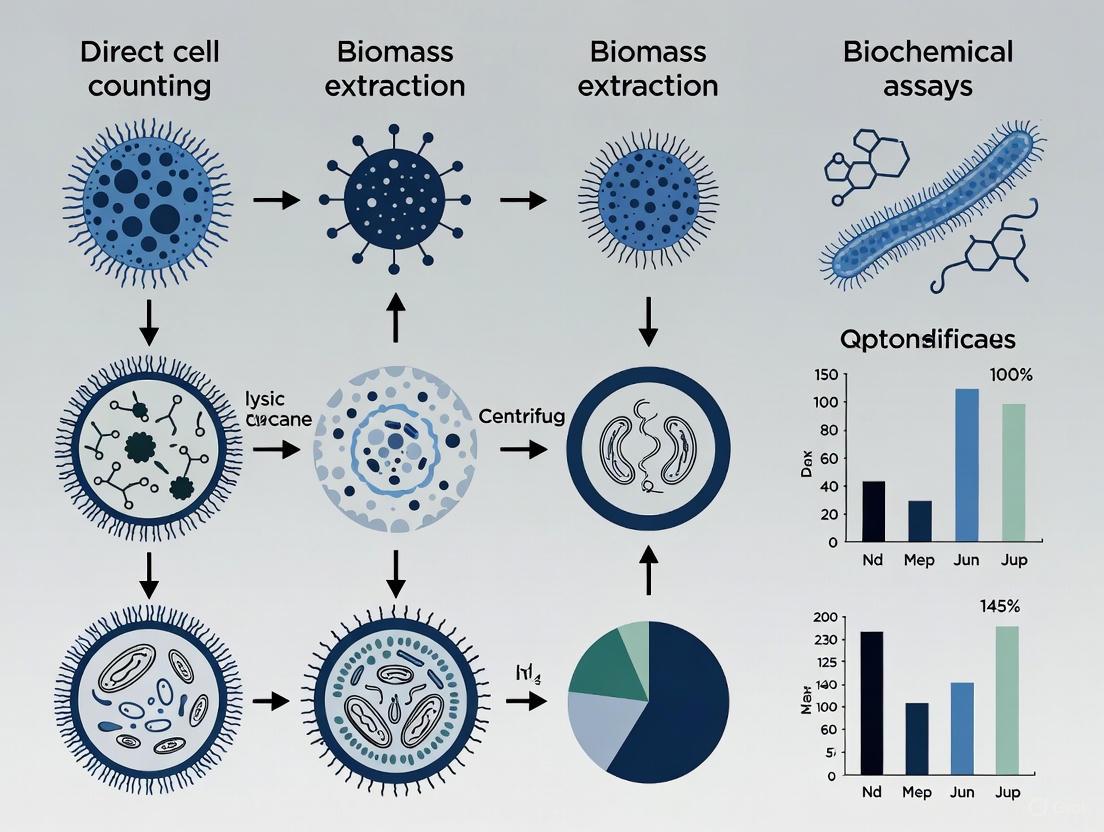
This article provides a systematic comparison of microbial biomass measurement techniques, tailored for researchers, scientists, and drug development professionals.
A Comprehensive Guide to Microbial Biomass Measurement Methods: From Foundational Principles to Advanced Applications in Research and Drug Development
Abstract
This article provides a systematic comparison of microbial biomass measurement techniques, tailored for researchers, scientists, and drug development professionals. It covers foundational principles, detailed methodologies, troubleshooting for common challenges, and rigorous validation approaches. By synthesizing current research, the review aims to serve as a definitive guide for selecting, optimizing, and validating the most appropriate biomass quantification method for specific experimental contexts, from environmental soil analysis to clinical biofilm assessment and pharmaceutical development.
Understanding Microbial Biomass: Core Concepts and Why Measurement Matters
Defining Microbial Biomass and Its Significance in Ecosystems and Industry
Microbial biomass refers to the total mass of living microorganisms—including bacteria, fungi, and protozoa—in a given habitat or ecosystem, often expressed in terms of living or dry weight per unit area or volume [1]. In soil, it represents the living component of soil organic matter, excluding soil animals and plant roots [2] [3]. Although it typically constitutes less than 5% of total soil organic matter, microbial biomass acts as a critical labile pool of carbon and nutrients, driving essential ecosystem processes such as decomposition, nutrient cycling, and soil structure formation [2].
Its significance extends from fundamental ecosystem functioning to various industrial applications. In ecosystems, microbial biomass is a key indicator of soil health and plays a vital role in carbon sequestration and nutrient supply to plants [4]. In industrial contexts, microbial biomass serves as a foundation for producing biofuels, bioplastics, biopharmaceuticals, and other valuable bioproducts through advanced biotechnological processes [5] [6].
Comparative Analysis of Microbial Biomass Measurement Methods
Accurately quantifying microbial biomass is fundamental to both ecological research and industrial biotechnology. However, the choice of measurement method can significantly influence results and their interpretation. The following section provides a detailed, data-driven comparison of prominent techniques.
Table 1: Overview of Major Microbial Biomass Measurement Methods
| Method | Underlying Principle | Key Measurable Parameters | Throughput | Relative Cost | Key Advantages | Key Limitations |
|---|---|---|---|---|---|---|
| Chloroform Fumigation-Extraction (FE) [2] [7] | Cell lysis via chloroform vapor; quantification of extracted cellular components. | Microbial C (ΔCmic), Microbial N (ΔNmic) | Medium | Low to Medium | Robust, established "gold standard"; provides nutrient pool data. | Susceptible to interference (e.g., from biochar); time-consuming. |
| Chloroform Fumigation-Incubation (FI) [2] [7] | Cell lysis via chloroform; quantification of CO₂ from lysed cell consumption. | Microbial C (ΔCmic) | Low | Low | Well-established historical method. | Even more susceptible to interference than FE; long incubation. |
| Phospholipid Fatty Acid (PLFA) Analysis [3] [8] | Extraction and quantification of membrane phospholipids, which degrade rapidly upon cell death. | Total microbial biomass, Fungal/Bacterial biomass, Community structure (low resolution). | Low | High | Measures living biomass directly; provides community composition data. | High cost; complex, variable protocols between labs [8]. |
| Quantitative PCR (qPCR) [8] | Amplification and quantification of biomarker genes (e.g., 16S rRNA for bacteria). | Gene copy abundance (Bacterial, Fungal). | High | Medium | High specificity; targets specific taxonomic groups. | Results vary with DNA extraction & primer choice; semi-quantitative. |
| Droplet-Digital PCR (ddPCR) [8] | Absolute quantification of biomarker genes via endpoint PCR in partitioned droplets. | Absolute gene copy number (Bacterial, Fungal). | High | High | Superior precision and repeatability vs. qPCR; less susceptible to inhibition. | Narrower dynamic range than qPCR; higher cost [8]. |
| CO₂ High Pressurization (CO2HP) [7] | Cell lysis via high-pressure CO₂; subsequent C measurement. | Microbial C (via extraction or incubation). | Medium | Research Stage | Novel approach. | CO2HP-I method can overestimate biomass due to CO₂ adsorption/desorption [7]. |
Experimental Data and Method Selection
Recent comparative studies provide critical insights into the relative performance of these methods, guiding researchers in selecting the most appropriate technique.
Table 2: Experimental Comparison of Fungi-to-Bacteria (F/B) Ratio Measurement Methods [8]
| Method | Precision | Repeatability | Correlation with PLFA | Best Use Case |
|---|---|---|---|---|
| PLFA Analysis | High | High | Benchmark | Gold standard for reliable F/B ratio and microbial abundance. |
| Droplet-Digital PCR (ddPCR) | High | High | Strong correlation | Preferred for precise, absolute quantification of gene abundance. |
| Quantitative PCR (qPCR) | Medium | Medium | Weaker correlation | Viable alternative if ddPCR is unavailable; requires careful calibration. |
| microBIOMETER | N/A | N/A | Poor correlation for F/B | Low-cost, rapid assessment of total microbial biomass only. |
A 2025 method comparison study concluded that PLFA and ddPCR provided the most reliable outcomes for assessing microbial abundance and the fungi-to-bacteria ratio, with PLFA being the most precise and repeatable [8]. While tools like microBIOMETER offer a low-cost option for estimating total microbial biomass, they did not match the reliability of PLFA for determining community composition [8].
Method selection can also be influenced by soil amendments. A 2025 study demonstrated that biochar, depending on its type and application rate, can interfere with traditional chloroform-based methods (FE and FI) and the novel CO2HP method, potentially leading to over- or underestimation of microbial carbon [7]. This highlights the necessity of validating methods in the context of specific experimental conditions.
Detailed Experimental Protocols
To ensure reproducibility, detailed protocols for two common and one emerging method are outlined below.
Chloroform Fumigation-Extraction (FE)
The FE method is a widely used and robust technique for estimating soil microbial biomass carbon and nitrogen [2].
Workflow Diagram: Chloroform Fumigation-Extraction
Materials & Reagents:
- Soil Sample: Fresh, pre-incubated soil, sieved (<2 mm) and adjusted to a standard moisture level.
- Chloroform (CHCl₃): Ethanol-free, highly pure.
- Potassium Sulfate (K₂SO₄) Extraction Solution: 0.5 M.
- Vacuum Desiccator: With porcelain plate.
- Beakers: For soil portions and extraction.
- Organic Carbon Analyzer: e.g., TOC analyzer.
Step-by-Step Protocol:
- Sample Preparation: Divide a fresh soil sample (equivalent to 25-50 g oven-dry weight) into two portions.
- Fumigation: Place one portion in a vacuum desiccator alongside a beaker containing ~50 ml of chloroform and a few anti-bumping granules. Evacuate the desiccator until the chloroform boils vigorously. Maintain the vacuum and incubate in the dark at 25°C for 24 hours.
- Control: Keep the second, non-fumigated portion in a sealed container at 25°C for the same duration.
- CHCl₃ Removal: After fumigation, repeatedly evacuate the desiccator to remove all chloroform fumes.
- Extraction: Transfer both the fumigated and non-fumigated soils to separate flasks. Add 0.5 M K₂SO₄ solution (typically at a 1:4 soil-to-solution ratio). Shake vigorously for 30-60 minutes.
- Filtration/Clarification: Filter or centrifuge the extracts to obtain a clear solution.
- Analysis: Determine the organic carbon (and nitrogen, if desired) concentration in both extracts using a suitable analyzer.
- Calculation: Calculate the microbial biomass C (ΔCmic) using the formula: ΔCmic = (Cfumigated - Cnon-fumigated) / kEC, where kEC is a conversion factor, typically 0.45 [2].
Phospholipid Fatty Acid (PLFA) Analysis
PLFA analysis measures membrane phospholipids, which are indicators of viable microbial biomass and community structure [8].
Workflow Diagram: PLFA Analysis
Materials & Reagents:
- Extraction Solvents: Single-phase extraction buffer (e.g., Citrate buffer, Methanol, Chloroform).
- Solid-Phase Extraction Columns: Silica-bonded columns.
- Derivatization Reagents: Mild alkaline methanol reagent for transmethylation.
- Internal Standards: Known amounts of specific PLFAs not found in the sample.
- Gas Chromatograph-Mass Spectrometer (GC-MS): For separation and detection.
Step-by-Step Protocol:
- Lipid Extraction: Extract total lipids from the soil sample using a single-phase mixture of citrate buffer, methanol, and chloroform. Shake for several hours.
- Phase Separation: Split the extract into polar and non-polar phases by adding citrate buffer and chloroform. The lipids are in the organic (chloroform) phase.
- Fractionation: Concentrate the lipid extract and load it onto a solid-phase extraction column. Elute the neutral lipids, glycolipids, and phospholipids sequentially. The phospholipid fraction is collected.
- Transmethylation: Subject the phospholipid fraction to mild alkaline methanolysis to convert the phospholipids into Fatty Acid Methyl Esters (FAMEs).
- GC-MS Analysis: Inject the FAME samples into a GC-MS system. The FAMEs are separated by the gas chromatograph and identified/quantified by the mass spectrometer.
- Data Analysis: Identify specific PLFA biomarkers (e.g., 18:2ω6 for fungi, specific branched-chain for bacteria) and quantify them. Total microbial biomass is estimated from the sum of all PLFAs, and the fungi-to-bacteria ratio is calculated from the respective biomarkers [3] [8].
Droplet-Digital PCR (ddPCR)
ddPCR provides absolute quantification of microbial abundance without the need for a standard curve, offering high precision [8].
Workflow Diagram: ddPCR Workflow
Materials & Reagents:
- Extracted DNA: From soil samples.
- ddPCR Supermix: Contains DNA polymerase, dNTPs, and other necessary components.
- Primers and Probes: Sequence-specific for bacterial 16S rRNA genes, fungal ITS or 18S rRNA genes, etc.
- Droplet Generation Oil & Cartridges: For water-in-oil emulsion.
- ddPCR System: Including droplet generator, thermal cycler, and droplet reader.
Step-by-Step Protocol:
- PCR Mix Preparation: Combine the DNA template with the ddPCR supermix, fluorophore-labeled probes (e.g., FAM, HEX), and forward and reverse primers for the target gene (e.g., 16S rRNA for bacteria).
- Droplet Generation: Load the PCR mix and droplet generation oil into a designated cartridge. The droplet generator partitions the sample into approximately 20,000 nanoliter-sized water-in-oil droplets.
- PCR Amplification: Transfer the droplets to a PCR plate and run a standard thermal cycling protocol. In droplets containing the target DNA, amplification occurs, leading to a fluorescent signal.
- Droplet Reading: After amplification, the droplet reader flows each droplet individually past a fluorescence detector. Droplets are counted as positive or negative based on their fluorescence amplitude.
- Absolute Quantification: The concentration of the target DNA in the original sample is calculated based on the fraction of positive droplets using Poisson statistics, providing an absolute copy number per unit of DNA or soil [8].
Research Reagent Solutions for Microbial Biomass Studies
Selecting the appropriate reagents and materials is critical for the accuracy and reproducibility of microbial biomass measurements.
Table 3: Essential Research Reagents and Materials
| Reagent / Material | Primary Function | Application Context | Key Considerations |
|---|---|---|---|
| Chloroform (CHCl₃) [2] | Cell membrane disruption and lysis of microorganisms. | Chloroform Fumigation (FE, FI). | Must be ethanol-free for maximum efficacy; requires careful handling and fume hood use. |
| K₂SO₄ Solution [2] | Extraction of soluble organic carbon and nitrogen from lysed microbial cells. | Chloroform Fumigation-Extraction (FE). | Standardized molarity (e.g., 0.5 M) is critical for cross-study comparisons. |
| PLFA Internal Standards [8] | Quantification and correction for extraction efficiency losses. | Phospholipid Fatty Acid (PLFA) Analysis. | Must be a non-indigenous PLFA (e.g., 19:0 PC) added at the very beginning of extraction. |
| PCR Primers & Probes [8] | Target-specific amplification of microbial biomarker genes. | qPCR and ddPCR. | Specificity is paramount (e.g., 16S rRNA for bacteria, ITS/18S for fungi); design impacts results. |
| Droplet Generation Oil [8] | Creates stable, monodisperse droplets for partitioning the PCR reaction. | Droplet-Digital PCR (ddPCR). | Must be compatible with the specific ddPCR instrument and thermal cycling conditions. |
Microbial biomass is a cornerstone of ecosystem stability and a versatile driver of industrial innovation. Its accurate quantification is non-trivial, with the optimal method depending heavily on the research question, budget, and required resolution. For broad ecological assessments of total living biomass and functional groups, PLFA analysis remains the most robust and informative benchmark [8]. For studies targeting specific taxonomic groups with high precision, ddPCR emerges as a superior molecular tool [8]. Researchers must be aware of potential interferences, such as those from soil amendments like biochar, which can compromise even established methods like FE and FI [7]. As the field advances, the integration of genomic data with ecosystem models promises a deeper, more predictive understanding of microbial functions across diverse environments [9].
Soil health is fundamentally governed by the living component beneath our feet—the soil microbiome. This diverse community of bacteria, fungi, protozoa, and other microorganisms acts as the primary engine driving nutrient cycling, organic matter decomposition, and ecosystem resilience [10] [11]. Despite its critical importance, this biological system has historically functioned as a "black box," with its intricate processes largely obscured from scientific view [10]. The quantification of soil microbial biomass provides a crucial index for peering into this black box, offering researchers a measurable proxy for understanding soil biological activity and its relationship to overall ecosystem function [11] [12].
Recent methodological advances have transformed our capacity to measure and interpret this living soil component. This guide provides a comparative analysis of the predominant techniques used to estimate microbial biomass, evaluating their applications, limitations, and performance across different research contexts. For soil scientists, ecologists, and environmental researchers, selecting an appropriate biomass quantification strategy is paramount for accurately assessing soil health status and predicting ecosystem responses to environmental change [12] [13].
Comparative Analysis of Microbial Biomass Measurement Methods
Performance Metrics and Applicability
Table 1: Comparison of Major Microbial Biomass Measurement Methods
| Method | What It Measures | Key Strengths | Key Limitations | Throughput | Cost | F/B Ratio Capability |
|---|---|---|---|---|---|---|
| Chloroform Fumigation-Extraction (CFE) | Total microbial biomass C and N via cell lysis [14] [15] | Considered reliable and interpretable; Direct biomass measurement [12] [15] | Labor-intensive; Requires toxic chemicals [12] | Low | Low-Moderate | No |
| Phospholipid Fatty Acid Analysis (PLFA) | Microbial biomass and community structure via membrane lipids [8] | Gold standard for F/B ratios; High precision and repeatability [8] [15] | Significant inter-laboratory variability; Complex protocols [8] | Moderate | High | Excellent |
| Quantitative PCR (qPCR) | Microbial abundance via gene copy numbers [8] | High sensitivity; Taxon-specific quantification | Inhibition biases; Narrow dynamic range [8] | High | Moderate | Good with limitations |
| Droplet Digital PCR (ddPCR) | Absolute microbial abundance via nucleic acid partitioning [8] | Better precision than qPCR; Reduced inhibition effects [8] | Narrower dynamic range than qPCR [8] | High | Moderate-High | Good with limitations |
| Substrate-Induced Respiration (SIR) | Active microbial biomass via CO₂ evolution [12] | Simple; High throughput; Functional activity measure [12] | Not suitable for all soil types (e.g., peat) [12] | High | Low | No |
| microBIOMETER | Total microbial biomass via turbidity and F/B ratio [8] | Rapid, low-cost, field-deployable [8] | Does not match PLFA results for F/B ratio [8] | Very High | Low | Limited reliability |
Method Selection Guidelines Based on Research Objectives
Table 2: Method Recommendations for Specific Research Applications
| Research Objective | Recommended Primary Method(s) | Complementary Method(s) | Critical Considerations |
|---|---|---|---|
| Total Microbial Biomass Assessment | CFE, SIR [12] [15] | PLFA, DNA quantification [15] | CFE provides robust biomass C estimates; SIR reflects active portion [12] |
| Fungi-to-Bacteria Ratio Determination | PLFA [8] | ddPCR, qPCR [8] | PLFA remains gold standard; molecular methods show promise but with biases [8] |
| High-Throughput Screening | SIR, microBIOMETER [12] [8] | POXC, MinC [12] [16] | Trade-offs between accuracy and throughput must be considered [12] |
| Microbial Community Modeling | PLFA, DNA-based methods [15] | CFE for calibration [15] | Correlation equations exist to relate different methods [15] |
| Agricultural Management Impact Studies | CFE, PLFA, SIR [12] | Enzyme assays, respiration metrics [12] [13] | Seasonal variation requires temporal sampling design [12] |
Experimental Protocols for Key Methodologies
Chloroform Fumigation-Extraction (CFE) for Microbial Biomass C and N
The CFE method provides a robust estimation of total microbial biomass carbon (Cₘᵢ𝒸) and nitrogen (Nₘᵢ𝒸) through direct cell lysis [14] [15]. The standard protocol involves:
Sample Preparation: Fresh soil samples are sieved (<2 mm) and adjusted to approximately 50-60% water holding capacity. Visible organic debris, roots, and stones are removed [14].
Fumigation Process: Duplicate soil samples (30 g each) are exposed to ethanol-free chloroform vapor for 24 hours in a vacuum desiccator maintained at 25°C in darkness [14].
Extraction and Analysis: Both fumigated and non-fumigated control samples are extracted with 0.5 M K₂SO₄ (1:4 w/v) by shaking for 30 minutes at 200 rpm. The extracts are filtered through Whatman No. 42 filter paper [14].
Calculation: Organic carbon in the extracts is determined by potassium dichromate oxidation and titration with ferrous ammonium sulfate. Cₘᵢ𝒸 is calculated as: Cₘᵢ𝒸 = (ECₑₓₜᵣₐ𝒸ₜₑ𝒸 - EC𝒸ₒₙₜᵣₒₗ) / kEC, where EC represents extractable C and kEC is the extraction efficiency factor (typically 0.45) [14].
Phospholipid Fatty Acid (PLFA) Analysis
PLFA analysis characterizes microbial biomass and community structure based on membrane lipid biomarkers [8]. The standardized protocol consists of six key stages:
Sample Storage and Preparation: Soils are freeze-dried and stored at -80°C to preserve lipid integrity [8].
Total Lipid Extraction: Lipids are extracted using a single-phase chloroform-methanol-citrate buffer mixture (1:2:0.8 v/v/v) [8].
Lipid Class Separation: The total lipid extract is fractionated into neutral lipids, glycolipids, and phospholipids using solid-phase extraction silica columns [8].
Transmethylation: Phospholipids are subjected to alkaline methanolysis to form fatty acid methyl esters (FAMEs) [8].
GC-MS Analysis: FAMEs are separated, identified, and quantified using gas chromatography-mass spectrometry [8].
Data Analysis: Biomarker fatty acids are assigned to specific microbial groups (e.g., 18:2ω6c for fungi, 16:1ω7c for bacteria) [8].
DNA-Based Quantification (qPCR/ddPCR)
Molecular approaches target taxonomic marker genes to estimate microbial abundance [8]:
DNA Extraction: Commercial soil DNA extraction kits are employed with bead-beating for cell lysis. Clay-rich soils may require modified protocols to improve extraction efficiency [15].
Primer Selection: Bacterial abundance is typically quantified using 16S rRNA gene primers (e.g., 515F/806R), while fungal abundance targets 18S rRNA gene or ITS region primers [8].
qPCR Protocol: Reactions contain template DNA, primer pairs, and SYBR Green master mix. Thermal cycling conditions include initial denaturation (95°C, 3 min), followed by 40 cycles of denaturation (95°C, 30 s), annealing (55°C, 30 s), and extension (72°C, 30 s) [8].
ddPCR Protocol: The reaction mixture is partitioned into ~20,000 nanodroplets. End-point PCR amplification is followed by droplet reading to determine positive and negative reactions, enabling absolute quantification without standard curves [8].
Methodological Decision Framework and Workflows
Analytical Workflow for Comprehensive Soil Health Assessment
Essential Research Reagents and Materials
Table 3: Essential Research Reagents for Microbial Biomass Analysis
| Reagent/Material | Application | Specific Function | Method(s) |
|---|---|---|---|
| Ethanol-free Chloroform | Cell membrane disruption | Lyses microbial cells to release cytoplasmic contents | CFE [14] |
| Potassium Sulfate (0.5 M K₂SO₄) | Soluble carbon extraction | Extracts organic C from fumigated and non-fumigated soils | CFE [14] |
| Phosphate Buffer (pH 7.4) | Lipid extraction medium | Maintains pH during phospholipid extraction | PLFA [8] |
| Chloroform-Methanol Mixture | Total lipid extraction | Single-phase extraction of membrane lipids from soil | PLFA [8] |
| Fatty Acid Methyl Ester (FAME) Standards | GC-MS calibration | Quantitative standards for fatty acid identification and quantification | PLFA [8] |
| SYBR Green Master Mix | DNA quantification | Fluorescent intercalating dye for qPCR amplification detection | qPCR [8] |
| Taxon-Specific Primers | Target amplification | Amplifies 16S rRNA (bacteria) or 18S/ITS (fungi) marker genes | qPCR/ddPCR [8] |
| Droplet Generation Oil | Reaction partitioning | Creates nanodroplets for absolute quantification in ddPCR | ddPCR [8] |
The journey to unravel soil's "black box" requires sophisticated methodological approaches that balance accuracy, practicality, and interpretive power. No single method currently provides a perfect solution for all research contexts, but strategic integration of complementary approaches can yield comprehensive insights into soil microbial communities and their functional contributions to ecosystem health [15] [13].
PLFA analysis remains the gold standard for fungi-to-bacteria ratio determination, while CFE provides robust estimates of total microbial biomass carbon [8] [14]. Emerging molecular techniques like ddPCR offer promising alternatives with enhanced precision, though they have not yet surpassed established methods for all applications [8]. For high-throughput screening, SIR and commercial kits like microBIOMETER provide practical options, though with acknowledged trade-offs in accuracy [12] [8].
Future methodological development should focus on standardizing protocols across laboratories, improving the interpretability of biomass measurements within soil health frameworks, and establishing clearer relationships between microbial indicators and ecosystem functions [12] [17]. As climate change and sustainable land management become increasingly pressing concerns, refining these "black box" indices will be essential for monitoring soil health and maintaining the ecosystem services upon which terrestrial life depends [10] [11].
Quantifying microbial biomass and its molecular components is a foundational step in research and drug development, yet the path from cell lysis to final data interpretation is fraught with challenges. The initial steps of cellular disruption and nucleic acid extraction introduce significant variability that can confound downstream analysis and signal interpretation. This guide objectively compares common methodological approaches by synthesizing experimental data from recent studies, providing a framework for selecting optimal protocols based on specific research goals.
The process of quantifying microbial elements involves a multi-stage pipeline, each stage of which introduces potential bias. It begins with cell lysis, where the cellular envelope is disrupted to release internal components, followed by extraction and purification of target molecules (e.g., DNA, RNA, metabolites). Finally, the detection and signal interpretation stage aims to correlate the measured signal with absolute biological quantities. Challenges at any one stage can compromise the entire experiment. This is particularly critical in low-biomass environments—such as certain human tissues, atmospheric samples, or treated drinking water—where the target signal is minimal and the risk of contamination or amplification bias is high [18].
The following sections break down this pipeline, comparing the efficiency of different techniques and providing detailed experimental protocols to aid in method selection and reproducibility.
Part 1: Comparative Analysis of Cell Lysis and Extraction Methods
The choice of cell lysis and subsequent extraction method has a profound impact on the yield, quality, and representativeness of the isolated analytes. The optimal method often depends on the cell type, the target molecule, and the desired downstream application.
Cell Lysis Method Efficiency
Cell lysis methods are broadly classified as mechanical, chemical, or enzymatic. Mechanical methods are often more effective for tough cell walls, while chemical and enzymatic methods can be milder and more specific.
Table 1: Comparison of Cell Lysis Methods for Different Microorganisms
| Lysis Method | Mechanism of Action | Optimal Cell Type | Efficiency / Key Finding | Major Drawbacks |
|---|---|---|---|---|
| Bead Beating (Horizontal) [19] | Physical grinding using beads in a vortex adapter. | Candida albicans (Yeast) | 100% lysis efficiency observed with RiboPure Lysis Buffer. | Generation of significant heat, requiring cooling. |
| Bead Beating (Vertical) [19] | Manual vortexing with beads in a vertical tube position. | Candida albicans (Yeast) | 83% lysis efficiency with RiboPure Lysis Buffer. | Less efficient than horizontal orientation due to reduced shearing area. |
| Lyticase Treatment [19] | Enzymatic degradation of the yeast cell wall. | Candida albicans (Yeast) | 95% lysis efficiency after 1 hour incubation. | Less efficient than optimized bead beating; longer processing time. |
| High-Pressure Homogenizer [20] | Shearing forces from forcing cells through a narrow orifice under high pressure. | Bacteria, Fungi (Large scale) | Protein release follows first-order kinetics; suitable for high throughput. | Heat generation; potential degradation of some enzymes [20]. |
| Detergent-Based Lysis [21] | Solubilizes membrane lipids and proteins to create pores. | Mammalian cells, Bacteria (for proteins) | Rapid lysis; choice of ionic (strong) or non-ionic (mild, protein-preserving) detergents. | Can interfere with downstream protein assays; may denature proteins. |
| Freeze-Thaw Cycling [21] | Formation of ice crystals that rupture the membrane. | Mammalian cells | Simple and widely used; helps preserve cellular proteins/nucleic acids. | Ineffective for cells with rigid walls; can cause cold denaturation of proteins. |
Impact of Lysis and Detachment on Metabolomic Profiles
Beyond simple efficiency, the method of preparing cells for analysis can drastically alter the metabolic profile observed. A 2022 untargeted metabolomics study on MDA-MB-231 breast cancer cells highlights this point.
Table 2: Impact of Sample Preparation on Metabolomic Profiles in MDA-MB-231 Cells [22]
| Experimental Factor | Compared Methods | Effect on Metabolic Profile | Key Metabolic Pathways Significantly Altered |
|---|---|---|---|
| Detachment Method | Trypsinization vs. Cell Scraping | The greatest effect on metabolic profiles, with a clear distinction between methods. | Tyrosine metabolism, Urea cycle/amino group metabolism, Arginine and proline metabolism, Vitamin B6 metabolism, Tryptophan metabolism. |
| Lysis Method | Homogenizer Beads vs. Freeze-Thaw Cycling | A lesser, but still significant, effect on profiles. | Primarily pathways related to fatty acids (e.g., de novo fatty acid biosynthesis, fatty acid activation). |
Supporting Experimental Data: The study found that scraped samples generally showed higher abundances of amino acids (e.g., histidine, leucine, phenylalanine) and urea cycle metabolites. In contrast, trypsinized samples had higher levels of lactate and acylcarnitines [22]. No single method was universally superior, underscoring the need for method selection based on the metabolite classes of interest.
Methods for Estimating Microbial Biomass
For environmental samples like soil, estimating total microbial biomass presents its own set of challenges, with different methods offering varying trade-offs between throughput, cost, and accuracy.
Table 3: Comparison of Proxies for Soil Microbial Biomass Estimation [23]
| Method | Principle | Key Advantages | Key Limitations |
|---|---|---|---|
| Chloroform Fumigation-Extraction (CFE) | Measures C released from lysed microbial cells. | Considered a "gold standard"; extensive historical use and evaluation. | Labor-intensive; uses toxic reagents; lacks taxonomic resolution; accuracy varies with soil type. |
| Phospholipid Fatty Acids (PLFA) | Quantifies lipids from living cell membranes. | Measures viable biomass; provides broad taxonomic resolution (e.g., fungi vs. bacteria). | Resource-intensive; does not account for Archaea; overlap in biomarkers can reduce accuracy. |
| Quantitative PCR (qPCR) | Measures abundance of a universal marker gene (e.g., 16S rRNA). | High throughput; reduced reagent use; can estimate fungal:bacterial ratios. | Affected by variable gene copy number per cell; vulnerable to "relic DNA" from dead cells. |
| Total DNA Yield | Measures total DNA extracted from a soil sample. | Rapid; potentially high throughput; low soil mass requirement. | Affected by extraction efficiency and "relic DNA"; relationship to live biomass not robust. |
| Bacterial-to-Host DNA Ratio (B:H) [24] | Estimates gut bacterial biomass from metagenomic data using host DNA as an internal standard. | Simple, low-cost; uses existing sequencing data; no extra experiments needed. | Primarily applicable to stool metagenomes where host DNA is present. |
Part 2: Detailed Experimental Protocols
To ensure reproducibility, below are detailed protocols for key experiments cited in this guide.
Objective: To compare the efficiency of different cell lysis methods for yeast cells stored in RNAlater. Materials:
- Candida albicans cells (10^7 cells in log growth phase)
- RiboPure Lysis Buffer (RPLB)
- Zirconium beads (0.5 mm)
- Vortex mixer with a horizontal vortex adapter
- Lyticase Lysis Buffer (LLB) with 2 U/μl lyticase
- Microscope for visualization
Methodology:
- Preparation: Aliquot 1 mL of C. albicans cell suspension (10^7 cells) and store at -80°C in RNAlater or a control medium (TSB with 15% glycerol).
- Lysis by Bead Beating:
- Thaw the aliquot.
- Add cells to a tube containing RiboPure Lysis Buffer and 0.5 mm zirconium beads.
- Secure the tube in a horizontal vortex adapter.
- Vortex at maximum speed for 10 minutes.
- Lysis by Lyticase Treatment (Control):
- Incubate cells in Lyticase Lysis Buffer (2 U/μl) for 1 hour at the recommended temperature.
- Efficiency Assessment:
- Use microscopic visualization to count lysed versus intact cells.
- Calculate the percentage of cell lysis for each method.
Reported Result: For cells stored in RNAlater, horizontal bead beating in RPLB resulted in 73.5% cell lysis efficiency, which was superior to the other methods tested under the same conditions [19].
Objective: To investigate the effects of different detachment and lysis methods on the metabolomic profile of MDA-MB-231 cells. Materials:
- MDA-MB-231 cell line
- Trypsin-EDTA solution for detachment
- Cell scrapers
- Homogenizer beads
- Liquid nitrogen for freeze-thaw cycles
- UHPLC-HRMS system for untargeted metabolomics
Methodology:
- Cell Culture: Grow MDA-MB-231 cells to 80-90% confluence.
- Detachment (Two Methods):
- Trypsinization: Detach cells using a standard trypsin-EDTA solution.
- Scraping: Mechanically detach cells using a sterile cell scraper.
- Lysis (Two Methods):
- Bead Homogenization: Lyse cell pellets using homogenizer beads in a mechanical homogenizer.
- Freeze-Thaw Cycling: Subject cell pellets to multiple cycles of freezing in liquid nitrogen and thawing.
- Metabolite Extraction & Analysis:
- Extract metabolites using a standardized solvent system.
- Analyze using UHPLC-HRMS.
- Process data with peak alignment, normalization, and multivariate statistical analysis (PCA, OPLS-DA).
- Identify pathways using software like MetaboAnalyst.
Part 3: Visualizing Workflows and Challenges
The following diagrams outline the logical relationships and workflows in microbial quantification and the specific challenges in low-biomass studies.
Part 4: The Scientist's Toolkit - Essential Research Reagents and Materials
Selecting the right reagents is critical for successful and reproducible cell lysis and biomass quantification.
Table 4: Key Research Reagent Solutions for Cell Lysis and Biomass Studies
| Reagent / Material | Function / Principle of Action | Common Applications |
|---|---|---|
| RiboPure Lysis Buffer [19] | A chemical buffer designed for efficient disruption of cellular membranes, often used in conjunction with mechanical methods. | Effective for lysing tough cell walls, such as those of yeast (e.g., Candida albicans). |
| Zirconium Beads (0.5 mm) [19] | Inert, durable beads that provide physical grinding action during bead beating to break open cells. | Mechanical lysis of microbial and fungal cells in bead mills. |
| Lyticase [19] | An enzyme that specifically targets and degrades the beta-glucan in yeast cell walls. | Enzymatic lysis of yeast cells; often a component of standard DNA/RNA extraction kits. |
| Sodium Dodecyl Sulfate (SDS) [21] | A strong ionic detergent that solubilizes lipids and proteins in the cell membrane, leading to complete lysis and protein denaturation. | General purpose cell lysis; plasmid DNA preparation; protein gel electrophoresis. |
| Non-Ionic Detergents (e.g., Triton X-100) [21] | Milder detergents that disrupt lipid-lipid and lipid-protein interactions but do not denature proteins. | Cell lysis where maintaining protein native structure and function is critical. |
| RNAlater [19] | A RNA-stabilizing solution that permeates tissues and cells to stabilize and protect cellular RNA. | Stabilization of RNA in cells and tissues prior to RNA extraction, preventing degradation. |
| Chloroform [23] | An organic solvent used in the chloroform fumigation-extraction (CFE) method to lyse microbial cells and release cellular carbon. | Estimation of soil microbial biomass carbon. |
| Bead Mill Homogenizer [20] | Equipment that uses rapid shaking with beads to disrupt cells through physical shearing and impact. | High-throughput mechanical lysis of a wide range of cell types, including bacteria and yeast. |
| High-Pressure Homogenizer [20] | Equipment that forces a cell suspension through a narrow valve under high pressure, shearing the cells. | Large-scale disruption of cells for industrial or extensive research applications. |
The journey from cellular lysis to accurate signal interpretation is complex and heavily influenced by methodological choices. As the comparative data shows, no single lysis or quantification method is universally superior. The decision between mechanical, chemical, or enzymatic lysis, or the selection of a biomass estimation proxy, must be guided by the specific cell type, the analyte of interest, and the required balance between throughput and accuracy. Furthermore, the challenges of working with low-biomass samples necessitate rigorous contamination controls throughout the entire workflow. By understanding the trade-offs and experimental evidence outlined in this guide, researchers and drug development professionals can make more informed decisions, leading to more reliable and interpretable quantification data.
In microbial research, accurately determining microbial biomass is fundamental to understanding ecosystem dynamics, biotechnological applications, and environmental processes. The methodologies for quantification can be broadly categorized into biomass-based systems, which measure collective activity or chemical components of the microbial community, and molecular-based systems, which target specific cellular components or genetic material for enumeration and identification [25]. This guide provides an objective comparison of these methodological categories, detailing their protocols, performance, and appropriate applications to inform researchers and drug development professionals in selecting the optimal tool for their specific research context.
The table below summarizes the core characteristics, performance metrics, and typical applications of the major method categories.
Table 1: Comparison of Biomass-Based and Molecular-Based Methods for Microbial Biomass Estimation
| Method Category | Specific Method | Principle of Operation | Key Measured Parameter | Reported Correlation/Performance | Throughput | Best-Suited Applications |
|---|---|---|---|---|---|---|
| Biomass-Based | Chloroform Fumigation-Extraction (FE) | Measures C & N flush from lysed microbial cells [26]. | Microbial Biomass Carbon (MBC) [26] | Correlates with DNA yield, PLFA, qPCR [15]. Dominates ~83% of MBC studies [26]. | Medium | Soil health studies; Ecosystem monitoring [14]. |
| Biomass-Based | Substrate-Induced Respiration (SIR) | Measures initial respiration response to added glucose [26]. | Basal Respiration Rate | Used in ~17% of studies; rapid response indicator [26]. | High | Metabolic activity assessment; quick soil health checks [14]. |
| Biomass-Based | Oxygen Uptake Rate (OUR) | Measures oxygen consumption by microbes under non-limited growth [25]. | Model Biomass (Activity-based) [25] | Correlated with DAPI cell count (69% of model-predicted biomass) [25]. | Medium | Wastewater transformation modeling; engineering applications [25]. |
| Molecular-Based | Phospholipid Fatty Acids (PLFA) | Quantifies membrane lipids as indicator of live biomass [15]. | Total PLFA concentration | Correlates with CFE; better for total biomass than fungi/bacteria parsing [15]. | Medium | Community structure analysis; broad biomass estimation [15]. |
| Molecular-Based | Quantitative PCR (qPCR) | Quantifies gene copies of target genes (e.g., 16S rRNA) [15]. | Gene Copy Number (GCN) | Correlates with CFE; improved with clay content correction [15]. | High | Targeted quantification of specific microbial groups. |
| Molecular-Based | Total DNA Yield | Extracts and quantifies total DNA from a soil sample [15]. | DNA Concentration (μg/g soil) | Correlates strongly with CFE [15]. | High | Total microbial load; pre-screening for molecular work. |
| Molecular-Based | Microscopy with Staining (DAPI/AO) | Fluorescent stains bind to DNA for direct cell counting [25]. | Total Cell Counts | DAPI count was 69% of model biomass from OUR [25]. | Low | Direct enumeration; distinguishing cell states [25]. |
Experimental Protocols
Key Biomass-Based Protocol: Chloroform Fumigation-Extraction (FE)
The FE method is a cornerstone technique for estimating soil microbial biomass carbon (MBC) and nitrogen (MBC) [26].
- Step 1: Sample Preparation. A moist soil sample (>40% water holding capacity) is divided into two subsamples. Any visible organic debris, roots, or stones are removed, and the soil is sieved (<2 mm) [14].
- Step 2: Fumigation. One subsample is placed in a desiccator with ethanol-free chloroform (stabilized with alternatives like β-isoamylene) and fumigated for 24 hours at 25°C in the dark. This step lyses microbial cells [26] [14].
- Step 3: Chloroform Removal. After fumigation, the chloroform vapor is completely evacuated from the desiccator by repeated vacuum extraction [26].
- Step 4: Extraction. Both the fumigated and the non-fumigated (control) subsamples are extracted with 0.5 M K₂SO₄ at a soil-to-solution ratio of 1:4 (w/v) for 30 minutes on a reciprocating shaker at 200 rpm [26] [14].
- Step 5: Filtration and Analysis. The soil suspensions are filtered (e.g., through Whatman No. 42 filter paper). The organic carbon in the extracts is then determined, often by oxidation with 0.4N K₂Cr₂O₇ and back-titration with ferrous ammonium sulfate (Walkley-Black method) [14].
- Step 6: Calculation. MBC is calculated from the difference in extractable organic carbon between the fumigated and non-fumigated samples using a conversion factor (k_EC, often 0.45) [26].
- Formula:
MBC = (Organic C_fumigated - Organic C_non-fumigated) / k_EC[14]
- Formula:
Key Molecular-Based Protocol: Quantitative PCR (qPCR)
qPCR is used to quantify the abundance of specific microbial genes (e.g., 16S rRNA for bacteria) in environmental samples [15].
- Step 1: Total DNA Extraction. Total genomic DNA is extracted from the soil or biomass sample using a commercial kit or standardized protocol (e.g., bead-beating for cell lysis). The efficiency of this step is critical and can be lower in clay-rich soils, requiring corrections in final data analysis [15].
- Step 2: DNA Quantification and Quality Check. The concentration and purity of the extracted DNA are measured using a spectrophotometer (e.g., NanoDrop) or fluorometer (e.g., Qubit).
- Step 3: Preparation of qPCR Reaction. The reaction mixture is prepared to contain:
- Template DNA (typically 1-10 ng/μL)
- Forward and reverse primers specific to the target gene
- Fluorescent probe (e.g., TaqMan) or DNA-binding dye (e.g., SYBR Green)
- dNTPs, reaction buffer, and a thermostable DNA polymerase
- Step 4: Amplification and Detection. The plate is run in a real-time PCR cycler. The cycle conditions typically are:
- Initial Denaturation: 95°C for 3-5 minutes.
- Amplification (40-50 cycles): Denaturation at 95°C for 15-30 seconds, Annealing at primer-specific temperature (50-60°C) for 30-45 seconds, and Extension at 72°C for 30-60 seconds. Fluorescence is measured at the end of each cycle.
- Step 5: Data Analysis. The cycle threshold (Ct) values for each sample are used. The gene copy number in the original sample is determined by comparing the Ct values to a standard curve created from serial dilutions of a known concentration of the target gene [15].
The following diagram illustrates the logical relationship and workflow selection between these two major methodological categories.
The Scientist's Toolkit: Essential Research Reagents and Materials
The table below lists key reagents and materials essential for executing the profiled microbial biomass estimation methods.
Table 2: Key Research Reagent Solutions for Microbial Biomass Methods
| Reagent/Material | Function/Description | Example Methods of Use |
|---|---|---|
| Ethanol-free Chloroform | Lyses microbial cells during fumigation by destroying cell membrane integrity [26]. | Chloroform Fumigation-Extraction (FE) [26] [14] |
| 0.5 M Potassium Sulfate (K₂SO₄) | Saline solution used to extract organic carbon and nitrogen from fumigated and non-fumigated soils [26] [14]. | Chloroform Fumigation-Extraction (FE) [14] |
| DNA Stains (DAPI, Acridine Orange) | Fluorescent dyes that bind to nucleic acids, enabling direct enumeration of total cell counts under microscopy [25]. | Direct Microscopy Enumeration [25] |
| Phosphate Buffered Saline (PBS) | Provides a stable, isotonic environment for handling and suspending microbial cells without causing osmotic stress. | Various, including cell washing and suspension |
| Lysis Buffers (e.g., with SDS) | Disrupts cell membranes and releases intracellular components, including DNA and proteins, for analysis. | DNA Extraction (for qPCR, GCN) [15] |
| Proteinase K | Broad-spectrum serine protease that degrades proteins and inactivates nucleases during DNA extraction, protecting the target DNA. | DNA Extraction (for qPCR, GCN) |
| SYBR Green / TaqMan Probes | Fluorescent markers used to detect and quantify amplified DNA products in real-time during qPCR cycles [15]. | Quantitative PCR (qPCR) [15] |
| Chloroform & Methanol Mixture | Organic solvent mixture used for the extraction of phospholipid fatty acids (PLFAs) from microbial membranes. | Phospholipid Fatty Acids (PLFA) |
This comparison elucidates that the choice between biomass-based and molecular-based systems is not a matter of superiority but of context. Biomass-based methods like FE and SIR offer a robust, integrative measure of the living microbial pool, making them indispensable for soil health and ecosystem studies [26] [14]. In contrast, molecular-based methods like qPCR and PLFA provide higher resolution for specific groups or total biomass estimation, though they may require corrections for environmental factors like clay content [15]. A strong correlation exists between the data produced by these different categories, such as between FE and total DNA yield or PLFA, validating their collective use in microbial ecology [15]. For a comprehensive understanding, researchers should consider a multi-method approach that leverages the strengths of both categories to validate findings and gain deeper insights into microbial community structure and function.
A Deep Dive into Measurement Techniques: Principles, Protocols, and Applications
For nearly half a century, chloroform-based methods have served as the cornerstone for quantifying soil microbial biomass, a critical parameter for understanding biogeochemical cycling and ecosystem functioning. Among these, the Fumigation-Incubation (FI) and Fumigation-Extraction (FE) methods have emerged as the most widely recognized and applied techniques. The FI method, pioneered by Jenkinson and Powlson in 1976, represented a breakthrough in indirect biomass estimation [27] [26]. Its successor, the FE method (also known as chloroform fumigation-extraction, CFE), developed by Vance et al. in 1987, offered a faster alternative applicable to a wider range of soils [28] [26]. Despite the emergence of modern techniques like phospholipid fatty acid analysis and molecular methods, these "traditional workhorses" maintain their relevance in contemporary soil science, with the FE method dominating current literature and being used in 83.2% of studies on microbial biomass carbon in 2024, compared to 16.5% for FI [26]. This guide provides a comprehensive, objective comparison of their performance, protocols, and applications to inform researcher selection.
Both FI and FE methods operate on the same fundamental principle: chloroform fumigation lyses microbial cells, releasing their internal contents, and the quantification of these released components allows for estimation of initial biomass. However, their pathways diverge significantly after fumigation, leading to distinct advantages and limitations.
The Fumigation-Incubation (FI) method involves measuring the respiration response of re-inoculated microbes to the killed biomass. After fumigation and chloroform removal, the soil is inoculated with a small amount of fresh, non-fumigated soil and incubated for 10 days. The respired CO₂ from the decomposition of the dead microbial cells is trapped and measured. The difference in CO₂ production between fumigated and non-fumigated controls is proportional to the initial microbial biomass, using a conversion factor (Kc) of 0.45 [27].
The Fumigation-Extraction (FE) method streamlines this process by directly measuring the cellular components released immediately after fumigation. Following the 24-hour fumigation and fumigant removal, soils are extracted with 0.5 M K₂SO₄ for 30 minutes. The difference in extractable organic carbon and nitrogen between fumigated and non-fumigated soils is measured, and microbial biomass is calculated using a conversion factor (kEC) of 0.45 for surface soils [28] [27] [26].
Table 1: Core Principle and Workflow Comparison of FI and FE Methods
| Feature | Fumigation-Incubation (FI) | Fumigation-Extraction (FE) |
|---|---|---|
| Fundamental Principle | Measures respiration of re-inoculated microbes consuming lysed cells | Directly measures cellular components (C, N, P, S) flushed from lysed cells |
| Post-Fumigation Process | 10-day incubation with inoculum | Immediate chemical extraction with 0.5 M K₂SO₄ |
| Primary Measurement | CO₂ evolution during incubation | Extractable organic C and total N in solution |
| Key Conversion Factor | Kc = 0.40–0.45 | kEC = 0.45 (for surface soils) |
Detailed Experimental Protocols
Standardized FI Protocol:
- Pre-incubation: Moist soil samples are often pre-incubated for a few days to stabilize microbial activity post-disturbance.
- Fumigation: Soil samples are placed in a desiccator with ethanol-free chloroform and incubated in the dark for 24 hours at 25°C [28].
- Fumigant Removal: Chloroform is removed by repeated evacuation.
- Inoculation & Incubation: Fumigated soils are inoculated with a small aliquot (e.g., 1% w/w) of non-fumigated soil and incubated for 10 days in sealed jars.
- CO₂ Measurement: The CO₂ evolved during incubation is trapped in an alkaline solution (e.g., NaOH) and quantified by titration, or measured via gas chromatography or infrared gas analysis [27].
Standardized FE Protocol:
- Fumigation: As in FI, soil samples are fumigated with ethanol-free chloroform for 24 hours [26].
- Fumigant Removal: Chloroform is completely removed by repeated evacuation. Chloroform stabilized with 2-methyl-2-butene is often used as it is more easily removed [26].
- Extraction: Fumigated and parallel non-fumigated control soils are extracted with 0.5 M K₂SO₄ (typically at a 1:4 soil-to-extractant ratio) by oscillating shaking at 200 rpm for 30 minutes [26] [14].
- Filtration & Analysis: The extracts are filtered (e.g., through Whatman No. 42 filter paper). The organic carbon in the extracts is then quantified, often by the Walkley-Black method [14] or via a TOC analyzer.
Comparative Performance and Supporting Data
The choice between FI and FE significantly impacts results, workflow, and applicability. Experimental data across diverse soils reveal critical performance differences.
Table 2: Comprehensive Performance Comparison of FI and FE Methods
| Performance Characteristic | Fumigation-Incubation (FI) | Fumigation-Extraction (FE) |
|---|---|---|
| Analysis Time | Long (~10 days incubation) [27] | Short (can be completed in ~2 days) [28] [29] |
| Applicable Soil Range | Limited; not suitable for acidic (pH <5), saline, or recently amended soils [28] [27] | Broad; validated for acidic, waterlogged, high OM, and saline soils [28] [29] |
| Measurable Elements | Primarily C and N [27] | C, N, P, and S simultaneously [26] [29] |
| Sensitivity to Soil Conditions | High sensitivity to soil water content, particularly in dry soils [28] | Less sensitive, though adjustments are needed for very dry soils [28] |
| Impact of Fumigation Time | Standardized at 24 hours | C/N release can increase with longer fumigation (up to 10 days), potentially causing 24-hour underestimation [28] |
| Influence of Nutrient Addition | N/A | Robust; not significantly biased by experimental N/P addition in acidic forests [30] |
| Integration with Isotopic Studies | Restricted to 14C, 13C, 15N [27] | Compatible with a wider range (14C, 13C, 15N, 32P, 35S) [27] |
Supporting Experimental Evidence:
- A study on forest soils found that a 1-day fumigation, as used in standard FE, underestimated the maximum flush of microbial C and N by 24% and 18%, respectively, on average, compared to longer fumigation times. This suggests that for some soils, the standard FE protocol may systematically underestimate biomass [28].
- The FE method has been tested for robustness in experimentally fertilized soils. Research in strongly acidified Chinese forests showed that adding nitrogen and phosphorus immediately before fumigation—thus not altering actual biomass—did not significantly bias MBC or MBN measurements, confirming its reliability for nutrient-addition studies [30].
- In a broad-scale comparison across eight soil orders, FE maintained strong correlations with other biomass proxies like PLFA and DNA-based methods, supporting its validity for cross-ecosystem studies [23].
Current Research Context and Method Selection
Within the broader thesis of microbial biomass measurement, FI and FE represent robust, "whole-biomass" approaches compared to specific biomarker methods (e.g., PLFA, ATP) or molecular techniques (e.g., qPCR). While FI was foundational, the scientific community has largely shifted towards FE due to its practicality and wider applicability [26].
The FE method's dominance is evident in its extensive use for calibrating newer models that explicitly incorporate microbial parameters into soil carbon cycling projections [23]. Its ability to provide access to "virtually all elements and organic components stored as CHCl₃-labile compounds" makes it a uniquely comprehensive tool [26]. However, both methods are considered a "black box" as they do not provide taxonomic differentiation between bacterial and fungal biomass, a key limitation addressed by methods like PLFA analysis [23].
Table 3: Essential Research Reagent Solutions
| Reagent / Material | Function in Protocol | Critical Specifications & Hazards |
|---|---|---|
| Chloroform (CHCl₃) | Lyses microbial cells during fumigation by destroying cell membrane integrity. | Must be ethanol-free. Stabilized with 2-methyl-2-butene is recommended. Toxic, suspected carcinogen [26] [31]. |
| 0.5 M Potassium Sulfate (K₂SO₄) | Extracts solubilized organic carbon and nitrogen from fumigated and non-fumigated soils. | Standard extractant for FE; ratio is typically 1:4 (soil:extractant w/v) [26] [14]. |
| Sodium Hydroxide (NaOH) | Traps CO₂ respired during the FI incubation for subsequent titration. | Used in a shallow vial inside the incubation jar with the soil sample [27]. |
| Chemical Fume Hood | Primary engineering control for all procedures involving chloroform. | Mandatory for protecting the researcher from toxic vapors [31]. |
The comparative analysis demonstrates a clear trade-off: while FI is a direct physiological measurement, FE offers greater speed, versatility, and applicability to a wider range of soil types.
Select Fumigation-Incubation (FI) if:
- Working with non-acidic, non-waterlogged soils where a physiological respiration-based measurement is preferred.
- Your laboratory infrastructure is geared towards respirometric measurements (e.g., GC, IRGA) but lacks access to a TOC analyzer.
Select Fumigation-Extraction (FE) if:
- Analyzing a broad range of soils, including acidic, waterlogged, or high organic matter soils [28] [29].
- Research requires high-throughput analysis or the simultaneous measurement of microbial biomass C, N, P, and S [26] [29].
- The study involves isotopic labeling with a wider range of isotopes (e.g., 32P, 35S) [27].
For most contemporary research scenarios, particularly those involving diverse soil types or high-throughput needs, the FE method presents the more robust and efficient choice, explaining its status as the current dominant technique in the field.
Method Workflows
Quantifying the soil microbial biomass is fundamental to understanding the role of microorganisms in driving biogeochemical processes, from organic matter decomposition to nutrient cycling [26]. This living component, often described as the "eye of the needle" through which all organic matter must pass, represents a small but critically active portion of soil organic matter [26]. Researchers have developed a suite of methodologies to estimate microbial biomass, each with distinct principles, advantages, and limitations. These methods can be broadly categorized into physiological approaches like substrate-induced respiration (SIR) and fumigation incubation (FI), chemical extraction techniques such as fumigation extraction (FE), and biochemical assays including measurements of adenosine triphosphate (ATP) or specific cellular components like ergosterol [32] [26].
The choice of method is rarely arbitrary and is often dictated by the specific research question, soil properties, and practical constraints. While no single method is without limitations, the use of multiple, independent techniques in tandem provides a powerful strategy to validate findings and ensure robust interpretation of the data [26]. This guide provides an objective comparison of these key methods, with a particular focus on the role of Substrate-Induced Respiration and the derived metabolic quotients in physiological profiling of soil microbial communities.
Comparative Analysis of Microbial Biomass Measurement Methods
Table 1: Comparison of major microbial biomass measurement methods.
| Method | Principle | What it Measures | Key Advantages | Key Limitations |
|---|---|---|---|---|
| Substrate-Induced Respiration (SIR) | Measures initial respiration response after adding an excess of an easily available substrate (e.g., glucose) [33]. | Maximum initial respiratory response, proportional to active microbial biomass [32]. | Simple, rapid, and cost-effective; can be combined with selective inhibition to estimate fungal:bacterial ratios [32]. | Does not measure total biomass C directly; requires calibration; response can be influenced by soil community structure [34]. |
| Fumigation-Extraction (FE) | Fumigation with chloroform lyses microbial cells; subsequent extraction measures released cellular components (e.g., C, N) [26]. | Extractable carbon (or nitrogen) from lysed microbial cells [34]. | Directly accesses a wide range of elements; dominant method in modern studies [26]. | Requires a calibration factor (kEC) to convert extracted C to biomass C; use of toxic chloroform [34] [26]. |
| Fumigation-Incubation (FI) | Fumigation lyses cells; subsequent incubation measures CO₂ released from the decomposition of killed biomass by re-colonizers [26]. | CO₂ flush from decomposition of lysed biomass. | Well-established historical method. | Requires an active, non-stressed re-colonizing population; unsuitable for soils with high organic matter or low pH [34]. |
| Adenosine Triphosphate (ATP) Assay | Extraction and measurement of ATP, a universal energy currency found in all living cells [26]. | Concentration of ATP in soil, correlated with microbial biomass [26] [35]. | Very rapid, sensitive, and cheap; particularly useful for soils with low organic matter [26]. | Requires a stable ATP-to-biomass-C ratio for conversion; this ratio can be affected by environmental conditions [26]. |
| Microscopy (Biovolume) | Direct counting and sizing of microbial cells (bacteria, fungal hyphae) in a soil film or smear [32]. | Direct count and biovolume of bacteria and fungi. | Direct observation of community structure; does not rely on physiological or chemical constants [32]. | Time-consuming and requires significant expertise; can be subjective [32]. |
Table 2: Summary of quantitative performance from comparative studies.
| Study Context | Method A | Method B | Key Finding | Reference |
|---|---|---|---|---|
| Soils with different pH (2.6 to 11.1% organic C) | Fumigation-Extraction (FE) | Substrate-Induced Respiration (SIR) | Strong correlation (r=0.95) between microbial biomass C estimates from both methods across the pH range. | [34] |
| Metal-contaminated soils | Fumigation-Extraction (FE) | SIR / ATP | Microbial biomass in metal-contaminated soils was about half of that in control soils, a result confirmed by all three methods (FE, SIR, ATP). | [35] |
| Ryegrass-amended & fumigated soils | Selective Inhibition (via SIR) | Direct Microscopy | Both methods detected the same directional shifts in fungal:bacterial ratios following soil treatments, demonstrating good agreement. | [32] |
| Various soils (15 studies) | ATP (Enzymatic assay) | FE (for MBC) | A weighted median of 9.6 µmol ATP g⁻¹ MBC was established, providing a conversion ratio. | [26] |
| Various soils (21 studies) | ATP (HPLC assay) | FE (for MBC) | A median of 5.8 µmol ATP g⁻¹ MBC was found, highlighting how methodology can influence conversion factors. | [26] |
Detailed Methodologies and Protocols
Substrate-Induced Respiration (SIR) and Selective Inhibition
The Substrate-Induced Respiration (SIR) method is based on measuring the initial burst of respiration after adding an ample amount of an easily decomposable substrate, most commonly glucose, to the soil [33]. This maximum respiratory response is directly proportional to the size of the active microbial biomass. A key advantage of the SIR method is its adaptability for determining the community structure of the biomass through selective inhibition [32].
Experimental Protocol for SIR with Selective Inhibition:
- Soil Preparation: Sieve (<2 mm) field-moist soil and adjust moisture to approximately 40-50% of its water-holding capacity. Pre-incubate for a defined period (e.g., 5-10 days) at a controlled temperature (e.g., 25°C) to stabilize microbial activity.
- Substrate Addition: Amend soil samples with a glucose solution to achieve a concentration that saturates microbial metabolism (a common rate is 5-10 mg glucose g⁻¹ soil). Include control samples without glucose.
- Selective Inhibition (for community structure): To parallel samples, add either a bacterial antibiotic (e.g., streptomycin) or a fungal antibiotic (e.g., cycloheximide) along with the glucose substrate.
- Respiratory Measurement: Immediately transfer the soils to sealed containers and incubate. Measure the evolution of CO₂ over a short period (2-6 hours) using an infrared gas analyzer or by trapping CO₂ in an alkali solution and titrating.
- Calculation:
- Total Microbial Biomass C: The maximum initial respiration rate (µL CO₂ g⁻¹ soil h⁻¹) from the glucose-amended sample is calculated. This value can be converted to microbial biomass C using a calibration factor established in the literature.
- Fungal:Bacterial Ratios: The respiration inhibited by streptomycin is attributed to bacteria, while the respiration inhibited by cycloheximide is attributed to fungi. These values are used to estimate the proportional contributions of each group to the total biomass [32].
Fumigation-Extraction (FE) Method
The Fumigation-Extraction (FE) method is currently the dominant technique for estimating microbial biomass carbon (MBC) [26]. It involves lysing microbial cells with chloroform vapor and then extracting and quantifying the cellular components released into the soil.
Experimental Protocol for FE:
- Soil Preparation: Divide a moist soil sample (>40% water-holding capacity) into two subsamples.
- Fumigation: Place one subsample in a desiccator with ethanol-free chloroform (often stabilized with 2-methyl-2-butene) and fumigate for 24 hours in the dark. After fumigation, remove the chloroform by repeated evacuation.
- Extraction: Extract both the fumigated subsample and the non-fumigated control subsample with 0.5 M K₂SO₄ (typically at a 1:4 soil:extractant ratio) by oscillating shaking for 30 minutes. Filter the extracts.
- Analysis: Analyze the extracts for organic carbon (e.g., using a TOC analyzer). The difference in extractable organic C between the fumigated and non-fumigated samples represents the carbon flushed from the lysed microbial cells (CHCl₃-labile C).
- Calculation: Microbial biomass C (MBC) is calculated as: MBC = EC / kEC, where EC is (organic C from fumigated soil) - (organic C from non-fumigated soil), and kEC is an empirical conversion factor, typically ranging from 0.35 to 0.45 [26].
Adenosine Triphosphate (ATP) Assay
Measuring Adenosine Triphosphate (ATP) offers a rapid and sensitive alternative for estimating microbial biomass, as ATP is the universal energy currency of living cells and is degraded rapidly in dead cells [26].
Experimental Protocol for ATP Analysis:
- Extraction: Add a potent extractant, such as trichloroacetic acid (TCA) or a proprietary buffer, to a soil sample to immediately inactivate enzymes and release ATP from microbial cells. Vigorously mix the suspension.
- Analysis: Two main analytical paths can be followed:
- Enzymatic Assay (Luminometry): Mix a portion of the soil extract with a firefly luciferin-luciferase enzyme complex. The light produced in the reaction, measured with a luminometer, is directly proportional to the ATP concentration. This method has been improved by replacing toxic paraquat with imidazole in the extractant [26].
- Chromatographic Assay (HPLC): Use High-Performance Liquid Chromatography (HPLC) to separate and quantify ATP along with other adenylates (ADP, AMP). This allows for the calculation of the Adenylate Energy Charge (AEC), an indicator of the metabolic energy status of the microbial community [26].
- Calculation: The measured ATP concentration is converted to microbial biomass C using a published ratio. Recent reviews suggest a median of 9.6 µmol ATP g⁻¹ MBC for the enzymatic assay and 5.8 µmol ATP g⁻¹ MBC for the HPLC-based technique [26].
Workflow and Metabolic Profiling
Experimental Workflow for Method Selection and Comparison
The following diagram outlines a logical decision-making workflow for selecting and applying the primary microbial biomass measurement methods discussed in this guide.
Diagram 1: A workflow for selecting microbial biomass measurement methods to achieve physiological profiling.
Calculation and Interpretation of Metabolic Quotients
Physiological profiling extends beyond mere biomass quantification to assess the metabolic state of the soil microbial community. This is achieved by calculating specific metabolic quotients.
Metabolic Quotient (qCO₂): The metabolic quotient for CO₂ (qCO₂) is the rate of basal respiration per unit of microbial biomass [34]. It represents the maintenance energy requirement of the soil microbial community and is interpreted as an indicator of environmental stress or ecosystem development. A higher qCO₂ suggests a microbial community under stress (e.g., from metal contamination, low pH) or in a state of ecological succession, where energy is inefficiently used for maintenance rather than growth [34].
Adenylate Energy Charge (AEC): The Adenylate Energy Charge is calculated when ATP, ADP, and AMP are measured (typically via HPLC) using the formula: AEC = (ATP + 0.5 × ADP) / (ATP + ADP + AMP) [26]. This ratio, which can range from 0 (all AMP) to 1 (all ATP), reflects the energy status of the microbial cells. A high AEC (>0.8) indicates a metabolically active and healthy community, while a low AEC suggests a starved or stressed community [26].
The Scientist's Toolkit: Essential Research Reagents and Materials
Table 3: Key research reagents and materials for microbial biomass measurements.
| Item | Function / Application |
|---|---|
| Glucose | The standard substrate used in the SIR method to induce a maximum respiratory response from the soil microbial community [33]. |
| Streptomycin & Cycloheximide | Antibiotics used in the selective inhibition technique, applied during SIR to selectively suppress bacterial and fungal activity, respectively, allowing for the estimation of their biomass contributions [32]. |
| Ethanol-free Chloroform | The fumigant used in FE and FI methods to lyse microbial cells. It is often stabilized with 2-methyl-2-butene (β-isoamylene) to avoid the complications of ethanol-stabilized chloroform and to facilitate its complete removal from soil [26]. |
| 0.5 M Potassium Sulfate (K₂SO₄) | The common extractant solution used in the FE method to dissolve cellular components released from fumigated microbial biomass [34] [26]. |
| Trichloroacetic Acid (TCA) / Imidazole | A powerful extractant combination used for the efficient and rapid extraction of ATP from soil microorganisms, with imidazole acting as a safer replacement for toxic paraquat [26]. |
| Luciferin-Luciferase Enzyme Complex | The key reagent in the bioluminescent ATP assay. It reacts with ATP to produce light, the intensity of which is measured with a luminometer to quantify ATP concentration [26]. |
| CO₂ Trapping Solution (e.g., NaOH) | Used in respirometric methods (SIR, FI) to absorb evolved CO₂, which is later quantified by titration to determine the rate of microbial respiration [32]. |
| Infrared Gas Analyzer (IRGA) | An instrumental alternative to chemical trapping for the direct, real-time measurement of CO₂ concentration in the headspace of incubating soil samples, used in SIR and other respiration methods [36]. |
The accurate quantification of microbial biomass is a fundamental requirement in diverse fields, including environmental science, pharmacology, and soil health research. Among the various techniques available, the analysis of Phospholipid Fatty Acids (PLFA) and Adenosine Triphosphate (ATP) has emerged as two prominent culturing-independent methods for estimating viable microbial biomass and, to a limited extent, assessing community composition. These biomarkers offer a rapid snapshot of the living microbial component, as they are rapidly degraded upon cell death. This guide provides a objective comparison of PLFA and ATP analysis, detailing their principles, experimental protocols, and performance characteristics to aid researchers in selecting the appropriate tool for their specific applications.
Principles and Methodological Comparison
PLFA analysis is a phenotypic approach that exploits the structural diversity of phospholipids, which are essential components of the cell membranes of all living organisms [37]. The method is based on the premise that phospholipids are rapidly degraded upon cell death, and thus provide a measure of the viable microbial community [37]. The profile of different PLFAs can serve as a fingerprint of the microbial community structure, and specific "signature" PLFAs can indicate the presence of broad microbial groups, such as fungi, Gram-positive bacteria, and Gram-negative bacteria [37].
ATP analysis, in contrast, quantifies adenosine triphosphate, the universal energy currency of all living cells [26]. Its concentration in a sample is used as a direct indicator of the presence of metabolically active biomass. The assay is fast, robust, and easy to perform [38]. A stable ratio of ATP to Microbial Biomass Carbon (MBC) is often assumed, allowing for the estimation of total living biomass from ATP measurements [26].
Table 1: Core Principles of PLFA and ATP Analyses
| Feature | Phospholipid Fatty Acid (PLFA) | Adenosine Triphosphate (ATP) |
|---|---|---|
| Target Molecule | Phospholipids from cell membranes [37] | Adenosine triphosphate (ATP) from cells [26] |
| Fundamental Principle | Phenotypic; membrane structural diversity [37] | Physiological; universal energy currency [26] |
| Information Gained | Total viable biomass; coarse-level community structure [37] | Total metabolically active biomass |
| Key Assumption | Phospholipids degrade rapidly after cell death [37] | ATP concentration correlates linearly with biomass [26] |
The following workflow diagrams illustrate the key procedural steps for each method.
PLFA Analysis Workflow
ATP Analysis Workflow
Comparative Performance Data
The performance of PLFA and ATP can be evaluated based on their sensitivity, the quantitative data they yield, and their ability to reflect changes in microbial communities under different conditions.
Table 2: Quantitative Comparison of PLFA and ATP in Environmental Samples
| Performance Metric | PLFA Analysis | ATP Analysis | Context & Experimental Data |
|---|---|---|---|
| Typical Biomass Yield | 1.17 × 10⁹ ± 7.68 × 10⁸ cells g⁻¹ dry soil (converted from PLFA) [38] | 9.47 × 10⁸ ± 1.07 × 10⁹ cells g⁻¹ dry soil (converted from ATP) [38] | Comparison in grassland soils showed PLFA and ATP yielded comparable but variable cell counts [38]. |
| Sensitivity to Management | Detects changes under no-till vs. conventional tillage; organic vs. conventional farming [12]. | Rapid response to environmental changes; useful for long-term monitoring [12]. | Both are sensitive indicators, but PLFA provides additional structural information [12]. |
| Community Composition Insight | Can distinguish broad groups (e.g., fungi, G+ and G- bacteria) using specific biomarkers [37]. | No taxonomic information; reflects total metabolically active biomass only. | PLFA profiles revealed 7 to 15 different individual PLFAs across a precipitation gradient [39]. |
| Correlation with Other Methods | Significantly different view of bacterial composition compared to 16S rRNA metabarcoding [40]. | Good correlation with FCM and PLFA for total biomass estimation in some studies [38]. | In a multi-method comparison, PLFA, ATP, FCM, and qPCR showed varying degrees of agreement [38]. |
A critical application of these methods is their use in conjunction with molecular techniques like 16S rRNA gene metabarcoding. While metabarcoding reveals relative taxonomic abundances, it cannot provide absolute quantitative data. PLFA analysis can be used to "calibrate" these relative sequences abundances into estimated absolute abundances, providing a more accurate picture of the microbial community [40]. For instance, one study found that adjusting relative abundances from metabarcoding with PLFA-based biomass estimates led to significant changes in the perceived microbial community composition across all substrates tested [40].
Detailed Experimental Protocols
Protocol for Phospholipid Fatty Acid (PLFA) Analysis
The following protocol is adapted from established methods [37] [41] and is routinely used for soil and environmental samples.
Lipid Extraction:
- Weigh 2-3 g of freeze-dried and homogenized sample.
- Add a single-phase extraction mixture consisting of chloroform, methanol, and a citrate buffer (pH 4.0) or phosphate buffer (pH 7.4) in a ratio of 1:2:0.8 (Bligh & Dyer method). The choice of buffer can affect efficiency, with citrate sometimes yielding more from acidic, organic-rich soils [41].
- Shake vigorously for 2 hours and centrifuge to separate phases. The organic (chloroform) layer contains the total lipids.
Lipid Fractionation:
- Load the concentrated lipid extract onto a solid-phase extraction (SPE) column packed with silica gel.
- Sequentially elute with:
- Chloroform → Recovers neutral lipids (e.g., triglycerides, cholesterol esters).
- Acetone → Recovers glycolipids.
- Methanol → Recovers the target phospholipids.
- Note: Recent efficiency evaluations suggest methanol may fail to recover a majority of phospholipids yet elute unexpected glycolipid, potentially biasing results [41]. This step requires careful validation.
Mild Alkaline Methanolysis (Transesterification):
- Take the methanol fraction (containing phospholipids) to dryness under a stream of N₂ gas.
- Add a solution of methanol-toluene and a KOH solution (alkaline catalyst) to convert the phospholipid fatty acids into Fatty Acid Methyl Esters (FAMEs).
- Incubate at 37°C for 30 minutes. The alkaline catalyst is generally more efficient (mean 86% across phospholipids) than an acidic one [41].
Analysis by Gas Chromatography (GC):
- Re-dissolve the FAMEs in hexane and inject into a Gas Chromatograph equipped with a flame ionization detector (FID) or a mass spectrometer (MS).
- Identify individual FAMEs by comparing their retention times to known standards. Quantify based on peak areas.
Protocol for Adenosine Triphosphate (ATP) Analysis
This protocol is based on the enzymatic luciferin-luciferase reaction and can be applied to soil and other biological samples [26].
ATP Extraction:
- Weigh 1 g of fresh soil/sample.
- Add a powerful extractant like Trichloroacetic Acid (TCA) or a proprietary nucleotide-releasing agent to immediately lyse cells and release ATP, while inactizing ATP-degrading enzymes.
- Vortex mix vigorously and centrifuge to pellet soil and cellular debris.
Enzymatic Reaction:
- Mix an aliquot of the supernatant with a buffered solution containing the enzymes luciferase and its substrate D-luciferin.
- The reaction is:
ATP + D-Luciferin + O₂ → (Luciferase) → Oxyluciferin + CO₂ + AMP + PPi + Light
Light Detection and Quantification:
- Measure the intensity of the emitted light immediately using a luminometer.
- The light output is directly proportional to the ATP concentration in the extract.
- Compare the sample's luminescence to a standard curve prepared with known concentrations of ATP to calculate the concentration in the original sample.
Research Reagent Solutions
Successful execution of PLFA and ATP analyses requires specific, high-quality reagents and equipment.
Table 3: Essential Research Reagents and Equipment
| Item | Function in Analysis | Example/Note |
|---|---|---|
| Chloroform | Primary solvent for lipid extraction in PLFA [41]. | Often used in a mixture with methanol and buffer. |
| Silica Gel Solid-Phase Extraction (SPE) Columns | Fractionates total lipid extract into neutral lipids, glycolipids, and phospholipids in PLFA [41]. | Critical for isolating the target phospholipid fraction. |
| Fatty Acid Methyl Ester (FAME) Standards | Calibration and identification of individual PLFAs by GC [41]. | A mixed standard is used for peak assignment. |
| Luciferase Enzyme Assay Kit | Core reagent for the bioluminescent detection of ATP [26]. | Contains purified luciferase and luciferin substrate. |
| Trichloroacetic Acid (TCA) or Imidazole Buffer | Efficient extractant for intracellular ATP; imidazole is a less toxic alternative to paraquat [26]. | Inactivates enzymes to stabilize ATP. |
| ATP Standard | For generating a calibration curve to quantify ATP in samples [26]. | Required for absolute quantification. |
| Gas Chromatograph with FID/MS | Separates and identifies individual FAMEs in PLFA analysis [37]. | Essential for final PLFA profiling. |
| Luminometer | Precisely measures the low-intensity light emitted from the luciferase reaction in ATP assay [26]. | Requires high sensitivity for environmental samples. |
Both PLFA and ATP analyses offer robust, culture-independent means to quantify microbial biomass, yet they serve distinct purposes and possess unique strengths and limitations. PLFA analysis is the more information-rich technique, providing not only an estimate of total viable biomass but also a coarse-level profile of the microbial community structure. However, its protocol is more labor-intensive and involves sophisticated instrumentation (GC), with recent studies highlighting potential inefficiencies in the lipid fractionation step [41]. ATP analysis excels in speed and simplicity, delivering a rapid snapshot of the metabolically active biomass, making it ideal for high-throughput monitoring and assessing immediate microbial responses to perturbations. Its main limitation is the lack of taxonomic information.
The choice between PLFA and ATP is dictated by the research question. If the goal is a broad assessment of total active biomass and its immediate response (e.g., in toxicity testing or process monitoring), ATP is superior. If the objective is to quantify biomass while simultaneously tracking gross changes in community structure (e.g., shifts in the fungal-to-bacterial ratio or changes in physiological status), then PLFA is the more appropriate tool. Furthermore, PLFA analysis can be powerfully combined with molecular techniques like 16S rRNA metabarcoding to translate relative sequence data into estimates of absolute taxon abundances, thereby providing a more comprehensive and quantitative understanding of microbial communities [40].
The accurate quantification of microbial biomass is a cornerstone of research in microbiology, environmental science, and drug development. Among the most critical tools for this purpose are polymerase chain reaction (PCR)-based technologies, which allow for the detection and quantification of specific nucleic acid targets. Quantitative PCR (qPCR), also known as real-time PCR, has long been the established gold standard for nucleic acid quantification [42]. However, the emergence of Droplet Digital PCR (ddPCR) presents a powerful alternative with distinct advantages for certain applications [43]. This guide provides an objective comparison of qPCR and ddPCR, focusing on their performance in quantifying microbial biomass. It synthesizes current experimental data to help researchers, scientists, and drug development professionals select the most appropriate technology for their specific research context, which is essential for generating reliable and reproducible data in the field of microbial ecology and beyond.
The fundamental difference between qPCR and ddPCR lies in their method of quantification. qPCR is a relative quantification method that relies on the monitoring of amplification in real-time, calculating the initial template concentration based on the cycle threshold (Cq) at which fluorescence crosses a detectable level [42]. This approach requires comparison to a standard curve of known concentrations [44] [43]. In contrast, ddPCR is an absolute quantification method that does not require a standard curve. It works by partitioning a PCR reaction into thousands of nanoliter-sized droplets. Following end-point PCR, droplets are analyzed as either positive or negative for the target, and the absolute concentration is calculated directly using Poisson statistics [45] [46]. This partitioning step makes ddPCR less susceptible to the effects of PCR inhibitors that are often present in complex sample matrices like soil or stool [42] [47].
Table 1: Fundamental Characteristics of qPCR and ddPCR
| Feature | Quantitative PCR (qPCR) | Droplet Digital PCR (ddPCR) |
|---|---|---|
| Quantification Method | Relative (requires standard curve) | Absolute (direct counting) |
| Primary Output | Cycle quantification (Cq) value | Copies per microliter (μL) |
| Reaction Partitioning | No partitioning; bulk reaction | Partitioned into thousands of droplets |
| Data Analysis | Real-time fluorescence monitoring | End-point fluorescence counting |
| Key Technological Principle | Kinetic analysis of amplification | Limiting dilution and Poisson statistics |
Comparative Performance Data
Direct comparisons of qPCR and ddPCR reveal a trade-off between the strengths of each platform. A 2025 study comparing methods for assessing the fungi-to-bacteria ratio in soil found that ddPCR offered better precision than qPCR, though it had a narrower dynamic range [8]. This enhanced precision is particularly valuable for detecting subtle changes, such as low-abundance targets or small fold-differences in gene expression. For instance, in a gene expression study, qPCR failed to identify a statistically significant fold change for the low-abundance target BCL2, whereas ddPCR resolved a significant 2.07-fold change with tighter error bars [43]. Furthermore, in a clinical trial setting for multi-strain probiotic detection, ddPCR demonstrated a 10- to 100-fold lower limit of detection compared to qPCR [47].
However, qPCR maintains a significant advantage in throughput and dynamic range. qPCR platforms can efficiently process 384-well plates in under an hour, whereas ddPCR workflows are typically slower and process fewer samples per run [44] [42]. The dynamic range of qPCR is also broader, spanning 6 to 8 orders of magnitude, compared to approximately 4 orders of magnitude for dPCR [44]. This makes qPCR more suitable for samples with extremely variable or high target concentrations.
Table 2: Experimental Performance Comparison of qPCR and ddPCR
| Performance Parameter | qPCR | ddPCR | Supporting Experimental Context |
|---|---|---|---|
| Sensitivity (Limit of Detection) | Best for moderate-to-high abundance targets (Cq < 35) [43] | Excellent for rare targets; can detect down to 0.5 copies/μL [43] [47] | Probiotic detection in fecal samples [47] |
| Precision | Good for mid/high expression levels (>twofold changes) [43] | Higher precision; reliable detection of <1.5-fold differences [43] [8] | Fungi-to-bacteria ratio measurement in soil [8] |
| Dynamic Range | Wide (6-8 orders of magnitude) [44] | Narrower (approx. 4 orders of magnitude) [44] | General bioanalysis applications [44] |
| Tolerance to Inhibitors | Susceptible; inhibitors affect amplification efficiency [42] | Resistant; partitioning minimizes impact of inhibitors [42] [46] | Analysis of complex soil and respiratory samples [48] [46] |
| Multiplexing Capability | Requires validation for matched efficiency [43] | Simplified; less dependent on optimization [43] | Gene expression analysis with multiple targets [43] |
| Throughput | High (96- or 384-well formats) [42] | Lower (limited by partitioning step) [44] [42] | General workflow comparison [44] |
| Cost-Effectiveness | Lower instrument and reagent costs [42] | Higher instrument and reagent costs [42] | Budget and sample volume considerations [42] |
Experimental Protocols for Microbial Quantification
The selection of a protocol is critical for obtaining accurate and reproducible results in microbial biomass quantification. The following examples outline core methodologies for both qPCR and ddPCR as applied in recent research.
Protocol: Absolute Quantification of Prokaryotes in Stool via 16S rRNA qPCR or ddPCR
This protocol, designed for quantifying prokaryotic concentration in human gut microbiome samples, can be adapted with either qPCR or ddPCR [49].
Sample Preparation: Stool samples are homogenized, and a wet weight is recorded. A subsample is used to determine moisture content by weighing before and after complete drying. DNA is extracted from a fixed mass of stool (e.g., 200 mg) using a commercial kit, such as the MagMax Total Nucleic Acid Isolation kit, often with a bead-beating step for mechanical lysis of robust microbial cells [47] [49]. The extracted DNA is then quantified using a fluorometer.
qPCR Workflow:
- Reaction Setup: Prepare reactions containing a universal 16S rRNA primer-probe set, a qPCR master mix (e.g., Taqman Fast Advanced), and a known mass or volume of the extracted DNA (e.g., 10 ng).
- Standard Curve: Include a dilution series of a standard with a known 16S rRNA gene copy number to generate a standard curve for relative quantification.
- Amplification: Run the plate on a real-time PCR instrument (e.g., Bio-Rad CFX Opus) with appropriate cycling conditions.
- Data Analysis: Calculate the 16S rRNA gene copies in each sample by interpolating Cq values against the standard curve. Normalize the results to the wet or dry mass of the original stool sample to report copies per gram [49].
ddPCR Workflow:
- Reaction Setup: Prepare a similar reaction mix as for qPCR but using a ddPCR supermix.
- Droplet Generation: Use an Automated Droplet Generator (e.g., Bio-Rad QX200) to partition each reaction into ~20,000 nanoliter-sized droplets.
- PCR Amplification: Perform end-point PCR on the droplet emulsion.
- Droplet Reading and Analysis: Run the droplets through a droplet reader that counts the positive and negative droplets for the target. The software (e.g., QX Manager) uses Poisson statistics to calculate the absolute concentration of 16S rRNA gene copies in copies/μL of the reaction mix. This value is then normalized to the original stool mass [49].
Protocol: Comparing qPCR and ddPCR for Multi-Strain Probiotic Detection
This protocol from a 2025 study details the steps for detecting specific bacterial strains from fecal samples after a clinical trial [47].
- DNA Isolation: Extract DNA from 200 mg of fecal sample using a magnetic bead-based kit on an automated processor, incorporating a bead-beating lysis step (e.g., with a Precellys homogenizer) to ensure efficient cell disruption.
- DNA Quantification: Normalize all samples to a consistent concentration (e.g., 10 ng/μL) using a fluorometric method (e.g., Qubit HS kit).
- Assay Design: Use strain-specific primer and probe sets targeting unique genomic regions of the probiotic strains. The same assays can be transferred between qPCR and ddPCR platforms with re-optimization.
- Parallel Amplification:
- qPCR: Run individual (singleplex) reactions on a real-time PCR system (e.g., Applied Biosystems 7500FAST) with a probe-based master mix.
- ddPCR: Run individual reactions using a droplet digital PCR system (e.g., Bio-Rad QX200) with a probe supermix. Ensure a minimum of 10,000 droplets per sample are generated and analyzed.
- Data Comparison: Analyze the results for sensitivity (true positive rate) and specificity (true negative rate) to compare the performance of the two platforms in discriminating between treated and untreated groups [47].
Workflow and Signaling Pathways
The following diagrams illustrate the core workflows for qPCR and ddPCR, highlighting the critical differences in their processes and data analysis.
Diagram 1: qPCR and ddPCR Workflow Comparison. This diagram contrasts the key steps in qPCR (left) and ddPCR (right), emphasizing the former's reliance on a standard curve and real-time analysis versus the latter's partitioning and absolute counting.
Decision Framework and Application Scenarios
Choosing between qPCR and ddPCR is not a matter of identifying a superior technology, but of selecting the right tool for the specific research question and experimental constraints. The following framework, based on comparative performance data, aids in this decision.
Diagram 2: Platform Selection Decision Framework. This flowchart guides researchers through key questions to determine the most appropriate PCR technology for their specific application.
Guidance for Common Scenarios:
- Choose ddPCR for: Absolute quantification of microbial load without standards [50], detection of rare microbial taxa or pathogens [42], analyzing samples with known inhibitors (e.g., soil, stool) [8] [47], and detecting subtle changes in gene copy number or microbial abundance [43].
- Choose qPCR for: High-throughput screening of large sample sets [42], gene expression analysis where target abundance is moderate to high [43], projects with budget constraints [44], and when the target concentration varies widely across samples, requiring a broad dynamic range [44] [42].
- A Hybrid Approach: Some laboratories adopt a cost-effective strategy by using qPCR for initial large-scale screening and following up with ddPCR for precise quantification of key samples or challenging targets [42].
Essential Research Reagent Solutions
The following table details key reagents and materials essential for implementing qPCR and ddPCR protocols in microbial biomass research.
Table 3: Essential Research Reagents and Materials for PCR-based Microbial Quantification
| Item | Function | Example Products & Kits |
|---|---|---|
| Nucleic Acid Extraction Kit | Isolates DNA from complex samples (stool, soil, swabs). Bead-beating is often critical for microbial lysis. | MagMax Total Nucleic Acid Isolation Kit [47], STARMag 96 X 4 Universal Cartridge Kit [48] |
| qPCR Master Mix | Contains enzymes, dNTPs, and buffers optimized for real-time PCR. Probe-based mixes are preferred for specificity. | Taqman Fast Advanced Mastermix [47], SYBR Fast Mastermix [47] |
| ddPCR Supermix | Formulated specifically for stable droplet generation and efficient amplification in a water-oil emulsion. | ddPCR Supermix for Probes (Bio-Rad) [47], QIAcuity PCR Master Mix (QIAGEN) |
| Primer & Probe Sets | Oligonucleotides designed to target biomarker genes (e.g., 16S rRNA for bacteria, 18S/ITS for fungi). | PrimePCR Assays (pre-optimized) [43], custom-designed assays [48] [47] |
| Standard Reference Materials | Known concentration standards (e.g., gBlocks, plasmids) essential for qPCR standard curves. | Synthetic oligonucleotides [46], quantified genomic DNA |
| Droplet Generation Oil/Consumables | Reagents and cartridges specific to the ddPCR platform for creating nanoliter droplets. | DG8 Cartridges and Droplet Generation Oil (Bio-Rad) |
| Fluorometer & Assay Kits | For quantifying and qualifying extracted DNA prior to PCR to ensure input quality. | Qubit Fluorometer with HS DNA Kit [47] |
The accurate quantification of microbial biomass and viability is a cornerstone of research in microbiology, pharmaceutical development, and industrial applications. Understanding the strengths and limitations of available assessment methods is crucial for experimental integrity. This guide provides a comparative analysis of three fundamental techniques: Crystal Violet staining for total biomass, Acridine Orange for total bacterial cell counts, and ATP-based assays for quantifying viable cells. Each method targets a distinct aspect of the biofilm or cellular population, and selecting the appropriate assay is critical for drawing accurate conclusions about microbial presence, activity, and the efficacy of antimicrobial agents.
Method Comparison and Experimental Data
The choice of quantification method directly influences the interpretation of experimental results, particularly when evaluating cleaning efficacy or antimicrobial treatments. The table below summarizes the core characteristics and performance data of the three assays.
Table 1: Comparative Overview of Crystal Violet, Acridine Orange, and ATP-based Assays
| Assay Feature | Crystal Violet | Acridine Orange | ATP-based Assay |
|---|---|---|---|
| Primary Measurement | Total adhered biomass (cells & EPS) [51] | Total number of bacterial cells (live & dead) [51] | Metabolically active viable cells [52] |
| Detection Principle | Colorimetric; binds negatively charged surface molecules [51] | Fluorescence; intercalates with nucleic acids [51] | Bioluminescence; ATP from viable cells fuels light reaction [52] [53] |
| Key Advantage | Simple, cost-effective, reliable for total biomass [51] | Reliable for total cell counts, distinguishes cells from EPS [51] | High sensitivity, excellent reproducibility, broad detection range [51] [52] |
| Key Disadvantage | Does not distinguish between live and dead cells [53] | Does not distinguish between live and dead cells [51] | Can be influenced by compounds that affect cell metabolism [52] |
| Reported Sensitivity | Conventional method with higher variation [54] | High sensitivity for total cell number [51] | Can detect as low as 1,563 cells/well; 100x background signal [55] |
| Data Reproducibility | Can exhibit variability [54] | High reproducibility [51] | Smaller standard deviations compared to other viability assays [52] |
Performance in Biofilm Removal and Killing Studies
The application context is vital for method selection. A systematic comparison study revealed that combining different assays is necessary to determine if a treatment kills bacteria or physically removes biofilm [51]. For instance:
- A Crystal Violet assay will show a signal reduction only if the biofilm structure is physically removed from the surface.
- An ATP-based viability assay will show reduced signal if the bacteria are killed, even if the dead biomass remains adhered.
- Acridine Orange staining will remain positive as long as bacterial cells (live or dead) are present on the surface.
This distinction is critical for assessing disinfectants and cleaners. For example, some commercial cleaners showed strong efficacy in killing bacteria (high reduction in ATP signal) but weak performance in removing total biomass (low reduction in Crystal Violet signal) [51].
Detailed Experimental Protocols
To ensure reproducibility, the following sections outline standard operating procedures for each assay as implemented in microtiter plate-based studies.
Crystal Violet Staining for Total Biomass
Principle: Crystal Violet (CV) is a cationic dye that binds indiscriminately to negatively charged surface molecules and polymers within the biofilm, including proteins and polysaccharides in the extracellular polymeric substance (EPS) [51].
Table 2: Key Reagents for Crystal Violet Staining
| Reagent/Material | Function |
|---|---|
| Crystal Violet Solution (0.1%) | Stains total biomass (cells and EPS). |
| Phosphate Buffered Saline (PBS) | Washes away unbound dye. |
| Ethanol/Acetone (80/20 v/v) | Elutes the bound dye for quantification. |
| Polystyrene Microtiter Plate | Surface for biofilm growth and staining. |
- Biofilm Formation: Grow biofilm in a microtiter plate for the desired duration (e.g., 24 hours).
- Washing: Carefully remove the culture medium and rinse the biofilm once with 100-350 µL of PBS or 0.9% NaCl to remove non-adherent planktonic cells.
- Staining: Add 100 µL of 0.1% Crystal Violet solution to each well. Incubate at room temperature for 15 minutes.
- Destaining/Washing: Remove the CV solution and wash the biofilm twice with PBS to remove any unbound dye.
- Elution: Add 100 µL of a solution containing 80% ethanol and 20% acetone to each well to elute the bound dye. Incubate at room temperature for 20 minutes.
- Quantification: Transfer the eluted dye to a new plate or dilute it as needed. Measure the optical density at a wavelength of 600 nm (OD600) using a plate reader.
Acridine Orange Staining for Total Bacterial Cells
Principle: Acridine Orange (AO) is a fluorescent nucleic acid-binding dye that intercalates with DNA and RNA. It fluoresces green when bound to double-stranded DNA and red when associated with single-stranded RNA, allowing for the quantification of total bacterial cells regardless of their viability [51].
Protocol [51]:
- Biofilm Formation and Washing: Grow and wash biofilm as described in the CV protocol (Steps 1-2).
- Staining: Add a solution of the fluorescent DNA-binding dye Acridine Orange to the washed biofilm. (Note: Specific concentration and incubation time should be optimized based on the reagent supplier's instructions and the bacterial strain).
- Washing: Rinse the biofilm gently to remove excess, unbound dye.
- Quantification: Measure the fluorescence signal using a fluorescence microplate reader. The specific excitation/emission wavelengths will depend on the dye's properties and the instrument's filters, typically in the range of ~500/526 nm for the green fluorescence associated with DNA.
ATP-based Assay for Viable Cells
Principle: This bioluminescence assay quantifies ATP, which is present in all metabolically active cells. The enzyme luciferase uses ATP to catalyze the oxidation of luciferin, producing light. The intensity of the emitted light is directly proportional to the ATP concentration, which correlates with the number of viable cells [52] [53].
Table 3: Research Reagent Solutions for ATP-based Viability Assay
| Reagent/Material | Function |
|---|---|
| BacTiter-Glo Reagent | Single-step reagent containing luciferase and substrate for ATP-to-light reaction. |
| CellTiter-Glo Reagent | Alternative commercial reagent for determining viable cell number. |
| White- or Black-Wall Microplate | Optically suitable for luminescence/fluorescence detection. |
| Luminometer or Luminescence-Capable Plate Reader | Instrument to detect and quantify the light output. |
Protocol (based on BacTiter-Glo Assay) [51] [53]:
- Biofilm Preparation: Grow biofilm in a white- or black-walled microtiter plate and wash with PBS as previously described.
- Reagent Addition: Add a volume of BacTiter-Glo Reagent equal to the volume of culture medium present in the well (e.g., 100 µL of reagent to 100 µL of PBS covering the biofilm).
- Incubation: Incubate the plate at room temperature for approximately 5 minutes to stabilize the luminescent signal.
- Quantification: Measure the luminescence signal using a luminometer or a luminescence-capable plate reader. The results are expressed as Relative Light Units (RLUs).
Workflow and Decision Pathway
The following diagram illustrates the logical process for selecting the appropriate assay based on the research question and the subsequent workflow for combined analysis.
Figure 1: Assay Selection and Workflow Guide
The selection of a biomass quantification method should be dictated by the specific parameter of interest. Crystal Violet remains a simple and reliable method for quantifying total adhered biomass. In contrast, Acridine Orange provides a more specific count of total bacterial cells, distinguishing cellular material from the EPS matrix. For assessments of metabolic activity and viability, ATP-based assays offer superior sensitivity and reproducibility. Critically, no single assay can provide a complete picture of biofilm removal efficacy. A combination of these methods—for example, Crystal Violet to measure physical removal and an ATP-based assay to measure bacterial killing—is often required to fully evaluate the mode of action of cleaners, disinfectants, and novel antimicrobial compounds [51]. This multi-faceted approach ensures accurate and meaningful data for researchers and drug development professionals.
The accurate quantification of microbial biomass is a fundamental requirement in microbial ecology, environmental science, and engineering. It provides critical insights into energy and nutrient storage within the living, active pool of an ecosystem, often described as the "eye of the needle" through which organic matter must pass [26]. However, the diverse nature of microbial habitats—from complex soil matrices to aquatic environments and resilient biofilms—presents unique challenges for biomass estimation. No single method is universally optimal, and the selection of an appropriate technique must be guided by the specific application, the sample matrix, and the research objectives.
This guide provides an objective comparison of the primary methods for microbial biomass measurement, framing them within a broader thesis on methodological comparison. It is designed to assist researchers, scientists, and drug development professionals in navigating the complexities of these techniques. We summarize quantitative performance data, detail standard experimental protocols, and provide visual workflows to aid in selecting the right tool for systems including soil, biofilm, and aquatic environments.
Comparative Analysis of Microbial Biomass Measurement Methods
A range of methods is available for estimating microbial biomass, each with distinct principles, advantages, and limitations. The choice of method can significantly influence the results and their interpretation, particularly when dealing with complex or amended matrices such as biochar-treated soils [7]. The following sections and tables provide a detailed comparison of the most prominent techniques.
Table 1: Key Characteristics of Prominent Microbial Biomass Measurement Methods
| Method | Core Principle | Typical Sample Type | Key Metric | Reported Yield/Output | Pros | Cons |
|---|---|---|---|---|---|---|
| Fumigation-Extraction (FE) | Chloroform lyses cells; C and N in extractant measured [26]. | Soil, sediment | Microbial Biomass C (MBC) | N/A (Base method) | Direct access to CHCl3-labile elements/organic components; dominates MBC studies (83.2% in 2024) [26]. | High sorption capacity materials (e.g., biochar) can cause over/under-estimation [7]. |
| Fumigation-Incubation (FI) | Chloroform lyses cells; C mineralization measured [26]. | Soil | Microbial Biomass C (MBC) | N/A (Base method) | Established, robust history. | Susceptible to interference from biochar [7]. |
| Substrate-Induced Respiration (SIR) | Maximum respiratory response to glucose amendment [26]. | Soil | Microbial Biomass | N/A (Base method) | Rapid, indicates active biomass. | Less cited (17% of FE in 2024) [26]. |
| Adenosine Triphosphate (ATP) Assay | Extract and measure ATP from microbial cells [26]. | Soil, aquatic, biofilm | Microbial Biomass C (MBC) | 5.8–9.6 µmol ATP g⁻¹ MBC [26] | Cheap, rapid, sensitive for low organic matter soils. | Rarely used (0.2% of citations in 2024) [26]. |
| Phospholipid Fatty Acids (PLFA) | Measure membrane lipids as biomass index [26]. | Soil, biofilm | Microbial Biomass | N/A (Biomass index) | Provides community structure data. | Rarely converted to MBC; 13% of FE citations in 2024 [26]. |
| CO₂ High Pressurization (CO2HP) | CO2 under pressure lyses microbial cells [7]. | Soil (including biochar-amended) | Microbial C (ΔCmic) | Overestimation at high biochar rates [7] | Novel, avoids chloroform. | CO2 adsorption in biochar pores creates artifact [7]. |
Table 2: Impact of Biochar on Microbial Biomass C (ΔCmic) Estimation (Experimental Data) Data adapted from [7]
| Soil Treatment | Fumigation-Extraction (FE) | Fumigation-Incubation (FI) | CO2HP-Extraction (CO2HP-E) | CO2HP-Incubation (CO2HP-I) |
|---|---|---|---|---|
| Unamended Soil (Control) | Similar ΔCmic across FE, FI, and CO2HP-E | Similar ΔCmic across FE, FI, and CO2HP-E | Similar ΔCmic across FE, FI, and CO2HP-E | Greatly overestimated ΔCmic |
| Soil + B440 Biochar (20 or 40 t ha⁻¹) | Increased ΔCmic | (Similar to FI and CO2HP-E) | (Similar to FI and CO2HP-E) | (Overestimation, particularly at higher rate) |
| Soil + B880 Biochar (20 or 40 t ha⁻¹) | Decreased ΔCmic | (Similar to FI and CO2HP-E) | (Similar to FI and CO2HP-E) | (Overestimation, particularly at higher rate) |
Detailed Experimental Protocols for Key Methods
Fumigation-Extraction (FE) for Microbial Biomass Carbon (MBC)
The FE method is the current dominant technique for estimating MBC, used in 83.2% of relevant studies in 2024 [26].
- Principle: A moist soil sample is divided into two subsamples. One is fumigated with ethanol-free chloroform to lyse microbial cells, while the other serves as a non-fumigated control. Both are then extracted with a saline solution, and the difference in extractable carbon is measured [26].
- Step-by-Step Protocol:
- Sample Preparation: Sieve soil (<2 mm) and adjust moisture to >40% water holding capacity.
- Fumigation: Place one subsample (equivalent to 25-50 g oven-dry soil) in a vacuum desiccator with beakers containing ethanol-free chloroform (stabilized with alternatives like β-isoamylene). Evacuate the desiccator until the chloroform boils vigorously for 2 minutes. Incubate in the dark at 25°C for 24 hours [26].
- CHCl₃ Removal: After fumigation, remove the chloroform by repeated evacuation.
- Extraction: Extract both the fumigated and non-fumigated control subsamples immediately with 0.5 M K₂SO₄ at a soil-to-extractant ratio of 1:4 for 30 minutes using oscillating shaking at 200 revolutions per minute [26].
- Filtration & Analysis: Filter the extracts and analyze the organic carbon content in the filtrate.
- Calculation: MBC is calculated as: MBC = (Carbon extracted from fumigated soil - Carbon extracted from non-fumigated soil) / kEC, where kEC is an efficiency factor, typically 0.45 [26].
Adenosine Triphosphate (ATP) Assay
The ATP method offers a rapid, sensitive, and cost-effective alternative, particularly for soils with low organic matter, and is a candidate for revitalization [26].
- Principle: ATP is extracted from microbial cells and quantified, serving as a proxy for living biomass due to its presence in all active cells. A stable ATP-to-MBC ratio enables reliable biomass estimation [26].
- Step-by-Step Protocol (Enzymatic in TCA extracts):
- Extraction: Add a trichloroacetic acid (TCA)-based extractant, which may include imidazole as a less toxic alternative to paraquat, to a fresh soil sample. Vigorously mix to lyse cells and release ATP [26].
- Filtration: Immediately filter the soil suspension to obtain a clear extract.
- Enzymatic Reaction: The extract is combined with a luciferin-luciferase enzyme mixture. Luciferase catalyzes the oxidation of luciferin, a reaction that is dependent on ATP and produces light.
- Measurement: The emitted light is measured using a luminometer. The intensity of the light is directly proportional to the ATP concentration in the extract.
- Calculation: The measured ATP is converted to MBC using a pre-determined ratio. A weighted median of 9.6 µmol ATP g⁻¹ MBC has been reported from enzymatic assays, while HPLC techniques suggest a median of 5.8 µmol ATP g⁻¹ MBC [26].
Visual Workflows and Signaling Pathways
Microbial Biomass Estimation Decision Workflow
Fumigation-Extraction (FE) Experimental Protocol
The Scientist's Toolkit: Essential Research Reagents and Materials
Table 3: Essential Reagents and Materials for Microbial Biomass Estimation
| Item | Function | Application Notes |
|---|---|---|
| Ethanol-free Chloroform | Lyses microbial cells during fumigation by destroying cell membrane integrity. | Must be stabilized with alternatives like 2-methyl-2-butene (β-isoamylene) for easy removal [26]. |
| 0.5 M Potassium Sulfate (K₂SO₄) | Standard saline extractant for solubilizing organic carbon and nitrogen released from lysed cells. | Soil-to-extractant ratio is typically 1:4 [26]. |
| Trichloroacetic Acid (TCA) / Imidazole | Acidic extractant for cellular ATP. Imidazole is used as a safer replacement for toxic paraquat [26]. | Used in the ATP assay protocol. |
| Luciferin-Luciferase Enzyme Mix | Bioluminescent reagent; light output is directly proportional to ATP concentration in the sample. | Core component of the enzymatic ATP assay for biomass estimation [26]. |
| Biochar | Soil amendment with high sorptive capacity that can interfere with traditional FI/FE methods. | Type (e.g., production temperature of 440°C vs 880°C) and application rate affect interference level [7]. |
Navigating Pitfalls and Enhancing Accuracy in Biomass Quantification
The accurate measurement of soil microbial biomass is fundamental to understanding soil health, nutrient cycling, and ecosystem functioning. However, the accuracy of these measurements is highly susceptible to interference from various soil constituents, particularly amendments like biochar and environmental contaminants. Biochar, a carbon-rich material produced from the pyrolysis of biomass, is widely used in agriculture to enhance soil fertility, sequester carbon, and remediate contaminants [56] [57]. Despite its benefits, its complex chemical and physical properties can significantly disrupt standard biological assays. Simultaneously, contaminants such as heavy metals and antibiotics can directly poison soil microbes, leading to underestimations of microbial biomass. This guide objectively compares the performance of common microbial biomass measurement methods when applied to soils amended with biochar or contaminated with pollutants, providing researchers with a framework to select and interpret these critical assays.
Key Microbial Biomass Measurement Methods and Principles
Several core methodologies are employed to quantify soil microbial biomass, each with distinct principles and operational procedures. The following table summarizes the most common techniques and their underlying mechanisms.
Table 1: Common Soil Microbial Biomass Measurement Methods
| Method | Principle | Key Measured Parameter |
|---|---|---|
| Chloroform Fumigation-Extraction (FE) | Chloroform lyses microbial cells, releasing cellular contents. The difference in extractable carbon, nitrogen, or phosphorus between fumigated and non-fumigated soils is measured [58]. | Microbial Biomass Carbon (MBC), Nitrogen (MBN) |
| Chloroform Fumigation-Incubation (FI) | The CO₂ released from a re-inoculated soil after fumigation is measured, representing the mineralization of lysed microbial cells [58]. | Microbial Biomass Carbon (MBC) |
| Substrate-Induced Respiration (SIR) | The initial respiratory response after adding an easily available carbon source (e.g., glucose) is measured, which is proportional to the active microbial biomass [59]. | Respiration Rate |
| Microcalorimetry | The heat output from soil microorganisms during metabolic activity is directly measured, providing a profile of microbial growth and activity [59]. | Thermal Power (µW) |
| Enzyme Activity Assays | The activity of specific enzymes (e.g., urease, dehydrogenase) involved in nutrient cycling is used as an indicator of microbial functional capacity [59]. | Enzyme Activity Rate |
The workflow below illustrates the decision-making process for selecting and applying these methods in the presence of potential interferents.
Interference from Biochar Soil Amendments
Biochar can interfere with microbial biomass measurements through multiple mechanisms, including strong sorption of reagents, cellular components, and metabolites, as well as by altering the soil's physical and chemical environment.
Interference with Fumigation-Based Methods
The fumigation-extraction (FE) method is particularly vulnerable to interference from biochar. The high specific surface area and porosity of biochar can sorb the chloroform fumigant, reducing its efficacy in lysing microbial cells [58]. More critically, biochar can also sorb the intracellular compounds released from lysed cells, preventing their extraction and leading to a significant underestimation of microbial biomass carbon (MBC) and nitrogen (MBN). One study demonstrated that biochar's large surface area and aromaticity were key properties increasing the partition coefficient of organic compounds, directly impacting extraction efficiency [60].
Table 2: Impact of Biochar on Fumigation-Extraction Parameters
| Biochar Pyrolysis Temperature | Biochar Application Rate | Observed Effect on FE-MBC | Proposed Mechanism |
|---|---|---|---|
| High (e.g., 700°C) [56] | 1-5% (w/w) [61] | Significant Underestimation | High sorption capacity for soluble C and chloroform. |
| Low (e.g., 350°C) [56] | 1-5% (w/w) [61] | Moderate Underestimation | Lower surface area and higher aliphatic content reduce sorption. |
| Variable | >2-3% (w/w) [60] | Underestimation increases with rate | Increased total sorption sites available in the soil matrix. |
Interference with Respiration and Activity-Based Methods
Biochar also affects physiological and activity-based methods. In substrate-induced respiration (SIR), biochar can sorb the added glucose substrate, limiting its availability to microbes and suppressing the respiratory response [56]. This results in an underestimation of the active microbial biomass. Furthermore, biochar can directly stimulate or inhibit microbial activity. For instance, low-temperature biochars may contain labile carbon fractions that stimulate microbial respiration, leading to potential overestimation of biomass, while high-temperature biochars can reduce N₂O emissions by up to 54%, indicating a shift in microbial processes [56].
Microcalorimetry, which measures metabolic heat, can be less directly affected by sorption but may detect an altered metabolic profile. One study found that biochar amendment changed the thermal power-time curve of soil, indicating a shift in the microbial community's activity and growth pattern, even when traditional enzyme assays showed no significant difference [59].
Interference from Soil Contaminants
Contaminants like heavy metals and antibiotics interfere primarily by being directly toxic to soil microorganisms, thereby suppressing their activity and biomass.
Heavy Metals
Heavy metals, such as cadmium (Cd), can inhibit microbial metabolism and reduce cell counts. However, the presence of biochar can mitigate this toxicity through sorption and immobilization, thereby reducing the interference in biomass measurements. In an Eisenia fetida–Solanum nigrum system, the addition of 5% biochar reduced the bioavailability of Cd, increased soil pH and organic carbon, and allowed for a more accurate reflection of microbial biomass by alleviating metal stress [61]. The measurement of metallothionein in earthworms in this system served as a biomarker of the reduced metal stress [61].
Antibiotics
Antibiotics in soil are designed to kill or inhibit microorganisms, posing a direct challenge to biomass measurement. Meta-analysis studies show that biochar's sorption capacity can also sequester antibiotics like sulfonamides and tetracyclines, reducing their bioavailability and thus their toxic effects on microbial biomass during assays [60]. The efficacy of this sorption is dependent on biochar properties and application rate.
Table 3: Interference from Contaminants and Mitigation by Biochar
| Contaminant Type | Effect on Microbial Biomass | Interference Mechanism | Biochar Mitigation Effect |
|---|---|---|---|
| Heavy Metals (e.g., Cd) | Decrease | Cytotoxicity; direct inhibition of microbial enzymes and metabolism [61]. | Sorption and immobilization; reduction in bioavailable fraction [61] [57]. |
| Antibiotics (e.g., Tetracyclines) | Decrease | Disruption of specific microbial functions (e.g., protein synthesis) [60]. | Sorption to biochar; reduced bioavailability and transport [60]. |
Experimental Protocols for Assessing Interference
To ensure accurate results, researchers should adopt specific experimental protocols when working with amended or contaminated soils.
Modified Fumigation-Extraction Protocol
For biochar-amended soils, the standard FE protocol requires validation and potential modification.
- K₂SO₄ Extraction: The standard extraction agent is 0.5 M K₂SO₄ [58] [62]. The concentration and volume may need optimization for soils with high biochar content to improve desorption.
- UV Absorption Measurement: As an alternative to measuring organic carbon, the UV absorbance of the extract at 280 nm can be used to estimate MBN, as it correlates well with the released cellular materials and may be less affected by certain biochar-derived dissolved organic matter [62].
- Critical Controls: Always include a set of control samples consisting of biochar alone (no soil) taken through the entire fumigation and extraction process. This controls for the background carbon and other compounds leached from the biochar itself, which is essential for accurate calculation.
Microcalorimetry Protocol
Microcalorimetry offers a direct and less invasive method to profile microbial activity.
- Sample Preparation: Fresh soil samples are recommended to preserve microbial viability. Sieve (e.g., 2 mm) and homogenize the soil without drying [59].
- Measurement: A sensitive microcalorimeter is used to measure the thermal power of the soil sample in real-time over a period of several hours to days. The resulting power-time curve provides parameters like maximum thermal power and total heat output [59].
- Data Interpretation: The growth rate constant and total heat emission are derived from the thermogram. These values reflect the metabolic activity and size of the microbial community, providing an index of biomass that is not reliant on chemical extraction [59].
The Scientist's Toolkit: Research Reagent Solutions
The following table details key reagents and materials essential for conducting these experiments in the presence of potential interferents.
Table 4: Essential Research Reagents and Materials
| Item | Function/Application | Considerations for Interfering Soils |
|---|---|---|
| Chloroform (CHCl₃) | Fumigant for lysing microbial cells in FE and FI methods [58]. | Verify efficacy in biochar-amended soils; biochar may sorb chloroform, requiring validation of exposure. |
| Potassium Sulfate (K₂SO₄) | Extraction solution for solubilizing cellular components after fumigation [58] [62]. | Standard concentration is 0.5 M. May need increased volume or concentration for efficient extraction from biochar. |
| Glucose Solution | Readily available carbon source for Substrate-Induced Respiration (SIR) assays [59]. | Biochar may sorb glucose. Consider higher substrate additions or pre-saturation of biochar sorption sites. |
| Microcalorimeter | Instrument for directly measuring metabolic heat output from soil microbes [59]. | Provides a less extraction-biased profile of microbial activity; useful for soils with high sorption capacity. |
| Biochar (Standard Reference) | Used as a positive control or amendment in interference studies. | Characterize properties like pyrolysis temperature, surface area (BET), and H/C ratio, as these dictate interference potential [57] [60]. |
The interaction between soil amendments like biochar, environmental contaminants, and microbial biomass measurement methods is complex and can lead to significant inaccuracies. Fumigation-based methods are highly susceptible to sorption artifacts, while respiration and activity-based methods can be confounded by toxic inhibition or substrate sorption. Microcalorimetry emerges as a promising alternative that avoids some extraction-related issues. Researchers must carefully select their methodology, employ rigorous controls, and fully characterize the interfering substances to ensure the reliability of their data. Future work should focus on developing standardized correction factors or modified protocols specifically validated for these challenging soil systems.
The accurate measurement of microbial biomass is a cornerstone of environmental microbiology, soil science, and pharmaceutical development. At the heart of this measurement lies the critical step of efficient cell lysis, which liberates intracellular components for subsequent analysis. Researchers have developed various methods to disrupt microbial cells, each with distinct mechanisms, advantages, and limitations. Among the most prominent are chloroform fumigation, microwave irradiation, and gamma irradiation.
This guide provides a objective comparison of these three lysis methods, focusing on their efficiency, underlying mechanisms, and practical applicability. The content is framed within the broader context of methodological research aimed at optimizing microbial biomass quantification, particularly for researchers and professionals who require reliable and efficient cell disruption techniques in their work. By synthesizing experimental data and methodological principles, this guide aims to support informed decision-making in selecting appropriate lysis protocols for specific research needs.
The three methods employ fundamentally different physical or chemical principles to achieve microbial cell lysis.
Chloroform Fumigation operates through biochemical disruption. Ethanol-free chloroform vapor penetrates cell membranes, causing lysis by degrading membrane integrity and releasing intracellular components into the surrounding environment. The fumigation process typically lasts 24 hours, after which the chloroform must be completely removed by evacuation before extraction of cellular components with a saline solution such as 0.5 M K₂SO₄ [26]. A key advantage is the use of 2-methyl-2-butene-stabilized chloroform, which facilitates complete removal and simplifies the procedure [26].
Microwave Irradiation utilizes dielectric heating to lyse cells. Microwave energy causes the rapid oscillation of dipole molecules (primarily water) within cells, generating intense internal heat through friction. This thermal effect, combined with potential non-thermal effects from the electromagnetic field, disrupts cellular structures. However, its penetration depth is lesser than gamma irradiation, potentially limiting effectiveness for larger or denser samples [63].
Gamma Irradiation employs high-energy photons from a Cobalt-60 source to induce cell lysis through both direct and indirect mechanisms. The high-energy photons directly damage cellular components like DNA and proteins. Indirectly, they radiolyze water within cells, generating reactive oxygen species (ROS) such as hydroxyl radicals that cause widespread oxidative damage to membranes and other cellular structures [63] [64]. This method offers superior penetration capability, enabling treatment of packaged materials.
Table 1: Core Principles and Operational Parameters of Lysis Methods
| Parameter | Chloroform Fumigation | Microwave Irradiation | Gamma Irradiation |
|---|---|---|---|
| Primary Mechanism | Biochemical membrane disruption | Dielectric heating (thermal) & non-thermal effects | Direct energy deposition & radical-induced oxidative damage |
| Penetration Depth | Vapor diffusion-dependent | Limited | Very High |
| Typical Exposure | 24 hours | Seconds to Minutes (e.g., 40-75 sec) | Minutes to Hours (dose-dependent) |
| Key Reagents | Ethanol-free chloroform, 0.5 M K₂SO₄ | None | N/A (Cobalt-60 source) |
| Sample Form | Moist soil/sample in desiccator | Various, but limited by penetration | Various, including pre-packaged final products |
The following diagram illustrates the fundamental lysis pathways for each method:
Comparative Performance Analysis
Lysis Efficiency and Measurement Outcomes
The efficacy of a lysis method is ultimately judged by its efficiency in releasing target intracellular components and its compatibility with downstream analysis.
Chloroform Fumigation: This method is the established standard for estimating microbial biomass carbon (MBC) and nitrogen (MBN) in soil science. The lysis efficiency is quantified by the flush of dissolved organic carbon (DOC) and nitrogen after fumigation, using a conversion factor (kEC typically 0.45) to calculate biomass [26] [30]. It is considered robust, though its accuracy can be influenced by soil properties like clay and organic matter content [23].
Microwave Irradiation: Studies indicate that microwave treatment can effectively lyse microbial cells for biomass estimation, showing results comparable to fumigation in some soils [26]. However, its major drawback is the potential for material degradation. Research on dental grafts found that microwave irradiation could reduce flexural properties, toughness, and impact strength, making materials prone to fracture [63]. Similarly, flavor compound loss was observed in treated foodstuffs [65].
Gamma Irradiation: This method achieves a Sterility Assurance Level (SAL) of 10⁻⁶, the standard for invasive medical devices, proving its high efficacy in inactivating microorganisms [66]. However, the lysis is accompanied by physicochemical alterations to the irradiated material. Doses sufficient to kill radioresistant viruses (above 25 kGy) can degrade collagen in bone matrix, affect mechanical properties, and cause discoloration or odor in polymers [63]. The damage is dose-dependent and can involve chain-breaking and cross-linking in polymers [63].
Practical Considerations and Limitations
Each method presents a unique set of practical constraints that influence its suitability for different applications.
Chloroform Fumigation requires handling a toxic chemical, necessitating specialized distillation to remove ethanol stabilizers or the use of safer alternatives like 2-methyl-2-butene-stabilized chloroform [26]. The process is time-consuming, involving a 24-hour fumigation period, and its accuracy can be compromised in soils with high organic matter or clay content [23] [30].
Microwave Irradiation offers rapid processing (seconds to minutes) but suffers from uneven penetration, leading to potential "cold spots" and incomplete lysis in non-homogeneous samples [63]. The thermal effects pose a significant risk of damaging heat-sensitive sample components, limiting its use for subsequent analyses requiring native biomolecule states [63].
Gamma Irradiation provides unparalleled penetration power, allowing sterilization of fully packaged products. However, it requires significant infrastructure (cobalt-60 sources, shielded irradiation chambers) and is subject to stringent regulatory oversight for radioactive materials [66]. The capital cost is high, and the process can induce long-term chemical changes in the irradiated product, such as increased brittleness in polymers [63] [66].
Table 2: Comprehensive Comparison of Lysis Method Performance and Applications
| Aspect | Chloroform Fumigation | Microwave Irradiation | Gamma Irradiation |
|---|---|---|---|
| Lysis Efficiency for MBC | High (established standard) [26] | Variable, comparable to fumigation in some soils [26] | Very High (achieving SAL 10⁻⁶) [66] |
| Impact on Sample Integrity | Minimal structural impact; can overestimate in high-clay soils [30] | High risk of thermal degradation and material weakening [63] | Can cause polymer cross-linking, collagen degradation, color changes [63] |
| Throughput & Speed | Low (~24 hours for fumigation) | Very High (seconds to minutes) | Medium to High (minutes to hours per batch) [66] |
| Toxicity & Safety | High (toxic chloroform vapors) | Low (non-ionizing radiation) | High (ionizing radiation; requires heavy shielding) [66] |
| Infrastructure & Cost | Low (lab-scale chemicals and glassware) | Medium (commercial microwave systems) | Very High (cobalt-60 source, secure facility) [66] |
| Ideal Application Context | Soil microbial biomass estimation in research | Rapid decontamination of heat-resistant materials | Terminal sterilization of medical devices & grafts [63] [66] |
Detailed Experimental Protocols
Chloroform Fumigation-Extraction for Microbial Biomass
This protocol is adapted from the standard method used in soil science [26].
- Principle: Chloroform vapor lyses microbial cells; the resulting flush of cellular components into a potassium sulfate extractant is used to calculate microbial biomass carbon and nitrogen.
- Materials:
- Ethanol-free chloroform (stabilized with 2-methyl-2-butene)
- 0.5 M Potassium Sulfate (K₂SO₄) solution
- Vacuum desiccator
- Oscillating shaker
- Filtration apparatus
- Procedure:
- Divide a moist soil sample (>40% water holding capacity) into two subsamples.
- Place one subsample in a vacuum desiccator with a beaker containing boiling chips and ethanol-free chloroform. Evacuate the desiccator until the chloroform boils for 2-3 minutes. Seal and keep in the dark at 25°C for 24 hours.
- After fumigation, remove the chloroform by repeated evacuation.
- Extract both the fumigated and the non-fumigated (control) subsamples with 0.5 M K₂SO₄ (e.g., 1:4 soil:extractant ratio) by shaking for 30 minutes at 200 rpm.
- Filter the extracts.
- Analyze the filtrates for Dissolved Organic Carbon (DOC) and Total Dissolved Nitrogen (TDN).
- Calculation:
- ( \Delta C = (DOC{fumigated} - DOC{control}) )
- ( MBC = \Delta C / k{EC} ), where ( k{EC} = 0.45 )
Gamma Irradiation Sterilization of Medical Grafts
This protocol outlines the process for sterilizing collagen-based dental grafts, as studied in physicochemical evaluations [63].
- Principle: High-energy gamma photons from a Cobalt-60 source inactivate microorganisms by causing direct and indirect (radical-mediated) damage to cellular components.
- Materials:
- Cobalt-60 gamma irradiation source (industrial panoramic irradiator)
- Product carriers or totes
- Dosimetry system
- Procedure:
- Package the medical grafts (e.g., collagen-based dermal or bone grafts) in their final packaging.
- Load the packaged products onto carriers, which are transported via a conveyor system into the irradiation chamber.
- Expose the products to a target dose of 25 kGy (or higher for radioresistant organisms) [63] [66]. The conveyor speed is controlled to ensure the entire product volume receives the minimum required dose.
- The dose is validated using dosimeters to ensure the Sterility Assurance Level (SAL) of 10⁻⁶ is met.
- Post-irradiation, products are stored without the need for quarantine.
- Quality Control: Post-sterilization analyses (e.g., FTIR, SEM, TGA) are recommended to monitor potential physicochemical changes to the graft material [63].
Research Reagent Solutions
The following table details key materials and reagents essential for implementing the described lysis methods in a research or industrial context.
Table 3: Essential Reagents and Materials for Lysis Protocols
| Reagent/Material | Primary Function | Application Context |
|---|---|---|
| Ethanol-free Chloroform | Cell membrane solvent, lysis agent | Chloroform Fumigation [26] |
| 2-Methyl-2-Butene Stabilizer | Prevents phosgene formation in chloroform | Safe Chloroform Fumigation [26] |
| 0.5 M K₂SO₄ Solution | Extraction of lysed cellular components | Fumigation-Extraction [26] [30] |
| Cobalt-60 Radioactive Source | Source of high-energy gamma photons | Gamma Irradiation [63] [66] |
| Industrial Microwave Generator | Source of microwave energy for dielectric heating | Microwave Irradiation [63] |
| Chemical Dosimeters | Validation of absorbed radiation dose | Gamma & E-beam Irradiation [66] |
The choice between fumigation, microwave, and gamma irradiation for cell lysis is not a matter of identifying a single superior technology, but rather of selecting the most appropriate tool for a specific application. Chloroform fumigation remains the gold standard for soil microbial biomass estimation in research settings due to its well-characterized relationship with biomass carbon, despite its lengthy process and use of toxic chemicals. Microwave irradiation offers rapid processing but is often unsuitable for material-sensitive applications due to thermal degradation risks. Gamma irradiation is unmatched for terminal sterilization of medical products and devices where deep penetration is required, though it carries a risk of inducing radiolytic damage to the product itself.
Future methodological development will likely focus on minimizing the drawbacks of each method, such as finding safer chemical alternatives to chloroform or optimizing gamma dose rates to reduce material impact. The ongoing research into novel lysis techniques, such as CO₂ high-pressure treatment, underscores the continuous pursuit of more efficient, safer, and more accurate methods for microbial analysis and sterilization [26].
In scientific research, the accuracy of data interpretation is fundamentally linked to a deep understanding of the methods used to generate that data. Method-specific artifacts—systematic errors or biases inherent to particular experimental approaches—can significantly skew results and lead to erroneous conclusions if not properly identified and accounted for. This guide examines two distinct methodological domains where such artifacts play a critical role: CO₂ adsorption studies for carbon capture applications and chloroform-based techniques for microbial biomass estimation. The former addresses pressing environmental challenges through technological innovation, while the latter provides crucial insights into soil microbial ecology and biogeochemical cycling. By objectively comparing methodological approaches within each domain and highlighting their characteristic artifacts, this guide aims to equip researchers with the knowledge needed to select appropriate methods, interpret results accurately, and advance their respective fields with greater methodological rigor.
CO₂ Adsorption: Performance Comparison and Methodological Considerations
Performance Comparison of CO₂ Adsorbents
The development of efficient CO₂ adsorption technologies is crucial for carbon capture, utilization, and storage (CCUS) applications aimed at mitigating climate change. Various adsorbent materials have been investigated, each with distinct performance characteristics, advantages, and limitations. The table below provides a comparative analysis of several prominent CO₂ adsorbents based on recent research findings:
Table 1: Performance comparison of different CO₂ adsorbents
| Adsorbent Material | Adsorption Capacity | Optimal Conditions | Key Advantages | Major Limitations |
|---|---|---|---|---|
| CaO-based | 0.62 g/g (0.14 g/g/min) | 750°C, 20% CO₂, 20 mL/min flow [67] | High theoretical capacity (786 mg/g), humidity tolerance, cost-effective [67] | High-temperature requirement, sintering issues, pore blockage [67] |
| Silicalite-1 Zeolites (Plate-like) | 1.89 mmol/g | 180°C crystallization, specific morphology [68] | High-value utilization of fly ash, tunable morphology [68] | Performance dependent on synthesis conditions and morphology [68] |
| Orange Peel Biochar (OPB) | 22.83 cm³/g (at 273 K, 1 bar) | Pyrolysis at 500°C [69] | High surface area (40.13 m²/g), abundant functional groups, waste valorization [69] | - |
| Bamboo Biochar (BB) | 14.12 cm³/g (at 273 K, 1 bar) | Pyrolysis at 500°C [69] | - | Lower surface area (7.38 m²/g) compared to OPB [69] |
| Metal-Organic Frameworks (MOFs) | Varies by structure | Dependent on specific MOF | High surface area, tunable porosity [70] [71] | High synthesis cost, sensitivity to moisture, mechanical instability [67] |
| Zeolites | 0.2-0.4 g/g (at 1 bar) | Temperature-swing operation | - | Capacity reduction (50-70%) under high humidity, high regeneration energy [67] |
| Activated Carbon | Varies by precursor | Dependent on specific material | Effective for organic molecules [67] | Low CO₂/N₂ selectivity, significant surface area loss after cycles [67] |
Experimental Protocols in CO₂ Adsorption Research
Thermogravimetric Analysis (TGA) represents a fundamental method for evaluating CO₂ adsorption performance. In a typical experiment investigating CaO-based adsorbents, researchers employ a thermogravimetric analyzer equipped with a high-precision balance, constant temperature water bath, flowmeters, heating elements, and gas cylinders. The standard protocol involves loading approximately 7 mg of commercial CaO into the analyzer, heating to the target temperature (e.g., 750°C), and exposing it to a CO₂-containing gas mixture (e.g., 20% CO₂) at a specific flow rate (e.g., 20 mL/min). The high-precision balance records mass change in real-time, allowing calculation of adsorption capacity and rate. Post-analysis characterization often includes scanning electron microscopy for morphology assessment, Brunauer-Emmett-Teller analysis for surface area and pore structure determination, and Fourier-transform infrared spectroscopy for chemical characterization [67].
Biochar Synthesis and Evaluation follows a different methodological pathway. For orange peel and bamboo biochars, the typical protocol involves pyrolyzing the precursor biomass at 500°C under inert atmosphere. The resulting biochars are then characterized for surface area and porosity using N₂ adsorption-desorption isotherms at 77 K, with surface area calculated via the BET method and pore size distribution determined using the Barrett-Joyner-Halenda model. Chemical characterization employs FTIR spectroscopy to identify functional groups, while SEM-EDS analysis reveals surface morphology and elemental composition. CO₂ adsorption capacity is evaluated using adsorption isotherms at standard temperatures (e.g., 273 K) and pressures (e.g., 1 bar) [69].
Zeolite Synthesis from Fly Ash represents an innovative approach to high-value waste utilization. The protocol typically involves extracting high-purity SiO₂ (up to 97.84%) from fly ash through high-temperature calcination, alkali fusion activation, and pickling. Silicalite-1 zeolites with different morphologies are then synthesized using this extracted SiO₂ as a silicon source, with tetrapropylammonium hydroxide as a template and NaOH as a base source. Critical synthesis parameters include crystallization time (e.g., 12 hours), crystallization temperature (e.g., 180°C), and specific molar ratios of water-silicon, TPA+/SiO₂, and NaOH/SiO₂. The resulting materials are characterized for crystallinity and subsequently evaluated for CO₂ adsorption capacity [68].
Method-Specific Artifacts in CO₂ Adsorption Studies
Several methodological artifacts can significantly impact the interpretation of CO₂ adsorption data:
Mass and Heat Transfer Limitations in TGA measurements can lead to underestimation of adsorption capacity, particularly with larger sample masses or suboptimal flow rates. The artifact manifests as apparently slower adsorption kinetics and reduced maximum capacity. This can be mitigated by optimizing adsorbent mass (e.g., 7 mg for CaO), ensuring proper gas flow distribution, and reporting complete experimental parameters to enable appropriate cross-study comparisons [67].
Morphological Dependencies introduce artifacts when comparing different material classes or even different formulations within the same material class. For instance, plate-like silicalite-1 zeolites demonstrate superior CO₂ adsorption capacity (1.89 mmol/g) compared to spherical (1.34 mmol/g) or cross-type (1.06 mmol/g) morphologies, highlighting how morphological factors alone can significantly impact performance metrics. Researchers must therefore carefully characterize and report material morphology and synthesis conditions to enable valid comparisons [68].
Condition-Specific Performance represents a significant source of potential artifacts when comparing materials tested under different conditions. Adsorption capacity can vary substantially with temperature, pressure, and gas composition. For example, CaO achieves optimal capacity at 750°C, while biochars are typically evaluated at near-ambient temperatures. Such fundamental differences in testing conditions create artificial performance disparities that reflect methodological choices rather than intrinsic material properties. Standardized reporting of full experimental conditions is essential for proper interpretation [67] [69].
The following diagram illustrates the generalized experimental workflow for CO₂ adsorption studies, highlighting key steps where methodological artifacts may be introduced:
Chloroform-Based Methods: Microbial Biomass Estimation and Binding Artifacts
Comparison of Microbial Biomass Estimation Methods
The accurate estimation of soil microbial biomass is crucial for understanding biogeochemical cycling, ecosystem functioning, and soil health. Various methods have been developed, each with distinct principles, applications, and methodological artifacts. The table below compares the most prominent approaches:
Table 2: Comparison of methods for estimating soil microbial biomass
| Method | Principle | Applications | Advantages | Limitations/Artifacts |
|---|---|---|---|---|
| Fumigation-Extraction (FE) | Chloroform lyses microbial cells, releasing cellular components for extraction and quantification [26] [72] | Soil microbial biomass C, N, P, S estimation; various soil types and sediments [72] | Applicable to diverse samples, measures multiple elements, well-established [26] [72] | Chloroform binding artifacts, kEC conversion factor variability, toxic reagent use [26] [23] [72] |
| Fumigation-Incubation (FI) | Chloroform lyses cells, followed by incubation and measurement of CO₂ evolution from killed biomass mineralization [72] | Soil microbial biomass C estimation | Historical significance, established methodology | Lengthy incubation, restricted to near-neutral soils, invalid with fresh organic matter [72] |
| ATP Assay | Extraction and quantification of adenosine triphosphate as a measure of active microbial biomass [26] | Soil microbial biomass estimation, particularly in low organic matter soils | Rapid, sensitive, requires small soil samples [26] | ATP extraction efficiency variability, requires calibration [26] |
| Phospholipid Fatty Acid (PLFA) Analysis | Extraction and quantification of membrane phospholipids as biomarkers of living microbial biomass [23] | Microbial biomass estimation, broad taxonomic resolution | Specific to living biomass, provides community structure information | Resource-intensive, overlaps between microbial groups, excludes archaea [23] |
| DNA-Based Methods | Extraction and quantification of total DNA or specific gene markers [23] | Microbial abundance estimation, community composition analysis | High throughput, minimal toxic reagents, small sample requirements | Relic DNA interference, variable DNA content per cell, extraction method sensitivity [23] |
Experimental Protocols in Chloroform-Based Methods
Chloroform Fumigation-Extraction (FE) represents the most widely used approach for microbial biomass estimation, applied in 83.2% of relevant studies according to recent analysis [26]. The standard protocol involves dividing moist soil samples (>40% water holding capacity) into two subsamples. One subsample is fumigated with ethanol-free chloroform in a desiccator for 24 hours, which kills microorganisms by destroying cell membrane integrity. The chloroform is subsequently removed through evacuation, and the fumigated soil is extracted with 0.5 M K₂SO₄ at a soil-to-extractant ratio of 1:4 for 30 minutes with oscillating shaking at 200 revolutions per minute. The other subsample (non-fumigated control) is extracted simultaneously without fumigation. The extracts are then filtered and analyzed for organic carbon, typically using automated procedures such as an automated carbon analyzer, which has largely replaced wet digestion methods. Microbial biomass carbon is calculated as the difference between fumigated and non-fumigated extractable organic carbon, divided by a conversion factor (kEC) of 0.45 [26] [72].
Adenosine Triphosphate (ATP) Extraction and Analysis offers an alternative approach that is gaining renewed interest. The modern protocol involves extracting ATP from soil samples using acidic trichloroacetic acid (TCA) with imidazole as a non-toxic replacement for paraquat. The extract is then analyzed either enzymatically with luciferase-luciferin assays or via high-performance liquid chromatography, with the latter approach enabling simultaneous quantification of all three adenylates (ATP, ADP, AMP) and calculation of the adenylate energy charge. The ATP content is converted to microbial biomass carbon using established ratios, with median values of approximately 9.6 μmol ATP g⁻¹ MBC for enzymatic determination and 5.8 μmol ATP g⁻¹ MBC for HPLC-based determination [26].
Method-Specific Artifacts in Chloroform-Based Methods
Chloroform Binding Artifacts represent a significant methodological concern in fumigation-based approaches. While chloroform effectively lyses microbial cells by destroying membrane integrity, it does not completely disrupt cellular structures, leaving many membrane-bound enzymes active. During the fumigation period, these enzymes continue metabolic processes, potentially leading to decomposition of cellular components. For instance, a portion of CHCl₃-labile nitrogen is decomposed to NH₄⁺ during fumigation, with this effect increasing with extended fumigation periods. Similar artifacts may affect other cellular components, potentially leading to overestimation or underestimation of certain microbial biomass fractions depending on the target analyte [26].
kEC Conversion Factor Variability introduces another significant artifact in FE methods. Although the value of 0.45 is widely accepted for converting extracted organic carbon to microbial biomass carbon, this factor inherently assumes consistent extraction efficiency across diverse soil types and conditions. However, studies have demonstrated that actual extraction efficiency may vary depending on soil properties such as texture, organic matter content, and microbial community composition. This variability can introduce systematic errors in cross-study comparisons, particularly when comparing soils with divergent characteristics. The problem is further compounded when extending the method to elements beyond carbon, as each element may have different extraction efficiencies and require element-specific conversion factors [72].
Methodological Incompatibilities create artifacts when comparing results across different biomass estimation approaches. Recent research examining relationships between FE, PLFA, DNA yield, and quantitative PCR methods across multiple soil orders and biomes has demonstrated significant methodological disparities. While generally positive correlations exist between these methods, the relationships are not consistent across different soil types, and conversion between methods requires soil-specific calibration. This poses particular challenges for modeling efforts and meta-analyses that incorporate data from studies using different methodological approaches [23].
The following diagram illustrates the decision-making process for selecting appropriate microbial biomass estimation methods while accounting for methodological artifacts:
The Scientist's Toolkit: Essential Research Reagents and Materials
Table 3: Essential research reagents and materials for CO₂ adsorption and microbial biomass studies
| Category | Reagent/Material | Specific Function | Methodological Considerations |
|---|---|---|---|
| CO₂ Adsorption | CaO Adsorbents | Chemisorption of CO₂ via carbonation reaction (CaO + CO₂ → CaCO₃) [67] | Optimal at 600-900°C; benefits from moderate humidity; sintering mitigation required [67] |
| Silicalite-1 Zeolites | CO₂ physisorption via porous crystalline structure [68] | Performance morphology-dependent; plate-like shows highest capacity (1.89 mmol/g) [68] | |
| Biochars | CO₂ physisorption via porous structure and surface functional groups [69] | Orange peel biochar superior to bamboo (22.83 vs. 14.12 cm³/g) due to higher surface area and functional groups [69] | |
| Thermogravimetric Analyzer | Real-time mass change measurement during adsorption [67] | Enables precise capacity and kinetics determination; requires optimization of mass, temperature, flow parameters [67] | |
| Microbial Biomass | Chloroform (CHCl₃) | Cell membrane disruption and lysis of microorganisms [26] [72] | Must be ethanol-free; β-isoamylene-stabilized preferred for easier removal; 24-hour fumigation standard [26] |
| Potassium Sulfate (K₂SO₄) | Extraction of cellular components from fumigated soils [26] [72] | 0.5 M concentration standard; soil-to-extractant ratio of 1:4; 30-minute extraction [26] | |
| Adenosine Triphosphate Reagents | Extraction and quantification of microbial energy currency [26] | Trichloroacetic acid extraction with imidazole; enzymatic or HPLC detection; conversion to biomass via established ratios [26] | |
| Phospholipid Fatty Acid Solvents | Extraction of membrane lipids as biomass biomarkers [23] | Specific to living biomass; provides community structure information; technically demanding [23] |
This comparative analysis demonstrates that both CO₂ adsorption studies and microbial biomass estimation face significant methodological challenges that can substantially impact data interpretation and cross-study comparisons. In CO₂ adsorption research, performance metrics are highly dependent on experimental conditions, material morphology, and measurement techniques, creating artifacts that complicate direct material comparisons. Similarly, in microbial biomass estimation, method-specific artifacts—including chloroform binding effects, conversion factor variability, and methodological incompatibilities—can significantly influence biomass quantification and ecological interpretation. Researchers in both fields must therefore exercise caution when comparing results obtained through different methodological approaches and should prioritize comprehensive reporting of experimental parameters to enable proper assessment of potential methodological artifacts. Future methodological development should focus on standardizing protocols, improving artifact detection and correction approaches, and establishing robust inter-method conversion factors where absolute standardization proves impractical.
Reproducibility remains a significant challenge in scientific research, particularly in fields involving complex biological systems like microbiome studies. Inconsistent results across different laboratories can stem from variations in experimental protocols, reagents, measurement techniques, and data analysis methods. This comparison guide objectively evaluates different approaches to standardization, with a specific focus on microbial biomass measurement methods, to provide researchers with evidence-based strategies for enhancing cross-laboratory consistency. We examine experimental data from multi-laboratory studies and compare established methodological frameworks to identify best practices for achieving reproducible results.
Comparative Analysis of Microbial Biomass Measurement Methods
Accurately quantifying soil microbial biomass is fundamental to understanding soil health and microbial ecology, yet researchers employ several divergent approaches with distinct advantages and limitations. The table below summarizes four primary methods based on recent comparative research [23].
| Method | Principle | Taxonomic Resolution | Key Limitations | Throughput & Resource Requirements |
|---|---|---|---|---|
| Chloroform Fumigation-Extraction (CFE) | Estimates microbial biomass carbon (MBC) by measuring C released from fumigated cells [23]. | None; provides a single biomass value. | Labor-intensive; uses toxic reagents; accuracy varies with soil type (e.g., underestimates in low-porosity soils) [23]. | Low throughput; high time and labor investment. |
| Phospholipid Fatty Acid (PLFA) Analysis | Quantifies lipids from cell membranes of living organisms [23]. | Broad groups (e.g., bacteria vs. fungi, Gram+ vs. Gram-). | Cannot detect archaea; resource-intensive; potential overlap with plant lipids [23]. | Low throughput; requires specialized equipment and expertise. |
| DNA Yield (Total Extraction) | Uses amount of extracted DNA as a proxy for total microbial biomass [23]. | None; provides a single biomass value. | Affected by DNA content per cell and extraction efficiency; vulnerable to "relic DNA" from dead cells [23]. | Medium-High throughput; less toxic reagent use. |
| Quantitative PCR (qPCR) / Gene Copy Number (GCN) | Quantifies abundance of marker genes (e.g., 16S rRNA gene) [23]. | Can partition bacterial, archaeal, and fungal abundance. | Affected by variability in gene copy number per genome and DNA extraction method; cannot differentiate living/dead cells [23]. | High throughput; enables relative abundance analysis. |
Each method reflects a different proxy for microbial biomass, and the choice of method significantly impacts the results and their interpretation. Studies have demonstrated that while these methods often correlate, they are not directly interchangeable, and their relationships can vary across different soil types and ecosystems [23]. This lack of unanimity complicates the comparison of data across studies and highlights the need for standardized reporting.
A Case Study in Multi-Laboratory Standardization
A recent international ring trial involving five laboratories successfully demonstrated a high degree of reproducibility in plant-microbiome research [73] [74]. The study employed a standardized model system to test the hypothesis that a specific bacterial strain, Paraburkholderia sp. OAS925, would consistently influence microbiome assembly and plant growth across different labs [73].
Experimental Protocol and Workflow
The following diagram illustrates the standardized workflow that was central to this successful multi-laboratory experiment [73].
Key Standardization Strategies and Outcomes
The study's success was attributed to several critical standardization strategies [73] [74]:
- Centralized Material Distribution: All participating laboratories received identical key materials from the organizing lab, including EcoFAB 2.0 devices, seeds, and synthetic community (SynCom) inocula. This eliminated variability stemming from differences in reagents and consumables.
- Detailed and Accessible Protocols: A comprehensive, step-by-step protocol with embedded annotated videos was provided to ensure every lab followed identical procedures for device assembly, plant growth, and inoculation.
- Centralized Downstream Analysis: To minimize analytical variation, all samples for 16S rRNA amplicon sequencing and metabolomics were sent to a single organizing laboratory for processing.
The outcomes were striking. All five laboratories observed consistent, inoculum-dependent changes. When Paraburkholderia was included (SynCom17), it dominated the final root microbiome, constituting 98% of the community across all labs. This led to a reproducible decrease in plant shoot biomass and altered root exudate profiles. In its absence (SynCom16), the final community structure was more variable between laboratories [73]. This study provides a powerful template for designing reproducible, multi-laboratory experiments.
Research Reagent Solutions for Reproducible Microbiome Science
The implementation of standardized, high-quality reagents is a cornerstone of experimental reproducibility. The following table details essential materials used in the featured multi-laboratory study [73] [74].
| Reagent / Material | Function in Experiment | Key Standardization Feature |
|---|---|---|
| EcoFAB 2.0 Device | A sterile, fabricated ecosystem that provides a controlled habitat for studying plant-microbe interactions [73]. | Standardized physical design and assembly protocol ensured identical growth environments across all labs. |
| Synthetic Community (SynCom) | A defined mix of 17 bacterial isolates used to inoculate plants, limiting complexity while retaining ecological relevance [73] [74]. | All strains were obtained from a public biobank (DSMZ), and identical cryopreserved stocks were distributed to all labs. |
| Brachypodium distachyon Seeds | A model grass organism used as the plant host in the study [73]. | Seeds were sourced from a single batch and distributed to all participating laboratories to minimize genetic variability. |
| Inoculum Preparation Protocol | A precise method for resuscitating and mixing the SynCom to a standardized cell density (1 × 10^5 cells/plant) [73]. | The protocol specified exact OD600 to CFU conversions and resuspension procedures, ensuring consistent starting inocula. |
Standardizing Data Analysis to Overcome Compositional Bias
A significant, often overlooked barrier to reproducibility in microbiome research is the compositional nature of sequencing data. Standard sequencing techniques provide relative abundances (proportions), not absolute cell counts. This means an observed increase in one taxon's relative abundance could be due to its actual growth or a decrease in other taxa [75].
The Problem and a Conceptual Solution
The diagram below illustrates the core problem of compositional data and a standardized analytical solution.
Analysis of relative data with inappropriate statistical tools can yield false discovery rates of up to 100% [75]. To address this, researchers can adopt reference frames, which involve analyzing how microbial populations change relative to one another rather than in absolute terms. Techniques such as log-ratio analysis cancel out the bias introduced by unknown microbial loads. Furthermore, differential ranking (DR) uses multinomial regression coefficients to rank which taxa are changing the most relative to each other between conditions, providing results consistent with those obtained from absolute abundance data derived from flow cytometry [75]. Incorporating these analytical standardizations is crucial for the valid comparison of microbiome studies across different projects and laboratories.
Achieving reproducibility across laboratories is a multi-faceted challenge that requires systematic standardization at every stage of research. Evidence shows that successful strategies include the use of controlled model systems like EcoFABs and SynComs, centralized distribution of reagents, meticulously detailed protocols, and the application of compositionally appropriate statistical methods. While different methods for measuring microbial biomass each have their place, understanding their limitations and interrelationships is key to interpreting and integrating data across studies. By adopting these comprehensive standardization strategies, researchers in microbiology and drug development can significantly enhance the reliability, comparability, and translational potential of their scientific findings.
Best Practices for Sample Handling, Storage, and Data Normalization
In the study of microbial biomass, the reliability of experimental data is not solely dependent on the analytical method chosen. It is equally contingent upon the rigor applied to sample handling, storage, and the subsequent normalization of the resulting data. Variations in pre-analytical procedures can significantly alter microbial activity and biomass, directly interfering with method performance and leading to inconsistent or erroneous conclusions. This guide objectively compares common microbial biomass measurement techniques, framing the comparison within the critical context of standardized best practices for sample integrity. Supporting experimental data highlights how sample handling and data treatment are integral to a robust research methodology.
Microbial Biomass Measurement Methods: A Comparative Analysis
Researchers have several methods at their disposal for estimating microbial biomass, each with distinct principles, advantages, and susceptibilities to interference. The following table summarizes the core features of these techniques.
Table 1: Comparison of Microbial Biomass Measurement Methods
| Method | Underlying Principle | Key Advantages | Key Limitations & Vulnerabilities | Reported Findings in Contaminated Soils |
|---|---|---|---|---|
| Fumigation-Extraction (FE) | Cell lysis via chloroform fumigation; measurement of extracted microbial C (ΔCmic) or N (ΔNmic) [7]. | Widely used; provides a direct chemical estimate of biomass [7]. | Susceptible to interference from soil amendments like biochar, which can adsorb CHCl3 or extracted C, leading to over- or under-estimation [7]. | Biomass was about half that in uncontaminated soils [35]. |
| Fumigation-Incubation (FI) | Cell lysis via chloroform fumigation; measurement of microbial respiration over incubation [7]. | Established, traditional method [7]. | Long incubation period; susceptible to interference from biochar [7]. | Biomass was about half that in uncontaminated soils [35]. |
| Substrate-Induced Respiration (SIR) | Measures initial respiration response after adding a glucose substrate [35]. | Estimates active microbial biomass; relatively quick assay [35]. | Measurements can be statistically affected during the initial days of incubation, requiring careful protocol timing [35]. | Showed a clear reduction in biomass in metal-contaminated soils [35]. |
| CO2 High Pressurization (CO2HP) | Cell lysis via pressurized CO2; released C is estimated via incubation (CO2HP-I) or extraction (CO2HP-E) [7]. | A newer technique avoiding chloroform [7]. | CO2HP-I method can greatly overestimate ΔCmic, possibly due to CO2 adsorption and slow release from biochar pores [7]. | Data suggests high susceptibility to interference from soil amendments [7]. |
| Soil ATP Content | Quantifies adenosine triphosphate, a universal energy currency in living cells [35]. | Direct measure of current microbial activity and viable biomass [35]. | Requires careful sample handling to preserve labile ATP; can be sensitive to extraction efficiency [35]. | Amount of biomass in metal-contaminated soils was about half of that in control soils [35]. |
Experimental Protocols and Supporting Data
To illustrate the practical performance and vulnerabilities of these methods, consider the following experiment comparing FI, FE, and CO2HP techniques in biochar-amended soils.
Experimental Methodology
- Sample Collection & Treatment: Soil was divided into several treatments: an unamended control, and soils amended with two types of biochar (produced at 440°C (B440) or 880°C (B880)) at two application rates (20 or 40 t ha⁻¹) [7].
- Sample Handling Post-Collection: Following standard collection protocols, all samples must be clearly labeled with a unique identifier and stored under conditions that preserve analyte stability—typically refrigerated or frozen immediately after processing if the analysis is not immediate [76] [77].
- Measurement Procedures:
- FI & FE: Soil samples were fumigated with chloroform. For FI, microbial respiration was measured over a 10-day incubation. For FE, soluble organic C was extracted and measured [7].
- CO2HP: Soil samples were subjected to pressurized CO2 for cell lysis. Released microbial C was then estimated either by monitoring respiration over 10 days (CO2HP-I) or by extracting soluble organic C (CO2HP-E) [7].
- Data Normalization: The released microbial carbon (ΔCmic) and nitrogen (ΔNmic) were calculated for each method, providing a normalized basis for comparison across techniques [7].
Results and Comparative Performance
The experimental data revealed significant methodological differences, particularly in the presence of soil amendments.
Table 2: Comparative Performance of Methods in Biochar-Amended Soils
| Treatment | FI Method (ΔCmic) | FE Method (ΔCmic) | CO2HP-E Method (ΔCmic) | CO2HP-I Method (ΔCmic) | Key Interpretation |
|---|---|---|---|---|---|
| Unamended Soil (Control) | Similar across methods | Similar across methods | Similar across methods | Greatly overestimated | All three main methods (FI, FE, CO2HP-E) agree in absence of interference. CO2HP-I is an outlier. |
| Soil + B440 Biochar | Value decreased | Value increased | Value similar to FI | Greatly overestimated | B440's functional groups may adsorb CHCl3, reducing efficacy of FI but causing over-extraction in FE. |
| Soil + B880 Biochar | Value decreased | Value decreased | Value decreased | Greatly overestimated | High-temperature biochar may cause microbial acclimation, reducing biomass, or adsorb analytes. |
This data underscores that the choice of method and the nature of the sample matrix are critical. The CO2HP-I method consistently overestimated biomass, while traditional methods (FI, FE) were significantly influenced by biochar type and amount [7].
Essential Workflow for Sample Integrity
The journey from sample collection to validated data requires a strict adherence to protocol at every stage. The following workflow diagrams the critical steps to ensure sample integrity.
The Scientist's Toolkit: Research Reagent Solutions
Successful execution of microbial biomass studies requires specific reagents and tools. The following table details essential items and their functions.
Table 3: Essential Research Reagents and Materials for Microbial Biomass Studies
| Item | Function / Purpose |
|---|---|
| Chloroform (CHCl₃) | The lysing agent used in Fumigation-Incubation (FI) and Fumigation-Extraction (FE) methods to disrupt microbial cells and release cellular contents [7]. |
| Potassium Sulfate (K₂SO₄) | A common extractant solution used in the Fumigation-Extraction (FE) method to solubilize microbial carbon and nitrogen after fumigation [7]. |
| Glucose Substrate | A readily available carbon source added to soil in the Substrate-Induced Respiration (SIR) method to stimulate microbial respiration and measure the active biomass [35]. |
| ATP Extraction Reagents | Chemical cocktails designed to rapidly lyse cells and stabilize the labile ATP molecule for quantification in the Soil ATP Content assay [35]. |
| Laboratory Information Management System (LIMS) | A software platform to maintain chain of custody, record storage conditions, track sample location, and log all QC results, ensuring data integrity from collection to analysis [76] [77]. |
| Temperature Monitoring Alerts | Systems (often part of LIMS) that provide real-time monitoring and warnings for storage unit temperature excursions, which is critical for preserving sample analyte stability [76]. |
Data Normalization and Presentation Workflow
Once reliable raw data is obtained through sound experimental practice, proper normalization and presentation are crucial for accurate interpretation and communication.
Adhering to structured data presentation principles is key. For quantitative data like distributions of microbial biomass measurements across samples, histograms are ideal for showing the distribution of a single dataset, while frequency polygons are excellent for comparing multiple distributions (e.g., biomass in contaminated vs. control soils) on the same graph [78] [79]. All tables and graphs should be numbered, have clear titles, and axes must be clearly labeled with units [78].
The comparison of microbial biomass measurement methods reveals that no single technique is universally superior. Instead, the optimal choice is context-dependent, influenced by the sample matrix, as demonstrated by the varying performance in biochar-amended soils. The reliability of any method, however, is fundamentally underpinned by stringent sample handling and storage protocols that preserve sample integrity from collection to analysis. Furthermore, transforming raw data into valid, comparable results requires careful normalization and clear presentation. Therefore, a rigorous, holistic approach that integrates validated measurement techniques with uncompromising best practices in sample management and data processing is essential for generating trustworthy data in microbial ecology and related fields.
Benchmarking Performance: Cross-Method Validation and Comparative Analysis
Inter-laboratory comparisons (ILCs), also known as proficiency testing or round-robin tests, are systematic exercises that evaluate the reliability of test results across different laboratories. These comparisons involve multiple laboratories testing the same or similar samples, followed by a collective analysis of the results to identify variations and assess methodological consistency [80]. Within microbial biomass research, ILCs provide an essential mechanism for validating measurement techniques, determining method-specific uncertainties, and establishing confidence in experimental data across different research settings [80].
The fundamental process of conducting an inter-laboratory comparison involves several critical stages: distributing highly similar samples to participating laboratories, having all laboratories perform the specified tests using their standard protocols, establishing an authoritative reference value for comparison, statistically evaluating deviations between individual laboratory results and the reference value, and finally, determining confidence levels for each laboratory's testing outcomes [80]. This structured approach allows researchers to identify systematic errors, methodological limitations, and technical variations that may affect the reproducibility and precision of microbial biomass measurements.
Comparative Analysis of Microbial Biomass Measurement Methods
Performance Comparison of Methodologies
The selection of appropriate methodologies for quantifying soil microbial biomass and determining fungi-to-bacteria (F/B) ratios significantly impacts the reliability and comparability of research outcomes. Recent comparative studies have evaluated the performance characteristics of predominant techniques, revealing distinct strengths and limitations across methodological approaches [8].
Table 1: Performance Comparison of Microbial Biomass Measurement Methods
| Method | Precision | Repeatability | Reliability for F/B Ratio | Key Limitations |
|---|---|---|---|---|
| PLFA Analysis | High | High | Most reliable | Significant inter-laboratory variability in analytical procedures [8] |
| ddPCR | Better than qPCR | Better than qPCR | Reliable | Narrower dynamic range than qPCR [8] |
| qPCR | Moderate | Moderate | Less reliable than PLFA/ddPCR | Unavoidable biases affect results [8] |
| MicroBIOMETER | Not specified | Not specified | Did not match PLFA results | Low-cost option suitable only for total microbial biomass [8] |
| CO₂ High Pressurization (CO₂HP-I) | Not specified | Not specified | Not applicable | Greatly overestimates ΔCmic with biochar amendments [7] |
PLFA analysis has emerged as the most precise and repeatable method, with approximately 81% of reviewed studies utilizing this technique for microbial community assessment [8]. The method differentiates fungal and bacterial biomass through group-specific biomarker lipids, allowing simultaneous determination of F/B ratios and characterization of major microbial groups [8]. However, significant variability in analytical procedures between laboratories and underreporting of key methodological details such as storage conditions remain substantial challenges for cross-study comparability [8].
PCR-based methods, particularly quantitative PCR (qPCR) and droplet-digital PCR (ddPCR), assess microbial abundances using biomarker genes, typically targeting 16S rRNA for bacteria and 18S rRNA or ITS regions for fungi [8]. While ddPCR demonstrates better precision and repeatability than qPCR by offsetting amplification biases, both methods suffer from variations in DNA extraction protocols and primer design that complicate inter-laboratory comparisons [8]. The study recommends parallel implementation of PLFA and ddPCR for optimal reliability in assessing microbial abundance and F/B ratios [8].
Impact of Soil Amendments on Method Efficacy
The accuracy of microbial biomass measurement methods can be significantly compromised by soil amendments such as biochar, with interference effects varying by both biochar type and application rate [7]. Research demonstrates that biochar produced at 440°C (B440) increased extractable C measurements when determined by fumigation-extraction (FE) methods, suggesting overestimation possibly due to CHCl₃ adsorption by functional groups in the biochar [7]. Conversely, biochar produced at 880°C (B880) decreased ΔCmic values, potentially indicating microbial acclimation to altered habitat conditions [7].
The CO₂ high pressurization (CO₂HP-I) method demonstrates particular vulnerability to interference, greatly overestimating ΔCmic compared to FE, FI, and CO₂HP-E methods, especially at higher biochar application rates [7]. This overestimation appears to result from CO₂ adsorption within biochar pores during treatment and subsequent slow release during incubation, creating measurement artifacts [7]. These findings highlight the critical importance of considering soil matrix effects when selecting microbial biomass measurement methods for amended soils.
Quantitative Assessment of Reproducibility in Inter-Laboratory Studies
Statistical Framework for Reproducibility Assessment
Inter-laboratory comparisons employ standardized statistical approaches to evaluate reproducibility and precision across participating laboratories. The most common evaluation method involves calculating a z-score using the formula: z = (Xi - Xpt)/Spt, where Xi represents the value of the laboratory's results, Xpt represents the reference value, and Spt represents the overall standard deviation of laboratory results [80].
Established acceptance thresholds for z-scores are typically set at ±2 for alert signals and ±3 for action signals, corresponding to nominal probabilities of 5% and 0.3%, respectively [80]. These statistical boundaries help laboratories identify when result deviations warrant investigative and corrective actions.
Table 2: Statistical Assessment Criteria in Inter-Laboratory Comparisons
| Evaluation Type | Assessment Method | Acceptance Thresholds | Corrective Actions |
|---|---|---|---|
| Bias Check | z-score = (Xi - Xpt)/Spt | ±2 (alert), ±3 (action) | Investigate systematic errors in reporting, personnel competence, specimen preparation, or equipment [80] |
| Scatter Assessment | Confidence interval on standard deviation estimation | Based on homoscedasticity hypothesis | Address lack of care or erratic malfunction in procedures [80] |
| Uncertainty Verification | Check consistency between participant's results and reference value with claimed uncertainty | Intervals should overlap | Reconsider uncertainty determination if underestimated [80] |
Reproducibility Patterns in Analytical Methods
Studies comparing reproducibility precision across analytical methods have identified consistent relationships between reproducibility standard deviation and mass fraction in food analysis, following the Horwitz function with systematic deviations at extreme concentration ranges (below 10⁻⁷ and above 10⁻²) [81]. This pattern holds significance for microbial biomass research, as similar methodological relationships likely influence reproducibility in environmental sample analysis.
The similarity between statistical properties derived from collaborative trials and proficiency tests across a wide mass fraction range (from approximately 0.1 ppb upwards) suggests consistent reproducibility challenges independent of study design [81]. These findings have important implications for detection limit determinations in microbial biomass measurement, particularly for low-abundance microbial targets.
Experimental Protocols for Method Comparison
Phospholipid Fatty Acid (PLFA) Analysis Protocol
PLFA analysis follows a structured six-step methodology for quantifying microbial biomass and determining F/B ratios [8]:
- Sample Storage and Preparation: Soil samples must be properly preserved to maintain lipid integrity, with specific storage conditions critically reported to enable reproducibility.
- Total Lipid Extraction: Lipids are extracted from soil samples using appropriate organic solvents.
- Lipid Class Separation: Different classes of lipids are separated to isolate phospholipids from other lipid types.
- Transmethylation: Fatty acids are derivatized to fatty acid methyl esters (FAMEs) for analysis.
- GC-MS Analysis: Separation and quantification of FAMEs using gas chromatography-mass spectrometry.
- Data Interpretation: Assignment of specific fatty acid biomarkers to bacterial and fungal groups following established guidelines [8].
Standardized reporting of methodological variations is essential, as differences in extraction protocols, separation techniques, and data interpretation guidelines can significantly impact results and hinder cross-laboratory comparisons [8].
PCR-Based Biomass Quantification Protocols
Both qPCR and ddPCR methods for microbial biomass assessment share fundamental procedural steps while differing in amplification and detection approaches:
- DNA Extraction: Consistent application of validated DNA extraction protocols is critical, as variation in extraction efficiency directly impacts quantitative results.
- Primer Design: Selection of appropriate biomarker targets (16S rRNA for bacteria; 18S rRNA or ITS for fungi) with careful attention to primer specificity.
- Amplification Conditions: Optimization of thermal cycling parameters and reaction components to maximize specificity and efficiency.
- Quantification Standards: Implementation of appropriate standard curves (qPCR) or absolute quantification approaches (ddPCR).
- Data Normalization: Application of consistent normalization factors to account for extraction and amplification variations.
The narrower dynamic range of ddPCR compared to qPCR necessitates careful sample dilution and optimization to ensure target concentrations fall within the optimal quantification range [8].
Research Reagent Solutions for Microbial Biomass Studies
Table 3: Essential Research Reagents for Microbial Biomass Measurement
| Reagent/Material | Function | Method Application |
|---|---|---|
| Chloroform | Cell lysis during fumigation | FI, FE methods [7] |
| Biomarker Lipids | Identification of microbial groups | PLFA Analysis [8] |
| DNA Extraction Kits | Nucleic acid isolation from soil matrices | qPCR, ddPCR [8] |
| Species-Specific Primers | Amplification of taxonomic gene markers | qPCR, ddPCR [8] |
| Reference Materials | Method calibration and quality control | All methods [80] |
| Organic Solvents | Lipid extraction and separation | PLFA Analysis [8] |
| Biochar Amendments | Study of soil amendment effects | Method comparison studies [7] |
Workflow Visualization of Inter-Laboratory Comparison Process
Inter Laboratory Comparison Workflow
Methodological Decision Framework for Microbial Biomass Studies
Method Selection Decision Framework
Accurately quantifying soil microbial biomass is fundamental to understanding soil health, nutrient cycling, and ecosystem functioning [12]. Researchers have developed a suite of methods to estimate this biomass, each with unique principles, advantages, and limitations. Among the most prominent are Fumigation-Extraction (FE), Phospholipid Fatty Acid analysis (PLFA), Quantitative Polymerase Chain Reaction (qPCR), and Adenosine Tri-Phosphate analysis (ATP). The correlation strength between these methods is not constant and can be influenced by soil type, environmental conditions, and the specific microbial community present [82] [23]. This guide provides an objective comparison of these methods by synthesizing experimental data from recent studies, offering researchers a clear framework for selecting and interpreting these essential tools in soil microbial ecology.
The relationships between these methods have been quantitatively assessed across diverse soils. The following table summarizes key correlation findings from comparative studies.
Table 1: Summary of Correlation Strengths Between Microbial Biomass Measurement Methods
| Method Pair | Reported Correlation Strength & Key Findings | Context / Conditions | Source |
|---|---|---|---|
| EL-FAME vs. PLFA | Stronger positive associations; dynamics in microbial abundances were similarly captured by both. | Soils incubated with nutrients/antibiotics; rapid changes in microbial communities. | [83] |
| EL-FAME/PLFA vs. qPCR | Strong positive associations, but relationships were weaker than between EL-FAME and PLFA. Soil basal respiration was more closely associated with EL-FAME/PLFA. | Soils incubated with nutrients/antibiotics; measurement of total microorganisms, bacteria, and fungi. | [83] |
| PLFA vs. qPCR | Quantitative relationships established across multiple soil orders and biomes; correlations can be affected by variable rRNA gene copy number. | Broad study across 8 soil orders and 11 biomes. | [23] |
| ATP vs. Other Methods | Cell abundances from ATP showed good repeatability. Correlation strength varied compared to FCM, qPCR, and PLFA. | Grassland soils from Beijing and Tibet; used for estimating absolute bacterial cell numbers. | [38] |
| FE (Microbial Biomass C) vs. PLFA | Both are established proxies for total microbial biomass; explicit empirical equations exist to relate them to each other. | Broad study across diverse soil types and ecosystems. | [23] |
Detailed Methodologies and Experimental Protocols
Understanding the experimental procedures behind each method is crucial for interpreting correlation data and selecting appropriate protocols.
Fumigation-Extraction (FE)
The FE method estimates microbial biomass carbon (MBC) and nitrogen (MBN) based on the release of cellular components after fumigation [12].
- Principle: Chloroform fumigation lyses microbial cells, releasing their contents. The carbon and nitrogen from these lysed cells are then extracted from the soil and quantified. The difference in extractable C and N between fumigated and non-fumigated soils is proportional to the microbial biomass [7].
- Protocol Outline:
- Soil Preparation: Fresh, homogenized soil is divided into two portions.
- Fumigation: One portion is exposed to ethanol-free chloroform vapor for 24 hours in a sealed desiccator.
- Extraction: Both the fumigated and non-fumigated (control) soils are extracted with a suitable solution, typically 0.5 M K₂SO₄.
- Analysis: The organic carbon in the extracts is measured, often via wet oxidation or combustion analysis. Microbial biomass carbon (MBC) is calculated as: MBC = (C from fumigated soil - C from non-fumigated soil) / kEC, where kEC is a conversion factor, typically 0.45 [12].
- Interferences: Biochar can adsorb chloroform, leading to an underestimation of lysis efficiency, or adsorb the released CO₂ during incubation, creating artifacts [7].
Phospholipid Fatty Acid (PLFA) Analysis
PLFA analysis quantifies microbial biomass and provides broad-level taxonomic information based on cell membrane lipids [23].
- Principle: Phospholipids are essential components of living cell membranes and are rapidly degraded upon cell death. Their quantification therefore serves as a biomarker for viable microbial biomass [38].
- Protocol Outline:
- Lipid Extraction: Lipids are extracted from soil using a single-phase mixture of chloroform, methanol, and a citrate buffer.
- Fractionation: The extracted lipids are fractionated using solid-phase extraction columns (e.g., silicic acid) to isolate the phospholipids from neutral and glycolipids.
- Transesterification: The phospholipid fraction is subjected to alkaline methanolysis to convert the fatty acids into fatty acid methyl esters (FAMEs).
- Analysis & Quantification: The FAMEs are separated, identified, and quantified using gas chromatography (GC) with a flame ionization detector (FID) or mass spectrometer (MS). The total amount of PLFA is used as an indicator of total microbial biomass [83] [23].
- Specific Biomarkers: Certain PLFAs can indicate microbial groups (e.g., fungi, Gram-positive bacteria, Gram-negative bacteria), offering insights into community composition.
Quantitative PCR (qPCR)
qPCR estimates microbial abundance by quantifying the number of copies of a target gene, typically the 16S rRNA gene for bacteria and the 18S rRNA or ITS region for fungi [23].
- Principle: This method uses the polymerase chain reaction to amplify a specific, conserved genetic marker in real-time. The cycle at which the amplification signal crosses a threshold (Ct value) is inversely proportional to the initial number of target gene copies in the sample.
- Protocol Outline:
- DNA Extraction: Total genomic DNA is extracted from the soil sample. The efficiency and bias of the DNA extraction kit can significantly impact results [23].
- Standard Curve Preparation: A dilution series of a known quantity of the target gene is prepared to create a standard curve.
- qPCR Amplification: Soil DNA samples and standards are run simultaneously in the qPCR instrument with primers specific to the target gene (e.g., 16S rRNA for total bacteria) and a fluorescent dye (e.g., SYBR Green).
- Quantification: The gene copy number in the soil sample is calculated by comparing its Ct value to the standard curve. Results are often reported as gene copies per gram of dry soil [38].
- Key Consideration: The relationship between gene copy number and actual cellular biomass is not constant. It is influenced by variations in rRNA gene copy number per genome across different taxa and the ratio of bacteria to fungi, as fungal genomes can contain highly variable and large numbers of rRNA gene copies [23].
Adenosine Tri-Phosphate (ATP) Analysis
ATP analysis measures the concentration of adenosine tri-phosphate, the universal energy currency of living cells, as an indicator of viable microbial biomass [38].
- Principle: Since ATP is present in all metabolically active cells and is rapidly degraded after cell death, its concentration in soil is correlated with the amount of living biomass.
- Protocol Outline:
- Extraction: ATP is extracted from soil using a powerful extractant, such as trichloroacetic acid combined with a phosphate buffer, to immediately inactivate enzymes and release ATP from cells.
- Quantification: The extract is mixed with a luciferin-luciferase enzyme complex. In the presence of ATP, this complex produces light.
- Measurement: The emitted light is measured with a luminometer. The intensity of the light is directly proportional to the amount of ATP in the extract.
- Conversion: The measured ATP value is converted to microbial biomass carbon using an established ratio (e.g., a typical conversion factor is 1 kg MBC = 5 mol ATP) [38]. The method is fast and robust but may require complementary data on the average ATP content per cell for precise quantification.
Logical Workflow and Method Relationships
The following diagram illustrates the fundamental principles and logical relationships between the four microbial biomass measurement methods, highlighting what each method ultimately quantifies.
The Scientist's Toolkit: Essential Research Reagents
Successful implementation of these methods requires specific and high-quality reagents. The following table details essential solutions and their functions.
Table 2: Key Research Reagent Solutions for Microbial Biomass Methods
| Method | Essential Reagents | Function | Key Considerations |
|---|---|---|---|
| FE | Ethanol-free Chloroform, 0.5 M K₂SO₄ solution | Cell lysis (fumigant), extraction of cellular components. | Chloroform is highly toxic; requires fume hood. Biochar can adsorb chloroform, causing interference [7]. |
| PLFA | Chloroform-Methanol buffer mixture, Silicic acid columns | Lipid extraction, fractionation of phospholipids. | Uses large volumes of toxic solvents. Specific fatty acids serve as taxonomic biomarkers [23]. |
| qPCR | DNA Extraction Kit, Primers (e.g., 16S/18S rRNA), SYBR Green dye, dNTPs | Cell lysis & DNA purification, target amplification, fluorescence detection. | DNA extraction efficiency is critical. Variable gene copy numbers between species affect quantification [23] [38]. |
| ATP | Trichloroacetic acid buffer, Luciferin-Luciferase enzyme mix | ATP extraction and inactivation of enzymes, bioluminescent reaction. | Requires rapid processing to prevent ATP degradation. Correlates with metabolically active biomass [38]. |
The choice of method for estimating soil microbial biomass involves a trade-off between cost, throughput, taxonomic resolution, and the specific biological question being addressed.
FE and PLFA show the strongest correlations with each other and with direct measures of microbial activity like soil basal respiration [83]. FE is a longstanding, cost-effective method for total biomass but lacks taxonomic resolution and uses toxic chloroform. PLFA provides insight into broad community structure but is also resource-intensive. qPCR is highly sensitive and offers high taxonomic resolution but does not directly measure biomass; the relationship between gene copy number and cellular biomass is variable and must be interpreted with caution [23] [38]. ATP is a rapid measure of metabolically active biomass but requires calibration to convert to carbon units and can be influenced by the physiological state of cells [38].
In conclusion, there is no single "best" method. FE and PLFA are often more reliable for quantifying total living biomass, while qPCR excels for tracking specific taxonomic groups. ATP is optimal for assessing immediate metabolic activity. Researchers should base their selection on their specific objectives and be aware that correlation strengths between these methods are context-dependent, influenced by soil properties and the structure of the microbial community itself.
Evaluating Commercial Kits and Low-Cost Alternatives (e.g., microBIOMETER)
The accurate measurement of microbial biomass and community structure is a fundamental objective in diverse scientific fields, from agricultural soil science to pharmaceutical drug development. Microbial biomass carbon (MBC) and the fungi-to-bacteria (F/B) ratio are critical indicators of ecosystem health, nutrient cycling, and biological activity [84] [8]. For researchers and scientists, selecting an appropriate measurement method involves balancing cost, precision, throughput, and technical feasibility.
This guide provides an objective comparison of commercial kits and low-cost alternatives, focusing on the microBIOMETER soil test kit and other innovations like the "Erlenmeter" turbidimeter. We synthesize recent experimental data to evaluate their performance against traditional laboratory methods, providing a clear framework for methodological selection in research and development contexts.
Comparative Analysis of Measurement Methods
A 2025 direct comparative study evaluated several methods for assessing microbial abundance and the F/B ratio in agricultural soils. The study compared a biomass-based commercial kit (microBIOMETER) with established laboratory techniques: phospholipid fatty acid (PLFA) analysis, quantitative PCR (qPCR), and droplet-digital PCR (ddPCR) [8].
Table 1: Comparative Performance of Microbial Biomass and F/B Ratio Measurement Methods
| Method | Principle | Best For | Performance Summary (vs. PLFA) | Key Limitations |
|---|---|---|---|---|
| PLFA | Biomass (lipid biomarkers) | Gold standard for F/B ratio; high-precision studies | Reference method; most precise and repeatable [8] | High cost; complex protocol; inter-laboratory variability |
| microBIOMETER | Biomass (optical density) | Rapid, low-cost field testing of total microbial biomass | Good for total microbial biomass; did not match PLFA for F/B ratio [8] | Lower accuracy for F/B ratio; requires soil suspension |
| ddPCR | DNA (absolute quantification) | High precision and repeatability for nucleic acid quantification | Better precision than qPCR; correlated well with PLFA [8] | Narrow dynamic range; high cost; requires DNA extraction |
| qPCR | DNA (relative quantification) | High-throughput DNA-based abundance estimates | Lower precision than ddPCR; influenced by biases [8] | Inhibition biases; semi-quantitative; difficult cross-study comparison |
| Erlenmeter | Turbidity (optical density) | Monitoring microbial growth in liquid culture [85] | Enables detailed growth curves; not designed for soil analysis [85] | Specific to liquid cultures; not applicable for solid samples |
The study concluded that PLFA and ddPCR provided the most reliable outcomes, with PLFA being the most precise and repeatable method for assessing microbial abundance and F/B ratio [8]. microBIOMETER was validated as a low-cost option for assessing total microbial biomass but did not match the performance of PLFA in determining the F/B ratio [8].
Correlation with Established Methods and Key Metrics
microBIOMETER operates on the principle of correlating turbidity changes in a soil slurry after flocculation with microbial biomass. The company states that the test shows a "strong correlation between available organic carbon and microbial biomass carbon," and that MBC can indicate overall soil health and nutrient availability [86]. However, it is noted that there is no universal formula to convert MBC to Total Organic Carbon (TOC), as the relationship varies between different soil types and management conditions [86].
Table 2: Key Applications and Validations of the microBIOMETER Kit
| Application Context | Key Finding | Implication for Researchers |
|---|---|---|
| General Soil Health | Microbial biomass is a leading indicator of soil health [87] | Suitable for long-term soil health monitoring programs. |
| Academic Research | Used in studies at Cornell University, University of Michigan, etc. [87] | Cost-effective for large-scale screening and student projects. |
| F/B Ratio Tracking | As MBC increases, the F/B ratio often increases [84] | Useful for tracking broad shifts in community structure. |
| Compost Testing | Can differentiate between active and finished compost [86] | Applicable to waste reduction and recycling process research. |
Detailed Experimental Protocols
microBIOMETER Workflow
The microBIOMETER protocol is designed for rapid, on-site testing and can be completed in approximately 20 minutes [84]. The methodology is as follows:
- Sample Collection: A representative soil sample is collected.
- Reagent Mixing: The soil is mixed with specific reagents provided in the kit. The reaction produces color changes corresponding to biological activity [84].
- Optical Measurement: The mixture is analyzed using a smartphone app. The phone's camera captures color variations and turbidity, and specialized algorithms interpret the data to provide MBC and an estimated F/B ratio [84].
- Data Analysis: Results are displayed in the app, and data can be stored for trend analysis over time [87].
"Erlenmeter" Turbidimeter Protocol
For context in microbial growth monitoring (e.g., in fermentation or drug development), the low-cost "Erlenmeter" offers an open-source alternative for liquid cultures [85]. Its experimental protocol is:
- Instrument Setup: The turbidimeter is built from an Arduino microcontroller, a light sensor (e.g., Adafruit TSL 2591), an LED (blue or orange depending on the microorganism), and an LCD display, all housed in 3D-printed parts [85].
- Calibration: The system is calibrated to measure optical density (OD) directly through a standard Erlenmeyer flask.
- Culture Monitoring: The flask containing the microbial batch culture is placed in the device. The LED beam crosses the center of the flask, and the light sensor detects the transmitted light.
- Data Logging: The microcontroller registers the signals, computes the OD, and displays the value. This allows for the detailed characterization of growth curves without the need to open the culture vessel, thus preventing contamination [85].
Reference Laboratory Method: PLFA Analysis
PLFA analysis is a multi-step laboratory procedure that can be summarized in the following workflow. This method serves as the benchmark against which newer, low-cost alternatives are often compared [8].
The process involves several critical stages where protocol variations can affect results. Key steps include extracting total lipids from soil samples, separating different lipid classes, and converting phospholipids to fatty acid methyl esters (FAMEs) for analysis by Gas Chromatography-Mass Spectrometry (GC-MS) [8]. The final data analysis uses specific biomarker lipids to differentiate and quantify fungal and bacterial biomasses, allowing for the calculation of the F/B ratio [8].
The Scientist's Toolkit
Table 3: Essential Research Reagents and Materials for Featured Methods
| Item | Function | Method Context |
|---|---|---|
| microBIOMETER Kit | Contains all reagents and tools for a rapid soil test. | microBIOMETER |
| Smartphone with App | Captures color/turbidity changes and runs analysis algorithms. | microBIOMETER |
| Arduino Microcontroller | Controls the LED, registers sensor signals, and computes OD. | Erlenmeter |
| TSL2591 Light Sensor | High-sensitivity light detector for accurate turbidity reading. | Erlenmeter |
| 10 mm LED (Blue/Orange) | Light source; wavelength chosen to match microbial absorption peaks. | Erlenmeter |
| Black Matte PLA Filament | For 3D-printed housing to minimize stray light reflections. | Erlenmeter |
| Chloroform-Methanol Solvent | For the extraction of total lipids from soil samples. | PLFA |
| Fatty Acid Methyl Esters (FAMEs) | Standards for calibrating and identifying microbial biomarkers. | PLFA |
| GC-MS Instrument | For separating and detecting specific phospholipid biomarkers. | PLFA |
The choice between commercial kits, low-cost alternatives, and traditional laboratory methods for microbial biomass measurement is contingent on the specific research goals and constraints.
For high-precision studies requiring definitive F/B ratio data, PLFA analysis remains the recommended gold standard, despite its higher cost and complexity [8]. When DNA-based quantification is required, ddPCR offers superior precision to qPCR [8].
For applications prioritizing cost-effectiveness, speed, and field deployment—such as large-scale soil health monitoring, educational projects, or initial screening—microBIOMETER provides a validated alternative for measuring total microbial biomass [8] [87]. Similarly, for research involving liquid cultures, the open-source Erlenmeter enables robust, non-invasive growth monitoring without the expense of commercial turbidimeters [85].
Researchers should consider these trade-offs carefully, and may find value in using a combination of these methods to triangulate results, leveraging the strengths of each approach to build a comprehensive understanding of microbial systems.
Measuring microbial biomass is fundamental to understanding soil health and ecosystem functioning. This guide objectively compares the performance of four common methods—PLFA analysis, qPCR, ddPCR, and microBIOMETER—for quantifying microbial biomass and the fungi-to-bacteria (F/B) ratio across different land-use intensities. Evidence indicates that PLFA analysis and ddPCR provide the most reliable and precise measurements, while the choice of method can be influenced by land-use history and specific research goals [8].
Soil microbial biomass is a crucial indicator of soil health, driving essential ecosystem functions like nutrient cycling, organic matter decomposition, and carbon storage [88]. The fungi-to-bacteria ratio (F/B ratio) further offers insights into the soil's biological status; a higher ratio is often associated with more stable carbon stocks and sustainable land-use practices [8].
Accurately measuring these parameters is challenging, as different methods are susceptible to various interferences and biases. This guide compares established and emerging methodologies, providing a framework for researchers to select the optimal technique based on their specific needs, particularly in studies involving varied land-use intensities.
The table below summarizes the core characteristics, performance, and optimal use cases for the four assessed methods.
Table 1: Comparison of Microbial Biomass and F/B Ratio Measurement Methods
| Method | Principle | Key Metrics | Reported Precision & Reliability | Key Advantages | Key Limitations/Land-Use Considerations |
|---|---|---|---|---|---|
| PLFA Analysis [8] | Extraction & analysis of phospholipid fatty acids from cell membranes. | Microbial abundance, F/B ratio. | High precision and repeatability; most reliable for F/B ratio; used in 81% of reviewed studies. | Differentiates fungal and bacterial biomarkers simultaneously; robust and well-established. | Protocol variability between labs; under-reported storage conditions can affect results. |
| qPCR [8] | Amplification & quantification of biomarker genes (e.g., 16S/18S rRNA). | Gene copy abundance (not direct biomass). | Lower precision than ddPCR; influenced by several unavoidable biases. | Widely accessible; high-throughput. | Results vary with DNA extraction kit and primer design; dynamic range narrower than qPCR. |
| ddPCR [8] | Digital quantification of biomarker genes via partitioning. | Gene copy abundance (not direct biomass). | Better precision, accuracy, and sensitivity than qPCR; correlates well with PLFA. | More resistant to inhibition than qPCR; no need for standard curves. | Narrower dynamic range than qPCR; not yet widespread. |
| microBIOMETER [8] | In-situ, colorimetric soil test. | Total microbial biomass (estimated), F/B ratio. | Low-cost and easy-to-use; effective for total biomass. | Did not match PLFA results for determining F/B ratio; provides a field-friendly option. |
Experimental Data on Land Use and Microbial Biomass
Impact of Land-Use Intensity on Microbial Biomass
A 2025 study investigating soils under a long-term gradient of land-use intensity provides critical quantitative data on its impact on microbial activity [88]. The findings demonstrate that intensive agricultural practices significantly suppress microbial function.
Table 2: Impact of Land-Use Intensity and Future Climate on Soil Microbial Respiration [88]
| Experimental Factor | Impact on Soil Microbial Respiration | Reported Magnitude of Change |
|---|---|---|
| High Land-Use Intensity (Conventional cropland vs. extensive grassland) | Reduction | -43% |
| Future Climate Conditions (vs. ambient climate) | Reduction | -12% |
| Experimental Heat Stress (per 1°C increase) | Increase | +17% |
| High Land-Use Intensity on heat stress response | Dampened increase | -25% slope reduction |
Method-Specific Experimental Protocols
To ensure reproducibility, the key experimental steps for the primary methods discussed are outlined below.
PLFA Analysis Protocol [8]:
- Sample Storage & Preparation: Soil samples are stored frozen (-20 °C) until analysis and sieved to remove roots and stones.
- Lipid Extraction: Total lipids are extracted from soil samples using a single-phase solvent mixture (e.g., chloroform, methanol, and citrate buffer).
- Lipid Separation: The extracted lipids are passed through solid-phase extraction columns to separate phospholipids from other lipid classes.
- Transmethylation: The phospholipid fraction is subjected to alkaline methanolysis to create fatty acid methyl esters (FAMEs).
- GC-MS Analysis: FAMEs are separated and quantified using Gas Chromatography-Mass Spectrometry (GC-MS).
- Data Analysis: Specific fatty acid biomarkers (e.g., 18:2ω6,9 for fungi; specific branched-chain for bacteria) are identified and used to calculate microbial biomass and F/B ratios.
qPCR/ddPCR Protocol for F/B Ratio [8]:
- DNA Extraction: Community DNA is extracted from soil samples using a commercial kit. The choice of kit can influence results.
- Primer Selection: Specific primer sets are used to amplify target genes:
- Bacteria: 16S rRNA gene
- Fungi: 18S rRNA gene or the Internal Transcribed Spacer (ITS) region
- Amplification & Quantification:
- For qPCR, the amplification is monitored in real-time using fluorescent dyes. Quantification relies on comparison to a standard curve.
- For ddPCR, the sample is partitioned into thousands of nanodroplets, and amplification occurs in each droplet. The count of positive vs. negative droplets is used for absolute quantification without a standard curve.
Workflow Diagram
The following diagram illustrates the logical decision-making process for selecting the appropriate microbial biomass measurement method based on research objectives and constraints.
The Scientist's Toolkit: Essential Research Reagents
Table 3: Key Reagents and Materials for Microbial Biomass Analysis
| Item | Function in Experiment |
|---|---|
| Chloroform-Methanol Solvent [8] | Used in PLFA analysis for the initial extraction of total lipids from soil samples. |
| Silica Solid-Phase Extraction (SPE) Columns [8] | Used to separate phospholipids from neutral lipids and glycolipids during PLFA analysis. |
| Fatty Acid Methyl Ester (FAME) Standards [8] | Certified standards used to identify and quantify specific microbial lipid biomarkers via GC-MS. |
| DNA Extraction Kit [8] [89] | Essential for PCR-based methods (qPCR/ddPCR) to isolate high-quality microbial DNA from soil. |
| Taxon-Specific Primers (e.g., for 16S/18S rRNA genes) [8] | Short, designed DNA sequences that target and amplify biomarker genes from specific microbial groups (bacteria/fungi). |
| Fluorescent DNA Intercalating Dye (e.g., SYBR Green) [8] | Binds to double-stranded DNA during qPCR, allowing for real-time fluorescence-based quantification. |
| PCR Master Mix | A pre-mixed solution containing DNA polymerase, dNTPs, and buffers necessary for the PCR amplification process. |
| Process Controls (e.g., blank extraction controls) [90] | Critical for low-biomass studies to identify and account for external DNA contamination introduced during sampling or processing. |
The fungi-to-bacteria ratio (F/B ratio) serves as a critical indicator of soil health and ecosystem functioning, reflecting the balance between these two fundamental components of the soil microbiome [8] [91]. A higher F/B ratio is frequently associated with more sustainable agroecosystems and enhanced soil carbon sequestration [8] [91]. Accurate measurement of this ratio is therefore essential for soil health monitoring and microbial ecology research.
Several methodological approaches have been developed to quantify fungal and bacterial biomass, each with distinct principles, advantages, and limitations. This guide provides a comprehensive comparison of three principal laboratory methods: phospholipid fatty acid analysis (PLFA), quantitative polymerase chain reaction (qPCR), and droplet digital PCR (ddPCR). We focus specifically on their performance characteristics for determining F/B ratios in agricultural soils, supported by recent experimental data and comparative studies.
Methodological Principles and Experimental Protocols
Phospholipid Fatty Acid Analysis (PLFA)
Principle: PLFA analysis exploits the fact that fungi and bacteria contain distinct biomarker lipids in their cell membranes, allowing for simultaneous determination of both groups and calculation of their ratio [8]. The method involves extracting and analyzing these signature phospholipids to estimate biomass.
Experimental Protocol: The PLFA procedure can be divided into six key steps [8]:
- Sample Storage and Preparation: Soil samples are stored under defined conditions and prepared for extraction.
- Total Lipid Extraction: Lipids are extracted from soil samples using organic solvents.
- Lipid Class Separation: Different classes of lipids are separated, isolating phospholipids.
- Transmethylation: Fatty acids are converted to methyl esters for gas chromatography analysis.
- GC-MS Measurement: Fatty acid methyl esters are separated and quantified using Gas Chromatography-Mass Spectrometry.
- Data Analysis: Concentrations of fungal and bacterial biomarker lipids are used to calculate biomass and F/B ratios.
Quantitative PCR (qPCR) and Droplet Digital PCR (ddPCR)
Principle: Both PCR-based methods target biomarker genes to estimate microbial abundance. Bacterial abundance is typically assessed by amplifying the 16S rRNA gene, while fungal abundance is determined by targeting the 18S rRNA gene or the Internal Transcribed Spacer (ITS) region [8]. The key difference lies in quantification: qPCR provides a relative measure based on amplification curves during PCR cycles, while ddPCR provides absolute quantification by partitioning samples into thousands of nanodroplets and counting positive/negative reactions post-amplification [92].
Experimental Protocol (Typical Workflow):
- DNA Extraction: Microbial DNA is extracted from soil samples. The choice of extraction protocol significantly impacts results [8].
- Primer/Probe Design: Specific primers and probes are designed for bacterial (16S) and fungal (18S/ITS) target genes.
- PCR Amplification and Detection:
- qPCR: The sample is amplified as a single reaction, and fluorescence is measured at each cycle to generate a quantification cycle (Cq) value. A standard curve is required for quantification [92].
- ddPCR: The sample reaction mixture is partitioned into ~20,000 nanodroplets. PCR amplification occurs within each droplet, which is then read as positive or negative for the target. Absolute copy numbers are calculated using Poisson statistics without the need for a standard curve [93] [92].
The following diagram illustrates the core workflow differences between qPCR and ddPCR.
Comparative Performance Analysis
Key Performance Metrics from Recent Studies
A seminal 2025 comparative study assessed PLFA, qPCR, and ddPCR alongside a commercial tool (microBIOMETER) using agricultural soil samples from differently managed fields [8]. The findings provide a direct benchmark for the three primary methods.
Table 1: Performance Comparison for F/B Ratio Determination in Agricultural Soils
| Method | Precision & Repeatability | Reliability for F/B Ratio | Dynamic Range | Key Advantages | Key Limitations |
|---|---|---|---|---|---|
| PLFA | Most precise and repeatable [8] | Most reliable; considered a gold standard for biomass [8] | Broad | Direct biomass measurement; high precision; well-established [8] | Inter-laboratory variability; underreported storage conditions [8] |
| ddPCR | Better precision than qPCR [8] [93] | High reliability; correlates well with PLFA [8] | Narrower than qPCR [8] [93] | Absolute quantification without standard curve; high sensitivity; robust to inhibitors [93] [92] | Higher cost; longer processing time; narrow dynamic range [8] [94] |
| qPCR | Lower precision than ddPCR [8] | Influenced by unavoidable biases [8] | Broad [92] | High-throughput; standardized protocols; fast [92] | Requires standard curve; susceptible to PCR inhibitors [92] |
The study concluded that PLFA and ddPCR provided the most reliable outcomes for assessing the F/B ratio, with PLFA being the most precise and repeatable [8]. While ddPCR offered superior precision to qPCR, it was noted to have a narrower dynamic range. The optimal approach suggested was to use these two methods in parallel [8].
Correlation with Soil Properties and Inter-Method Relationships
A large-scale 2025 study investigating interrelationships among microbial biomass estimation methods across diverse soils found that while methods for total microbial biomass often correlate well, parsing bacterial and fungal components remains challenging [15] [95]. Key findings include:
- Correlations between methods (CFE, PLFA, qPCR) were strongest for total microbial biomass and bacterial biomass [15] [95].
- Correlations involving fungal biomass (via PLFA or qPCR) were consistently less significant than those for bacterial biomass or total biomass [15] [95].
- DNA-based quantifications (qPCR, ddPCR) can be improved by correcting for clay content, which inhibits DNA extraction efficiency [15] [95].
Essential Research Reagent Solutions
Successful implementation of these methods relies on specific reagents and kits. The following table outlines essential materials and their functions.
Table 2: Key Research Reagents and Their Functions
| Category | Specific Reagent/Kit | Function in Protocol |
|---|---|---|
| PLFA Analysis | Organic Solvents (e.g., chloroform, methanol) | Extraction of total lipids from soil samples [8] |
| Solid Phase Extraction Columns | Separation of phospholipids from other lipid classes [8] | |
| Methylation Reagents | Transmethylation of fatty acids to Fatty Acid Methyl Esters (FAMEs) [8] | |
| Standard Mixtures (e.g., FAME mixes) | Calibration and identification of peaks in GC-MS analysis [8] | |
| DNA-Based Methods (qPCR/ddPCR) | DNA Extraction Kits (e.g., DNeasy Blood & Tissue Kit) | Efficient lysis of microbial cells and purification of genomic DNA from soil [93] |
| PCR Master Mixes | Contains DNA polymerase, dNTPs, and optimized buffers for amplification [93] | |
| Sequence-Specific Primers & Probes | Target bacterial 16S rRNA and fungal 18S rRNA/ITS genes for quantification [8] [93] | |
| ddPCR Oil for Droplet Generation | Creates stable nanodroplets for partitioning in ddPCR [93] |
Based on current comparative evidence, the choice of method for determining the F/B ratio depends heavily on the specific research goals, resources, and required data quality.
- For highest precision and biomass-based assessments: PLFA is the recommended primary method, providing the most reliable and repeatable F/B ratio outcomes [8].
- For high sensitivity and absolute quantification without standards: ddPCR is superior, especially for low-abundance targets or in inhibitor-rich environments like clay soils [8] [93] [15]. It shows better correlation with PLFA than qPCR [8].
- For high-throughput screening with a broad dynamic range: qPCR remains a viable tool, though researchers must be aware of its susceptibility to biases and lower precision compared to ddPCR and PLFA [8] [92].
For the most comprehensive analysis, the parallel use of PLFA and ddPCR is an optimal strategy to leverage the strengths of both biomass-based and DNA-based quantification systems [8]. Future work should aim to standardize protocols across laboratories to improve the comparability of data generated by these powerful techniques.
Guidelines for Using Multiple Methods to Confirm Biomass Estimates
Accurately estimating biomass is a critical requirement across multiple scientific disciplines, from quantifying carbon storage in forest ecosystems to understanding microbial processes in soils. The complexity of biological systems and the limitations inherent in any single measurement technique necessitate a multi-method approach for confirmation and validation. This guide provides a comprehensive comparison of predominant biomass estimation methods, detailing their experimental protocols, applications, and performance characteristics to enable researchers to make informed decisions about method selection and implementation.
Forest Biomass Estimation Methods
Forest biomass estimation employs distinct methodological approaches, each with characteristic strengths and limitations. Traditional field-based methods rely on direct measurement and allometric equations, providing high accuracy at the cost of significant labor and spatial limitation. Remote sensing technologies like LiDAR, SAR, and optical sensors offer spatial efficiency but require calibration with field data and face limitations such as cloud cover or complex data processing [96].
Table 1: Comparison of Forest Aboveground Biomass Estimation Methods
| Method Category | Specific Technology | Key Advantages | Key Limitations | Typical Application Context |
|---|---|---|---|---|
| Field-Based | Allometric Equations | High precision for measured trees [96] | Labor intensive; spatially limited [96] | Destructive sampling plots; model calibration [97] |
| Active Remote Sensing | LiDAR (TLS, ALS) | High point density; detailed 3D structure [98] [99] | Higher cost; limited coverage [96] [99] | Fine-scale structural mapping; understory biomass [98] |
| Active Remote Sensing | SAR (e.g., L-/P-band) | Penetrates vegetation; good for high biomass [100] | Complex data processing; signal noise [96] | Large-scale national mapping; biomass in dense canopies [100] |
| Passive Remote Sensing | Optical Imagery (e.g., Landsat) | Wide availability; long time series [99] | Signal saturation at high canopy density [99] | Regional multi-temporal studies; land cover classification [100] |
| Modeling Approach | Additive Biomass Model System | Ensures additivity of components; high flexibility [97] | Requires reliable parameter estimation [97] | National Forest Inventories; carbon stock reporting [97] |
Microbial Biomass Estimation Methods
In soil science, estimating microbial biomass presents different challenges, primarily focused on detecting and quantifying microscopic life in a complex matrix.
Table 2: Comparison of Microbial Biomass Carbon (MBC) Estimation Methods
| Method Name | Principle | Key Advantages | Key Limitations | Frequency of Use (2024) |
|---|---|---|---|---|
| Fumigation-Extraction (FE) | Fumigation with CHCl₃ lyses cells; measures C in extract [26] | Direct access to CHCl₃-labile compounds; dominates MBC studies [26] | Requires toxic chloroform; multi-step process [26] | 83.2% of studies [26] |
| Adenosine Triphosphate (ATP) Assay | Extraction and measurement of ATP from microbial cells [26] | Cheap, rapid, and sensitive; good for low organic matter soils [26] | Requires stable ATP/MBC ratio; rarely used [26] | 0.2% of studies [26] |
| Substrate-Induced Respiration (SIR) | Measures respiration burst after glucose addition [26] | Measures active biomass; well-established [26] | Indirect measurement; requires calibration [26] | 17% of studies [26] |
| Fumigation-Incubation (FI) | Fumigation, then incubation to measure CO₂ evolution [26] | Historical benchmark method [26] | Longer process than FE; influenced by non-microbial decomposers [26] | 16.5% of studies [26] |
| Phospholipid Fatty Acids (PLFA) | Extraction and analysis of membrane lipids [26] | Provides community structure information alongside biomass [26] | Rarely converted to MBC; relatively expensive [26] | ~13% of FE citations [26] |
Detailed Experimental Protocols
Protocol 1: The Fumigation-Extraction (FE) Method for Microbial Biomass
The FE method is the most widely used procedure for estimating soil microbial biomass carbon (MBC) [26].
- Sample Preparation: A moist soil sample (>40% water holding capacity) is divided into two subsamples [26].
- Fumigation: One subsample is placed in a desiccator with ethanol-free chloroform (stabilized with 2-methyl-2-butene) and fumigated for 24 hours. This process kills virtually all living microorganisms by destroying cell membrane integrity [26].
- CHCl₃ Removal: The chloroform vapor is completely removed from the desiccator by repeated evacuation [26].
- Extraction: The fumigated soil subsample is extracted with 0.5 M K₂SO₄ at a soil-to-extractant ratio of 1:4 for 30 minutes via oscillating shaking at 200 revolutions per minute, then filtered [26].
- Control Extraction: The second, non-fumigated subsample is extracted simultaneously with the start of fumigation to account for background soluble soil organic carbon [26].
- Analysis: Organic carbon is measured in both the fumigated and non-fumigated extracts. The difference in extractable C between them represents the flush of C from killed microbial cells (EC) [26].
- Calculation: MBC is calculated as EC / kEC, where kEC is a conversion factor, typically 0.45 [26].
Protocol 2: Additive Biomass Model System for Single-Tree Biomass
This approach ensures the biomass of tree components (stem, branches, leaves) adds up to the predicted total biomass.
- Destructive Sampling: Fell sample trees and meticulously separate them into components (e.g., trunks, branches, leaves, bark). Measure the fresh weight of each component [97].
- Oven Drying: Sub-samples from each component are oven-dried until a constant weight is achieved to determine moisture content and calculate total dry biomass for each component [97].
- Model Specification: Establish a system of allometric equations, typically power functions, for each biomass component and for total aboveground biomass. A common form is ( Y = e^{a}X^{b} + \varepsilon ), where Y is the component's biomass, X is a predictive variable (e.g., Diameter at Breast Height - DBH, or the combined variable D²H), and a & b are model parameters [97].
- Parameter Estimation: Use a fitting technique that accounts for the inherent correlation between the component and total equations, and that handles heteroscedasticity. For small sample sizes, the Generalized Method of Moments (GMM) is recommended. For larger datasets, the Nonlinear Seemingly Uncorrelated (NSUR) method is reliable [97].
- Validation: The fitted model system is validated against independent data, with goodness-of-fit evaluated using metrics like the coefficient of determination (R²) and Root Mean Square Error (RMSE) [97].
Protocol 3: Terrestrial Laser Scanning (TLS) for Understory Biomass
TLS provides a non-destructive means to estimate the biomass of shrubs and low-statured trees.
- Field Scanning: Establish sampling plots. Use a TLS (e.g., Trimble X7) to scan the plot from multiple stations (2-4) at opposite angles to minimize occlusion and achieve high point cloud density [98].
- Point Cloud Registration: Co-register the point cloud data (PCD) from all stations into a single local coordinate system using reflective spheres or paired points for coarse registration [98].
- Data Preprocessing: Clean and prepare the registered PCD for analysis [98].
- Metric Generation:
- Voxel-Based Approach: The PCD is subdivided into 3D volumetric pixels (voxels). The occupancy of voxels by points is used to calculate metrics like plant volume. A key challenge is selecting the optimal voxel size [98].
- Non-Voxel-Based Approach: This method avoids voxelization by directly using the PCD to calculate structural metrics, such as convex hull volume, thereby bypassing the complexity of voxel size selection [98].
- Model Development: The derived metrics (e.g., volume) are correlated with the dry biomass of destructively harvested sample plants to develop a regression model [98].
- Biomass Estimation: The regression model is applied to the TLS-derived metrics from new scans to predict biomass non-destructively [98].
Workflow Visualization
The following diagram illustrates a generalized decision-making workflow for selecting and combining biomass estimation methods, synthesizing principles from both forest and microbial ecology.
The Scientist's Toolkit: Key Research Reagents and Materials
Table 3: Essential Materials for Biomass Estimation Experiments
| Item Name | Function/Application | Example Use Case |
|---|---|---|
| Ethanol-Free Chloroform | Lyses microbial cells during fumigation [26] | Fumigation-Extraction (FE) for MBC [26] |
| 0.5 M K₂SO₄ Solution | Extracts soluble organic carbon from soil [26] | Extracting fumigated and non-fumigated soil samples [26] |
| Adenosine Triphosphate (ATP) Reagents | Enzymatic detection of cellular ATP via luminescence [26] | Rapid, sensitive estimation of active microbial biomass [26] |
| Terrestrial Laser Scanner (TLS) | Captures high-density 3D point cloud of vegetation structure [98] | Non-destructive estimation of understory shrub volume and biomass [98] |
| Allometric Equation Parameters | Convert tree measurements (DBH, H) to biomass estimates [97] | Predicting individual tree component and total biomass from field inventory data [97] |
Confirming biomass estimates requires a strategic, multi-method approach. Key guidelines include: prioritize complementary methods that balance scalability and accuracy (e.g., calibrating remote sensing with field plots); adopt hierarchical verification where a cheaper, rapid method (like ATP assay) is confirmed against a standard (like FE); and always report methodology and uncertainty rigorously, as methodological differences are a major source of disparity in maps and estimates [26] [100]. Future research is directed towards hybrid methods and advanced modeling like Bayesian geostatistics to achieve more precise biomass estimation with lower costs and statistically rigorous uncertainty [96] [99].
Conclusion
No single method for measuring microbial biomass is universally superior; the optimal choice depends on the specific research question, sample type, and available resources. Traditional methods like fumigation-extraction remain robust for total biomass, while PLFA and ATP assays offer insights into community structure and viable biomass, respectively. PCR-based methods provide high specificity but are influenced by biases. Future efforts should focus on standardizing protocols to improve cross-study comparability and developing integrated approaches that combine multiple methods for a more comprehensive understanding of microbial communities. For biomedical research, adopting rigorous, validated biomass quantification is crucial for advancing areas like biofilm eradication in medical devices and understanding host-microbiome interactions.
References
- 1. MICROBIAL BIOMASS definition and meaning | Collins English Dictionary [https://www.collinsdictionary.com/dictionary/english/microbial-biomass]
- 2. Microbial Biomass - an overview | ScienceDirect Topics [https://www.sciencedirect.com/topics/agricultural-and-biological-sciences/microbial-biomass]
- 3. Microbial biomass - Eurofins Agro [https://www.eurofins-agro.com/en/microbial-biomass]
- 4. A key soil driver in management of ecosystem functioning [https://www.sciencedirect.com/science/article/abs/pii/S0048969718311331]
- 5. Microbial bioproducts: current advances, industrial ... [https://link.springer.com/article/10.1007/s43994-025-00247-0]
- 6. Engineering Useful Microbial Species for Pharmaceutical ... [https://www.mdpi.com/2076-2607/13/3/599]
- 7. Comparison of different methods for estimating microbial ... [https://www.sciencedirect.com/science/article/pii/S0038071725000252]
- 8. Comparison of methods for assessing fungi-to-bacteria ... [https://link.springer.com/article/10.1007/s00374-025-01911-7]
- 9. Microbes Matter: A New Framework to Represent Microbial ... [https://climatesciences.lbl.gov/2025/03/07/microbes-matter-a-new-framework-to-represent-microbial-function-in-ecosystem-models/]
- 10. Unboxing the black box—one step forward to ... - PMC [https://pmc.ncbi.nlm.nih.gov/articles/PMC9957845/]
- 11. Soil Microbial Biomass: A Crucial Indicator of Soil Health [http://www.agriculturejournal.org/volume12number1/soil-microbial-biomass-a-crucial-indicator-of-soil-health/]
- 12. Microbiological Indicators for Assessing the Effects of ... [https://www.mdpi.com/2073-4395/15/2/335]
- 13. A review on effective soil health bio-indicators for ... [https://www.frontiersin.org/journals/microbiology/articles/10.3389/fmicb.2022.938481/full]
- 14. Soil respiration, microbial biomass, and stoichiometry ... [https://www.nature.com/articles/s41598-025-23152-2]
- 15. Interrelationships among methods of estimating microbial ... [https://impact.ornl.gov/en/publications/interrelationships-among-methods-of-estimating-microbial-biomass-]
- 16. An Overview of Common Soil Health Indicators [https://cropsandsoils.extension.wisc.edu/articles/an-overview-of-common-soil-health-indicators/]
- 17. Blind spots in global soil biodiversity and ecosystem ... [https://www.nature.com/articles/s41467-020-17688-2]
- 18. Guidelines for preventing and reporting contamination in ... [https://www.nature.com/articles/s41564-025-02035-2]
- 19. Comparison of the efficiency of different cell lysis methods and ... [https://bmcmicrobiol.biomedcentral.com/articles/10.1186/s12866-019-1473-z]
- 20. A Review on Macroscale and Microscale Cell Lysis Methods [https://www.mdpi.com/2072-666X/8/3/83]
- 21. Introduction to cell lysis for cellular analysis [https://www.abcam.com/en-us/knowledge-center/cell-biology/cell-lysis]
- 22. Comparison of Lysis and Detachment Sample Preparation ... [https://pmc.ncbi.nlm.nih.gov/articles/PMC8879193/]
- 23. Interrelationships among methods of estimating microbial ... [https://www.sciencedirect.com/science/article/abs/pii/S0038071725001373]
- 24. A Simpler, Smarter Way to Measure Gut Bacterial Biomass [https://isbscience.org/news/health/isb-scientists-develop-new-gut-bacterial-biomass-measurement/]
- 25. Comparison of methods for determination of microbial ... [https://www.sciencedirect.com/science/article/abs/pii/S0043135400004504]
- 26. Microbial biomass estimation by fumigation extraction and ... [https://link.springer.com/article/10.1007/s00374-025-01939-9]
- 27. Fumigation Incubation - an overview | ScienceDirect Topics [https://www.sciencedirect.com/topics/earth-and-planetary-sciences/fumigation-incubation]
- 28. Influences of chloroform exposure time and soil water ... [https://www.sciencedirect.com/science/article/abs/pii/S0038071702001244]
- 29. Soil Microbial Biomass Analysis [https://www.lifeasible.com/custom-solutions/environmental/soil/soil-bioindicator-analysis/soil-microbial-biomass-analysis/]
- 30. Is microbial biomass measurement by the chloroform fumigation extraction method biased by experimental addition of N and P?. iForest - Biogeosciences and Forestry 14: 408-412 (2021) . [https://iforest.sisef.org/contents/?id=ifor3374-014]
- 31. Fact Sheet: Phenol-Chloroform Extraction - UPenn EHRS [https://ehrs.upenn.edu/health-safety/lab-safety/chemical-hygiene-plan/fact-sheets/fact-sheet-phenol-chloroform-extraction]
- 32. Comparison of substrate induced respiration, selective ... [https://www.sciencedirect.com/science/article/pii/S0038071799001224]
- 33. A substrate-induced respiration (SIR) method for ... [https://www.sciencedirect.com/science/article/pii/003807179090002H]
- 34. Relationship between SIR and FE estimates of microbial ... [https://www.sciencedirect.com/science/article/pii/S0038071797000114]
- 35. Comparison of different microbial biomass and activity ... [https://pubmed.ncbi.nlm.nih.gov/15792589/]
- 36. Comparison of methods for measuring soil microbial ... [https://pubmed.ncbi.nlm.nih.gov/17376552/]
- 37. Phospholipid Fatty Acids - an overview [https://www.sciencedirect.com/topics/agricultural-and-biological-sciences/phospholipid-fatty-acids]
- 38. Soil bacterial quantification approaches coupling with relative ... [https://pmc.ncbi.nlm.nih.gov/articles/PMC5500469/]
- 39. Phospholipid biomarkers in Mars-analogous soils of the ... [https://www.cambridge.org/core/journals/international-journal-of-astrobiology/article/phospholipid-biomarkers-in-marsanalogous-soils-of-the-atacama-desert/7CFEE58C41D3A0A66F2D278AF0A0D970]
- 40. Phospholipid fatty acid (PLFA) analysis as a tool to ... [https://pubmed.ncbi.nlm.nih.gov/34146605/]
- 41. Efficiency evaluation of phospholipid fatty acid method ... [https://www.frontiersin.org/journals/microbiology/articles/10.3389/fmicb.2025.1587425/full]
- 42. Digital PCR vs. Real-Time PCR: Understanding the Key ... [https://www.labmanager.com/digital-pcr-vs-real-time-pcr-understanding-the-key-differences-33665]
- 43. qPCR vs. ddPCR: Which Is Best for You? [https://www.bioradiations.com/qpcr-vs-ddpcr-assays-select-the-best-gene-expression-analysis-method-for-your-application1125/]
- 44. When to Choose Quantitative PCR vs Digital PCR [https://kcasbio.com/blogs/quantitative-pcr-vs-digital-pcr-choosing-the-right-platform-for-bioanalysis/]
- 45. dPCR vs. ddPCR: Why Precision Matters in Cell and Gene ... [https://www.roslinct.com/insights/dpcr-vs-ddpcr/]
- 46. Comparing the precision of two digital PCR applications for ... [https://www.nature.com/articles/s41598-025-13143-8]
- 47. Comparison of qRT-PCR and ddPCR for multi-strain ... [https://www.frontiersin.org/journals/microbiology/articles/10.3389/fmicb.2025.1579797/full]
- 48. Comparative Performance of Digital PCR and Real-Time RT ... [https://pmc.ncbi.nlm.nih.gov/articles/PMC12474457/]
- 49. Absolute quantification of prokaryotes in the... | Nature Protocols [https://www.nature.com/articles/s41596-025-01165-5?error=cookies_not_supported&code=b99561c0-aedf-419b-835a-32160fc656cb]
- 50. Current Applications of Absolute Bacterial Quantification in Microbiome... [https://pmc.ncbi.nlm.nih.gov/articles/PMC8467167/]
- 51. Is biofilm removal properly assessed? Comparison ... [https://pmc.ncbi.nlm.nih.gov/articles/PMC4824840/]
- 52. A Systematic Comparison Identifies an ATP-Based Viability ... [https://pmc.ncbi.nlm.nih.gov/articles/PMC4871979/]
- 53. A combination of assays reveals biomass differences in ... [https://pmc.ncbi.nlm.nih.gov/articles/PMC2908736/]
- 54. High-throughput screening alternative to crystal violet ... [https://www.sciencedirect.com/science/article/pii/S0167701221002116]
- 55. Comparison of MTT and ATP-based assays for the ... [https://pubmed.ncbi.nlm.nih.gov/7762413/]
- 56. Leveraging Biochar Amendments to Enhance Food Security ... [https://pmc.ncbi.nlm.nih.gov/articles/PMC12251727/]
- 57. Biochar for Soil Amendment: Applications, Benefits, and ... [https://www.mdpi.com/2306-5354/12/11/1137]
- 58. 经典论文解读: 一种测量土壤微生物生物量碳的提取方法 [https://rcees.cas.cn/jz/202407/t20240723_7234492.html]
- 59. 不同灌溉方式下3种土壤微生物活性测定方法比较 [https://www.ecologica.cn/html/2017/12/stxb201606021062.htm]
- 60. 生物炭影响抗生素在土壤中环境行为的Meta分析 [https://www.hjkx.ac.cn/hjkx/ch/html/20230153.htm]
- 61. Influence of biochar on the remediation of cadmium ... [https://www.sciencedirect.com/science/article/pii/S2590182624000080]
- 62. 两种测定土壤微生物量氮方法的比较初探 [https://www.plantnutrifert.org/article/doi/10.11674/zwyf.2005.0620]
- 63. Physicochemical evaluation of gamma and microwave ... [https://www.sciencedirect.com/science/article/abs/pii/S0969806X19302087]
- 64. Effects of Acute and Chronic Gamma Irradiation on the Cell ... [https://www.mdpi.com/2223-7747/10/3/439]
- 65. Comparative Effects of Gamma and Microwave Irradiation ... [https://pubmed.ncbi.nlm.nih.gov/8585332/]
- 66. Radioactive Sources and Alternative Technologies in ... - NCBI [https://www.ncbi.nlm.nih.gov/books/NBK573888/]
- 67. Optimizing CaO-based CO2 adsorption: Impact of ... [https://pmc.ncbi.nlm.nih.gov/articles/PMC12320160/]
- 68. Comparative Studies on CO2 Adsorption Performance of ... [https://link.springer.com/article/10.1007/s12633-025-03269-9]
- 69. Comparative Analysis of CO2 Adsorption Performance ... [https://www.mdpi.com/1420-3049/30/7/1607]
- 70. CO2 Adsorption and Curing Analysis 2025 and Forecasts ... [https://www.marketreportanalytics.com/reports/co2-adsorption-and-curing-228502]
- 71. Advances in CO2 capture and separation materials [https://www.sciencedirect.com/science/article/pii/S2772656825000806]
- 72. Measuring soil microbial biomass using an automated ... [https://www.sciencedirect.com/science/article/abs/pii/S0038071710003573]
- 73. Breaking the reproducibility barrier with standardized ... [https://pmc.ncbi.nlm.nih.gov/articles/PMC12416739/]
- 74. Breaking the reproducibility barrier with standardized ... [https://journals.plos.org/plosbiology/article?id=10.1371/journal.pbio.3003358]
- 75. Establishing microbial composition measurement ... [https://www.nature.com/articles/s41467-019-10656-5]
- 76. Sample Management: Recommendation for Best Practices ... [https://pmc.ncbi.nlm.nih.gov/articles/PMC4779093/]
- 77. Sample Collection & Processing Best Practices For Labs [https://qbench.com/blog/sample-collection-processing-best-practices-for-labs]
- 78. Presentation of Quantitative Data [https://ihatepsm.com/blog/presentation-quantitative-data]
- 79. Presenting Quantitative Data Graphically [https://courses.lumenlearning.com/waymakermath4libarts/chapter/presenting-quantitative-data-graphically/]
- 80. What is an inter laboratory comparison ? [https://www.compalab.org/pages/what-is-an-ilc/what-is-an-interlaboratory-comparison.html]
- 81. Comparison of reproducibility precision on mass fraction in ... [https://pubmed.ncbi.nlm.nih.gov/34713313/]
- 82. Why is the strength of relationships between pairs ... [https://www.sciencedirect.com/science/article/pii/003807179400229T]
- 83. A comparison among EL-FAME, PLFA, and quantitative ... [https://www.sciencedirect.com/science/article/pii/S0038071724002463]
- 84. Microbes, Author at MicroBiometer [https://microbiometer.com/author/microbes2714/?srsltid=AfmBOooCbFIQajiIaWKwmNAAhDU2M2khR3CyFpnt1kPNNZKTKV4OBs8v]
- 85. The 'Erlenmeter': a low-cost, open-source turbidimeter for no ... [https://pmc.ncbi.nlm.nih.gov/articles/PMC11243968/]
- 86. Science Corner: Soil Carbon Q & A with Dr. Judy [https://www.microbiometer.com/blog/soil-carbon-q-a-with-dr-judy/?srsltid=AfmBOopPdLTA5zEgVauGBrya6a-OV-QSTNy_6NrQb169f4h0U3TFyK_o]
- 87. microBIOMETER Study to Indicate Soil Health [https://microbiometer.com/blog/microbiometer-study/?srsltid=AfmBOopSuDb3qWItgcMiPCKB2S3vKsj3GHpWJWq6BDrprfbHbKpga4nW]
- 88. Sustainable Land Use Enhances Soil Microbial Respiration ... [https://pmc.ncbi.nlm.nih.gov/articles/PMC12020990/]
- 89. Experimental parameters defining ultra-low biomass ... [https://www.nature.com/articles/s41522-021-00209-4]
- 90. Planning and analyzing a low-biomass microbiome study [https://pmc.ncbi.nlm.nih.gov/articles/PMC12445924/]
- 91. Fungi to bacteria ratio: Historical misinterpretations and ... [https://www.sciencedirect.com/science/article/abs/pii/S1146609X18300389]
- 92. dPCR vs qPCR [https://www.qiagen.com/us/applications/digital-pcr/beginners/dpcr-vs-qpcr]
- 93. Comparison of Real-Time PCR and Droplet Digital PCR for ... [https://pmc.ncbi.nlm.nih.gov/articles/PMC9105557/]
- 94. Comparison of RT-qPCR and RT-ddPCR on Assessing ... [https://pubmed.ncbi.nlm.nih.gov/40673468/]
- 95. Interrelationships among methods of estimating microbial ... [https://experts.umn.edu/en/publications/interrelationships-among-methods-of-estimating-microbial-biomass-/]
- 96. Comparison between Different Forest Biomass Estimation ... [https://ect-journals.rtu.lv/conect/article/view/CONECT.2025.066]
- 97. Comparison of Parameter Estimation Methods Based on ... [https://www.mdpi.com/1999-4907/14/8/1655]
- 98. Comparison of Three Approaches for Estimating ... [https://www.mdpi.com/2072-4292/16/6/1060]
- 99. Improved aboveground biomass estimation and regional ... [https://cbmjournal.biomedcentral.com/articles/10.1186/s13021-024-00286-w]
- 100. Comparison of national level biomass maps for conterminous ... [https://cbmjournal.biomedcentral.com/articles/10.1186/s13021-016-0060-y]