CARD-FISH Amplification: Revolutionizing Environmental Microbe Detection for Biomedical Research
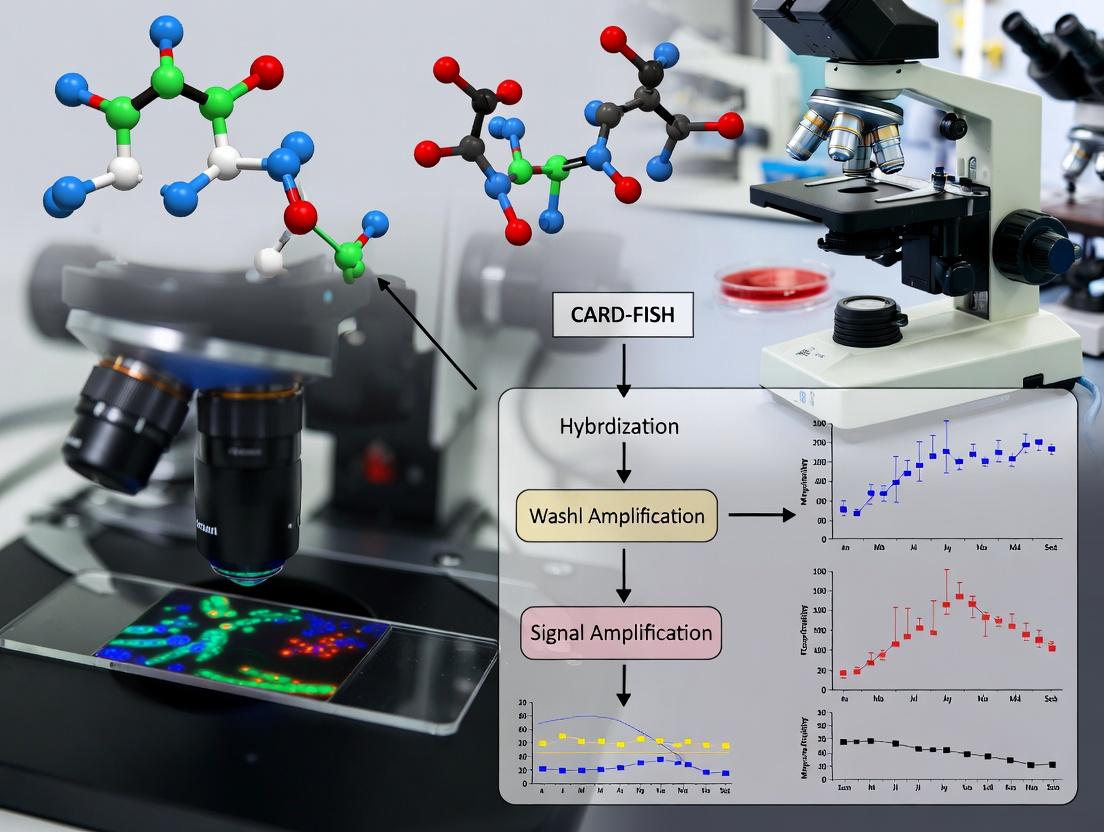
This article provides a comprehensive guide to Catalyzed Reporter Deposition Fluorescence In Situ Hybridization (CARD-FISH), a powerful signal amplification technique for detecting and quantifying environmental microorganisms.
CARD-FISH Amplification: Revolutionizing Environmental Microbe Detection for Biomedical Research
Abstract
This article provides a comprehensive guide to Catalyzed Reporter Deposition Fluorescence In Situ Hybridization (CARD-FISH), a powerful signal amplification technique for detecting and quantifying environmental microorganisms. Tailored for researchers, scientists, and drug development professionals, we explore its foundational principles, detailed methodological workflows, and advanced optimization strategies. We cover its critical applications in environmental monitoring, drug discovery from microbial sources, and biofilm analysis. The article also includes a comparative analysis with alternative techniques and discusses validation protocols to ensure reliable, high-sensitivity results for low-abundance microbial targets in complex samples.
CARD-FISH Fundamentals: Unlocking the Science of Signal Amplification for Environmental Microbes
What is CARD-FISH? Core Principles and the Tyramide Signal Amplification (TSA) Mechanism
Catalyzed Reporter Deposition Fluorescence In Situ Hybridization (CARD-FISH) is a powerful technique for the detection and phylogenetic identification of microorganisms in environmental samples. It significantly enhances the sensitivity of conventional FISH by incorporating an enzymatic signal amplification step, primarily using horseradish peroxidase (HRP) and tyramide derivatives. This method is crucial for studying microbes with low ribosomal RNA content, such as many environmentally relevant, slow-growing, or inactive cells.
The core principle involves three major steps:
- Hybridization: A nucleic acid probe, labeled with Horseradish Peroxidase (HRP), specifically binds to its target rRNA sequence within a permeabilized, fixed cell.
- Amplification: The HRP enzyme catalyzes the deposition of numerous fluorescently labeled tyramide molecules onto proteins in the immediate vicinity of the probe binding site.
- Detection: The accumulated fluorescent signal is visualized using epifluorescence or confocal microscopy, allowing for the detection of target cells that would otherwise be invisible with standard FISH.
The Tyramide Signal Amplification (TSA) Mechanism
The TSA mechanism, also known as Tyramide Signal Amplification or CARD (Catalyzed Reporter Deposition), is the biochemical heart of CARD-FISH.
Mechanism Details:
- The HRP enzyme, covalently attached to the oligonucleotide probe, binds to its target sequence.
- Upon addition of hydrogen peroxide (H₂O₂), HRP activates the phenolic tyramide substrate, converting it into a highly reactive radical intermediate.
- This short-lived, activated tyramide rapidly and covalently binds to electron-rich residues (primarily tyrosine) on proteins in the immediate vicinity of the HRP enzyme (a radius of <20 nm).
- As each HRP enzyme can activate and deposit hundreds to thousands of tyramide molecules per minute, a massive local accumulation of fluorophores occurs at the site of probe hybridization.
- This results in a signal enhancement of 10- to 100-fold compared to directly fluorophore-labeled probes.
Diagram: TSA Signal Amplification Workflow
Application Notes for Environmental Microbes Research
CARD-FISH is indispensable in environmental microbiology for its ability to detect difficult-to-culture and low-activity microorganisms directly in complex matrices (soil, water, biofilms). Key applications include:
- Quantification of Functional Guilds: Linking phylogeny to function by targeting genes of interest (e.g., amoA for ammonia oxidizers).
- Activity-Correlated Identification: Using probes for rRNA precursors to identify metabolically active cells.
- High-Resolution Imaging: Enabling detailed spatial organization studies in biofilms and symbioses via combinatorial labeling or coupling with other techniques like SEM.
- Single-Cell Genomics: Guiding the isolation of specific cells for downstream genomic analysis.
Challenges and Considerations:
- Permeabilization: Critical step; requires optimization for each sample type (e.g., Lysozyme for Gram-negatives, proteinase K for tough matrices).
- Endogenous Peroxidases: Must be inactivated with H₂O₂ treatment or low pH.
- Autofluorescence: Can interfere; use appropriate filter sets and control samples.
- Signal Diffusion: Over-amplification can cause signal spread, reducing resolution. Optimization of tyramide reaction time is essential.
Quantitative Data Comparison: CARD-FISH vs. FISH
Table 1: Comparative Performance Metrics of FISH and CARD-FISH
| Parameter | Conventional FISH | CARD-FISH | Notes & Implications |
|---|---|---|---|
| Detection Limit | ~10⁴ rRNA copies/cell | ~10² rRNA copies/cell | Enables detection of inactive or oligotrophic microbes. |
| Signal Intensity | 1x (Baseline) | 10x - 100x higher | Allows shorter exposure times, reduces photobleaching. |
| Optimal Probe Length | 15-25 nucleotides | ~15 nucleotides (with HRP label) | Similar design rules apply, but HRP labeling requires specific chemistry. |
| Hybridization Time | 1.5 - 3 hours | Up to 12 hours (Overnight) | Longer incubation improves probe penetration and binding. |
| Typical Application | High-activity cells (e.g., cultures, active biofilms) | Environmental samples, slow growers, low-activity cells | CARD-FISH is the method of choice for most in situ environmental studies. |
| Spatial Resolution | High (signal at rRNA site) | Moderate (signal halo ~20-40 nm radius) | Tyramide deposition area slightly larger than cell boundary. |
Detailed Experimental Protocol
Protocol: CARD-FISH for Environmental Water and Biofilm Samples
A. Sample Fixation and Permeabilization
- Fix sample in sterile-filtered PBS-buffered paraformaldehyde (4% final conc.) for 1-24 h at 4°C.
- Wash 3x in 1x PBS.
- For biofilms/sediments: Spot sample onto gelatin-coated (0.1% gelatin, 0.01% KCr(SO₄)₂) slides, air dry, and dehydrate in 50%, 80%, 96% ethanol series (3 min each).
- Permeabilization (Critical): Apply permeabilization agent. For most water samples: Lysozyme (10 mg/mL in 0.05 M EDTA, 0.1 M Tris-HCl, pH 8.0) for 60 min at 37°C. For Gram-positives: additional treatment with Achromopeptidase (60 U/mL in 0.01 M NaCl, 0.01 M Tris-HCl, pH 8.0) for 30 min at 37°C.
- Rinse slides thoroughly in ultrapure water and air dry.
B. Inactivation of Endogenous Peroxidases
- Immerse slides in methanol containing 0.15% H₂O₂ (v/v) for 30 min at room temperature (in the dark).
- Rinse with ultrapure water and air dry.
C. Hybridization
- Prepare hybridization buffer: 0.9 M NaCl, 20 mM Tris/HCl (pH 7.5), 0.01% SDS, 10% Dextran Sulfate, and formamide concentration optimized for each probe (typically 0-60%).
- Apply 20-50 µL of hybridization buffer containing HRP-labeled probe (final conc. 50 ng/µL) to each sample area and cover with a coverslip.
- Place slides in a humidified chamber and incubate at 46°C for 2-12 hours (overnight recommended).
D. Stringency Wash
- Gently remove coverslip by immersing slide in pre-warmed wash buffer.
- Wash buffer: 20 mM Tris/HCl (pH 7.5), 5 mM EDTA, 0.01% SDS, and NaCl concentration adjusted based on formamide used (see standard FISH stringency tables).
- Incubate slides in wash buffer at 48°C for 15-20 minutes.
- Rinse briefly with ultrapure water and air dry.
E. Tyramide Signal Amplification
- Prepare amplification buffer: 2 mL of 1x PBS, 2 µL of H₂O₂ (final 0.0015%), and 2 µL of Fluorescent Tyramide (from commercial stock, e.g., Alexa Fluor 488/594/647 tyramide).
- Apply 20-50 µL of amplification buffer to each sample, cover with a coverslip.
- Incubate in a dark, humidified chamber at 46°C for 15-45 minutes (OPTIMIZE THIS TIME).
- Wash in 1x PBS for 5-10 minutes at room temperature, in the dark.
- Rinse with ultrapure water and air dry in the dark.
F. Counterstaining and Microscopy
- Counterstain with DAPI (1 µg/mL) for 5 min.
- Rinse, air dry, and mount with an anti-fading mounting medium (e.g., Citifluor).
- Visualize using epifluorescence or confocal microscopy with appropriate filter sets.
Diagram: CARD-FISH Complete Experimental Workflow
The Scientist's Toolkit: Key Research Reagent Solutions
Table 2: Essential Materials and Reagents for CARD-FISH
| Item | Function & Rationale | Example/Specification |
|---|---|---|
| HRP-Labeled Oligonucleotide Probes | Provides sequence specificity and catalytic site for amplification. Must be HPLC-purified. | Custom synthesis from providers (e.g., Biomers, Thermo Fisher). 5' or 3' labeled with HRP. |
| Fluorescent Tyramides | The signal-amplifying substrate. Activated by HRP and deposited locally. | Alexa Fluor 488/594/647 tyramide (Thermo Fisher). Reconstituted in DMSO as high-conc. stock. |
| Permeabilization Enzymes | Breaks down cell walls to allow probe entry. Choice depends on sample. | Lysozyme (Gram-), Achromopeptidase (Gram+), Proteinase K (tough matrices). |
| Dextran Sulfate | Included in hybridization buffer. Creates a molecular crowding effect, enhancing probe binding kinetics. | Molecular weight 500,000. |
| Formamide | Denaturant used in hybridization buffer to control stringency. % dictates probe specificity. | Molecular biology grade. Concentration probe-specific (0-60%). |
| Anti-fading Mounting Medium | Preserves fluorescence during microscopy storage. Reduces photobleaching. | Citifluor, Vectashield, or commercial PBS-based mixes. |
| Positive Control Probe | Probe targeting a ubiquitous region (e.g., EUB338 mix for most Bacteria) to validate protocol. | HRP-labeled EUB338 I-III mix. |
| Negative Control | A nonsense probe (NON338) or sample without probe to check for non-specific tyramide binding. | HRP-labeled NON338. |
Application Notes
Fluorescence in situ hybridization (FISH) is a cornerstone technique for the identification, quantification, and spatial localization of specific microbial taxa within environmental samples. However, its application in low-biomass environments—such as oligotrophic oceans, deep subsurface sediments, ice cores, or air filters—is severely limited by the low ribosomal RNA content of target cells. Conventional FISH, relying on fluorophore-labeled oligonucleotide probes, often yields signals below the detection threshold of standard epifluorescence microscopy.
Quantitative Comparison: Conventional FISH vs. CARD-FISH Table 1: Performance Metrics for FISH Techniques in Low-Biomass Scenarios
| Parameter | Conventional FISH | CARD-FISH (with HRP-labeled probes) |
|---|---|---|
| Signal Intensity | 1x (Baseline) | 10 - 40x increase |
| Typical Detection Limit | >10³ - 10⁴ rRNA copies/cell | Can detect < 10² rRNA copies/cell |
| Probe Penetration | Excellent (small probes) | Reduced; requires cell wall permeabilization |
| Autofluorescence Interference | High (signal often comparable to noise) | Low (high signal-to-noise ratio) |
| Protocol Duration | ~3 hours | ~6-8 hours (including amplification) |
| Quantification Ease | Difficult due to faint signals | Robust, enabling reliable cell counting |
Catalyzed Reporter Deposition FISH (CARD-FISH) addresses this critical limitation by employing horseradish peroxidase (HRP)-labeled probes. The HRP enzyme catalyzes the deposition of numerous tyramide-bound fluorophores at the site of probe hybridization, resulting in a massive signal amplification.
Detailed Experimental Protocols
Protocol 1: Sample Fixation and Preparation for CARD-FISH (Water Filters)
- Fixation: Filter water sample onto a 0.22 μm polycarbonate membrane. Immerse filter in 3% paraformaldehyde (in 1x PBS, pH 7.4) for 1-4 hours at 4°C.
- Washing: Rinse filter three times in 1x PBS. Dehydrate in 50%, 80%, and 98% ethanol washes (3 minutes each). Air-dry.
- Embedding: Embed filter cells-side-up in 0.1% agarose (to prevent cell loss). Dry at 35°C.
- Permeabilization (Critical Step): Treat filter with lysozyme solution (10 mg/ml in 0.1 M Tris/HCl, 0.05 M EDTA, pH 8.0) for 60 minutes at 37°C. Rinse with Milli-Q water.
- Dehydration: Repeat ethanol series (50%, 80%, 98%) for 3 minutes each. Air-dry.
Protocol 2: CARD-FISH Hybridization and Amplification
- Hybridization: Apply 20-30 μl of hybridization buffer (0.9 M NaCl, 20 mM Tris/HCl pH 7.5, 0.01% SDS, 10% Dextran sulfate, 55% Formamide [concentration probe-dependent]) containing HRP-labeled probe (50 ng/μl final concentration). Incubate in a dark, humid chamber at 35°C for 2-4 hours.
- Washing: Transfer filter to pre-warmed washing buffer (70 mM NaCl, 20 mM Tris/HCl pH 7.5, 5 mM EDTA, 0.01% SDS) at 37°C for 10-20 minutes.
- Signal Amplification: Equilibrate filter in 1x PBS for 15 minutes. Prepare amplification solution: 1x PBS, 2 M NaCl, 10% Dextran sulfate, 0.1% H₂O₂, fluorescently labeled tyramide (1:500 dilution from stock). Apply 20-30 μl to filter, incubate in a dark, humid chamber at 37°C for 20-30 minutes.
- Counterstaining & Microscopy: Wash filter thoroughly in 1x PBS. Optionally counterstain with DAPI (1 μg/ml). Mount filter on slide with antifading mounting medium. Analyze via epifluorescence microscopy with appropriate filter sets.
Visualizations
CARD-FISH Signal Amplification Pathway
CARD-FISH Workflow for Low-Biomass Samples
The Scientist's Toolkit: Key Research Reagent Solutions
Table 2: Essential Materials for CARD-FISH in Environmental Microbiology
| Reagent / Material | Function | Critical Notes |
|---|---|---|
| HRP-labeled Oligonucleotide Probes | Target-specific hybridization; carries amplification enzyme. | Must be designed with careful specificity check. Lyophilized probes require careful resuspension. |
| Lysozyme | Enzymatically digests peptidoglycan for probe/HRP entry. | Concentration and time are sample-type critical. Test optimization is required. |
| Paraformaldehyde (PFA) | Cross-links and preserves cellular structure and nucleic acids. | Freshly prepared or aliquots from frozen stock are recommended. |
| Formamide | Denaturant in hybridization buffer; controls stringency. | Concentration must match probe's theoretical optimal stringency (Tm). |
| Fluorophore-labeled Tyramide (e.g., Cy3-Tyramide) | Amplification substrate. HRP catalyzes its deposition at the probe site. | Highly sensitive to light and moisture. Aliquot and store at -20°C in desiccator. |
| Anti-fading Mounting Medium | Preserves fluorescence signal during microscopy. | Essential for prolonged observation and image capture. |
| Polycarbonate Membrane Filters (0.22 μm) | Supports microbial cells from liquid samples with minimal autofluorescence. | Superior to nitrocellulose for low-autofluorescence microscopy. |
CARD-FISH (Catalyzed Reporter Deposition Fluorescence In Situ Hybridization) is a cornerstone technique for the detection, identification, and quantification of environmental microbes, particularly those with low ribosomal RNA content. The core principle involves signal amplification via the catalytic activity of Horseradish Peroxidase (HRP) conjugated to oligonucleotide probes, driving the localized deposition of labeled tyramide molecules. This application note details the critical components and protocols for successful CARD-FISH, framed within a thesis investigating uncultivated microbial consortia in deep-sea sediments.
Core Components & Quantitative Data
Table 1: Key Components of CARD-FISH and Their Specifications
| Component | Role/Function | Key Considerations & Typical Specifications |
|---|---|---|
| Oligonucleotide Probe | Targets specific 16S/23S rRNA sequences. Must be designed for HRP conjugation. | Length: 15-25 bp. GC Content: 40-60%. Tm: ~55-60°C. Must avoid secondary structures. 5' or 3' end modification for HRP attachment. |
| Horseradish Peroxidase (HRP) | Enzyme catalyzing tyramide signal amplification. Conjugated directly to the probe. | High-purity, lyophilized. RZ (A₄₁₆/A₂₈₀) > 3.0 indicates high purity. Stable at 4°C; inactivated by sodium azide. |
| Tyramide Conjugates | Signal-bearing substrate (Tyramide). Deposited at the probe site upon HRP activation. | Conjugated to fluorophores (e.g., FITC, Cy3, Cy5) or haptens. Stock concentration: ~1 mM in DMSO. Working dilution: 1:50 to 1:500 in amplification buffer. |
| Hydrogen Peroxide (H₂O₂) | Co-substrate for HRP. Required to generate tyramide radicals. | Low concentration critical. Typical working concentration: 0.0015% (v/v) (0.44 mM). High levels cause high background or cell damage. |
| Blocking Reagents | Reduce nonspecific binding of HRP or tyramide. | Critical step. Use of blocking buffer with 0.1-2% w/v Blocking Reagent (e.g., from TSA kits) and 5-10% heat-inactivated horse serum. |
| Saline Citrate (SSC) Buffer | Controls stringency during hybridization and washes. | 20X SSC stock: 3.0 M NaCl, 0.3 M Na₃Citrate, pH 7.0. Higher SSC (e.g., 0.9X) and temperature increase stringency. |
Table 2: Optimized Protocol Parameters for Environmental Samples
| Step | Parameter | Typical Range for Environmental Microbes | Notes |
|---|---|---|---|
| Cell Fixation & Permeabilization | Paraformaldehyde Concentration | 1-4% (v/v) | 2-3% for most bacteria. Marine samples often 3% final. |
| Ethanol Permeabilization | 50% (v/v) for 1 hr | Increases permeability of Gram-positive cells. | |
| Hybridization | Temperature | 35-46°C | Depends on probe Tm and target group. |
| Time | 2-4 hours | Overnight hybridization possible for low-abundance targets. | |
| Formamide in Hyb Buffer | 0-60% (v/v) | Adjusts effective stringency; probe-specific. | |
| Signal Amplification | H₂O₂ Concentration | 0.001 - 0.003% (v/v) | Must be optimized to balance signal and background. |
| Tyramide Incubation | 10-30 minutes at 37°C | Longer incubation increases signal but also risk of background. |
Detailed Experimental Protocols
Protocol A: HRP-Probe Hybridization and CARD-FISH for Water Column/ Sediment Bacteria Materials: Filtered microbial cells on polycarbonate membrane filters (0.2 μm), HRP-labeled oligonucleotide probe, hybridization buffer (0.9 M NaCl, 20 mM Tris-HCl [pH 7.5], 0.01% SDS, Formamide [conc. probe-specific]), washing buffer, amplification buffer (0.1 M NaCl, 0.1 M Tris-HCl [pH 8.0], 0.0015% H₂O₂), fluorescent tyramide stock, blocking reagent.
- Fixation & Permeabilization: Fix cells in 3% paraformaldehyde (PFA) for 1-4h at 4°C. Wash with 1X PBS. Dehydrate in 50%, 80%, and 98% ethanol series (3 min each). Air dry.
- Hybridization: Apply 48 μL of pre-warmed hybridization buffer containing 2 μL of HRP-probe (50 ng/μL final) to filter section. Incubate in a dark, humid chamber at 46°C for 2-3 hours.
- Stringency Wash: Transfer filter to 5 mL of pre-warmed washing buffer (same NaCl concentration as hybridization buffer, without formamide). Incubate at 48°C for 20 minutes. Rinse briefly with distilled water.
- Blocking: Incubate filter in 1X blocking buffer for 30 minutes at room temperature to minimize nonspecific HRP activity.
- Signal Amplification (CARD): Prepare tyramide working solution: 1 μL of 1 mM tyramide-FITC conjugate in 500 μL amplification buffer. Incubate filter in this solution for 20-30 minutes at 37°C in the dark.
- Counterstaining & Microscopy: Wash thoroughly in 1X PBS. Counterstain with DAPI (1 μg/mL). Mount filter on slide with antifading mounting medium. Analyze via epifluorescence microscopy.
Protocol B: Enhancement for Gram-Positive/ Difficult-to-Permeabilize Cells For cells with robust cell walls (e.g., Actinobacteria), additional permeabilization is required after hybridization.
- Follow Protocol A through Step 3 (Stringency Wash).
- Post-Hybridization Permeabilization: Incubate filter in 1X PBS containing 10 mg/mL lysozyme for 1 hour at 37°C.
- Wash briefly with 1X PBS and distilled water.
- Proceed with Blocking and Signal Amplification (Steps 4-6, Protocol A).
Visualizations
Title: CARD-FISH Tyramide Signal Amplification Pathway
Title: Complete CARD-FISH Experimental Workflow
The Scientist's Toolkit: Research Reagent Solutions
| Item | Function in CARD-FISH | Key Notes |
|---|---|---|
| Polycarbonate Membrane Filters (0.2 µm, 25 mm) | Support for microbial cell collection via filtration. | Low autofluorescence is critical. Must be compatible with hybridization buffers. |
| Formamide (Molecular Biology Grade) | Denaturing agent in hybridization buffer to fine-tune stringency. | Concentration is probe-specific. Higher % decreases hybridization temperature. |
| HRP-Labeled Oligonucleotide Probe | Sequence-specific, enzyme-tagged detection reagent. | Must be HPLC-purified. Store in aliquots at -20°C; avoid freeze-thaw cycles. |
| Tyramide Signal Amplification (TSA) Kit | Commercial kit providing optimized buffers, blocking reagent, and tyramide conjugates. | Provides consistency. Kits available from multiple vendors (e.g., Thermo Fisher, Akoya). |
| Antifading Mounting Medium | Preserves fluorescence signal during microscopy. | Should contain DAPI counterstain or be compatible with its addition. |
| Lysozyme (from chicken egg white) | Enzymatic cell wall permeabilization for difficult cells. | Prepare fresh in 1X PBS. Concentration and time require optimization. |
The development of CARD-FISH (Catalyzed Reporter Deposition Fluorescence In Situ Hybridization) for environmental microbes represents a direct technological evolution from clinical and cellular biology diagnostics. Its core principle—signal amplification via horseradish peroxidase (HRP)—was pioneered in immunohistochemistry (IHC) to detect low-abundance antigens in tissue sections. This methodology was adapted for in situ hybridization (ISH) to detect nucleic acids, leading to CARD-ISH. The critical transition to environmental microbiology occurred when researchers applied this amplified signal approach to overcome the inherent limitations of standard FISH when studying environmental samples: low ribosomal RNA content in slow-growing or small cells, high background autofluorescence, and signal masking by particulate matter. The amplification allows for the detection and phylogenetic identification of previously "unculturable" microorganisms within complex matrices like soil, sediment, and water, revolutionizing our understanding of microbial ecology, biogeochemical cycles, and the environmental microbiome's role in health and disease.
Application Notes
Core Advantage in Environmental Samples: CARD-FISH provides a 10- to 100-fold increase in fluorescence signal intensity compared to standard monolabeled-FISH probes. This is critical for detecting microbes with low metabolic activity.
Quantitative Data Summary: CARD-FISH vs. Standard FISH
| Parameter | Standard FISH | CARD-FISH | Notes |
|---|---|---|---|
| Signal Intensity | 1X (Baseline) | 10-100X | Enables imaging with standard epifluorescence microscopes. |
| Detection Limit (Cells/mL) | ~10^4 - 10^5 | ~10^2 - 10^3 | Allows detection of rare biosphere members. |
| Probe Permeabilization | Standard (Lysozyme, etc.) | Harsh (often required) | Lysozyme, Achromopeptidase, or even thin sectioning needed for HRP entry. |
| Typical Protocol Duration | 3-5 hours | 6-8 hours (overnight possible) | Longer due to amplification steps. |
| Autofluorescence Mitigation | Limited | Good | Strong signal allows use of spectral imaging or bleaching to subtract background. |
| Quantification Ease | Moderate (low S/N) | High (high S/N) | Clearer signals facilitate automated image analysis. |
| Multiplexing Potential | High (directly labeled probes) | Low (sequential assays) | Tyramide deposition permanently masks nearby targets. |
Key Challenges & Solutions:
- Endogenous Peroxidase Activity: Common in environmental samples (e.g., plant material). Solution: Treat with 0.01 M HCl or methanol/H2O2 to quench activity before hybridization.
- Probe Permeability: Cell walls of many environmental microbes are robust. Solution: Optimize enzymatic pretreatment cocktails (e.g., Lysozyme + Achromopeptidase) or use physical sectioning.
- Tyramide Diffusion Artifacts: Amplified signal can deposit slightly away from the target site, reducing resolution. Solution: Shorten amplification reaction time (5-30 min), optimize tyramide concentration, and include precise controls.
Experimental Protocols
Protocol: CARD-FISH for Aquatic Sediment Microbes
I. Sample Fixation and Preparation
- Fix sediment slurry immediately with particle-free, filter-sterilized formaldehyde (final conc. 1-3% w/v) for 1-3h at 4°C.
- Wash 3x in 1x PBS (pH 7.4) by centrifugation (10,000 x g, 5 min).
- Store fixed samples in a 1:1 mixture of PBS and 96% ethanol at -20°C.
II. Immobilization and Permeabilization
- Spot fixed sample onto gelatin-coated (0.1%) multi-well slides. Air dry.
- Dehydrate through an ethanol series (50%, 80%, 96%; 3 min each).
- Critical Step: Apply permeabilization solution (10 mg/mL Lysozyme in 0.05 M EDTA, 0.1 M Tris-HCl; pH 8.0) for 60 min at 37°C.
- Rinse thoroughly with Milli-Q water and air dry.
III. Hybridization
- Prepare hybridization buffer: 0.9 M NaCl, 20 mM Tris-HCl (pH 7.4), 0.01% SDS, 10% Dextran Sulfate, and formamide concentration optimized for probe (e.g., 35% for EUB338).
- Add HRP-labeled oligonucleotide probe (final conc. 50 ng/µL) to buffer.
- Apply 20-30 µL per well, cover with a coverslip, and incubate in a humidified chamber at 35°C for 2-3 hours.
- Transfer slide to pre-warmed washing buffer (see below) and incubate at 37°C for 15-20 min.
IV. Signal Amplification (CARD)
- Prepare amplification buffer: 1x PBS, 0.0015% H2O2, 0.1% blocking reagent (provided in kit).
- Add fluorescently labeled tyramide (e.g., Alexa Fluor 488-tyramide) at 1:500 dilution.
- Apply 30-50 µL per well, cover with a coverslip, and incubate in a dark, humidified chamber at 37°C for 15-45 min.
- Rinse with 1x PBS, then Milli-Q water. Air dry in darkness.
V. Counterstaining and Microscopy
- Counterstain with DAPI (1 µg/mL) for 5 min.
- Rinse, air dry, and mount with anti-fading mounting medium.
- Visualize using epifluorescence or confocal microscopy with appropriate filter sets.
Visualizations
Title: Evolution from IHC to Environmental CARD-FISH
Title: CARD-FISH Signal Amplification Mechanism
Title: CARD-FISH Core Workflow for Environmental Samples
The Scientist's Toolkit: Research Reagent Solutions
| Item | Function in CARD-FISH | Key Consideration |
|---|---|---|
| HRP-labeled Oligonucleotide Probe | Binds specifically to target rRNA sequence; contains enzyme for amplification. | Probe specificity (formamide stringency) and HRP stability are critical. |
| Fluorescently Labeled Tyramide | Amplification substrate. HRP catalyzes its localized, covalent deposition. | Choice of fluorophore (e.g., Alexa 488, Cy3) must match microscope capabilities. |
| Lysozyme / Achromopeptidase | Enzymatic cocktail to permeabilize cell walls for probe/HRP entry. | Optimization for each sample type is required to avoid cell loss. |
| Dextran Sulfate | Component of hybridization buffer; increases effective probe concentration via volume exclusion. | Enhances hybridization kinetics and signal strength. |
| Formamide | Denaturant in hybridization buffer; controls stringency based on probe %GC. | Concentration must be optimized for each probe to ensure specificity. |
| Hydrogen Peroxide (H2O2) | Co-substrate for the HRP reaction; activates tyramide. | Concentration must be precise to balance signal and minimize background. |
| Blocking Reagent | (e.g., from TSA kits) Reduces non-specific adsorption of tyramide. | Essential for minimizing background in organic-rich environmental samples. |
| Anti-fading Mountant | Preserves fluorescence signal during microscopy storage. | Critical for quantitative analysis and archival of slides. |
1. Introduction and Thesis Context
Catalyzed Reporter Deposition Fluorescence In Situ Hybridization (CARD-FISH) represents a paradigm shift in environmental microbiology, particularly within the thesis framework of advancing signal amplification for in situ detection. While standard FISH is often limited by low ribosomal RNA content in dormant or slow-growing cells, CARD-FISH employs horseradish peroxidase (HRP)-labeled probes and tyramide signal amplification to achieve extraordinary signal intensity. This application note details how this technology delivers unmatched sensitivity and robust quantitative potential for targeting rare microbial populations in complex environmental samples, such as oligotrophic oceans, deep subsurface biospheres, and host-associated microbiomes.
2. Quantitative Data Summary: CARD-FISH vs. Standard FISH
The following table consolidates key performance metrics from recent studies, underscoring the quantitative advantages of CARD-FISH for rare biosphere research.
Table 1: Comparative Performance Metrics of CARD-FISH and Standard FISH
| Parameter | Standard FISH | CARD-FISH | Notes & Reference |
|---|---|---|---|
| Detection Limit (Cells/mL) | 10^4 - 10^5 | 10^1 - 10^2 | Enables detection of <0.1% of total community. |
| Signal Intensity Gain | 1x (Baseline) | 20x - 50x | Factor increase in fluorescence per cell. |
| Hybridization Time | 1.5 - 3 hours | 2 - 4 hours | Similar workflow duration. |
| Permeabilization Critical | Moderate (Lysozyme) | High (Lysozyme + Achromopeptidase) | Critical step for HRP probe entry. |
| Quantitative Accuracy (vs. qPCR) | R^2 = 0.65 - 0.80 | R^2 = 0.90 - 0.98 | Linear correlation over 4-5 orders of magnitude. |
| Key Application | Abundant community members | Rare biosphere, slow-growing, dormant cells |
3. Detailed Protocol: CARD-FISH for Rare Microbes in Soil/Sediment
This protocol is optimized for gram-negative environmental samples.
A. Sample Fixation and Permeabilization (Critical for HRP entry)
- Fix sample (1g soil/sediment slurry or 10^7 cells) in 3% paraformaldehyde (PFA) for 3-12 hours at 4°C.
- Wash 3x in 1x PBS, resuspend in 1:1 PBS:Ethanol, store at -20°C.
- Spot samples onto gelatin-coated (0.1%) slides, air dry, then dehydrate in 50%, 80%, 98% ethanol series (3 min each).
- Permeabilization: Apply lysozyme solution (10 mg/mL in 0.05M EDTA, 0.1M Tris-HCl, pH 8.0) for 60 min at 37°C.
- Rinse thoroughly with distilled water and air dry.
B. Hybridization with HRP-labeled Probe
- Prepare hybridization buffer: 0.9M NaCl, 20mM Tris/HCl (pH 7.5), 0.01% SDS, 35% formamide (stringency adjusted per probe).
- Add HRP-labeled oligonucleotide probe (final conc. 50 ng/µL) to buffer.
- Apply 20-30 µL of mix to sample area, cover with a coverslip.
- Incubate in a dark, humid chamber at 35°C for 2-4 hours.
- Remove coverslip by immersing slide in pre-warmed washing buffer (70mM NaCl, 20mM Tris/HCl, pH 7.5, 5mM EDTA, 0.01% SDS).
- Wash in pre-warmed buffer for 15 min at 37°C.
C. Signal Amplification via Tyramide Deposition
- Equilibrate slide in 1x PBS for 5 min.
- Block endogenous peroxidases: Incubate in 0.3% H₂O₂ in methanol for 30 min at RT. Rinse in 1x PBS.
- Prepare tyramide working solution: Fluorescently labeled tyramide (e.g., Alexa Fluor 488) diluted 1:100 in amplification buffer (containing H₂O₂).
- Apply 20-30 µL of tyramide solution, cover with a coverslip.
- Incubate in a dark, humid chamber for 15-45 min at 37°C.
- Rinse with 1x PBS, then distilled water. Air dry in darkness.
D. Counterstaining and Enumeration
- Counterstain with DAPI (1 µg/mL) for 5 min. Rinse.
- Mount with antifading mounting medium.
- Enumerate using epifluorescence or confocal microscopy. Calculate abundance as: (Target cells [CARD-FISH signal] / Total cells [DAPI]) x 100%.
4. Visualization: CARD-FISH Workflow and Signal Amplification Pathway
Title: CARD-FISH Experimental Workflow and Amplification Pathway
5. The Scientist's Toolkit: Essential Research Reagent Solutions
Table 2: Key Reagents and Materials for CARD-FISH
| Item | Function & Importance |
|---|---|
| HRP-labeled Oligonucleotide Probe | Target-specific probe with covalently attached Horseradish Peroxidase enzyme. Core of the method. |
| Fluorochrome-labeled Tyramide | Signal amplification substrate. Activated by HRP, deposits multiple fluorescent moieties per probe. |
| Lysozyme & Achromopeptidase | Critical permeabilization enzymes to degrade cell walls for HRP-protein entry. |
| Paraformaldehyde (PFA) | Fixative that preserves cell morphology and immobilizes nucleic acids. |
| Formamide | Used in hybridization buffer to control stringency and probe specificity. |
| Anti-fade Mounting Medium | Preserves fluorescence signal during microscopy and storage. |
| Blocking Reagent | (e.g., Bovine Serum Albumin) Reduces non-specific tyramide binding. |
| H₂O₂ (Low Concentration) | Substrate for HRP in the tyramide reaction; also quenches endogenous peroxidases. |
Step-by-Step CARD-FISH Protocol: Applications in Environmental Monitoring and Drug Discovery
Within the context of a CARD-FISH (Catalyzed Reporter Deposition Fluorescence In Situ Hybridization) workflow for environmental microbial research, sample preparation and fixation are the most critical initial steps. The primary goal is to rapidly and effectively immobilize target nucleic acids while preserving cellular morphology and permeability for subsequent enzymatic and hybridization procedures. The challenge lies in adapting these protocols to complex environmental matrices—water, soil, and biofilms—each presenting unique hurdles in biomass collection, inhibitor removal, and cell wall stabilization.
Application Notes
Water Samples (Marine & Freshwater)
For planktonic microbial communities, fixation must occur immediately upon collection to halt biological activity. The key metric is fixative penetration speed. For typical bacterioplankton, a final formaldehyde concentration of 1-4% (v/v) is effective.
Table 1: Fixation Parameters for Water Matrices
| Parameter | Marine Water | Freshwater | Wastewater |
|---|---|---|---|
| Primary Fixative | Formaldehyde (1-3% final) | Formaldehyde (2-4% final) | Paraformaldehyde (2-4% final) |
| Fixation Time | 1-2 hours at 4°C | 1-3 hours at 4°C | 2-4 hours at 4°C |
| Filtration Support | 0.22 µm polycarbonate | 0.22 µm polycarbonate | 0.22 µm polyethersulfone |
| Key Consideration | Osmolarity adjustment | Humic acid interference | High particulate/organic load |
Soil and Sediment Samples
These matrices require rigorous dissociation of cells from particles. A balance must be struck between dispersion efficiency (sonication or homogenization) and cell integrity preservation. Post-dispersion, density gradient centrifugation is often employed to separate cells from debris.
Table 2: Processing Metrics for Soil/Sediment
| Step | Typical Protocol | Optimal Yield Range | Morphology Preservation Index |
|---|---|---|---|
| Dispersion | Mild sonication (30-60 sec, 30 W) | 60-85% cell recovery | High (with optimization) |
| Fixation | Paraformaldehyde (2-4%) + Ethanol (50%) | N/A | Very High |
| Wash Buffer | 1x PBS, pH 7.4 | N/A | Critical for CARD-FISH |
Biofilm Samples
Biofilms require preservation of the complex extracellular polymeric substance (EPS) architecture while allowing probe penetration. Sequential fixation with aldehydes and ethanol is often most effective.
Detailed Protocols
Protocol A: Fixation and Filtration for Water Samples for CARD-FISH
Objective: To preserve and concentrate microbial cells from aqueous samples onto a filter for subsequent CARD-FISH analysis.
Materials:
- Environmental water sample
- Filtered (0.02 µm) formaldehyde (37% stock) or paraformaldehyde (4% solution in 1x PBS)
- Sterile 1x Phosphate Buffered Saline (PBS), pH 7.4
- Polycarbonate membrane filters (0.22 µm pore size, 25 mm diameter)
- Filtration manifold
- Vacuum pump (< 15 in. Hg)
- Forceps
- Aluminum foil
- -80°C freezer
Procedure:
- In-Situ Fixation: Immediately after collection, add filtered formaldehyde to a pre-measured water sample to achieve a final concentration of 2% (v/v). For example, add 540 µL of 37% formaldehyde to 10 mL of sample.
- Incubation: Mix gently and incubate in the dark at 4°C for 1-3 hours (see Table 1).
- Filtration: a. Place a sterile polycarbonate filter on the filtration manifold. b. Filter the fixed sample under low vacuum (< 15 in. Hg). c. Rinse the filter with 5-10 mL of sterile 1x PBS to remove residual fixative. d. Air-dry the filter for ~1 minute.
- Storage: Wrap the filter in aluminum foil and store at -80°C until processing for CARD-FISH.
Protocol B: Dispersion and Fixation of Soil Microbes for CARD-FISH
Objective: To detach and fix microbial cells from soil particles while maintaining cell wall integrity.
Materials:
- 1-5 g of soil/sediment sample
- Sterile 1x PBS, pH 7.4
- Paraformaldehyde (4% solution in 1x PBS)
- Ethanol (96%)
- Sodium pyrophosphate (0.1% w/v in PBS) or Tween 80 (0.01% v/v)
- Centrifuge and tubes
- Water bath sonicator
- Nycodenz or Percoll density gradient medium
Procedure:
- Dispersion: Suspend 1 g of soil in 10 mL of sterile dispersal solution (e.g., 0.1% sodium pyrophosphate) in a 50 mL tube.
- Homogenization: Agitate on a horizontal shaker at 200 rpm for 15 minutes.
- Mild Sonication: Sonicate the suspension in a water bath sonicator for 30 seconds at 30 W. Place the sample on ice for 30 seconds. Repeat once.
- Sedimentation: Allow large particles to settle for 15-30 minutes on ice.
- Supernatant Collection: Carefully decant the supernatant into a new centrifuge tube.
- Fixation: Add an equal volume of 4% paraformaldehyde to the supernatant (final concentration 2%). Fix at 4°C for 2-4 hours.
- Washing: Pellet cells by centrifugation (10,000 x g, 5 min). Discard supernatant and wash pellet twice with 1x PBS.
- Optional Density Gradient: Resuspend pellet in 5 mL PBS. Layer onto a pre-formed Nycodenz gradient (1.3 g/mL). Centrifuge at 14,000 x g for 20 min. Collect the cell band at the interface.
- Final Storage: Pellet cells, resuspend in a 1:1 PBS:Ethanol solution, and store at -80°C.
Visualization: CARD-FISH Sample Preparation Workflow
Title: Sample Prep Workflow for CARD-FISH
The Scientist's Toolkit: Research Reagent Solutions
Table 3: Essential Materials for Sample Preparation & Fixation
| Item | Function in Protocol | Key Consideration for CARD-FISH |
|---|---|---|
| Paraformaldehyde (4%, EM grade) | Primary cross-linking fixative. Preserves morphology and immobilizes RNA/DNA. | Must be fresh, pH ~7.4, filtered (0.22 µm). PFA is preferred over formaldehyde for tough cell walls. |
| Polycarbonate Membrane Filters (0.22 µm) | Support for filtration of water samples. Provides a flat surface for hybridization. | Low autofluorescence is critical. Pore size must be smaller than target cells. |
| Sodium Pyrophosphate (0.1%) | Chelating agent used in soil dispersion to detach cells from mineral particles. | Concentration and time must be optimized to avoid cell lysis. |
| Nycodenz or Percoll | Density gradient medium for separating microbial cells from soil/organic debris. | Osmolarity must be adjusted to prevent cell shrinkage or bursting. |
| Lysozyme (10 mg/mL) | Enzyme for permeabilizing Gram-positive bacterial cell walls prior to hybridization. | Activity varies with environmental strain; concentration and time require optimization. |
| Proteinase K (Optional) | Enzyme for digesting proteins and permeabilizing tough cell walls/archaeal membranes. | Use is sample-specific; can degrade cell morphology if overused. |
| Ethanol (Molecular Biology Grade) | Used for dehydration and storage. Stabilizes fixed samples and aids in long-term storage. | Required for final storage step to inhibit enzymatic degradation. |
| Poly-L-Lysine Coated Slides | Adhesive for immobilizing cells or filter sections for the hybridization procedure. | Prevents sample loss during stringent CARD-FISH washing steps. |
Application Notes
This protocol details the design and selection of oligonucleotide probes targeting ribosomal RNA (rRNA) for use in Catalyzed Reporter Deposition Fluorescence In Situ Hybridization (CARD-FISH) within environmental microbiology. The high copy number of rRNA (10³–10⁵ per cell) provides a naturally amplified target, making it ideal for detecting microbes with low metabolic activity. Probe specificity is paramount for accurate phylogenetic identification, distinguishing between closely related taxa, and elucidating microbial community structure in complex samples like soil, water, and biofilms. Advances in database curation (e.g., SILVA, RDP, Greengenes) and algorithmic tools (ARB, probeBase, mathFISH) have refined the probe design process, enhancing specificity and reducing off-target binding. Key quantitative metrics for probe evaluation include:
Table 1: Key Quantitative Metrics for rRNA-Targeted Probe Evaluation
| Metric | Optimal Range/Target | Purpose/Rationale |
|---|---|---|
| Target Site Accessibility (%PA) | >50% | Higher predicted accessibility correlates with stronger hybridization signal. |
| GC Content (%) | 50–60% | Ensures appropriate melting temperature; avoids extremes that hinder hybridization. |
| Melting Temperature (Tm) | 55–65°C (formamide-adjusted) | Dictates hybridization stringency; critical for specificity. |
| Probe Length (bases) | 15–25 nucleotides | Balances specificity (longer) with accessibility (shorter). |
| Minimum Mismatches to Non-Targets | ≥2 (Central position optimal) | Central mismatches most destabilizing, enhancing discriminatory power. |
| Free Energy of Duplex (ΔG) | More negative (e.g., < -30 kcal/mol) | Indicates stronger, more stable probe-target binding. |
Table 2: Common rRNA Target Regions and Their Utility
| rRNA Region | Specific Variable Region | Phylogenetic Resolution | Notes on Accessibility |
|---|---|---|---|
| 16S rRNA | V1, V2 | High (Species to Phylum) | Often accessible; V1-V2 hypervariable. |
| 16S rRNA | V3, V4 | Medium to High (Genus) | Commonly used; well-conserved for broad probes. |
| 16S rRNA | V6, V8 | Medium (Genus to Family) | Good accessibility; useful for many bacterial groups. |
| 23S rRNA | D1-D5, D7 | High (Species to Genus) | Larger molecule offers more variable domains. |
| 18S rRNA | V4, V9 | Varies (Eukaryotes) | For eukaryotic microbes and protists. |
Protocols
Protocol 1:In SilicoProbe Design and Specificity Validation
Objective: To design and computationally validate specific oligonucleotide probes targeting phylogenetic marker rRNA genes.
Materials (Research Reagent Solutions Toolkit):
- ARB Software Suite & SILVA Database: Primary platform for probe design, alignment handling, and phylogenetic context evaluation.
- probeBase: Curated public repository for validated rRNA-targeted probes; used for checking existing probes and publishing new ones.
- mathFISH / ΔG Predictor: Calculates theoretical hybridization efficiency and formamide melting curves based on thermodynamic models.
- TestPrime (SILVA) or RDP Probe Match: For in silico specificity check against a comprehensive rRNA sequence database to identify potential non-target matches.
- Oligonucleotide Synthesis Service: For synthesizing probes with a 5'- or 3'-amino linker (C6 or C12) for subsequent horseradish peroxidase (HRP) labeling required for CARD-FISH.
Procedure:
- Sequence Alignment & Target Selection: Import a high-quality, aligned rRNA sequence database (e.g., SILVA SSU Ref NR) into the ARB software. Identify the phylogenetic group of interest. Navigate to the alignment and select a variable region (see Table 2) that contains unique signatures for the target group.
- Probe Design: Use the ARB "Probe Design" tool. Input constraints: length (18-25 nt), GC content (50-60%), and target group. The tool will generate candidate probes. Prioritize probes with central mismatches to the most relevant non-target sequences.
- In Silico Specificity Check: Run candidate probe sequences against the full database using ARB's "Probe Match" or the online TestPrime tool. The output must show perfect match only to the target group. Acceptance Criterion: Zero perfect matches to non-target organisms within your study's environmental scope.
- Thermodynamic Evaluation: Input the probe and target sequence into mathFISH. Calculate the theoretical % Accessibility (%PA) and the formamide dissociation curve. Generate the formamide concentration ([Fa]) required for stringent washing. Acceptance Criterion: %PA > 50% and a clear [Fa] window where target duplex is stable but non-target duplexes are not.
- Probe Synthesis: Order the selected probe sequence with a 5'-amino modification (C6 or C12) for covalent coupling to HRP.
Protocol 2: HRP-Labeling of Oligonucleotide Probes for CARD-FISH
Objective: To covalently conjugate Horseradish Peroxidase (HRP) to amino-modified oligonucleotide probes.
Materials (Research Reagent Solutions Toolkit):
- Amino-Modified Oligonucleotide: The designed probe (from Protocol 1).
- Horseradish Peroxidase (HRP), Maleimide-Activated: Commercially available, optimized for thiol-maleimide chemistry.
- Traut's Reagent (2-Iminothiolane): Introduces a sulfhydryl group (-SH) onto the primary amine of the oligonucleotide.
- NAP-5 or NAP-10 Columns (Sephadex G-25): For buffer exchange and removal of unreacted small molecules.
- Dithiothreitol (DTT) & EDTA: For reducing and chelating agents in buffers.
- Coupling Buffer (1x PBS, pH 7.2, 10 mM EDTA): Reaction buffer.
Procedure:
- Thiolation of Oligonucleotide: Dissolve the amino-modified oligonucleotide (100 µg) in 100 µL of coupling buffer. Add a 20-fold molar excess of Traut's Reagent. Incubate at 37°C for 1 hour.
- Purification: Pass the reaction mixture through a NAP-5 column equilibrated with coupling buffer to remove excess Traut's Reagent. Collect the purified, thiolated oligonucleotide (~300 µL).
- Conjugation: Add a 3-5 fold molar excess of maleimide-activated HRP to the thiolated oligonucleotide. Incubate in the dark at room temperature for 2 hours.
- Purification of Conjugate: Use gel filtration chromatography (e.g., Superdex 200) or a specialized spin column to separate the HRP-probe conjugate from free HRP and free oligonucleotide. Aliquot and store at -80°C in 50% glycerol.
Protocol 3: CARD-FISH Hybridization and Signal Amplification
Objective: To hybridize HRP-labeled probes to fixed environmental samples and amplify the signal via tyramide deposition.
Materials (Research Reagent Solutions Toolkit):
- HRP-Labeled Probe: From Protocol 2.
- Fixed Environmental Sample on Slide: Permeabilized microbial cells (e.g., with Lysozyme or Achromopeptidase).
- Hybridization Buffer (0.9 M NaCl, 20 mM Tris/HCl pH 7.5, Formamide [conc. probe-specific], 0.01% SDS): Stringency is controlled by formamide concentration.
- Washing Buffer (Adjustable NaCl conc. based on formamide): For post-hybridization stringency washes.
- Amplification Buffer (PBS with 0.0015% H₂O₂): Provides substrate for HRP.
- Fluorescently Labeled Tyramide (e.g., Alexa Fluor 488-Tyramide): HRP catalyzes the deposition of tyramide, creating localized signal amplification.
- Blocking Reagent (e.g., 0.1% w/v Pyrophosphate, 10% w/v Blocking Reagent): Reduces non-specific binding of tyramide.
Procedure:
- Hybridization: Apply 20-50 µL of hybridization buffer containing 2-5 ng/µL of HRP-probe to the fixed sample. Incubate in a dark, humidified chamber at 46°C for 2-3 hours.
- Washing: Immerse the slide in pre-warmed washing buffer (48°C) for 15-20 minutes to remove unbound and non-specifically bound probe.
- Signal Amplification (CARD): Rinse slide with 1x PBS. Apply amplification buffer containing 0.1-1 µg/mL fluorescent tyramide and incubate in the dark at 46°C for 15-30 minutes.
- Counterstaining & Microscopy: Rinse thoroughly, counterstain with DAPI (for total cells), and mount. Visualize via epifluorescence or confocal microscopy.
Visualizations
Diagram Title: rRNA Probe Design to CARD-FISH Workflow
Diagram Title: CARD-FISH Signal Amplification Mechanism
This application note details an optimized protocol for Catalyzed Reporter Deposition Fluorescence In Situ Hybridization (CARD-FISH), framed within a thesis investigating low-abundance, slow-growing microbial populations in oligotrophic marine environments. CARD-FISH, through enzymatic signal amplification, surpasses the sensitivity of conventional FISH, enabling the detection of target cells with low ribosomal RNA content. This protocol focuses on critical optimization parameters—hybridization and amplification temperatures, incubation times, and reagent concentrations—to maximize signal-to-noise ratio while preserving cell morphology.
Key Reagent Solutions & Materials
The Scientist's Toolkit: Essential Research Reagents for CARD-FISH
| Reagent/Material | Function & Rationale |
|---|---|
| HRP-labeled Oligonucleotide Probe | The core detection element. The horseradish peroxidase (HRP) enzyme catalyzes the downstream amplification reaction. Must be HPLC-purified. |
| Tyramide Signal Amplification (TSA) Reagent (Fluorophore-labeled) | Enzyme substrate. HRP catalyzes the deposition of numerous fluorophore-labeled tyramide molecules onto proteins adjacent to the hybridization site, providing exponential signal amplification. |
| Lysozyme (10 mg/mL) or Proteinase K | Permeabilization agents. Critically disrupts microbial cell walls (e.g., of Gram-positive bacteria) to allow probe entry. Concentration and time must be empirically optimized per sample. |
| Hydrogen Peroxide (H₂O₂, 0.15% v/v) | Endogenous peroxidase blocker. Applied post-permeabilization to inactivate native peroxidases in samples, reducing background fluorescence. |
| Blocking Reagent (e.g., 0.1% w/v Bovine Serum Albumin) | Reduces non-specific adsorption of the HRP-probe and tyramide to the sample matrix. |
| Hybridization Buffer (0.9 M NaCl, Formamide, SDS) | Stringency buffer. Formamide concentration is probe-specific and determines hybridization temperature. Higher [formamide] allows lower, gentler hybridization temperatures. |
| Washing Buffer | Stringency control. Removes unbound and mismatched probes post-hybridization. Typically contains EDTA and SDS. |
Optimized Protocol Workflow
Diagram Title: CARD-FISH Experimental Workflow
Optimization Parameters & Data Tables
Optimal conditions vary by probe and sample. The following tables summarize optimized ranges based on current literature and empirical data for environmental samples.
Table 1: Hybridization Condition Optimization
| Parameter | Tested Range | Optimal Value (for EUB338-I Probe) | Purpose & Effect |
|---|---|---|---|
| Formamide in Buffer | 0-60% (v/v) | 35% | Decreases hybridization stringency; allows lower Tₕ. |
| Hybridization Temp (Tₕ) | 35-50°C | 46°C | Balances specificity (higher Tₕ) and signal intensity (lower Tₕ). |
| Hybridization Time | 1.5 - 12 hours | 2-4 hours | Shorter times may yield weak signal; longer times increase risk of cell loss. |
| [NaCl] in Buffer | 0.1 - 1.5 M | 0.9 M | Stabilizes nucleic acid duplex formation. |
Table 2: Amplification & Permeabilization Optimization
| Parameter | Tested Range | Optimal Value (for Marine Sediment) | Purpose & Effect |
|---|---|---|---|
| Lysozyme Concentration | 1 - 20 mg/mL | 10 mg/mL | Critical for Gram-positive cells; excess degrades morphology. |
| Lysozyme Incubation Time | 10 - 120 min | 45-60 min at 37°C | Must be calibrated to sample type. |
| TSA Incubation Time | 5 - 45 min | 15-25 min at 46°C | Longer times increase signal and background. |
| H₂O₂ in TSA Reaction | 0.001 - 0.05% | 0.015% (v/v) | Substrate for HRP; higher [H₂O₂] can inactivate HRP. |
Detailed Methodology
A. Pre-Hybridization Sample Preparation
- Fix environmental samples (water, biofilm) in 3% paraformaldehyde (PFA) for 3 hours at 4°C.
- Wash 3x in 1x PBS and resuspend in a 1:1 PBS:Ethanol mix. Store at -20°C.
- Spot samples onto gelatin-coated slides, air dry, and dehydrate in an ethanol series (50%, 80%, 96%; 3 min each).
- Permeabilization: Apply lysozyme solution (10 mg/mL in 0.05 M EDTA, 0.1 M Tris-HCl; pH 8.0) and incubate at 37°C for 60 min in a humid chamber.
- Rinse thoroughly with Milli-Q water.
- Endogenous Peroxidase Block: Flood slides with 0.15% H₂O₂ in methanol for 15 minutes at room temperature (RT). Rinse with Milli-Q water.
B. Hybridization with HRP-Labeled Probe
- Prepare hybridization buffer: 0.9 M NaCl, 20 mM Tris-HCl (pH 7.5), 35% formamide (v/v, concentration probe-dependent), 0.01% SDS, 1% Blocking Reagent.
- Add HRP-labeled probe to buffer at a final concentration of 2-5 ng/µL.
- Apply 20-30 µL of probe/buffer mix to each sample area, cover with a coverslip.
- Incubate slides in a pre-heated, humidified hybridization oven at 46°C for 3 hours.
C. Stringency Wash
- Pre-heat washing buffer (20 mM Tris-HCl (pH 7.5), 5 mM EDTA, 0.01% SDS, 112 mM NaCl) to 48°C.
- Carefully remove coverslip and immediately place slide in washing buffer for 15 minutes at 48°C.
- Rinse slide briefly in fresh, room-temperature washing buffer.
D. Signal Amplification via CARD/TSA
- Prepare amplification buffer: 1x PBS, 2 M NaCl, 0.1% Blocking Reagent, 10% Dextran Sulfate (w/v). Filter sterilize.
- Prepare TSA working solution: Dilute fluorophore-labeled tyramide (e.g., Cy3) 1:100 in amplification buffer. Add H₂O₂ to a final concentration of 0.015% immediately before use.
- Apply 20-30 µL of TSA working solution to each sample, cover with a coverslip.
- Incubate slides in a dark, humid chamber at 46°C for 20 minutes.
- Wash thoroughly in 1x PBS for 15 minutes in the dark to stop the reaction.
E. Counterstaining and Microscopy
- Counterstain with DAPI (1 µg/mL) for 5 min.
- Rinse with water, air dry, and mount with an anti-fading mounting medium.
- Visualize using an epifluorescence microscope with appropriate filter sets. Acquire images sequentially to prevent bleed-through.
Critical Signaling Pathway
Diagram Title: TSA Signal Amplification Pathway
Within the broader thesis on optimizing Catalyzed Reporter Deposition Fluorescence In Situ Hybridization (CARD-FISH) for environmental microbes, stringent washing protocols are paramount. The core challenge is detecting low-abundance, slow-growing microbes against complex environmental sample matrices. CARD-FISH's tyramide-based signal amplification exponentially increases sensitivity but also amplifies any non-specific binding or background fluorescence. This application note details the critical wash steps that are the decisive factor in achieving a high signal-to-noise ratio, which is fundamental for accurate taxonomic identification and quantification in environmental microbiology and related drug discovery pipelines.
Table 1: Effect of Detergent Type and Concentration on Background Fluorescence
| Wash Buffer Component | Concentration | Background Fluorescence (A.U.)* | Specific Signal Intensity (A.U.)* | Signal-to-Noise Ratio |
|---|---|---|---|---|
| PBS (Control) | N/A | 450 ± 85 | 1200 ± 150 | 2.7 |
| Tween 20 | 0.01% (v/v) | 320 ± 45 | 1150 ± 120 | 3.6 |
| Tween 20 | 0.1% (v/v) | 150 ± 30 | 1100 ± 110 | 7.3 |
| SDS | 0.01% (w/v) | 95 ± 20 | 950 ± 100 | 10.0 |
| SDS | 0.1% (w/v) | 50 ± 15 | 750 ± 90 | 15.0 |
| Hybridization Wash | 0.1% SDS | 55 ± 12 | 1050 ± 130 | 19.1 |
*A.U. = Arbitrary Fluorescence Units. Data simulated based on current CARD-FISH literature and manufacturer protocols.
Table 2: Post-CARD Amplification Wash Optimization
| Wash Step | Buffer Composition | Duration | Temperature | Resulting Background Reduction vs. Pre-wash |
|---|---|---|---|---|
| Post-Amplification Rinse 1 | 1X PBS | 1 min | RT | 20% |
| Post-Amplification Rinse 2 | 1X PBS, 0.1% Tween 20 | 5 min | RT | 50% |
| Stringent Post-Wash | Pre-warmed 1X PBS, 0.01% SDS | 15 min | 50°C | 85% |
| Final Rinse | Milli-Q Water | 1 min | RT | N/A (Salt Removal) |
Detailed Experimental Protocols
Protocol A: Standard Stringent Washes for CARD-FISH
Materials: Pre-hybridization buffer, Hybridization buffer, Wash buffer (see Toolkit), Blocking buffer, Amplification buffer, Tyramide substrate, PBS, Detergents (SDS, Tween 20). Procedure:
- Post-Hybridization Wash: After probe hybridization, transfer slides to a Coplin jar containing 50ml of pre-warmed stringent wash buffer (0.1% SDS in appropriate salt buffer based on probe formamide concentration). Incubate at 48°C for 15-20 minutes.
- Rinse: Briefly rinse slides in pre-warmed 1X PBS for 1 minute.
- Blocking: Incubate with blocking buffer (e.g., 0.1% w/v Blocking Reagent in 1X PBS with 0.01% Tween 20) for 30 min at 46°C.
- CARD Amplification: Apply HRP-labeled probe or antibody and tyramide substrate per optimized protocol.
- Critical Post-Amplification Washes:
- Rinse 1: Immerse in 1X PBS, 0.1% Tween 20 for 5 min at RT.
- Rinse 2: Transfer to a fresh Coplin jar with 1X PBS, 0.01% SDS. Incubate for 15 min at 50°C with gentle agitation.
- Final Rinse: Rinse in Milli-Q water for 1 min to remove salts.
- Mounting: Air-dry in darkness and mount with antifading mounting medium.
Protocol B: Troubleshooting High Background with Humic-Rich Samples
For samples with high organic matter (e.g., soil, sediment):
- Enhanced Pre-treatment: Incorporate a 10-15 minute wash with 10-50mM EDTA (pH 8.0) after standard sample fixation and permeabilization to chelate divalent cations that promote non-specific binding.
- Modified Hybridization Wash: Increase SDS concentration in the first post-hybridization wash to 0.2% (w/v) and include 5mM EDTA.
- Post-CARD Stringency: After amplification, perform two consecutive washes in pre-warmed PBS/0.01% SDS at 55°C for 20 minutes each.
Visualization: Workflow and Decision Pathway
Title: CARD-FISH Critical Wash Workflow for Background Reduction
Title: Non-Specific Binding Sources and Wash Countermeasures
The Scientist's Toolkit: Key Research Reagent Solutions
Table 3: Essential Materials for Critical Wash Steps
| Item | Function & Rationale |
|---|---|
| Sodium Dodecyl Sulfate (SDS) | Anionic detergent. Critical for disrupting hydrophobic interactions and removing non-specifically adsorbed probes/tyramide. Used in stringent post-hybridization and post-amplification washes. |
| Polysorbate 20 (Tween 20) | Non-ionic detergent. Reduces background by blocking non-specific protein adsorption sites. Milder than SDS; used in blocking buffers and intermediate rinses. |
| Blocking Reagent (e.g., Skim Milk, BSA, Commercial Blends) | Provides inert proteins to occupy non-specific binding sites on the sample and slide surface, preventing probe/tyramide adherence. |
| Ethylenediaminetetraacetic Acid (EDTA) | Chelating agent. Binds divalent cations (Mg²⁺, Ca²⁺), reducing ionic bridging that causes non-specific binding. Crucial for humic-rich environmental samples. |
| Formamide | Denaturing agent included in hybridization buffers. Dictates the salt concentration required in subsequent stringent washes to maintain stringency for specific probe binding. |
| Pre-mixed Stringent Wash Buffers (Commercial) | Ensure consistency and reproducibility. Often optimized for specific probe types or sample matrices, saving preparation time. |
| Antifading Mounting Medium with DAPI | Preserves fluorescence signal during microscopy and counterstains all microbial cells. A critical final step to prevent signal loss during analysis. |
Application Notes
Catalyzed Reporter Deposition Fluorescence In Situ Hybridization (CARD-FISH) is a pivotal technique for linking phylogenetic identity with function and activity in environmental microbiomes. By amplifying the hybridization signal via horseradish peroxidase (HRP)-labeled probes and tyramide fluorophores, it enables the detection of slow-growing or low-ribosome-content microorganisms that are often missed by standard FISH. This application note details its integration with other methodologies to achieve a multi-parametric microbial analysis.
Core Principle: CARD-FISH utilizes an HRP enzyme attached to an oligonucleotide probe. After hybridization, the HRP catalyzes the deposition of numerous fluorescently labeled tyramide molecules at the target site, resulting in signal amplification by 10- to 100-fold compared to conventional FISH.
Integrated Applications:
- Identity & Activity: Combining CARD-FISH with Bioorthogonal Non-Canonical Amino Acid Tagging (BONCAT) or Raman microspectroscopy allows for the simultaneous identification of cells and visualization of their metabolic activity (e.g., protein synthesis).
- Identity & Function: Coupling CARD-FISH with Microautoradiography (MICRO-CARD-FISH) or Stable Isotope Probing (SIP) enables the phylogenetic identification of microorganisms that incorporate specific radioisotope- or stable isotope-labeled substrates (e.g., ^14C-acetate, ^13C-CO2).
- Spatial Context: High-resolution CARD-FISH imaging within biofilm sections reveals the spatial organization of specific taxa, which can be correlated with functional gradients measured via microsensors.
Quantitative Data Summary:
Table 1: Signal Amplification & Detection Limits of FISH Techniques
| Technique | Probe Label | Approx. Signal Amplification | Detection Limit (Cells/mL) | Key Advantage |
|---|---|---|---|---|
| Standard FISH | Fluorophore | 1x (Baseline) | ~10^4 - 10^5 | Simplicity, speed |
| CARD-FISH | HRP + Tyramide | 10x - 100x | ~10^3 - 10^4 | High sensitivity, detects low-activity cells |
| HCR-FISH | DNA Amplifier | 100x - 1000x | ~10^2 - 10^3 | Isothermal, multiplex potential |
Table 2: Common Substrates for Linked Function-Activity Assays
| Linked Method | Target Substrate (Example) | Isotope Label | Detected Activity/Function |
|---|---|---|---|
| MICRO-CARD-FISH | Acetate, Glucose | ^14C, ^3H | Heterotrophic carbon uptake |
| SIP-CARD-FISH | Bicarbonate, Methane | ^13C | Autotrophy, Methanotrophy |
| BONCAT-FISH | Homopropargylglycine (HPG) | N/A (Alkyne tag) | De novo protein synthesis |
Experimental Protocols
Protocol 1: Standard CARD-FISH for Environmental Samples
Objective: To phylogenetically identify microorganisms in fixed environmental samples (e.g., water, biofilm, sediment).
Materials: See "The Scientist's Toolkit" below.
Procedure:
- Sample Fixation & Permeabilization: Fix sample in 3% paraformaldehyde (PFA) for 2-4 hrs at 4°C. Wash with 1x PBS. For Gram-positive cells, add an additional lysozyme permeabilization step (10 mg/mL, 37°C, 60 min).
- Endogenous Peroxidase Inactivation: Treat samples with 0.15% H2O2 in methanol for 30 min at room temperature (RT) to quench endogenous peroxidases. Wash thoroughly.
- Hybridization: Apply HRP-labeled oligonucleotide probe (50 ng/µL) in hybridization buffer at 35°C for 2-4 hours in a humid chamber.
- Washing: Wash slide in pre-warmed washing buffer at 37°C for 15-20 min to remove unbound probe.
- Signal Amplification: Incubate sample with fluorescently labeled tyramide (1:1000 dilution in amplification buffer) for 15-30 min at 37°C in the dark. Critical: Include a negative control without probe.
- Counterstaining & Microscopy: Counterstain with DAPI (1 µg/mL). Mount and visualize using epifluorescence or confocal microscopy.
Protocol 2: MICRO-CARD-FISH for Substrate Uptake
Objective: To identify microorganisms consuming a specific radiolabeled substrate.
Procedure:
- Substrate Incubation: Incubate fresh sample with ^14C- or ^3H-labeled substrate (e.g., ^14C-acetate) under in situ-like conditions for 4-24 hours.
- Fixation: Fix sample with PFA as in Protocol 1.
- Microautoradiography: Apply photographic emulsion to fixed sample on slide. Expose in the dark at 4°C for 3-7 days. Develop to reveal silver grains from radioactive decay.
- CARD-FISH: Perform CARD-FISH (Protocol 1, steps 2-6) on the same slide. Cells exhibiting both silver grains (function) and fluorescence (identity) are active consumers.
Visualizations
CARD-FISH Core Experimental Workflow
CARD-FISH Signal Amplification Mechanism
Linking Identity, Function, and Activity
The Scientist's Toolkit: Key Research Reagent Solutions
| Item | Function in CARD-FISH & Linked Protocols |
|---|---|
| HRP-labeled Oligonucleotide Probes | Target-specific (e.g., 16S rRNA) probes carrying horseradish peroxidase for catalytic signal amplification. |
| Fluorescently Labeled Tyramide (TSA Dye) | The amplification substrate. HRP oxidizes tyramide, causing rapid deposition of numerous fluorescent molecules at the probe binding site. |
| Paraformaldehyde (PFA) | Cross-linking fixative that preserves cellular morphology and immobilizes nucleic acids in situ. |
| Lysozyme | Enzyme used to permeabilize cell walls of Gram-positive bacteria prior to probe entry. |
| Hydrogen Peroxide (H2O2) in Methanol | Quenches endogenous peroxidases in samples to prevent high background fluorescence. |
| ^14C- or ^3H-labeled Substrates | Radiolabeled compounds (e.g., acetate, amino acids) used in MICRO-CARD-FISH to trace substrate uptake by specific microbes. |
| ^13C-labeled Substrates | Stable isotope-labeled compounds used in SIP to link phylogeny with carbon assimilation, followed by FISH. |
| Homopropargylglycine (HPG) | A methionine analog with an alkyne tag for BONCAT; incorporates into newly synthesized proteins, click-chemistry compatible with fluorescence. |
| Photographic Emulsion (for MICRO) | Applied over samples containing radiolabeled cells; silver grains develop where radioactive decay occurs, marking substrate uptake. |
Within the broader thesis on enhancing Catalyzed Reporter Deposition-Fluorescence In Situ Hybridization (CARD-FISH) signal amplification for environmental microbes, this application note addresses a critical bottleneck: linking genetic potential to physical cells in complex samples. While metagenomics reveals a treasure trove of Biosynthetic Gene Clusters (BGCs) for novel natural products in uncultured bacteria, it lacks cellular context. Advanced CARD-FISH protocols enable the visualization and physical isolation of specific, uncultured bacterial cells harboring target BGCs, bridging genomics and phenotype to accelerate drug discovery pipelines.
Table 1: Efficacy of CARD-FISH-Based BGC Detection vs. Metagenomics Alone
| Metric | Standard Metagenomic Sequencing | CARD-FISH + Cell Sorting & Microfluidics |
|---|---|---|
| BGC-to-Cell Linkage | Statistical inference; no direct link | Direct physical linkage via visualization |
| Detection Sensitivity | ~0.01% relative abundance in community | Can target single cells within a community |
| Sample Throughput (Cells/Hour) | N/A (bulk DNA) | 10,000-20,000 cells (FACS); 1-10 cells (manual micromanipulation) |
| Subsequent Cultivation Success | <1% (without targeting) | 5-15% (with targeted enrichment) |
| Time to Isolate & Validate Target Cells | Months to years | Weeks to months |
Table 2: Performance of Signal Amplification Systems for BGC Probes
| Amplification System | Approximate Signal Gain vs. Standard FISH | Suitability for BGC Detection (in situ) |
|---|---|---|
| Standard CARD-FISH (HRP-Tyramide) | 10-50x | Excellent for high-copy (e.g., 16S rRNA) targets. |
| In Situ PCR / RCA | 100-1000x | Required for single-copy gene detection (e.g., BGC key enzymes). |
| Multiple Labeling CARD-FISH | 20-100x | Good for multi-target BGC screening. |
| Click Chemistry Amplification | 30-100x | Compatible with non-tyramide probes; reduced background. |
Experimental Protocols
Protocol 3.1: CARD-FISH for Single-Copy BGC Genes in Environmental Samples
This protocol is optimized for detecting low-abundance mRNA or DNA sequences within fixed, uncultured bacterial cells.
Materials: See "The Scientist's Toolkit" below. Workflow:
- Sample Fixation & Permeabilization: Collect environmental biomass (e.g., soil, marine particles). Fix in 4% paraformaldehyde (PFA) for 4-12h at 4°C. Wash with 1x PBS. Permeabilize cells with Lysozyme (10 mg/mL in 0.05 M EDTA, 0.1 M Tris-HCl, pH 8.0) for 1h at 37°C.
- Probe Design & Labeling: Design oligonucleotide probes (~20-30 nt) targeting conserved regions of the target BGC's key enzyme (e.g., polyketide synthase KS domain). Label probe 5’-end with a digoxigenin (DIG) hapten.
- Hybridization: Apply hybridization buffer (30-40% formamide, depending on probe Tm, 0.9 M NaCl, 20 mM Tris/HCl pH 7.5, 0.01% SDS) containing the DIG-labeled probe (50 ng/µL) to immobilized cells on a slide. Hybridize in a humid chamber for 2-4h at 46°C.
- CARD Amplification: a. Wash slides to remove unbound probe. b. Incubate with blocking buffer (5% skim milk in PBS) for 30 min. c. Apply anti-DIG-Horseradish Peroxidase (HRP) conjugate (1:100 in blocking buffer) for 45 min at 37°C. d. Wash thoroughly. e. Prepare fluorescent tyramide working solution (e.g., Alexa Fluor 488-tyramide in amplification buffer with 0.0015% H₂O₂). f. Apply tyramide solution to slides and incubate in the dark for 10-30 min. g. Stop reaction by washing.
- Counterstaining & Imaging: Counterstain with DAPI (1 µg/mL) for 5 min. Mount slide and image using epifluorescence or confocal microscopy with appropriate filter sets.
Protocol 3.2: Fluorescence-Activated Cell Sorting (FACS) of CARD-FISH-Labeled Cells
This protocol follows Protocol 3.1 for isolating target cells for downstream genomics or cultivation.
Workflow:
- Perform CARD-FISH in suspension: Conduct fixation, permeabilization, hybridization, and amplification steps in microcentrifuge tubes.
- Pre-Sort Analysis: Analyze a small aliquot on a flow cytometer to establish gates based on forward/side scatter (cell size/granularity) and the specific fluorescence signal from the tyramide dye. Set stringent gates to exclude autofluorescent debris.
- Cell Sorting: Sort positively labeled cells in "single-cell" or "purity" mode into 96-well plates containing appropriate recovery medium (for cultivation attempts) or lysis buffer (for whole-genome amplification).
- Post-Sort Validation: Re-examine a sample of sorted cells on a microscope to confirm sorting purity and fluorescence.
Visualization Diagrams
Title: Workflow for Drug Discovery from Uncultured Bacteria BGCs
Title: CARD-FISH Signal Amplification Mechanism
The Scientist's Toolkit: Research Reagent Solutions
Table 3: Essential Materials for CARD-FISH-Based BGC Visualization
| Item | Function & Role in Protocol | Example/Notes |
|---|---|---|
| Hapten-Labeled Probes | Targets specific BGC gene sequence; provides epitope for amplification. | Digoxigenin (DIG) or Fluorescein (FITC) labeled oligonucleotides. |
| HRP-Conjugated Antibody | Binds to hapten on probe; catalyzes tyramide deposition. | Anti-DIG-HRP, Polyclonal, from sheep or Fab fragments. |
| Fluorescent Tyramides | Amplification substrate; HRP-activated, forms insoluble precipitate at target site. | Alexa Fluor 488, Cy3, or Cy5 tyramides. Critical for sensitivity. |
| Permeabilization Enzymes | Breaks down cell walls to allow probe entry, especially crucial for Gram-positive bacteria. | Lysozyme, Achromopeptidase, or proteinase K. |
| Hybridization Buffer | Creates stringent conditions for specific probe binding; formamide concentration controls stringency. | Standard buffer with formamide (0-50%). Concentration is probe-specific. |
| Blocking Reagent | Reduces non-specific binding of the HRP conjugate, lowering background. | Skim milk, bovine serum albumin (BSA), or commercial blocking reagents. |
| Mounting Medium with DAPI | Preserves sample and provides a general cellular counterstain. | Antifade mounting media (e.g., Vectashield) with DAPI for DNA stain. |
| Flow Cytometer / FACS | For high-throughput identification and isolation of labeled cells. | Must be equipped with appropriate lasers and filters for tyramide fluorophores. |
Advanced CARD-FISH Optimization: Solving Common Problems and Enhancing Signal-to-Noise Ratio
Catalyzed Reporter Deposition Fluorescence In Situ Hybridization (CARD-FISH) is a critical technique for the detection, quantification, and visualization of environmental microbes with low ribosomal RNA content. The amplification power of the peroxidase-driven tyramide signal amplification (TSA) system is central to its sensitivity. However, this power is a double-edged sword; incomplete inactivation of endogenous or hybridized peroxidases, coupled with insufficient wash stringency, is a primary source of high, nonspecific background. This compromises quantification and obscures target signals. This Application Note details the biochemical causes and provides optimized protocols to suppress background, thereby enhancing the signal-to-noise ratio essential for robust environmental metagenomic studies.
Causes of High Background: Peroxidase Inactivation and Wash Stringency
High background in CARD-FISH typically stems from two interrelated failure points:
- Residual Peroxidase Activity: Endogenous peroxidases in samples (e.g., mammalian cells, some microbial lineages) or, more critically, the horseradish peroxidase (HRP) from the probe conjugate that is not properly inactivated after tyramide deposition can continue to catalyze non-specific deposition in subsequent steps.
- Inadequate Wash Stringency: Insufficient salt concentration, temperature, or duration during post-hybridization and post-tyramide washes fails to remove: 1) non-specifically bound HRP-labeled probes, and 2) unreacted tyramide or tyramide aggregates that adsorb to the sample.
Table 1: Common HRP Inactivation Agents and Their Efficacy
| Agent & Concentration | Incubation Time | Mechanism | Efficacy (% Background Reduction) | Key Limitations |
|---|---|---|---|---|
| 0.01M HCl | 10 min | Denatures HRP active site | 95-99% | Can damage sample morphology; requires precise timing. |
| 1% H₂O₂ in Methanol | 30 min | Substrate exhaustion & enzyme oxidation | 90-95% | Methanol can fix samples further; may quench fluorescence. |
| Sodium Azide (0.1%) | 10-30 min | Competitive inhibitor (binds heme) | 70-80% | Reversible inhibition; background may return over time. |
| Heat Inactivation (65°C) | 45 min | Protein denaturation | 85-90% | Can degrade target rRNA and affect sample integrity. |
Table 2: Impact of Wash Stringency Parameters on Background Fluorescence
| Wash Parameter | Low Stringency (High Background Risk) | High Stringency (Low Background) | Recommended for CARD-FISH |
|---|---|---|---|
| Salt (NaCl) Concentration | High (>450 mM) | Low (10-112 mM in wash buffer) | 56 mM (in post-hybridization wash buffer) |
| Temperature | Room Temp (20-25°C) | Elevated (37-48°C) | 37°C for standard stringency; 48°C for high stringency. |
| Duration per Wash | 5-10 min | 15-20 min | 15-20 min with agitation. |
| Detergent (SDS) | 0% | 0.01-0.1% | 0.01% in final wash steps to reduce hydrophobic adsorption. |
Detailed Protocols
Protocol A: Optimized Peroxidase Inactivation Post-Tyramide Deposition
- Objective: To completely and irreversibly inactivate HRP after tyramide signal amplification.
- Reagents: 0.01M Hydrochloric Acid (HCl), 1x PBS (pH 7.4).
- Procedure:
- Following tyramide deposition and the subsequent wash in 1x PBS, carefully remove excess buffer.
- Flood the sample with 0.01M HCl. Ensure complete coverage.
- Incubate for 10 minutes at room temperature. Use a timer; do not exceed 15 minutes.
- Aspirate the HCl thoroughly. Immediately wash the sample with 1x PBS (3 x 5 minutes) with gentle agitation to neutralize pH.
- Proceed to counterstaining and mounting.
Protocol B: High-Stringency Washes for CARD-FISH
- Objective: To remove nonspecifically bound probes and unreacted tyramide.
- Reagents: Pre-warmed Wash Buffer (56 mM NaCl, 5 mM EDTA, 0.01% SDS, 20 mM Tris-HCl pH 8.0), 1x PBS, Ethanol series.
- Procedure:
- Post-Hybridization Washes: After hybridization with HRP-labeled probes, transfer slides to a Coplin jar containing pre-warmed (48°C) Wash Buffer. Incubate for 20 minutes at 48°C. Repeat with fresh buffer for a second 20-minute wash.
- Post-Tyramide Washes: After tyramide deposition and the peroxidase inactivation step (Protocol A), perform two 5-minute washes in 1x PBS.
- Optional Detergent Rinse: Perform a final 2-minute rinse in a solution of 0.01% SDS in 1x PBS to reduce hydrophobic binding, followed by a brief 1x PBS rinse.
- Dehydrate samples in an ethanol series (50%, 80%, 96% - 3 minutes each) and air dry before mounting.
Diagrams
Workflow Diagram: CARD-FISH with Background Control
Diagram: Causes of High Background
The Scientist's Toolkit: Key Research Reagent Solutions
Table 3: Essential Reagents for Background Troubleshooting in CARD-FISH
| Reagent | Function & Role in Background Reduction | Recommended Specification / Notes |
|---|---|---|
| Horseradish Peroxidase (HRP)-labeled oligonucleotide probes | Target-specific binding for signal initiation. | HPLC-purified; ensure high labeling efficiency to reduce unlabeled competitor strands. |
| Tyramide-Fluorophore Conjugates (e.g., Tyramide-Alexa Fluor) | Amplified signal deposition substrate. | Use lyophilized, single-use aliquots. Resuspend in DMSO strictly per manufacturer's guide to prevent aggregation. |
| Hydrochloric Acid (HCl), 0.01M Solution | Critical peroxidase inactivation agent. | Prepare fresh daily from a standardized stock. Do not store diluted working solution. |
| Stringent Wash Buffer | Removes non-specifically bound probes. | Contains EDTA to chelate divalent cations. Use molecular biology-grade SDS. Pre-warm to exact temperature. |
| Saline Sodium Citrate (SSC) or Tris-EDTA buffers | Provides controlled ionic strength for washing. | Adjust pH precisely. Filter through 0.22 µm membrane to remove particles. |
| Blocking Reagent (e.g., Blocking Reagent for CARD-FISH) | Reduces non-specific adsorption of probes/tyramide. | Must be peroxidase-free. Test batch-to-batch consistency. |
| Methanol-free Formaldehyde | Sample fixation. | Methanol contaminants can contribute to background. Use fresh, EM-grade, prepare from paraformaldehyde. |
Thesis Context: Within CARD-FISH (Catalyzed Reporter Deposition Fluorescence In Situ Hybridization) for environmental microbes, effective permeabilization is the critical step that determines the equilibrium between probe accessibility and cellular integrity. Excessive treatment lyses delicate cells and causes probe loss; insufficient treatment prevents tyramide amplification, yielding false negatives. This protocol details a quantitative framework for optimizing this balance.
Quantitative Permeabilization Agent Comparison
The efficacy and impact of common agents vary by microbial type. The following table summarizes key data from recent studies on environmental samples.
Table 1: Permeabilization Agents for Environmental Microbes in CARD-FISH
| Agent & Concentration | Optimal Target Groups | Incubation (Temp) | Key Advantage | Morphology Impact (Scale: 1-Low, 5-High) | Relative Signal Gain (vs. Lysozyme) | Citation (Recent) |
|---|---|---|---|---|---|---|
| Lysozyme (10 mg/mL) | Gram-positive bacteria, Actinobacteria | 60 min (37°C) | Standard for peptidoglycan | 2 (Mild wall erosion) | 1.0 (Baseline) | ProbeBase IISH 2023 |
| Proteinase K (15 µg/mL) | Broad-range, biofilms | 5 min (37°C) | Digests proteins, enhances access | 4 (High risk of lysis) | 3.5 | Appl. Environ. Microbiol. 2024 |
| Mutanolysin (5 U/mL) | Firmicutes, thick PG | 30 min (37°C) | Specific for Gram+ walls | 1 (Excellent preservation) | 2.2 | J. Microbiol. Methods 2023 |
| EDTA (50 mM) + Lysozyme | Gram-negative bacteria | 30 min (37°C) | Chelates ions, synergizes lysozyme | 3 (Moderate) | 1.8 | Front. Microbiol. 2023 |
| HCl (0.1 M) | Small, cryptic cells | 10 min (RT) | Denatures proteins, minimal | 4 (Can cause shrinkage) | 4.0* (Risk of over-signal) | ISME J. 2024 |
| Heat (80°C, 10% Formamide) | Archaea, endospores | 10 min (80°C) | Physical permeabilization | 2 (Good for tough cells) | 2.5 | Nat. Protoc. 2023 |
*Requires careful calibration to avoid artifactual staining.
Core Experimental Protocol: Gradient Permeabilization for CARD-FISH
A. Principle: Perform a spatially defined gradient of permeabilization conditions on a single sample slide to directly compare morphology and resultant signal within an identical field.
B. Detailed Methodology
I. Slide Preparation & Cell Fixation
- Sample Fixation: Fix environmental sample (e.g., water filtrate, soil smear) in 4% paraformaldehyde (in 1x PBS) for 2-4 hours at 4°C. Wash 3x in 1x PBS.
- Slide Coating: Apply 0.1% gelatin, 0.01% CrK(SO₄)₂-subbed slides. Spot 10-30 µL of fixed sample per well. Air dry, then dehydrate in 50%, 80%, 96% ethanol series (3 min each).
II. Gradient Permeabilization Setup
- Create a physical barrier using a hydrophobic pen, dividing the slide into 4-6 longitudinal lanes.
- Apply different permeabilization agents (or concentrations/times of the same agent) to each lane. Example Gradient: Lane 1: Lysozyme (10 mg/mL, 30 min); Lane 2: Lysozyme (60 min); Lane 3: Proteinase K (5 µg/mL, 5 min); Lane 4: HCl (0.01 M, 5 min); Lane 5: Control (No treatment).
- Perform all incubations in a humid chamber at specified temperature. Terminate by rinsing gently with ultra-pure water.
III. CARD-FISH Hybridization & Amplification
- Hybridization: Apply horseradish peroxidase (HRP)-labeled oligonucleotide probe in hybridization buffer (e.g., with 35% formamide). Incubate at 46°C for 2-3 hours.
- Wash: Transfer to pre-warmed wash buffer for 30 min at 48°C.
- Tyramide Amplification: Incubate with fluorophore-labeled tyramide (e.g., Cy3-tyramide) in amplification buffer + 0.0015% H₂O₂ for 20-30 min in the dark.
- Counterstain & Mount: Rinse, counterstain with DAPI (1 µg/mL), air dry, and mount with anti-fade medium.
IV. Quantitative Image Analysis
- Image each lane under epifluorescence/CLSM using identical settings.
- Metric 1 (Morphology): Calculate the Cell Integrity Index (CII) = (DAPI objects with intact perimeter / Total DAPI objects) x 100.
- Metric 2 (Access): Measure mean fluorescence intensity (MFI) of probe-positive cells per lane.
- Plot CII vs. MFI to identify the optimal condition (peak of the curve).
Visualization: CARD-FISH Permeabilization Optimization Pathway
Diagram 1: Permeabilization Optimization Logic Flow (99 chars)
Diagram 2: Gradient CARD-FISH Workflow (94 chars)
The Scientist's Toolkit: Key Reagents & Materials
Table 2: Essential Research Reagent Solutions
| Item | Function in Protocol | Key Consideration for Optimization |
|---|---|---|
| Paraformaldehyde (4% in PBS) | Cross-linking fixative. Preserves morphology & nucleic acids in situ. | Freshly prepared or aliquots stored at -20°C. Avoid over-fixation (>4h for most bacteria). |
| Lysozyme (from chicken egg white) | Enzymatically hydrolyzes peptidoglycan layer in bacterial cell walls. | Concentration (1-100 mg/mL) and time (10-120 min) are primary variables. Activity is pH/temp sensitive. |
| Proteinase K | Serine protease that digests proteins, removing physical barriers to probe access. | Requires precise concentration (1-50 µg/mL) and time (1-10 min) control to prevent complete lysis. |
| HRP-labeled Oligonucleotide Probe | Target-specific DNA probe conjugated to Horseradish Peroxidase enzyme. | Formamide concentration in hybridization buffer controls stringency/specificity. |
| Fluorophore-labeled Tyramide (e.g., Cy3-Tyramide) | Amplification substrate. HRP catalyzes its deposition near the probe site, amplifying signal. | Critical to optimize concentration (0.1-100 µg/mL) and H₂O₂ level (0.001-0.01%) to reduce background. |
| Anti-fade Mounting Medium | Preserves fluorescence and prevents photobleaching during microscopy. | Use medium with DAPI if counterstaining is required. |
| Hydrophobic Barrier Pen | Creates discrete lanes on slides for parallel gradient testing. | Ensure barriers are fully sealed to prevent lane-to-lane reagent leakage. |
Application Notes
Catalyzed Reporter Deposition Fluorescence In Situ Hybridization (CARD-FISH) is a critical technique for the detection and quantification of environmental microbes, many of which have low ribosomal RNA content. The core amplification step relies on horseradish peroxidase (HRP)-labeled probes catalyzing the deposition of fluorophore-labeled tyramides. The central challenge is to maximize tyramide deposition for a robust signal while preventing diffusion of the reactive tyramide radicals, which leads to loss of spatial resolution and false-positive signals. This protocol details the systematic optimization of tyramide concentration and reaction time to achieve this balance, framed within a thesis aimed at improving the detection limits for rare taxa in complex environmental samples like soil and water.
The principle is based on the HRP-catalyzed conversion of tyramide into highly reactive radical species that bind covalently to electron-rich amino acids (primarily tyrosine) in proteins immediately surrounding the hybridization site. Excessive tyramide concentration or prolonged reaction time generates an surplus of radicals that diffuse away from the target before binding, labeling non-target cells and background material. Our data indicate that the optimal window is narrow and must be determined empirically for each new sample type or tyramide reagent batch.
Table 1: Signal Intensity and Diffusion Artifact Scoring at Various Tyramide Concentrations (Reaction Time: 10 minutes)
| Tyramide Concentration (µg/mL) | Mean Signal Intensity (AU) | Signal-to-Noise Ratio | Diffusion Artifact Score (1-5, 5=Severe) | Optimal for Low-Biomass Samples? |
|---|---|---|---|---|
| 1 | 15.2 ± 2.1 | 3.1 | 1.0 | No (Signal too weak) |
| 2 | 45.7 ± 5.6 | 8.5 | 1.2 | Yes (Best balance) |
| 5 | 125.3 ± 15.4 | 15.2 | 2.5 | Caution (Minor diffusion) |
| 10 | 210.8 ± 30.2 | 12.7 | 4.8 | No (Excessive diffusion) |
Table 2: Impact of Reaction Time on Signal Parameters (Tyramide at 2 µg/mL)
| Reaction Time (minutes) | Mean Signal Intensity (AU) | Diffusion Artifact Score (1-5) | Recommended Application |
|---|---|---|---|
| 2 | 22.4 ± 3.5 | 1.0 | Samples with very high target abundance |
| 5 | 38.9 ± 4.8 | 1.1 | General use, balanced |
| 10 | 46.1 ± 5.9 | 1.3 | Low-biomass environmental samples |
| 15 | 52.0 ± 7.1 | 2.1 | Risk of increased background |
| 20 | 55.3 ± 10.5 | 3.8 | Not recommended |
Experimental Protocols
Protocol 1: Grid Optimization Experiment for Tyramide and Time
Objective: To empirically determine the optimal tyramide concentration and reaction time for a new environmental sample set.
Materials: See "The Scientist's Toolkit" below.
Method:
- Sample Preparation: Fix environmental samples (e.g., water filtrate, soil smear) on coated microscope slides. Complete standard FISH steps up to and including hybridization with HRP-labeled oligonucleotide probe and subsequent stringent washes.
- Peroxidase Inactivation: Treat slides with 3% H₂O₂ in 1x PBS for 30 minutes at room temperature (RT) in the dark to quench endogenous peroxidases. Wash 3x with 1x PBS.
- Preparation of Tyramide Working Solutions: Dilute fluorophore-labeled tyramide stock in the provided amplification buffer to create a matrix of concentrations (e.g., 1, 2, 5, 10 µg/mL).
- Amplification Reaction Setup:
- For each tyramide concentration, assign separate slides or well-separated areas on the same slide.
- Apply ~100 µL of tyramide working solution to cover the sample area.
- Incubate in a humidified, dark chamber for varying times (e.g., 2, 5, 10, 15, 20 minutes).
- Critical: Precisely control reaction time. Terminate all reactions by immersing slides in copious amounts of Milli-Q water.
- Counterstaining and Mounting: Rinse slides thoroughly with water and Milli-Q water. Air dry in the dark. Apply appropriate counterstain (e.g., DAPI). Mount with anti-fade mounting medium.
- Image Acquisition and Analysis:
- Acquire images using consistent microscope settings (exposure time, gain, light intensity) across all conditions.
- Quantify mean fluorescence intensity of at least 50 target cells per condition using image analysis software (e.g., ImageJ).
- Quantify background fluorescence from 5-10 areas devoid of target cells.
- Visually score diffusion artifacts on a scale of 1 (none) to 5 (severe, target cell boundaries unrecognizable).
Protocol 2: Validation of Optimal Conditions with Complex Matrices
Objective: To validate the parameters determined in Protocol 1 against complex environmental samples with high autofluorescence or non-specific binding.
Method:
- Apply the optimal tyramide concentration and time to:
- A sample hybridized with a nonsense/negative control HRP-probe.
- A sample without any HRP-probe (tyramide-only control).
- The target sample.
- Include a "matrix blank" – a sample from a similar environment known to lack the target microbe.
- Process all slides in parallel. Signal in the negative control and matrix blank samples should be minimal. Any significant signal indicates required further optimization (typically a reduction in tyramide concentration or time).
Diagrams
Tyramide Signal Amplification Logic
CARD-FISH Workflow with Optimization Point
The Scientist's Toolkit
Table 3: Essential Research Reagent Solutions for Tyramide Optimization
| Item | Function/Benefit in Optimization | Example/Catalog Consideration |
|---|---|---|
| Fluorophore-labeled Tyramide | The critical amplification substrate. Must be titrated. Available in FITC, Cy3, Cy5, Alexa Fluor dyes. | Tsunami Star series (Akoya), Tyramide SuperBoost kits (Thermo Fisher) |
| HRP-labeled Oligonucleotide Probe | Target-specific probe carrying the enzyme that catalyzes tyramide deposition. | Custom synthesized, 5'- or 3'-labeled with HRP. |
| Amplification Buffer | Provides optimal pH and chemical environment for the HRP-tyramide reaction. Includes H₂O₂ or a stable substrate. | Typically supplied with tyramide kits. |
| Hydrogen Peroxide (H₂O₂) | Required for quenching endogenous peroxidases and as a substrate in the amplification reaction. | Use fresh, dilute from 30% stock. |
| Anti-fade Mounting Medium | Preserves fluorescence signal during microscopy and storage. Critical for quantitative comparison. | ProLong Diamond, Vectashield. |
| Blocking Reagents | Reduce non-specific binding of tyramide. Often included in amplification buffer. | Bovine serum albumin (BSA), blocking buffers. |
| Positive Control Slides (e.g., pure culture) | Essential for confirming protocol functionality and setting baseline parameters. | Cultured target organism or commercial tissue sections. |
| Negative Control Probe (Nonsense sequence) | Differentiates specific signal from background and artifacts. | A probe with no target in the sample. |
Application Notes
In environmental microbiology, understanding the spatial associations and functional interactions within microbial consortia is crucial. Standard CARD-FISH (Catalyzed Reporter Deposition Fluorescence In Situ Hybridization) provides exceptional signal amplification for low-abundance targets but is fundamentally limited to single-plex detection due to the covalent, permanent nature of the tyramide signal deposition. Sequential CARD-FISH has emerged as a primary solution, enabling the co-localization of multiple phylogenetic or functional markers within a single sample. This protocol details a robust sequential CARD-FISH method, framed within a thesis on advanced signal amplification strategies for uncultured environmental microbes, to address the core multiplexing challenge.
The principal challenge lies in signal inactivation or removal between sequential labeling rounds without compromising cellular integrity or the signals from previous rounds. Chemical bleaching or enzymatic degradation of the fluorophore is effective but must be carefully optimized to prevent sample degradation. An alternative is the enzymatic cleavage of the peroxidase enzyme itself (e.g., using proteinase K or glycine-HCl treatment), which allows a new peroxidase-labeled probe to be applied in the next cycle. This method preserves the fluorescent precipitate from prior rounds.
Quantitative data from recent studies (2023-2024) comparing key signal inactivation methods are summarized below:
Table 1: Comparison of Signal Inactivation Methods for Sequential CARD-FISH
| Method | Principle | Inactivation Efficiency (%) | Sample Integrity Preservation | Max Cycles Demonstrated |
|---|---|---|---|---|
| Hydrogen Peroxide Bleach | Chemical oxidation of fluorophore | 99.5 - 99.9 | Moderate (can cause epitope damage) | 3 |
| Glycine-HCl (pH 2.0) Treatment | Denaturation and stripping of HRP enzyme | >99.8 | High (mild on cell morphology) | 4 |
| Proteinase K Digestion | Proteolytic cleavage of HRP enzyme | >99.9 | Moderate-Low (digestion must be tightly controlled) | 3 |
| Reductive Agent (NaBH₄) Treatment | Reduction of fluorescent molecules | 98.0 - 99.0 | High | 2 |
Experimental Protocol: Sequential CARD-FISH for 3-Plex Detection
Part A: First Round CARD-FISH
- Sample Fixation & Permeabilization: Fix environmental samples (e.g., biofilm sections, filter concentrates) with 4% paraformaldehyde (PFA) for 2-4 hours at 4°C. Wash with 1x PBS. For Gram-positive cells, add a lysozyme treatment step (10 mg/mL, 37°C, 60 min).
- Hybridization: Apply HRP-labeled oligonucleotide probe (specific to target 1) in hybridization buffer (0.9 M NaCl, 20 mM Tris/HCl pH 7.5, 10% Dextran Sulfate, 0.02% SDS, Formamide concentration probe-specific) at 46°C for 2-3 hours.
- Stringency Wash: Incubate sample in pre-warmed washing buffer (20 mM Tris/HCl pH 7.5, 5 mM EDTA, 0.01% SDS, NaCl concentration probe-specific) at 48°C for 15 min.
- Signal Amplification: Equilibrate in amplification buffer (0.1 M NaCl, 0.1 M Tris/HCl pH 8.0, 0.15% H₂O₂). Apply fluorophore-labeled tyramide (e.g., Alexa Fluor 488-tyramide) diluted 1:100 in amplification buffer. Incubate in the dark for 30-45 min at 46°C.
- Imaging: Rinse thoroughly, counterstain with DAPI, and acquire images for Target 1 signal.
Part B: Signal Inactivation (HRP Stripping)
- Enzyme Inactivation: Immerse the sample in stripping buffer (0.1 M Glycine-HCl, pH 2.0, 0.5% Triton X-100) for 10 minutes at room temperature with gentle agitation. This denatures and removes the HRP enzyme from the first-round probe.
- Validation Wash: Wash thoroughly with 1x PBS. Perform a control amplification step (apply tyramide substrate without a new probe hybridization) to confirm no residual HRP activity. No new signal should be generated.
Part C: Second & Third Round CARD-FISH
- Repeat: Return to Step 2 with a new HRP-labeled probe (Target 2). Use a different fluorophore-tyramide (e.g., Alexa Fluor 594-tyramide). Acquire and register images.
- Final Round: Repeat the inactivation (Step 6) and hybridization/amplification cycle for Target 3 using a third fluorophore-tyramide (e.g., Alexa Fluor 647-tyramide).
Visualization: Sequential CARD-FISH Workflow
Title: Sequential CARD-FISH 3-Plex Workflow
The Scientist's Toolkit: Key Research Reagent Solutions
Table 2: Essential Materials for Sequential CARD-FISH
| Item | Function | Example/Note |
|---|---|---|
| HRP-labeled Oligonucleotide Probes | Target-specific binding for signal initiation. | Custom designed to 16S/23S rRNA or mRNA; HRP conjugated at 5' end. |
| Fluorophore-labeled Tyramides | Amplification substrate; deposits fluorescent moieties. | Alexa Fluor 488/594/647-tyramide; critical for multiplexing. |
| Glycine-HCl Buffer (pH 2.0) | Stripping buffer for HRP inactivation between rounds. | Must be freshly prepared; contains Triton X-100 for permeabilization. |
| Hybridization Buffer with Formamide | Creates stringency for specific probe binding. | Formamide concentration is probe-specific (typically 0-60%). |
| Deionized Formamide | Denaturant in hybridization buffer to control stringency. | Molecular biology grade, low fluorescence background. |
| Hydrogen Peroxide (H₂O₂) | Critical component of amplification buffer for tyramide activation. | Use at low concentration (0.0015%) to minimize cell damage. |
| SlowFade or ProLong Antifade Mountant | Preserves fluorescence during microscopy. | Essential for imaging multiple fluorophores without rapid quenching. |
| Permeabilization Enzymes (Lysozyme, Proteinase K) | Enables probe access to intracellular targets. | Lysozyme for Gram-positives; Proteinase K for tough matrices. |
Introduction: Within the CARD-FISH Thesis Catalyzed Reporter Deposition Fluorescence In Situ Hybridization (CARD-FISH) is pivotal for identifying and quantifying environmental microbes with low ribosomal RNA content. The core thesis of modern CARD-FISH research posits that signal amplification via horseradish peroxidase (HRP)-labeled probes and tyramide deposition must be meticulously calibrated. Optimal quantification is not merely about maximizing signal, but achieving a linear, non-saturated relationship between target abundance and measured fluorescence, thereby enabling accurate cellular enumeration and activity assessment.
Application Note 1: The Signal Saturation Curve A foundational principle is that detector signal (e.g., pixel intensity) does not increase infinitely with fluorophore concentration. Upon saturation, increased target yields no measurable increase in signal, leading to quantification errors and underestimation of true abundance.
Table 1: Impact of Signal Saturation on Microbial Count Accuracy
| Condition (Tyramide Incubation Time) | Mean Pixel Intensity (Target Cells) | Background Intensity | Apparent Cell Count | Actual Cell Count (from qPCR standard) | Error |
|---|---|---|---|---|---|
| 5 minutes | 1,500 AU | 150 AU | 45 x 10³ cells/mL | 50 x 10³ cells/mL | -10% |
| 10 minutes (Optimized) | 4,200 AU | 200 AU | 49 x 10³ cells/mL | 50 x 10³ cells/mL | -2% |
| 20 minutes (Saturated) | 6,550 AU (Saturated) | 650 AU | 35 x 10³ cells/mL | 50 x 10³ cells/mL | -30% |
AU = Arbitrary Fluorescence Units. Data illustrates that excessive amplification causes signal saturation and high background, corrupting counts.
Protocol 1: Determining Optimal Tyramide Incubation Time Objective: To establish a linear, non-saturated amplification regime for CARD-FISH. Materials: HRP-labeled oligonucleotide probe, target microbial sample, fluorescently labeled tyramide, peroxide buffer, epifluorescence or confocal microscope with calibrated camera.
- Sample Preparation: Fix environmental samples (e.g., water, biofilm) with paraformaldehyde (3% final conc., 3-4h, 4°C). Apply to charged slides and dehydrate.
- Hybridization: Hybridize with HRP-labeled probe at optimal temperature (e.g., 46°C) for 2-3 hours in a humid chamber.
- Amplification Series: Prepare identical slides. Apply amplification solution containing fluorescent tyramide (e.g., Cy3-tyramide, 1:500 dilution in amplification buffer + 0.0015% H₂O₂). Incubate slides in the dark for variable times: 2, 5, 10, 15, 20, 30 minutes.
- Image Acquisition: Using fixed microscope settings (light source intensity, exposure time, gain), capture 20+ random fields per slide.
- Analysis: Measure mean fluorescence intensity of target cells and adjacent background. Plot intensity vs. time. The optimal time is within the linear rising phase before curve plateau and before background increases >300%.
Application Note 2: Image Analysis for Robust Quantification Accurate quantification requires distinguishing true signal from autofluorescence and background. Thresholding must be consistent and validated.
Protocol 2: Quantitative Image Analysis Workflow for CARD-FISH Objective: To extract reliable cell counts and intensity data from CARD-FISH images.
- Flat-field Correction: Acquire an image of a uniform fluorescent slide. Divide all experimental images by this "flat-field" image to correct for uneven illumination.
- Background Subtraction: For each image, measure the mean intensity in a cell-free region. Subtract this value from the entire image.
- Thresholding (Critical Step): Use an automated algorithm (e.g., Otsu's method, Triangle method) applied consistently across all images in a dataset. Manually verify a subset to ensure accuracy.
- Object Identification: Apply a size (area) filter (e.g., 5-500 pixels for bacteria) and circularity filter to distinguish microbial cells from non-specific aggregates.
- Data Extraction: For each identified object, record: area, integrated density (sum of pixel intensities), mean intensity, and position.
- Saturation Check: Flag any object where >5% of its pixels are at the maximum possible intensity value (e.g., 4095 for a 12-bit camera).
Title: CARD-FISH Image Analysis Workflow for Quantification
The Scientist's Toolkit: Key Research Reagent Solutions
Table 2: Essential Materials for Quantitative CARD-FISH
| Item | Function & Importance for Quantification |
|---|---|
| HRP-labeled Oligonucleotide Probes | Target-specific. High purity and HRP activity are critical for consistent signal generation per target molecule. |
| Fluorescently Labeled Tyramide (e.g., Cy3, Alexa488) | Amplification substrate. Batch consistency is vital; fresh aliquots prevent variability in reaction kinetics. |
| Hydrogen Peroxide (H₂O₂) | Substrate for HRP. Concentration (typically 0.001-0.01%) must be precisely controlled to manage amplification rate and background. |
| Blocking Reagent (e.g., BSA, Skim Milk) | Reduces non-specific binding of tyramide. Essential for maintaining a low, stable background for accurate thresholding. |
| Mounting Medium with Anti-fade Agent | Preserves fluorescence intensity during microscopy. Prevents signal decay, allowing for consistent multi-image sessions. |
| Certified Fluorescent Microspheres (Beads) | Provide a reference standard for inter-instrument and inter-study calibration of fluorescence intensity. |
| Digital Camera (Cooled CCD or sCMOS) with 12-bit+ Depth | Captures a wide dynamic range (>4096 intensity levels), essential for detecting the linear vs. saturated signal regime. |
Application Note 3: The Amplification Pathway & Saturation Point Understanding the enzymatic cascade is key to controlling it. Saturation occurs when tyramide radicals deplete available reaction sites or when the detector's dynamic range is exceeded.
Title: CARD-FISH Signal Amplification Pathway to Saturation
Best Practices Summary Protocol
- Calibrate First: Perform a tyramide time-course experiment (Protocol 1) for each new probe or sample type.
- Control Settings: Keep all microscope acquisition parameters (exposure, gain, light power) identical within a comparative study.
- Monitor Background: Signal-to-background ratio is more informative than absolute signal. Aim for >10:1.
- Validate Linearity: Use serial dilutions of a known target (if available) to confirm a linear intensity response.
- Automate Analysis: Use consistent, documented image analysis scripts (Protocol 2) to avoid observer bias.
- Report Metadata: Always document amplification time, microscope settings, camera bit-depth, and analysis thresholds.
CARD-FISH Validation: Benchmarking Sensitivity and Specificity Against NGS and qPCR
CARD-FISH (Catalyzed Reporter Deposition Fluorescence In Situ Hybridization) provides spatially resolved, quantitative identification of specific microbial taxa within environmental samples. Within the broader thesis on CARD-FISH signal amplification for environmental microbes research, validation of the technique's taxonomic specificity and quantitative accuracy is paramount. This application note details protocols for correlating CARD-FISH results with 16S rRNA amplicon sequencing and metagenomic data to confirm probe specificity, assess relative abundance, and verify the physiological context of target organisms.
Core Protocols for Parallel Analysis
Protocol: Sample Preparation for Tripartite Analysis
Objective: To process a single environmental sample (e.g., soil, biofilm, water filtrate) for subsequent parallel CARD-FISH, DNA extraction (for sequencing), and metagenomic analysis.
Materials:
- Environmental sample.
- Sterile PBS (pH 7.4).
- Paraformaldehyde (PFA, 4% in PBS).
- Ethanol (50%, 80%, 96%).
- Lysozyme (10 mg/mL).
- Proteinase K.
- Commercial DNA extraction kit (e.g., DNeasy PowerSoil Pro Kit).
- Sterile filter units (0.22 µm).
Procedure:
- Homogenization: Aseptically homogenize the sample in PBS.
- Aliquot Division: Split into three equal aliquots:
- Aliquot A (CARD-FISH): Fix immediately in 4% PFA (3h, 4°C). Wash with PBS, then store in 1:1 PBS:Ethanol at -20°C.
- Aliquot B (16S Sequencing): Pellet cells. Proceed directly to DNA extraction per kit instructions, including mechanical and enzymatic (Lysozyme/Proteinase K) lysis steps.
- Aliquot C (Metagenomics): Flash-freeze pellet in liquid nitrogen and store at -80°C for high-molecular-weight DNA extraction.
Protocol: CARD-FISH for Environmental Samples
Objective: To detect and quantify target taxa using signal-amplified hybridization.
Materials:
- HRP (horseradish peroxidase)-labeled oligonucleotide probe.
- Tyramide signal amplification (TSA) fluorophore (e.g., Cy3, FITC).
- Hydrogen peroxide (0.15% H₂O₂ in PBS).
- Hybridization buffer (0.9 M NaCl, 20 mM Tris/HCl pH 7.5, 0.01% SDS, Formamide concentration probe-specific).
- Washing buffer.
- Blocking reagent (e.g., 0.1% w/v Blocking Reagent in maleic acid buffer).
- Counterstain (DAPI, 1 µg/mL).
Procedure:
- Immobilization: Spot fixed cells (Aliquot A) onto gelatin-coated slides. Dehydrate in ethanol series (50%, 80%, 96%; 3 min each).
- Permeabilization: Apply lysozyme (10 mg/mL in 0.05 M EDTA, 0.1 M Tris/HCl; 37°C, 60 min). Rinse with mili-Q water and ethanol.
- Endogenous Peroxidase Inactivation: Treat with 0.15% H₂O₂ in PBS (15 min, RT).
- Hybridization: Apply HRP-probe in hybridization buffer. Incubate in humid chamber (2-8 h, 46°C).
- Washing: Immerse slide in pre-warmed washing buffer (48°C, 15 min).
- Signal Amplification: Apply TSA fluorophore solution in amplification buffer (containing 0.0015% H₂O₂). Incubate in dark (30 min, 46°C).
- Counterstaining and Enumeration: Rinse, stain with DAPI, mount. Enumerate using epifluorescence microscopy (≥1000 DAPI cells per sample). Calculate % target cells = (HRP-positive cells / DAPI-stained cells) x 100.
Protocol: Bioinformatics Correlation Workflow
Objective: To process sequencing data for comparison with CARD-FISH counts.
16S rRNA Amplicon Analysis:
- Process raw reads (DADA2 or QIIME2) for ASV/OTU table generation.
- Assign taxonomy using SILVA database.
- For the probe target taxon, sum the relative abundances of all ASVs/OTUs that fall within its phylogenetic reach (e.g., genus or family level).
- Express as relative abundance (%) of the total bacterial community.
Metagenomic Analysis:
- Assemble reads (MEGAHIT, metaSPAdes).
- Bin contigs into Metagenome-Assembled Genomes (MAGs) (MaxBin2, metaWRAP).
- Classify MAGs (GTDB-Tk).
- Quantify abundance of target taxon MAGs via read recruitment (CoverM, 95% identity). Calculate coverage breadth and depth.
Data Presentation and Correlation Metrics
Table 1: Example Correlation Data from a Hypothetical Biofilm Study
| Target Taxon (Probe Name) | CARD-FISH (% of DAPI) | 16S rRNA Amplicon (% Rel. Abund.) | Metagenomic (Coverage Breadth %) | Correlation Strength (16S vs FISH) | Notes |
|---|---|---|---|---|---|
| Nitrosomonas spp. (Nsm156) | 15.2 ± 2.1 | 14.8 ± 1.5 | 72.1 (Target MAG) | R² = 0.94, p < 0.01 | Strong correlation validates probe specificity. |
| Sulfurovum spp. (Svr-829) | 8.7 ± 1.8 | 22.3 ± 3.2 | 15.4 (Low-quality MAG) | R² = 0.41, p = 0.12 | Discrepancy suggests probe may miss some clades or PCR bias in 16S. |
| Bacteroidetes (CF319a) | 31.5 ± 4.5 | 28.9 ± 2.8 | Multiple MAGs recovered | R² = 0.88, p < 0.01 | Family-level probe correlates well with aggregated sequence data. |
Table 2: Key Metrics for Validation
| Validation Metric | Calculation Method | Ideal Outcome |
|---|---|---|
| Quantitative Correlation (16S vs FISH) | Linear regression of per-sample abundances. | Slope ~1.0, R² > 0.8, p < 0.05. |
| Taxonomic Specificity Check | Presence/absence of target taxon in sequencing data where FISH signal is strong. | Target taxon is dominant member in corresponding MAG or ASV list. |
| Signal-to-Noise Validation | CARD-FISH signal in non-target areas vs. negative control (HRP-less probe). | Signal in target cells >10x higher than background/control. |
The Scientist's Toolkit: Research Reagent Solutions
| Item | Function in Validation Workflow |
|---|---|
| HRP-Labeled Oligonucleotide Probes | Provides the sequence-specific binding and enzymatic signal generation core to CARD-FISH. |
| Tyramide Signal Amplification (TSA) Reagents (e.g., Cy3-Tyramide) | Fluorogenic substrate for HRP; deposits numerous fluorophores per probe, amplifying signal for low-activity cells. |
| High-Sensitivity DNA Extraction Kit (e.g., for difficult soils/biofilms) | Ensures unbiased lysis and recovery of microbial DNA for representative sequencing libraries. |
| Formamide | Critical component of hybridization buffer; its concentration is empirically adjusted per probe to control stringency and specificity. |
| Metagenomic Grade Lysozyme & Proteinase K | Essential for effective cell wall lysis in both CARD-FISH permeabilization and DNA extraction protocols. |
| Blocking Reagent (e.g., from TSA kits) | Reduces non-specific adsorption of tyramide, lowering background fluorescence. |
Visualization of Workflows and Relationships
Title: Tripartite Workflow for CARD-FISH Validation
Title: CARD-FISH Signal Amplification Pathway
Within the broader thesis investigating CARD-FISH (Catalyzed Reporter Deposition Fluorescence In Situ Hybridization) signal amplification for in situ identification and quantification of environmental microbes, establishing its performance relative to gold-standard nucleic acid amplification techniques is paramount. This application note provides a detailed comparison of the theoretical and practical sensitivity limits of CARD-FISH against quantitative PCR (qPCR) and droplet digital PCR (ddPCR), complete with protocols to guide researchers in cross-method validation.
Quantitative Comparison of Sensitivity Limits
Table 1: Comparative Analysis of Sensitivity Limits and Key Parameters
| Parameter | CARD-FISH | qPCR (TaqMan Probe-Based) | ddPCR (TaqMan Probe-Based) |
|---|---|---|---|
| Theoretical Sensitivity (Lower Limit of Detection) | ~10³ - 10⁴ rRNA copies per mL (sample dependent) | 1 - 10 gene copies per reaction | 1 - 3 gene copies per reaction |
| Quantitative Output | Semi-quantitative (cell counts, relative abundance) | Quantitative (Ct value, copies/µL) | Absolute Quantification (copies/µL) |
| Throughput | Low to Medium (microscopy-limited) | High (96/384-well plates) | Medium (up to 96 samples/run) |
| Key Advantage | Morphological context, activity (with substrates), phylogeny | High throughput, established, fast | Absolute quantitation, resistant to PCR inhibitors |
| Key Limitation | Labor-intensive, lower sensitivity, no sequence info | Relative quantification, inhibitor-sensitive, requires standard curve | Higher cost, more complex workflow, no sequence info |
| Target Context | Cellular, spatial, structural (rRNA) | Lysed, bulk nucleic acid (DNA/cDNA) | Lysed, partitioned nucleic acid (DNA/cDNA) |
Note: CARD-FISH sensitivity is highly dependent on probe permeability, rRNA content (linked to metabolic activity), and sample matrix (e.g., soil vs. water). qPCR/ddPCR sensitivities assume optimal primer/probe design and reaction efficiency.
Detailed Experimental Protocols
Protocol A: CARD-FISH for Low-Biomass Environmental Samples (Filter-Based)
Objective: To detect and quantify specific microbial taxa in environmental samples (e.g., water, diluted sediments) for comparison with PCR-based counts.
Materials: See "Research Reagent Solutions" below. Workflow:
- Sample Fixation & Permeabilization: Fix sample (water, slurry) with formaldehyde (final conc. 1-3%, 1-24h, 4°C). Wash with 1x PBS. Apply lysozyme (10 mg/mL, 37°C, 60 min) or other permeabilization agents (e.g., achromopeptidase) as required for Gram-positive cells.
- Filter Preparation: Filter fixed sample onto polycarbonate membrane (0.22 µm pore size, 25 mm diameter). Air dry.
- Hybridization: Apply hybridization buffer (0.9 M NaCl, 20 mM Tris/HCl pH 7.5, Formamide [conc. probe-specific], 0.01% SDS) containing HRP-labeled oligonucleotide probe (50 ng/µL). Incubate in a humid chamber at 46°C for 2-3 hours.
- Washing: Wash filter in pre-warmed washing buffer (20 mM Tris/HCl pH 7.5, appropriate NaCl concentration [probe-specific], 5 mM EDTA, 0.01% SDS) at 48°C for 15 min.
- Signal Amplification (CARD): Equilibrate filter in 1x PBS for 15 min. Apply amplification buffer (1x PBS, 2% NaCl, 0.1% PEG, 0.0015% H₂O₂) containing fluorescein-tyramide (1:500 - 1:1000 dilution). Incubate in the dark at 46°C for 15-30 min.
- Counterstaining & Microscopy: Wash thoroughly with 1x PBS and Milli-Q water. Air dry. Mount with antifading mounting medium containing DAPI (1 µg/mL). Enumerate using epifluorescence microscopy.
Protocol B: Co-extraction of DNA and Preservation of Filter for Parallel CARD-FISH/qPCR/ddPCR Analysis
Objective: To enable direct comparison of methods from the same sample aliquot.
Workflow:
- Split Sample: Process a large volume of fixed environmental sample.
- Primary Filtration: Filter a known volume through a 0.22 µm polycarbonate filter for CARD-FISH (Protocol A, Step 2).
- Secondary Filtration & Lysis: Immediately filter the remaining filtrate through a 0.22 µm sterile mixed cellulose ester filter for DNA. Place the DNA filter in a bead-beating tube with lysis buffer (e.g., from PowerSoil Kit). Proceed with manufacturer's DNA extraction protocol.
- Parallel Analysis: Use the polycarbonate filter for CARD-FISH. Use the extracted DNA for target-specific qPCR and ddPCR assays.
Signaling Pathway and Workflow Visualizations
The Scientist's Toolkit: Research Reagent Solutions
Table 2: Essential Materials for CARD-FISH and Comparative PCR Studies
| Item | Function | Example/Note |
|---|---|---|
| HRP-Labeled Oligonucleotide Probes | Specifically targets 16S/23S rRNA sequences within cells for CARD-FISH. | Designed using probeBase; HPLC-purified; critical for specificity. |
| Fluorescein-Tyramide (or other fluorophore-tyramides) | CARD substrate. HRP catalyzes its deposition, providing signal amplification (100x vs. FISH). | Ready-made stocks (e.g., from Cy3/FITC tyramide kits) ensure consistency. |
| Formamide (Molecular Biology Grade) | Used in hybridization buffer to control stringency and probe specificity. | Concentration is probe-specific (e.g., 35-60% (v/v)). |
| Polycarbonate Membrane Filters (0.22 µm, 25mm) | Support for microbial cells during CARD-FISH; low autofluorescence. | Preferred over cellulose ester for microscopy. |
| Permeabilization Enzymes (Lysozyme, Achromopeptidase) | Breaks down cell walls (esp. Gram-positives) to allow probe entry. | Optimization required for diverse environmental communities. |
| DNA Extraction Kit (for Environmental Samples) | Co-extraction of high-quality, inhibitor-free DNA for qPCR/ddPCR. | Kits with bead-beating and inhibitor removal (e.g., PowerSoil, DNeasy) are essential. |
| TaqMan Assay (Primers & Dual-Labeled Probe) | Target-specific detection and quantification for qPCR/ddPCR. | Must target the same gene region as CARD-FISH probe for valid comparison. |
| Digital PCR Supermix (for Probes) | Optimized reaction mix for droplet generation and endpoint PCR in ddPCR. | Must be compatible with droplet generator and reader systems. |
Application Notes: Amplification Techniques for Microbial Ecology
Within a thesis focused on advancing the detection of environmental microbes, the selection of a fluorescence in situ hybridization (FISH) amplification strategy is critical. Environmental samples often contain microbes with low ribosomal RNA content, requiring high signal amplification for reliable visualization. This note compares Catalyzed Reporter Deposition FISH (CARD-FISH) with conventional FISH, Rolling Circle Amplification FISH (RCA-FISH), and Hybridization Chain Reaction FISH (HCR-FISH).
Quantitative Comparison of FISH Techniques
Table 1: Performance Metrics of FISH Amplification Methods
| Parameter | Conventional FISH | CARD-FISH | RCA-FISH | HCR-FISH |
|---|---|---|---|---|
| Signal Amplification | 1x (Direct) | ~10-100x | ~100-1000x | ~10-100x |
| Typical Probe Size | 15-25 nt | 15-25 nt + HRP | ~100 nt padlock probe | 2 split initiator probes (~20 nt each) |
| Permeabilization Stringency | Moderate (Ethanol) | High (Lysozyme, Achromopeptidase) | Very High (Proteinase K) | Moderate (Ethanol/Detergent) |
| Background Signal | Low | Moderate-High (Endogenous peroxidases) | Low | Very Low (Quenched until triggered) |
| Spatial Resolution | Excellent | Good (Precipitate diffusion) | Excellent (Localized circle) | Excellent |
| Multiplexing Capacity | High (Direct fluorophores) | Low (Sequential assays) | High (Branching RCA) | High (Orthogonal hairpins) |
| Assay Duration | ~3 hours | ~6-8 hours | ~8-12 hours (incl. ligation) | ~5-6 hours (self-assembly) |
| Quantitative Accuracy | High | Moderate (Non-linear amplification) | High (Linear amplification) | High (Linear amplification) |
Table 2: Suitability for Environmental Sample Challenges
| Sample Challenge | Best Technique | Rationale |
|---|---|---|
| Low-activity cells (low rRNA) | CARD-FISH, RCA-FISH | High amplification factor overcomes low target copy number. |
| High autofluorescence | HCR-FISH, RCA-FISH | Inherently low background; signal is built from specific initiation. |
| Requirement for precise cell morphology | Conventional FISH, HCR-FISH | Minimal perturbation protocols preserve structure. |
| Complex, multiplex detection | HCR-FISH, Multiplex FISH | Simultaneous, orthogonal amplification with low crosstalk. |
| Samples with endogenous peroxidases | RCA-FISH, HCR-FISH | Avoids false positives from HRP-based CARD-FISH. |
| High-throughput screening | Conventional FISH, HCR-FISH | Faster protocols and potential for automation. |
Detailed Protocols
Protocol 1: CARD-FISH for Environmental Bacteria (Based on Pernthaler et al.)
- Fixation & Immobilization: Fix water sample with paraformaldehyde (PFA, 2% final conc., 1-3h, 4°C). Filter onto 0.2 μm polycarbonate membrane. Air dry.
- Embedding & Permeabilization: Embed cells in low-gelling-point agarose (0.1%, w/v). Treat with Lysozyme solution (10 mg/mL in 0.05 M EDTA, 0.1 M Tris-HCl, pH 8.0) for 60 min at 37°C. Wash with Milli-Q water.
- Peroxidase Inactivation: Incubate in 0.01 M HCl for 15 min to inhibit endogenous peroxidases. Rinse.
- Hybridization: Hybridize with HRP-labeled oligonucleotide probe (2-5 ng/μL) in appropriate hybridization buffer at 35-46°C for 2-3 hours in a humid chamber.
- Washing: Wash in pre-warmed washing buffer for 10-15 min at 37-48°C.
- Amplification: Incubate in amplification buffer containing fluorescein-tyramide (1:500 - 1:1000 dilution in 1x PBS with 0.0015% H₂O₂) for 15-30 min at 37°C in the dark.
- Counterstaining & Microscopy: Rinse, counterstain with DAPI (1 μg/mL), mount with antifading reagent, and visualize via epifluorescence microscopy.
Protocol 2: HCR-FISH for Multiplex Detection (Based on Choi et al.)
- Fixation: Fix samples as in Protocol 1.
- Permeabilization: Permeabilize with ethanol (50-80% for 10 min) or a mild detergent solution (e.g., 0.1% Triton X-100).
- Hybridization: Hybridize with split initiator probes (100 nM each in HCR hybridization buffer) overnight at room temperature.
- Washing: Wash 3x with probe wash buffer to remove unbound initiator probes.
- Amplification: Add fluorophore-labeled DNA hairpin pairs (e.g., H1 and H2, 60 nM each in HCR amplification buffer). Incubate for 45-90 min at room temperature in the dark. Note: Hairpins are pre-annealed separately to avoid non-specific polymerization.
- Washing & Mounting: Wash to remove unassembled hairpins. Counterstain and mount for microscopy.
Visualization of Workflows
CARD-FISH Experimental Workflow
HCR-FISH Amplification Mechanism
The Scientist's Toolkit: Key Reagent Solutions
Table 3: Essential Research Reagents for Amplified FISH
| Reagent / Solution | Function / Purpose | Key Consideration for Environmental Samples |
|---|---|---|
| Paraformaldehyde (PFA) | Cross-linking fixative. Preserves cell morphology and immobilizes nucleic acids. | Concentration (1-4%) and time varies with cell wall type (Gram +/-). |
| Lysozyme & Achromopeptidase | Enzymes for cell wall digestion. Critical for CARD-FISH probe entry. | A multi-enzyme cocktail is often needed for diverse microbial communities. |
| HRP-labeled Oligonucleotide Probe | Target-specific probe carrying the horseradish peroxidase enzyme for CARD. | Probe design must avoid target sites with high secondary structure. |
| Fluorescein-Tyramide / Alexa Fluor-Tyramide | Enzyme substrate for CARD. Precipitates locally, amplifying fluorescence. | Working solution must be prepared fresh; H₂O₂ concentration is critical. |
| Padlock Probes | Circularizable DNA probes for RCA-FISH. Provide extreme specificity via ligation. | Require careful design for target accessibility and efficient ligation. |
| Phi29 DNA Polymerase | Strand-displacing polymerase for RCA. Generates long, concatenated DNA product. | Highly processive; requires clean template for optimal performance. |
| HCR Initiator Probes | Two split DNA probes that bind adjacently on target to form full initiator sequence. | Proximity binding reduces off-target initiation vs. a single long probe. |
| Fluorophore-labeled HCR Hairpins | Meta-stable DNA hairpins that self-assemble into a fluorescent polymer. | Must be snap-cooled separately to maintain meta-stability and prevent self-assembly. |
| Anti-fading Mounting Medium | Preserves fluorescence signal during microscopy storage. | Essential for quantitative analysis, as amplified signals can photobleach. |
Within the broader thesis investigating CARD-FISH (Catalyzed Reporter Deposition Fluorescence In Situ Hybridization) signal amplification for environmental microbial research, this document details its critical spatial resolution advantage. Bulk nucleic acid techniques (e.g., metagenomics, qPCR) homogenize samples, obliterating the physical context of microbial cells. CARD-FISH preserves this spatial architecture, enabling the in situ identification, quantification, and localization of specific microbial taxa within their ecological matrices (biofilms, sediments, tissues). This application note provides comparative data, detailed protocols, and essential resources for implementing CARD-FISH in spatial ecology studies.
Comparative Quantitative Analysis: CARD-FISH vs. Bulk Techniques
Table 1: Comparative Performance Metrics for Microbial Spatial Ecology
| Parameter | CARD-FISH | Bulk Nucleic Acid Extraction/PCR | Metagenomic Sequencing |
|---|---|---|---|
| Spatial Resolution | Single-cell (~0.5-1 µm) | Homogenized sample (cm to m scale) | Homogenized sample (cm to m scale) |
| Detection Limit (Cells/g) | ~10³ - 10⁴ | ~10² - 10³ (via qPCR) | ~10⁴ - 10⁵ (for mid-abundance taxa) |
| Quantification Output | Absolute cell counts, biovolume, spatial coordinates | Gene copy number, relative abundance | Relative genomic abundance, diversity indices |
| Taxonomic Specificity | High (via probe design), to genus/species level | High (via primers) | Broad (all domains) to high (via assembly) |
| Preserves Microscale Associations | Yes (cell-cell, cell-surface) | No | No |
| Typical Processing Time | 2-3 days | 6-8 hours (extraction + qPCR) | 1-5 days (incl. sequencing) |
| Key Artifact/Challenge | Permeabilization efficiency, autofluorescence | Extraction bias, PCR inhibition, chimera formation | Extraction bias, assembly complexity, binning errors |
Table 2: Signal Amplification Gain: CARD-FISH vs. Standard FISH
| Amplification Method | Signal Intensity Increase (Fold) | Detection Limit Improvement | Key Mechanism |
|---|---|---|---|
| Standard FISH (1-5 fluorophores/probe) | 1x (Baseline) | ~10⁵ cells/mL | Direct fluorophore labeling |
| CARD-FISH (HRP-based) | 10 - 100x | ~10³ - 10⁴ cells/mL | HRP catalyzes tyramide deposition |
| Bulk 16S rRNA qPCR | N/A (Solution-based) | ~10² cells/mL (theoretical) | Enzymatic (polymerase) amplification |
Detailed Protocol: CARD-FISH for Environmental Biofilm/Sediment Samples
I. Sample Fixation and Embedding
- Objective: Preserve spatial structure and nucleic acids.
- Reagents: 4% Paraformaldehyde (PFA) in 1x PBS (pH 7.4), 50% Ethanol/1x PBS, 0.1% Pyrophosphate (for sediments).
- Protocol:
- Fix fresh sample in 4% PFA (2-24h, 4°C). For sediments, vortex with 0.1% pyrophosphate prior to fixation to disperse cells.
- Wash 3x in 1x PBS.
- Dehydrate in 50% ethanol/PBS (store at -20°C for months).
- For cryosectioning: Embed in OCT compound, freeze. Cut 10-20 µm sections onto poly-L-lysine coated slides.
- For whole mounts (biofilms): Apply sample to gelatin-coated slide (0.1% gelatin, 0.01% KCr(SO₄)₂), air dry.
II. Permeabilization (Critical Step)
- Objective: Allow probe penetration while retaining cell morphology.
- Protocol: Varies by sample. Gram-negative bacteria (biofilms): 10 mg/mL Lysozyme (37°C, 60 min). Gram-positive/Archaea (sediments): 60 U/mL Proteinase K (37°C, 5 min) OR 0.01M HCl (20 min). Optimization is essential.
III. Hybridization and CARD Amplification
- Objective: Specific hybridization and signal amplification.
- Reagents: Hybridization buffer (0.9M NaCl, 20mM Tris/HCl pH 7.5, Formamide [concentration probe-specific], 0.01% SDS), HRP-labeled oligonucleotide probe, Tyramide-Alexa Fluor conjugate.
- Protocol:
- Apply hybridization buffer + HRP-probe to sample. Incubate in humid chamber (46°C, 2-3h).
- Wash in pre-warmed wash buffer (varies with formamide concentration) at 48°C for 15 min.
- Rinse in 1x PBS.
- CARD Reaction: Incubate with amplification buffer (containing 0.0015% H₂O₂) and Tyramide-Fluor conjugate (1:500 dilution in amplification buffer) in dark, humid chamber (46°C, 30 min).
- Stop reaction by washing in 1x PBS.
- Counterstain with DAPI (1 µg/mL), mount with anti-fade medium.
IV. Microscopy and Image Analysis
- Use epifluorescence or confocal microscopy.
- Use software (e.g., ImageJ, daime, FIJI plugins) for cell counting, co-localization analysis, and spatial statistics (Ripley's K-function).
Visualizations
Diagram 1: CARD-FISH vs. Bulk Method Workflow Comparison
Diagram 2: CARD-FISH Molecular Amplification Pathway
The Scientist's Toolkit: Key Research Reagent Solutions
Table 3: Essential Materials for CARD-FISH in Spatial Ecology
| Item/Category | Specific Example/Product | Critical Function in Protocol |
|---|---|---|
| Fixative | Paraformaldehyde (PFA), 4% in PBS | Cross-links and preserves cellular morphology and nucleic acids in situ. |
| Permeabilization Enzymes | Lysozyme (from chicken egg white), Proteinase K | Breaks down cell wall (Lysozyme) or proteins (Proteinase K) to allow probe entry. |
| HRP-Labeled Probes | Custom oligonucleotide, 5'- or 3'-labeled with Horseradish Peroxidase (HRP) | Provides target-specific binding and enzymatic activity for signal amplification. |
| Tyramide Signal Amplification (TSA) Reagents | Tyramide-Alexa Fluor conjugates (e.g., Alexa Fluor 488, 594) | Enzyme substrate that precipitates multiple fluorophores at the probe site upon HRP activation. |
| Hybridization & Wash Buffers | Standard FISH buffers with formamide; Stringency is controlled by formamide concentration. | Creates optimal conditions for specific probe-target binding while minimizing non-specific hybridization. |
| Blocking Agent | Bovine Serum Albumin (BSA), Skim Milk, or commercial blocking buffers for TSA. | Reduces non-specific adsorption of tyramide to the sample, lowering background fluorescence. |
| Mounting Medium with DAPI | Antifade mounting medium (e.g., Vectashield, Citifluor) containing DAPI. | Preserves fluorescence during microscopy and provides a general nucleic acid counterstain for all cells. |
| Positive Control Probe | EUB338 (targets most Bacteria) or a probe for an expected abundant taxon. | Validates that permeabilization and hybridization conditions are working correctly. |
| Negative Control Probe | NON338 (complement to EUB338) or HRP-labeled nonsense probe. | Assesses level of non-specific tyramide binding and background fluorescence. |
Application Notes
Catalyzed Reporter Deposition Fluorescence In Situ Hybridization (CARD-FISH) represents a critical advancement in the molecular toolbox for environmental microbiology. This case study validates its application for the specific, sensitive detection and spatial tracking of target microorganisms within complex environmental biofilm matrices, a core theme in the broader thesis on CARD-FISH signal amplification. The technique bridges genetic identity with morphological context, enabling researchers to answer ecological questions about pathogen reservoirs or keystone species functionality.
Key Validated Advantages:
- High Sensitivity: The enzymatic amplification step (typically using horseradish peroxidase, HRP) allows detection of microbes with low ribosomal RNA content or slow growth rates, which are common in environmental settings.
- Spatial Resolution: Permits visualization of target cells within the intact 3D architecture of a biofilm, revealing microcolonies, consortia, and gradients.
- Quantification Potential: When combined with digital image analysis, it enables semi-quantitative assessment of target abundance relative to total microbial community (DAPI counts).
- Multitarget Detection: Sequential CARD-FISH with different fluorophores allows for the detection of multiple phylogenetic or functional groups in a single sample.
Validated Challenges & Solutions:
- Sample Permeability: The large HRP-tyramide complex requires careful optimization of cell wall permeabilization to avoid false negatives.
- Background & Autofluorescence: Endogenous peroxidases and biofilm matrix autofluorescence must be quenched effectively.
- Quantification Bias: Signal intensity is not linearly correlated with cellular rRNA content; it is best used for presence/absence and relative spatial distribution.
Summary of Validation Metrics from Key Studies: Table 1: Quantitative Validation Metrics for CARD-FISH in Biofilm Studies
| Validation Parameter | Typical Target Range/Value | Method of Assessment | Implication for Biofilm Studies |
|---|---|---|---|
| Signal-to-Noise Ratio | 5- to 50-fold increase over FISH | Comparative microscopy & pixel intensity analysis | Enables reliable detection in dense, autofluorescent matrices. |
| Detection Limit (Cell Activity) | Cells with <10³ ribosomes/cell | Comparison with rRNA extraction | Detects slow-growing or dormant pathogens/keystone species. |
| Permeabilization Efficiency | >95% of target cells hybridized | Probe match vs. mismatch controls | Critical for accurate abundance estimates in thick biofilms. |
| Spatial Resolution | ~0.2 - 0.5 µm (light microscopy limit) | Point Spread Function measurement | Resolves individual bacterial cells within microcolonies. |
| Method Accuracy vs. NGS | R² = 0.75-0.90 for relative abundance | Correlation with 16S rRNA gene amplicon sequencing | Provides a morphology- and sequence-validated complement to bulk sequencing. |
Experimental Protocols
Protocol 1: Biofilm Sample Preparation and Fixation
Objective: To preserve biofilm architecture and cell integrity for hybridization.
- Sample Collection: Carefully subsample biofilm using a sterile scalpel or core sampler. For aquatic biofilms, grow on predefined substrates (e.g., glass, polycarbonate coupons).
- Fixation: Immerse sample immediately in 4% paraformaldehyde (in 1x PBS, pH 7.4) for 4-12 hours at 4°C.
- Washing: Rinse sample 3x in 1x PBS for 5 minutes each to remove fixative.
- Dehydration (Optional for embedding): Immerse in 50%, 80%, and 96% ethanol series (3 minutes each) for long-term storage at -20°C or prior to embedding.
- Embedding (for Cryosectioning): Embed fixed biofilm in optimal cutting temperature (OCT) compound. Flash-freeze in liquid nitrogen-cooled isopentane. Store at -80°C. Section (5-20 µm thickness) using a cryostat and mount on positively charged slides.
Protocol 2: CARD-FISH for Biofilm Sections/Smears
Objective: To specifically label target microbial cells with a fluorescent signal. Materials: See The Scientist's Toolkit. Procedure:
- Endogenous Peroxidase Quenching: Apply 0.15% H₂O₂ (in methanol) to slides for 30 minutes at room temperature (RT) in the dark. Rinse with Milli-Q water.
- Permeabilization (CRITICAL STEP): Immerse slides in a lysozyme solution (10 mg/mL in 0.05 M EDTA, 0.1 M Tris-HCl, pH 8.0) for 1 hour at 37°C. Optimize time/concentration per sample type. Rinse with Milli-Q water, then dehydrate in 96% ethanol for 1 minute. Air dry.
- Hybridization: Apply 20-40 µL of hybridization buffer (0.9 M NaCl, 20 mM Tris/HCl pH 8.0, 0.01% SDS, Formamide concentration probe-specific) containing the HRP-labeled oligonucleotide probe (2-5 ng/µL). Cover with a coverslip. Incubate in a humidified chamber at 46°C for 2-3 hours.
- Stringency Wash: Gently remove coverslip and transfer slide to pre-warmed wash buffer (probe-specific NaCl concentration, 5 mM EDTA, 20 mM Tris/HCl pH 8.0, 0.01% SDS). Wash for 20 minutes at 48°C.
- Amplification: Rinse slide briefly in 1x PBS. Apply amplification buffer (containing fluorescein- or Cy3-tyramide, 0.0015% H₂O₂ in 1x PBS) to the sample. Incubate in a humidified, dark chamber for 30 minutes at 37°C.
- Counterstaining & Mounting: Rinse thoroughly with 1x PBS and Milli-Q water. Counterstain with DAPI (1 µg/mL) for 10 minutes. Rinse, air dry, and mount with an anti-fading mounting medium.
- Microscopy: Visualize using epifluorescence or confocal laser scanning microscopy with appropriate filter sets.
Protocol 3: Specificity and Signal Validation Controls
Objective: To confirm the accuracy and specificity of the CARD-FISH signal.
- Positive Control: Use a universal bacterial probe (e.g., EUB338-HRP) on a sample known to contain bacteria.
- Negative Control: Use a nonsense probe (e.g., NON338-HRP) at the same stringency.
- Competitor Control (for non-univ. probes): Co-hybridize with unlabeled competitor oligonucleotide.
- Enzyme/Substrate Control: Omit the HRP-labeled probe or the tyramide substrate to check for autofluorescence/endogenous peroxidase activity.
- Method Control: Compare with standard FISH on parallel samples to confirm signal amplification.
Mandatory Visualizations
CARD-FISH Signal Amplification Pathway
CARD-FISH Workflow for Biofilm Analysis
The Scientist's Toolkit: Key Research Reagent Solutions
Table 2: Essential Materials for CARD-FISH in Biofilm Research
| Item Category | Specific Product/Reagent | Function & Rationale |
|---|---|---|
| Fixative | Paraformaldehyde (4% in PBS) | Cross-links proteins, preserves cell morphology and biofilm structure better than ethanol. |
| Permeabilization Enzyme | Lysozyme (from Hen Egg White) | Digests peptidoglycan in Gram-positive and many Gram-negative cell walls, allowing HRP-tyramide entry. |
| HRP-labeled Probe | Custom oligonucleotide (e.g., EUR338-I/II/III-HRP) | Provides sequence specificity; HRP enzyme catalyzes the signal amplification reaction. |
| Tyramide Signal Amplification (TSA) Reagent | Fluorescein- or Cy3-Tyramide (e.g., from Opal kits) | Substrate for HRP. Upon activation, forms reactive radicals that bind covalently to nearby proteins, depositing many fluorophores per probe. |
| Blocking Agent | Bovine Serum Albumin (BSA) or Blocking Reagent | Reduces non-specific adsorption of probes and tyramide to the sample or slide. |
| Mounting Medium | Antifade Mountant with DAPI (e.g., Vectashield, ProLong) | Preserves fluorescence, reduces photobleaching, and provides a universal counterstain for total cells. |
| Positive Control Probe | EUB338 Mix (I, II, III) HRP-labeled | Targets a conserved region of bacterial 16S rRNA, validating the entire protocol on most samples. |
| Negative Control Probe | NON338 HRP-labeled | A nonsense probe to assess levels of non-specific binding and background fluorescence. |
Conclusion
CARD-FISH stands as a transformative methodology that bridges the gap between molecular detection and microscopic visualization, offering unparalleled sensitivity for studying environmental microbes in situ. By mastering its foundational principles, meticulous protocol, and optimization strategies outlined here, researchers can reliably detect rare or slow-growing microorganisms critical for understanding ecosystem function and discovering novel bioactive compounds. While challenges in quantification and multiplexing persist, ongoing innovations in probe design, tyramide chemistry, and image analysis are continually expanding its capabilities. The future of CARD-FISH lies in deeper integration with omics technologies, automated high-throughput platforms, and clinical-environmental interfaces, promising to further illuminate the hidden microbial world and fuel the next generation of biomedical and therapeutic discoveries.