Microbial Interactions in Ecosystems: From Molecular Mechanisms to Biomedical Applications
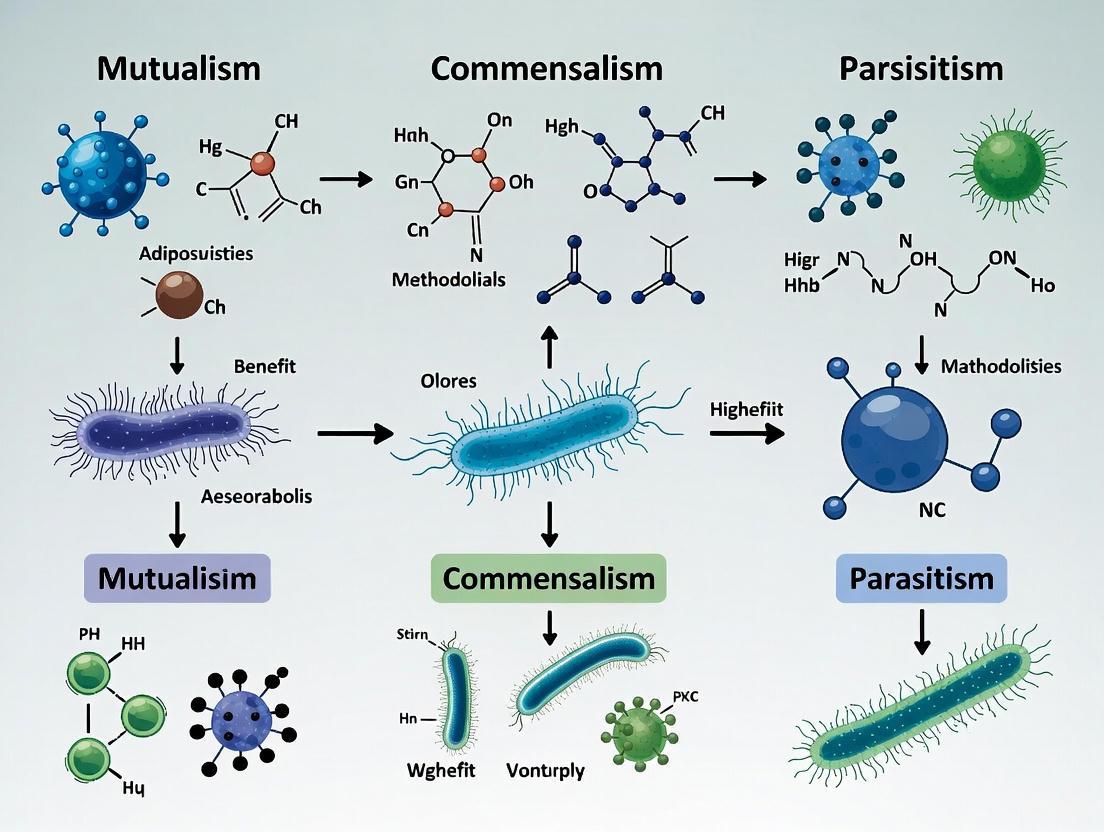
This article synthesizes current knowledge on microbial interactions—mutualism, commensalism, and parasitism—and their profound implications for ecosystem functioning and biomedical innovation.
Microbial Interactions in Ecosystems: From Molecular Mechanisms to Biomedical Applications
Abstract
This article synthesizes current knowledge on microbial interactions—mutualism, commensalism, and parasitism—and their profound implications for ecosystem functioning and biomedical innovation. It explores the molecular and eco-evolutionary foundations of these relationships, reviews advanced methodological approaches for their study, and addresses key challenges in predicting and controlling interaction outcomes. By integrating theoretical ecology with clinical and pharmaceutical applications, we highlight how understanding microbial networks can revolutionize drug discovery, microbiome-based therapies, and strategies to combat antimicrobial resistance, offering a critical resource for researchers and drug development professionals.
The Ecological and Evolutionary Foundations of Microbial Relationships
In the intricate ecosystems formed by microorganisms, interactions are rarely binary but rather exist along a dynamic spectrum. The study of the microbial interactome—the complex web of interactions between microorganisms and their hosts or environments—has revealed that these relationships are fundamental to health, disease, and ecosystem functioning [1]. Advances in high-throughput sequencing and analytical methods have enabled researchers to begin deciphering these complex relationships, which can be broadly categorized as mutualism (benefiting both partners), commensalism (benefiting one without affecting the other), and parasitism (benefiting one at the expense of the other) [2] [3]. Understanding the mechanisms, dynamics, and transitions between these interaction states provides a critical foundation for manipulating microbial communities for therapeutic and industrial applications [1] [4].
These symbiotic interactions represent a continuum of relationships typified by the net effect that each microbe has on its interaction partner [1]. This continuum can be mathematically framed using a Cartesian coordinate system where the x-axis represents the effect of microorganism A on B, and the y-axis represents the effect of microorganism B on A [1]. Within this framework, the five primary ecological interactions can be precisely defined: competition (-,-), mutualism (+,+), parasitism (+,-), commensalism (+,0), and amensalism (0,-) [1]. This review provides a comprehensive technical examination of these microbial relationships, their underlying mechanisms, and the experimental approaches used to study them, with particular emphasis on their implications for human health and drug development.
Defining the Interaction Spectrum
Core Ecological Relationships in Microbial Systems
Microbial interactions form the foundation of complex communities in environments ranging from the human gut to aquatic ecosystems. These relationships can be classified based on the fitness benefits or costs imposed on each partner:
Mutualism: Both microbial partners derive fitness benefits from the interaction. A quintessential example is the relationship between humans and gut bacteria such as Lactobacillus, which helps break down indigestible carbohydrates, provides essential vitamins, and enhances intestinal barrier function, while receiving shelter and nutrients in return [3]. Similarly, in legume-rhizobia interactions, plants gain access to fixed atmospheric nitrogen while providing carbohydrates to the bacteria [5].
Commensalism: One organism benefits while the other remains unaffected. Humans host numerous commensal relationships, such as with dust mites that consume dead skin cells without imparting harm or benefit [3]. In microbial ecology, many bacteria colonize host surfaces without detectable impact on host fitness, though these relationships may shift under different environmental conditions [6].
Parasitism: One organism benefits at the expense of the other. Common parasites affecting humans include pathogenic bacteria like Giardia intestinalis, which multiplies in human intestines, causing diarrhea, stomach cramps, and dehydration [3]. The parasitic relationship persists because the parasite relies on the host for survival while reducing host fitness.
Table 1: Characteristics of Microbial Interaction Types
| Interaction Type | Effect on Microbe A | Effect on Microbe B | Example |
|---|---|---|---|
| Mutualism | + | + | Lactobacillus and humans [3] |
| Commensalism | + | 0 | Dust mites and humans [3] |
| Parasitism | + | - | Giardia intestinalis and humans [3] |
| Amensalism | 0 | - | Penicillium secreting antibiotics [1] |
| Competition | - | - | Microbes competing for nutrients [1] |
The Parasite-Mutualist Continuum Framework
Rather than existing as discrete categories, microbial interactions typically operate along a fluid parasite-mutualist continuum where the relative costs and benefits to each partner can strengthen or weaken over ecological or evolutionary time [4]. This continuum concept dates back several decades, with early work by Ewald highlighting the fundamental role of transmission routes in driving evolutionary transitions between parasitism and mutualism [4]. The position along this continuum is highly context-dependent, varying with environmental conditions, host physiology, and community composition [6] [4].
Microorganisms can rapidly transition along this continuum due to their short generation times, large population sizes, high mutation rates, and genome flexibility [4]. Even individual microbial strains can display different interaction types depending on context. The root fungus Colletotrichum tofieldiae, for instance, acts as a mutualist under phosphate-limited conditions by supplying phosphorus to its host plant Arabidopsis thaliana, but becomes parasitic when host tryptophan-derived metabolites are disrupted [6].
Quantitative Frameworks for Analyzing Microbial Interactions
Mathematical Modeling of Interaction Dynamics
Mathematical models provide powerful tools for quantifying and predicting microbial interaction dynamics. Consumer-resource models have been developed to capture the dynamic behavior of host and symbiont populations over time, incorporating interdependent fitness and density-dependent effects that go beyond classic Lotka-Volterra assumptions [7]. These models can be represented as differential equations that describe population changes:
$$\begin{aligned} \dfrac{d pn}{dt} &= r{pn} pn + F{pn}(pn,mn,pi,mi)- c{p{in}} pn pi - \mu{{p}n} p_n^2\, , \end{aligned}$$
$$\begin{aligned} \dfrac{d mn}{dt} &= F{mn}(pn,mn,pi,mi) - c{m{in}} mn mi - \mu{{m}n} mn^2\, , \end{aligned}$$
where $pn$ and $mn$ represent native host and microbial symbiont biomass, $r{pn}$ represents the intrinsic growth rate of the host, $F$ functions represent benefits of interaction, $c$ parameters represent competition, and $\mu$ parameters represent mortality [7].
Network theory provides another mathematical framework for analyzing microbial interactions, classifying them as weighted (quantifying interaction strength), signed (including positive/negative values), and directed (specifying source and target of interactions) [1]. Directed, signed, and weighted networks are necessary to fully represent all five forms of ecological interactions, as they can describe asymmetric relationships where one organism affects another differently than it is affected in return [1].
Table 2: Network Theory Representations of Microbial Interactions
| Network Type | Key Characteristics | Ecological Relationships Representable |
|---|---|---|
| Undirected | Mutually positive or negative relationships only | Mutualism, competition |
| Weighted | Quantifies strength/magnitude of interactions | All, with intensity information |
| Signed | Weights can be positive or negative | All, with benefit/harm information |
| Directed | Relationships have source and target (cause and effect) | All five types (mutualism, commensalism, parasitism, amensalism, competition) |
Experimental Measurement and Network Inference
Inferring microbial interaction networks from experimental data presents significant challenges due to the unique characteristics of microbiome data, which are compositional (relative abundances sum to one), sparse (contain many zeros), and subject to technical artifacts [1]. Both cross-sectional and longitudinal study designs are employed, with each offering distinct advantages:
Cross-sectional methods use static snapshots of multiple individuals to infer undirected, weighted interaction networks that may indicate positive or negative associations but not causal relationships [1]. These approaches include both parametric methods (which assume adherence to a statistical model) and non-parametric methods (which do not) [1].
Longitudinal approaches employ repeated time-series measurements of one or more individuals to clarify ecological mechanisms and infer directed networks that can suggest causality [1]. These are particularly valuable for understanding how interactions shift over time in response to environmental changes or therapeutic interventions.
Due to tool-specific biases, microbial interaction networks identified by different statistical methods are often discordant, motivating the development of more general tools, ensemble approaches, and the incorporation of prior knowledge into predictions [1].
Mechanisms Governing Interaction Dynamics
Molecular Determinants of Symbiotic Outcomes
The position of a microbe along the parasite-mutualist continuum is governed by complex molecular mechanisms that mediate host-symbiont recognition, resource exchange, and immune evasion:
Lipid-mediated signaling: Sphingolipids produced by gut bacteria like Bacteroides species play a vital role in maintaining gut homeostasis and promoting symbiosis [5]. These lipids activate immune cell regulation through Toll-like receptor 2 signaling in macrophages, limiting inflammatory signaling and potentially reducing risks of inflammatory bowel disease [5].
Specialized metabolic pathways: Tryptophan-derived specialized metabolites in plants, particularly indole glucosinolates, serve as key regulators determining whether fungal endophytes behave as mutualists or parasites [6]. Disruption of these metabolites in Arabidopsis thaliana converts the beneficial relationship with Colletotrichum tofieldiae into a parasitic one [6].
Virulence factor expression: In certain bacterial strains, host immune status determines pathogenic behavior. Xanthomonas strains Leaf131 and Leaf148 exhibit pathogenicity in plants lacking RBOHD (an NADPH oxidase required for reactive oxygen species production) but behave as commensals in wild-type plants [6]. RBOHD-generated ROS suppresses virulence by downregulating the type II secretion system [6].
Horizontal gene transfer: The acquisition of genetic elements can rapidly alter microbial behavior. In the bacterial genus Rhodococcus, strains transition from beneficial to pathogenic upon acquiring a virulence plasmid and revert to mutualism when the plasmid is lost [6]. Similarly, the acquisition of the tripartite pathogenicity island marks the emergence of pathogenic P. syringae lineages from commensal ancestors [6].
The following diagram illustrates the molecular mechanisms that govern transitions along the parasite-mutualist continuum:
Context-Dependency and Interaction Shifts
Microbial relationships exhibit remarkable plasticity, shifting between interaction modes in response to environmental conditions, host physiology, and microbial community composition:
Environmental drivers: Nutrient availability can fundamentally alter interaction outcomes. The fungus Colletotrichum tofieldiae provides phosphorus to host plants under phosphate-limited conditions (mutualism) but becomes parasitic when phosphate is abundant [6]. Similarly, salinity and total suspended solids have been identified as critical environmental factors shaping microbial community composition in aquatic systems [8].
Host immune status: The same microbial strain can produce different outcomes depending on host immunity. Xanthomonas strains behave as pathogens in rbohD mutant plants incapable of mounting proper ROS responses but exist as commensals in wild-type plants [6].
Microbial community context: Multi-species interactions can modulate pairwise relationships. Synthetic bacterial communities can attenuate the virulence of potentially pathogenic Xanthomonas strains, demonstrating how community context supresses individual species' pathogenic potential [6].
Evolutionary transitions: Experimental evolution studies demonstrate that pathogenic microbes can evolve into mutualists under selective pressure. Pseudomonas protegens CHA0 evolved into a plant growth-promoting mutualist within the rhizosphere of A. thaliana during a six-month association through mutations in the gacS/gacA regulatory system [6].
Methodologies for Studying Microbial Interactions
Experimental Approaches and Model Systems
Research into microbial interactions employs diverse model systems and methodological approaches tailored to specific research questions:
Synthetic microbial ecosystems: Reduced-complexity synthetic communities provide enhanced controllability for investigating ecological interactions [9]. These systems have been used to establish various relationships including commensalism, amensalism, mutualism, competition, and predation, revealing how these relationships are context-dependent and shaped by environmental factors [9].
Squid-Vibrio symbiosis: The relationship between the Hawaiian bobtail squid (Euprymna scolopes) and the bioluminescent bacterium Vibrio fischeri serves as an important model for understanding bacterial colonization of epithelial surfaces [10]. Advanced imaging techniques like Selective Volume Illumination Microscopy (SVIM) have enabled 3D visualization of bacterial flows during colonization [10].
Plant-microbe systems: Arabidopsis thaliana and its microbial communities provide versatile models for studying interaction shifts [6]. These systems have revealed how tryptophan-derived metabolites and immune responses determine microbial behavior.
Experimental evolution: This approach permits direct observation of evolutionary transitions in real time by culturing organisms over multiple generations under controlled conditions [4]. For instance, pathogenic Pseudomonas protegens evolved mutualistic traits after six months of association with A. thaliana roots [6].
The following workflow illustrates a generalized experimental approach for quantifying microbial interactions:
The Scientist's Toolkit: Research Reagent Solutions
Table 3: Essential Research Reagents and Methods for Studying Microbial Interactions
| Reagent/Method | Function/Application | Technical Considerations |
|---|---|---|
| Gnotobiotic Systems | Establish defined microbial communities in sterile hosts | Enables controlled studies but may lack ecological complexity |
| 16S rRNA Amplicon Sequencing | Profile microbial community composition | Provides taxonomic information but limited functional data |
| Shotgun Metagenomics | Assess functional potential of microbial communities | More comprehensive than 16S but computationally intensive |
| Selective Volume Illumination Microscopy (SVIM) | High-contrast 3D imaging of microbial dynamics | Enables visualization of colonization events in real-time [10] |
| Synthetic Microbial Communities | Reduced-complexity systems for testing ecological theories | Enhances controllability but may oversimplify interactions [9] |
| Experimental Evolution | Observe real-time transitions along parasite-mutualist continuum | Directly tests evolutionary hypotheses but time-intensive [4] |
Implications for Therapeutic Development
Understanding the dynamic spectrum of microbial interactions has profound implications for drug development and therapeutic interventions:
Microbiome-informed therapeutics: Mapping the microbial interactome may lead to more precise manipulations of the human microbiome, with the goal of engineering solutions to microbiome-associated diseases [1]. This approach could guide species selection, dosing regimens, and the development of next-generation probiotics.
Antimicrobial strategies: Research into symbiotic relationships between fungi and bacteria provides insights into mechanisms of antimicrobial and antibiotic resistance, potentially informing the development of medicines that can overcome this resistance [3].
Therapeutic manipulation of interaction outcomes: Understanding the drivers of interaction shifts could enable therapeutic interventions that steer potentially pathogenic microbes toward commensal or mutualistic behavior [6]. For instance, modulating host metabolites or immune responses might prevent pathogenic transitions of otherwise benign microbes.
Predictive models for community dynamics: Integrating quantitative frameworks with molecular mechanisms may eventually enable predicting how microbial communities will respond to perturbations, facilitating the design of effective therapeutic strategies [1] [7].
The fluid nature of microbial relationships presents both challenges and opportunities for therapeutic development. As we enhance our understanding of the conditional outcomes of microbial interactions, we move closer to precisely manipulating microbial communities for improved health outcomes.
The intricate functional relationships between microorganisms and their hosts—ranging from mutualism and commensalism to parasitism—are not fixed but exist as a dynamic spectrum [6]. These interactions are defined and sustained by a complex molecular dialogue, a communication highway that involves an extensive repertoire of chemical signals [11]. This dialogue, essential for ecological balance and host health, is primarily mediated through three core mechanisms: the production of secondary metabolites, density-dependent communication via quorum sensing, and the exchange of genetic material. The molecular basis of this communication involves membrane-less organelles, natural deep eutectic solvents, and a complex repertoire of primary and secondary metabolites that interact within different liquid matrices and biofilms [11]. Understanding these processes is not only fundamental to microbial ecology but also provides a foundation for novel therapeutic strategies, including the development of anti-virulence drugs that target communication pathways without exerting lethal selective pressure on pathogens [12].
Secondary Metabolites: The Chemical Vocabulary of Interaction
Roles in Mediating Microbial Relationships
Secondary metabolites are bioactive compounds not essential for primary growth but crucial for environmental interactions and defense. They serve as a key chemical interface in the continuum of microbial relationships, with their production and perception often determining whether an interaction is mutually beneficial, neutral, or pathogenic [6]. In the plant microbiome, for instance, tryptophan-derived specialized metabolites are pivotal drivers of interaction shifts. The root fungal endophyte Colletotrichum tofieldiae exhibits context-dependent behavior, acting as a mutualist under phosphate-limiting conditions by supplying phosphorus to the host Arabidopsis thaliana. However, disruption of the host's tryptophan-derived metabolite pathway, particularly indole glucosinolates (IGS), converts this mutualism into a parasitic relationship [6]. This establishes specialized metabolites as critical regulators that prevent pathogenic shifts across diverse plant-fungal systems.
Table 1: Key Secondary Metabolite Classes and Their Functions in Microbial Dialogue
| Metabolite Class | Example Compounds | Producing Organisms | Functional Role in Interaction |
|---|---|---|---|
| Cyclic Lipopeptides | Surfactin [11] | Bacillus velezensis | Induced Systemic Resistance (ISR) elicitor in plants; regulates biofilm formation and quorum sensing [11]. |
| Terpenes/Terpenoids | Sesquiterpenes (e.g., from ABA-BOT cluster) [6] | Colletotrichum tofieldiae (pathogenic strain) | Activates host abscisic acid (ABA) pathway, suppressing defenses and promoting disease [6]. |
| Polyketides & Non-ribosomal Peptides | Carbapenem [13] | Erwinia carotovora | Antibiotic activity; production is regulated by quorum sensing [13]. |
| AHLs (N-acylhomoserine lactones) | 3-oxo-C6-HSL [13] | Diverse Gram-negative bacteria (e.g., Erwinia, Pseudomonas) | Primary quorum sensing signals for population density-dependent gene regulation [14] [13]. |
Experimental Protocol: Investigating Metabolite-Mediated Interaction Shifts
Objective: To determine how host secondary metabolites influence the transition of a fungal endophyte from mutualism to parasitism.
Methodology based on Hiruma et al. (2016) and related work [6]:
Plant and Fungal Material:
- Use wild-type Arabidopsis thaliana and mutant lines deficient in key biosynthetic pathways (e.g., cyp79b2b3 mutants for IGS deficiency).
- Use a known beneficial fungal strain, such as Colletotrichum tofieldiae.
Inoculation and Growth Conditions:
- Inoculate surface-sterilized seeds or seedlings with a spore suspension of C. tofieldiae.
- Grow plants under controlled conditions, specifically under phosphate (Pi) limitation to induce the mutualistic behavior of the fungus.
- Include non-inoculated control plants for each genotype.
Phenotypic Assessment:
- After several weeks of growth, measure key plant fitness parameters: shoot fresh weight, root biomass, and chlorophyll content.
- Quantify fungal colonization levels in roots via quantitative PCR (qPCR) or by microscopy.
Molecular and Chemical Analysis:
- Analyze the expression of plant defense and phosphate starvation response genes via RNA-seq or RT-qPCR.
- Use liquid chromatography-mass spectrometry (LC-MS) to profile and quantify tryptophan-derived metabolites (e.g., camalexin, indole glucosinolates) in the roots of different plant genotypes.
Data Interpretation:
- Mutualism is indicated by promoted plant growth in inoculated wild-type plants under Pi limitation, coupled with restricted fungal colonization.
- A shift to parasitism is indicated by significant growth suppression in inoculated IGS-deficient mutants, correlated with hyper-colonization of the fungus.
Figure 1: Host Metabolites Govern Fungal Lifestyle Transition. The shift of the fungus Colletotrichum tofieldiae from mutualism to parasitism is determined by host phosphate status and the presence of specific defense metabolites like indole glucosinolates [6].
Quorum Sensing: Coordinating Collective Behavior
Principles and Mechanisms
Quorum Sensing (QS) is a cell-to-cell communication mechanism allowing bacteria to sense their population density and coordinately regulate gene expression [13]. This process relies on the production, release, and group-wide detection of diffusible signal molecules called autoinducers. The core model involves a LuxI-type synthase that produces an acyl-homoserine lactone (AHL) signal. As the cell population grows, the extracellular concentration of AHL increases proportionally. Once a critical threshold (the "quorum") is reached, the AHL binds to a LuxR-type transcriptional regulator, forming a complex that activates or represses target genes [13] [12]. This system allows bacteria to behave as a coordinated multicellular entity, regulating processes such as virulence factor production, biofilm formation, secondary metabolite synthesis, and conjugation [13] [12].
Table 2: Quantitative Data on Key Quorum Sensing Systems and Regulated Functions
| Bacterial Species/Strain | Primary QS Signal | LuxI/R Homologs | Key Regulated Functions/Phenotypes |
|---|---|---|---|
| Erwinia carotovora ssp. carotovora (Ecc) strain ATCC 39048 | 3-oxo-C6-HSL [13] | CarI / CarR [13] | Carbapenem antibiotic production [13]. |
| Erwinia carotovora ssp. carotovora (Ecc) strain SCRI193 | 3-oxo-C6-HSL [13] | ExpI / ExpR, VirR [13] | Production of exoenzymes (PCWDEs) and other virulence factors [13]. |
| Synthetic Community from Populus deltoides | AHLs (Multiple) [14] | Not Specified | Modulates community structure and secondary metabolite production; disruption alters relative abundance of members [14]. |
Experimental Protocol: Quorum Quenching and its Impact on Community Structure
Objective: To assess the role of AHL-based QS in structuring a synthetic microbial community (SynCom) by disrupting signal propagation.
Methodology based on the 2025 synthetic community study [14]:
Community and Culture:
- Construct a defined synthetic community (e.g., the 10-member SynCom from Populus deltoides).
- Grow the community in an appropriate liquid medium with successive passaging to allow stable structure formation.
Quorum Quenching Treatment:
- Experimental Group: Treat the community with a purified AiiA-lactonase, an enzyme that inactivates AHLs by cleaving the lactone ring [14].
- Control Group: Culture the community under identical conditions without lactonase.
Monitoring and Sampling:
- Monitor community dynamics over multiple passages (e.g., 5-7 transfers).
- Sample the community at specific passages for downstream analysis.
Downstream Analysis:
- Microbial Community Structure: Use 16S rRNA amplicon sequencing to track changes in the membership and relative abundance of community members in both treated and control groups [14].
- Metabolic Profiling: Analyze the exo-metabolome of the communities using techniques like LC-MS or GC-MS to identify changes in the profile of secondary metabolites [14].
- Interaction Assays: Perform pairwise inhibition assays between members to determine if quorum quenching alters microbe-microbe antagonism [14].
Data Interpretation:
- A significant shift in the relative abundance of dominant members in the lactonase-treated group, without a change in overall membership, indicates that QS shapes community hierarchy.
- Altered metabolic profiles and reduced inhibition in pairwise assays demonstrate that QS regulates secondary metabolite production, which in turn mediates microbial interactions.
Figure 2: AHL Quorum Sensing Mechanism and Disruption. The canonical AHL-QS pathway and its inhibition by quorum quenching enzymes like AiiA lactonase, which degrades the signal molecule [14] [13] [12].
Genetic Exchange: Horizontal Gene Transfer as a Driver of Interaction Plasticity
Horizontal Gene Transfer and Virulence
Horizontal Gene Transfer (HGT) is a powerful mechanism enabling rapid microbial adaptation by facilitating the acquisition of new genetic traits. The transfer of mobile genetic elements, such as virulence plasmids, can directly alter the outcome of host-microbe interactions, effectively converting commensals or mutualists into pathogens [6]. A key example is found in the bacterial genus Rhodococcus, where strains typically exist as mutualists. However, acquisition of a specific virulence plasmid, carrying the fas locus (which encodes cytokinin biosynthesis genes), converts these bacteria into pathogens causing leafy gall disease [6]. Similarly, phylogenetic analyses of Pseudomonas syringae show that the acquisition of the tripartite pathogenicity island (T-PAI), containing the type III secretion system (T3SS) and effector genes, marks a key evolutionary step in the emergence of pathogenic lineages from commensal ancestors [6].
Spontaneous Mutations and Experimental Evolution
Beyond HGT, subtle genetic changes can drive major functional shifts. Experimental evolution studies demonstrate that pathogenic microbes can evolve into mutualists under selective pressure. In one study, the pathogenic bacterium Pseudomonas protegens CHA0 evolved into a plant growth-promoting mutualist within the A. thaliana rhizosphere over a six-month period. This transition was driven by mutations in the gacS/gacA two-component regulatory system, a global regulator of bacterial virulence. The mutant strain exhibited enhanced fitness in the rhizosphere, improved adaptation to root exudates, and reduced phytotoxicity compared to the ancestral pathogen [6]. This underscores how functional plasticity in microbial interactions can arise from relatively small genetic changes.
The Scientist's Toolkit: Essential Reagents and Methodologies
Table 3: Research Reagent Solutions for Studying Molecular Dialogue
| Reagent/Material | Function/Application | Specific Example |
|---|---|---|
| AiiA Lactonase | A quorum quenching enzyme; used to disrupt AHL-based signaling and study its functional role in microbial communities [14]. | Purified enzyme added to synthetic microbial communities to study shifts in structure and metabolite production [14]. |
| Bacterial Biosensors | Engineered strains used to detect and quantify specific QS signals or to screen for Quorum Sensing Inhibitors (QSIs) [12]. | Strains of Agrobacterium tumefaciens or Chromobacterium violaceum used as AHL reporters [12]. |
| Synthetic Microbial Communities (SynComs) | Defined, multi-species communities used to study microbial interactions in a controlled, reducible system [6] [14]. | A 10-member SynCom from Populus deltoides used to investigate QS-mediated community assembly [14]. |
| Plant Mutant Lines | Genetically modified plants used to dissect the role of specific host genes/metabolites in shaping microbial interactions. | Arabidopsis thaliana cyp79b2b3 double mutant (deficient in indole glucosinolates) used to study fungus-endophyte lifestyle shifts [6]. |
| High-Throughput Sequencing (HTS) | A cornerstone of molecular ecology; used for biodiversity assessment, transcriptomics, and community analysis (e.g., via 16S rRNA amplicon sequencing) [15]. | Used to track changes in the relative abundance of SynCom members after quorum quenching [14]. |
| Metabolomics Platforms (LC-MS, GC-MS) | Used to identify and quantify the repertoire of metabolites (signals, antibiotics, etc.) produced during microbial interactions [14]. | Used to profile altered secondary metabolite production in lactonase-treated communities [14]. |
The molecular dialogue within ecosystems is an integrated network where secondary metabolites, quorum sensing, and genetic exchange are deeply interconnected. QS often directly regulates the production of secondary metabolites, which in turn can function as signaling molecules, antibiotics, or virulence factors that shape microbial community structure and host outcomes [11] [14] [13]. Simultaneously, the genetic capacity for these interactions can be rapidly altered through HGT and mutation, underscoring the dynamic nature of these relationships [6].
Figure 3: Integrated Network Governing Microbial Interaction Outcomes. The final phenotype of a microbial interaction is determined by the interplay between microbial processes—such as QS-regulated metabolite production and genetic exchange—and host physiological and metabolic status [11] [6].
This intricate molecular dialogue, with its inherent plasticity, provides a rich source of targets for therapeutic intervention. Strategies such as quorum quenching and the use of quorum sensing inhibitors (QSIs) aim to attenuate pathogenicity without causing cell death, thereby potentially reducing selective pressure for resistance [12]. Future research harnessing molecular ecological network analyses and synthetic communities will be crucial to translate this knowledge from controlled laboratory settings to complex natural environments and clinical applications [6] [15].
Eco-evolutionary dynamics in microbial communities represent a frontier in understanding how ecological interactions and evolutionary processes form bidirectional feedback loops. These dynamics are central to ecosystem functioning, stability, and host health. Microbial interactions—spanning mutualism, commensalism, and parasitism—are not static but exist along a functional continuum, with dynamic shifts occurring in response to host physiology, microbial adaptation, and environmental conditions [6]. Understanding the mechanisms governing these transitions is critical for predicting community behavior and manipulating microbiomes for therapeutic and biotechnological applications. This review synthesizes recent advances in quantifying, modeling, and experimentally manipulating these complex feedback systems, providing researchers with both theoretical frameworks and practical methodologies for investigating microbial eco-evolutionary dynamics.
Dynamic Shifts in Plant-Microbe Interactions: A Paradigm for Context-Dependent Relationships
Host-Determined Interaction Shifts
The plant-microbe interface serves as an exemplary model for understanding context-dependent interactions. Research demonstrates that interaction outcomes are highly plastic and determined by multiple contextual factors:
Specialized Metabolites as Determinants: In Arabidopsis thaliana, tryptophan-derived specialized metabolites, particularly indole glucosinolates (IGS), critically regulate fungal behavior. The root fungal endophyte Colletotrichum tofieldiae shifts from mutualism to parasitism depending on host metabolic status. Under phosphate limitation, it promotes plant growth by supplying phosphorus. However, in IGS-deficient mutants (e.g., cyp79b2b3), this mutualistic relationship transitions to parasitism, characterized by hyper-colonization and growth suppression [6]. This mechanism is conserved across plant-fungal systems, including interactions with beneficial fungi like Serendipita indica and Sebacina vermifera [6].
Immune Status as a Switch: Plant immune status can determine microbial lifestyle transitions. Strains of Xanthomonas (Leaf131 and Leaf148) isolated from healthy A. thaliana leaves exhibit pathogenic behavior in rbohD mutant plants deficient in NADPH oxidase-mediated reactive oxygen species (ROS) production. Mechanistically, RBOHD-generated ROS suppresses bacterial virulence by downregulating the type II secretion system (T2SS), specifically by inhibiting expression of gspE, a key T2SS component [6]. In wild-type plants, ROS restriction transforms potentially pathogenic microbes into beneficial ones, even providing protection against foliar pathogens like Pseudomonas syringae [6].
Table 1: Host-Determined Interaction Shifts in Plant-Microbe Systems
| Host Factor | Microbial System | Mutualistic Context | Parasitic Context | Molecular Mechanism |
|---|---|---|---|---|
| Indole glucosinolates | Colletotrichum tofieldiae-Arabidopsis | Phosphate limitation; growth promotion | IGS deficiency; hyper-colonization & growth suppression | PEN2-dependent antifungal compounds restrict fungal proliferation [6] |
| ROS production (RBOHD) | Xanthomonas Leaf148-Arabidopsis | Wild-type plants; pathogen suppression | rbohD mutants; disease symptoms | ROS inhibits T2SS (gspE expression), limiting CAZyme secretion [6] |
| Tryptophan-derived metabolites | Synthetic microbial community-Arabidopsis | Community promotes growth | Metabolite deficiency causes dysbiosis | Metabolites regulate community structure and function [6] |
Microbial-Determined Interaction Shifts
Microbes possess genetic and regulatory elements that enable rapid lifestyle transitions, enhancing their adaptability across host environments:
Transcriptional and Metabolic Reprogramming: In Colletotrichum tofieldiae, the transcription factor CtBOT6 acts as a molecular switch between mutualistic and pathogenic lifestyles. Overexpression of CtBOT6 activates the ABA-BOT gene cluster, converting the beneficial Ct4 strain into a pathogen capable of colonizing roots and leaves while suppressing host defenses through abscisic acid (ABA)-mediated mechanisms [6]. Similarly, comparative genomics reveals that C. tofieldiae retains numerous genes associated with pathogenicity, suggesting that functional regulation rather than genomic structure primarily determines microbial behavior [6].
Horizontal Gene Transfer and Plasmid Acquisition: The bacterial genus Rhodococcus exhibits lifestyle transitions dependent on plasmid presence. Strains acquire pathogenicity through virulence plasmid acquisition, specifically via the fas locus encoding cytokinin biosynthesis genes, and revert to mutualism when the plasmid is lost [6]. Recombination events at the att locus can convert non-virulence plasmids into virulence plasmids, accelerating the emergence of pathogenic lineages [6].
Evolutionary Adaptation through Mutation: Experimental evolution studies demonstrate that pathogenic microbes can evolve into mutualists under selective pressure. Within six months in the A. thaliana rhizosphere, pathogenic Pseudomonas protegens CHA0 evolved mutualistic traits through mutations in the gacS/gacA two-component regulatory system, resulting in enhanced host fitness, improved adaptation to root exudates, and reduced phytotoxicity compared to the ancestral strain [6].
Table 2: Microbial-Determined Mechanisms of Interaction Shifts
| Mechanism | Microbial System | Genetic Elements | Functional Outcome | Experimental Evidence |
|---|---|---|---|---|
| Transcriptional regulation | Colletotrichum tofieldiae | CtBOT6 transcription factor, ABA-BOT cluster | Switches between mutualism and pathogenesis | CtBOT6 overexpression converts mutualist to pathogen [6] |
| Horizontal gene transfer | Rhodococcus spp. | Virulence plasmids, fas locus, att site | Gain/loss of pathogenicity | Plasmid acquisition confers leafy gall disease [6] |
| Spontaneous mutation | Pseudomonas protegens CHA0 | gacS/gacA two-component system | Pathogen to mutualist evolution | Mutations after 6-month rhizosphere selection [6] |
| Phylogenetic lineage evolution | Pseudomonas syringae | Tripartite pathogenicity island (T-PAI) | Commensal/mutualist to pathogen transition | T3SS and effector gene acquisition [6] |
Quantitative Genetics of Microbiome-Mediated Traits
Theoretical Framework for Microbiome-Enabled Heritability
Traditional quantitative genetics requires extension to account for microbiome contributions to host phenotypic variation. A groundbreaking theoretical framework partitions host trait variance into components attributable to host genetics and the microbiome, addressing the non-Mendelian inheritance patterns of microbial communities [16]. This framework introduces:
Variance Decomposition: Host trait variance (VP) can be decomposed into host genetic variance (VG), microbiome-mediated variance (VM), and their covariance (CovGM), such that VP = VG + VM + CovGM + VE (where VE represents environmental variance) [16].
Microbial Transmission Classification: Microbes are categorized based on concordance between host ancestry and microbial ancestry, complementing concepts of lineal inheritance (direct parent-offspring transmission) and collective inheritance (population-level transmission) [16].
Heritability Extensions: The framework generalizes narrow-sense (h²) and broad-sense (H²) heritability to include microbial effects, creating microbially informed analogues that quantify microbiome-mediated contributions to host-level evolutionary change [16].
Predicting Microbiome-Mediated Responses to Selection
Microbiome-mediated responses to host-level selection can arise from various transmission modes, not solely vertical transmission. The contribution of non-vertical transmission depends strongly on host life history traits, including dispersal ecology, social structure, and generation time [16]. This theoretical approach enables prediction of evolutionary trajectories without presupposing detailed transmission mechanisms, instead relying on patterns of microbe-host ancestral concordance that are empirically measurable through microbial genealogy tracking.
Trade-Offs in Microbial Phenotypes: Physiological Constraints and Ecological Implications
Growth-Adaptability Trade-Offs
Microbial phenotypes are shaped by fundamental trade-offs between growth optimization and other fitness traits. Growth rate maximization, while advantageous in stable, nutrient-rich conditions, is often suboptimal in fluctuating environments:
Proteome Allocation Constraints: Bacteria face proteome allocation trade-offs where protein resources allocated to ribosomes for rapid growth cannot be invested in stress response or metabolic flexibility proteins. E. coli maintains a "proteome reserve" of anabolic enzymes even in nutrient-rich conditions, enabling faster adaptation to nutrient downshifts [17]. Strains with larger proteome reserves exhibit shorter lag phases during amino acid downshifts but grow more slowly in optimal conditions [17].
Carbon Catabolite Regulation: The glucose-lactose diauxie in E. coli illustrates adaptability trade-offs. Tight carbon catabolite repression (CCR) maximizes growth in preferred carbon sources but prolongs diauxic lags during carbon transitions. Weakened CCR, observed in natural yeast isolates like S. bayanus, reduces maximal growth rates but enables faster metabolic switching, representing a generalist strategy beneficial in fluctuating environments [17].
Table 3: Microbial Trade-Offs and Their Ecological Implications
| Trade-Off Dimension | Physiological Basis | Ecological Strategy | Representative Taxa |
|---|---|---|---|
| Growth rate vs. metabolic adaptability | Proteome allocation between ribosomes and catabolic/anabolic enzymes | Specialist (copiotroph) vs. Generalist (oligotroph) | E. coli (specialist) vs. S. bayanus (generalist) [17] |
| Growth yield vs. rate | Energy metabolism strategy: respiration (high yield) vs. fermentation (high rate) | Efficiency vs. Speed | Saccharomyces cerevisiae (overflow metabolism) [17] |
| Antibiotic tolerance vs. growth | Resource allocation to defense mechanisms vs. proliferation | Stress resistance vs. Competition | Mycobacterium tuberculosis (slow growth, high tolerance) [17] |
Ecological Consequences of Phenotypic Trade-Offs
The growth-adaptability trade-off drives the emergence of distinct ecological strategies:
Oligotrophic vs. Copiotrophic Lifestyles: Slow-growing oligotrophs (K-strategists) invest in resource acquisition and stress tolerance systems, dominating in nutrient-poor environments like open oceans (e.g., SAR11). Fast-growing copiotrophs (r-strategists) maximize growth in nutrient-rich but variable environments like mammalian guts [17].
Coexistence Mechanisms: Trade-offs facilitate species coexistence through niche partitioning. The specialist-generalist continuum, maintained by proteome allocation constraints, creates frequency-dependent advantages that sustain diversity in fluctuating environments [17].
Population Heterogeneity: Within clonal populations, bet-hedging strategies emerge where subpopulations differentially express traits (e.g., fast switchers vs. slow switchers in yeast galactose utilization), ensuring population survival under unpredictable conditions [17].
Synthetic Microbial Ecosystems: Experimental Approaches for Dissecting Eco-Evolutionary Dynamics
Engineering Defined Microbial Communities
Synthetic microbial ecosystems provide reduced-complexity, highly controllable models for investigating ecological interactions and evolutionary dynamics [9]. These systems enable:
Interaction Mapping: Construction of defined communities with systematically varied composition to quantify interaction strengths between microbial taxa and identify keystone species [9].
Context-Dependency Testing: Precisely controlled environments to determine how physical and chemical factors (pH, temperature, nutrient availability) modulate ecological relationships between microbes [9].
Dynamic Relationship Monitoring: Real-time tracking of how ecological relationships (commensalism, amensalism, mutualism, competition, predation) shift under changing conditions or selection pressures [9].
Protocol: Establishing Synthetic Microbial Ecosystems
Objective: Construct a synthetic microbial community to quantify context-dependent interaction shifts and eco-evolutionary feedback.
Materials:
- Bacterial/Fungal Strains: Axenic cultures of target microorganisms
- Growth Media: Chemically defined minimal media with systematic nutrient variations
- Cultivation Systems: Multi-well plates or chemostats for controlled co-culture
- Monitoring Equipment: Spectrophotometer, flow cytometer, sequencing platform
Methodology:
- Strain Selection and Preparation: Select microbial taxa based on phylogenetic diversity and documented ecological interactions. Maintain axenic cultures in appropriate media.
Community Assembly: Inoculate defined combinations of strains at specified ratios in controlled environments. Include mono-culture controls for fitness comparisons.
Environmental Manipulation: Systematically vary environmental parameters (nutrient availability, pH, temperature) across experimental replicates.
Temporal Monitoring: Track population dynamics (cell counts, biomass), functional outputs (metabolite profiles), and interaction phenotypes through time-series sampling.
Interaction Quantification: Calculate interaction coefficients from growth rates in mono-culture versus co-culture using modified Lotka-Volterra models or generalized linear models.
Evolutionary Tracking: Propagate communities through serial transfers, sequencing isolates or whole communities at intervals to monitor evolutionary adaptations.
The Scientist's Toolkit: Essential Research Reagents and Methodologies
Table 4: Key Research Reagent Solutions for Microbial Eco-Evolutionary Dynamics
| Reagent/Method | Function/Application | Technical Considerations |
|---|---|---|
| Defined synthetic communities | Reduced-complexity model systems for interaction studies | Enables controlled manipulation of composition and environmental variables [9] |
| (p)ppGpp modulation systems | Stringent response manipulation to probe growth-adaptability trade-offs | Critical for studying proteome allocation and nutrient transition responses [17] |
| Gnotobiotic host systems | Host-microbiome interaction studies without confounding microbial variables | Essential for determining host versus microbial contributions to phenotypes [6] |
| Virulence plasmids (e.g., Rhodococcus fas locus) | Horizontal gene transfer studies and pathogenicity emergence | Enables tracking of how mobile genetic elements alter interaction outcomes [6] |
| Quantitative genetic framework | Partitioning host and microbiome variance components | Statistical approach for heritability estimation of microbiome-mediated traits [16] |
| Experimental evolution setups | Direct observation of eco-evolutionary dynamics | Requires carefully controlled selection regimes and replicate lines [6] [17] |
Eco-evolutionary dynamics in microbial communities are governed by feedback loops between ecological interactions and evolutionary adaptation. The dynamic continuum between mutualism, commensalism, and parasitism reflects context-dependent optimization of microbial traits shaped by fundamental trade-offs. The integration of quantitative genetics with microbial ecology provides novel frameworks for predicting how microbiome-mediated traits respond to selection, while synthetic ecosystems offer powerful experimental approaches for mechanistic studies. Understanding these principles advances fundamental knowledge and enables precision manipulation of microbial communities for therapeutic interventions, agricultural applications, and ecosystem management. Future research should focus on quantifying the timescales of these eco-evolutionary feedbacks and developing computational models that integrate both ecological and evolutionary processes across organizational levels.
The evolution of pathogen virulence—the reduction in host fitness caused by infection—represents a fundamental puzzle in evolutionary biology and disease ecology [18]. Rather than following a simple trajectory toward benign coexistence, virulence is shaped by complex evolutionary trade-offs operating across multiple biological scales, from within-host physiological interactions to between-host population dynamics [19] [18]. Understanding these dynamics is crucial for researchers and drug development professionals aiming to predict disease outcomes and design effective interventions.
Contemporary theoretical frameworks have moved beyond early assumptions that pathogens universally evolve toward lower virulence, instead recognizing that evolutionarily stable strategies depend on ecological context, transmission dynamics, and host-pathogen genetic interactions [19]. The trade-off hypothesis posits that virulence evolves as a consequence of optimizing between-host transmission, wherein traits that enhance transmission may concurrently increase host harm [19] [18]. This review synthesizes current models of virulence evolution, experimental methodologies for testing theoretical predictions, and the implications for managing microbial ecosystems encompassing mutualistic, commensal, and parasitic relationships.
Theoretical Frameworks for Virulence Evolution
Fundamental Trade-Off Models
The dominant conceptual framework for understanding virulence evolution centers on trade-offs between different components of parasite fitness. Early models established that pathogen evolution seeks to maximize basic reproduction number (R₀), which in a simple SIR framework is expressed as:
R₀ = βS / (μ + ν + γ)
where β is the transmission rate, S is the density of susceptible hosts, μ is the background mortality rate, ν is the virulence (infection-induced mortality rate), and γ is the recovery rate [18]. This formulation reveals that parasite fitness depends on both the rate at which new infections are produced (βS) and the duration of infection (1/(μ + ν + γ)).
Table 1: Key Theoretical Predictions of Virulence Evolution
| Evolutionary Driver | Predicted Effect on Virulence | Underlying Mechanism |
|---|---|---|
| Transmission-Virulence Trade-off [18] | Intermediate optimum | Higher replication increases transmission but shortens infection period |
| Host Mortality Rate [18] | Increases with extrinsic mortality | Shorter expected host lifespan favors faster transmission |
| Multiple Infections [18] | Generally increases | Competition among strains favors faster replication |
| Spatial Structure [20] | Variable; decreases with high connectivity | Gene flow increases resistance diversity in connected populations |
| Seasonality [21] | Intermediate optimum in obligate killers | Must complete transmission before season ends |
The most widely studied trade-off involves virulence and transmission, linked through within-host replication rates: increasing parasite abundance typically enhances transmission probability but simultaneously accelerates host damage and mortality [18]. This generates a non-linear relationship where natural selection favors intermediate virulence levels that optimally balance these competing constraints.
Coevolutionary Dynamics and Feedback Loops
Host-pathogen interactions often involve coevolutionary dynamics where both partners adapt in response to each other. Theoretical models incorporating costly host resistance and pathogen infectivity reveal diverse evolutionary outcomes including stable coexistence, evolutionary cycling, and evolutionary branching [22]. These coevolutionary trajectories are highly sensitive to ecological feedback—the process by which evolutionary changes alter population dynamics, which in turn modify selection pressures.
Recent models demonstrate that host population connectivity significantly shapes these coevolutionary outcomes [20]. Well-connected host populations maintain higher resistance diversity through gene flow, whereas isolated populations exhibit lower resistance and greater vulnerability to pathogen-induced declines [20]. This spatial dimension of coevolution creates a heterogeneous landscape of host-pathogen interactions with important implications for disease management.
Multi-Host Dynamics and Community Context
Many pathogens infect multiple host species, creating complex ecological networks that influence virulence evolution. Theoretical work predicts that in multi-host systems, the evolution of virulence depends critically on parasite specialization and the nature of inter-host interactions (competitive, mutualistic, or exploitative) [23].
Table 2: Virulence Evolution in Multi-Host Systems
| Host-Host Interaction Type | Effect on Shared Parasite Virulence | Evolutionary Mechanism |
|---|---|---|
| Competition | Increases | Reduced host abundance intensifies selection for rapid transmission |
| Mutualism | Decreases | Increased host abundance reduces selection for rapid transmission |
| Exploitation | Depends on specialization | Direction varies with which host species drives transmission |
| Immune Evasion [19] | Enables coexistence | Variants avoiding cross-immunity can succeed despite lower transmissibility |
Models predict that increasing competition between host species generally elevates virulence in shared parasites, whereas mutualistic interactions between hosts select for lower virulence [23]. The emergence of immune evasion mechanisms further complicates these dynamics by enabling pathogen variants to exploit hosts with pre-existing immunity to other strains, as observed with SARS-CoV-2 Omicron variant [19].
Experimental Approaches and Methodologies
Quantifying Infection Dynamics in Multi-Host Systems
Experimental Objective: To dissect the specific roles of host and pathogen effects in shaping within-host infection dynamics and test competing hypotheses about virulence evolution.
Rationale: Variation in infection dynamics across host species profoundly influences parasite epidemiology and evolution, but the mechanisms remain poorly understood due to logistical challenges in studying multi-host, multi-parasite systems [24].
Experimental Design and Model System
- Model System: Three coexisting rodent species from Israel's northwestern Negev Desert (Gerbillus andersoni, G. pyramidum, and G. gerbillus) and their predominant bacterial pathogens (Bartonella krasnovii A2 and Mycoplasma haemomuris-like bacterium) [24]
- Host Selection: Non-reproductive adult males from each rodent species to minimize variability unrelated to host and pathogen species
- Pathogen Characteristics:
- Bartonella: Flea-borne, penetrates red blood cells (RBCs), causes acute infections
- Mycoplasma: Parasitizes RBC outer membrane, causes chronic infections, transmitted through host-to-host contact
Inoculation Protocol and Monitoring
- Pre-inoculation Screening: All rodents tested negative for Bartonella and Mycoplasma via molecular testing of blood samples 1-2 weeks before inoculation
- Inoculation: Five male specimens of each rodent species inoculated with either Bartonella or Mycoplasma on day 0
- Supplementary Session: Additional six male hosts from each rodent species inoculated with Mycoplasma to investigate variability in infection dynamics
- Monitoring Schedule:
- Bartonella-inoculated hosts: Blood samples every 9-11 days until day 139 post-inoculation
- Mycoplasma-inoculated hosts: Blood samples every 7 days until day 133 post-inoculation
- Reinfection Challenge: Selected hosts from each group reinfected with the same pathogen strain on day 160 to assess immune memory and within-host dynamics upon repeated exposure
Figure 1: Experimental Workflow for Multi-Host Infection Dynamics
Resistance Phenotyping Through Inoculation Assays
Experimental Objective: To characterize host resistance diversity and levels across populations with varying connectivity and disease history.
Rationale: Understanding how resistance structure varies spatially is essential for predicting pathogen spread and evolution in heterogeneous landscapes [20].
Population Selection and Sampling
- Population Selection: 19 natural Plantago lanceolata populations selected from different locations within a host network, representing both isolated and well-connected populations
- Connectivity Metrics: Population connectivity (Sₕ) calculated based on Euclidian distances between populations calibrated by species dispersal capacity
- Disease History: Infection status recorded over 14 years (2001-2014) to categorize populations by pathogen exposure
Resistance Assay Protocol
- Pathogen Strains: Four distinct strains of Podosphaera plantaginis used for inoculation
- Experimental Setup: Each plant inoculated with all four pathogen strains in controlled conditions
- Resistance Scoring: Binary scoring (0 = susceptible, 1 = resistant) for each host-pathogen strain combination
- Phenotype Profiling: Sixteen possible resistance phenotype profiles (0000 to 1111) generated for each host individual
- Statistical Analysis: Diversity metrics compared across connectivity categories and disease history
Synthetic Microbial Ecosystems
Experimental Objective: To investigate ecological interactions within simplified, controllable microbial communities.
Rationale: Synthetic ecosystems reduce complexity while enhancing controllability, enabling systematic study of ecological relationships like commensalism, amensalism, mutualism, competition, and predation [9].
Community Design and Assembly
- Strain Selection: Microbial species selected based on well-characterized interactions and genetic tractability
- Interaction Mapping: Defined ecological relationships established through prior knowledge of metabolic capabilities and communication systems
- Environmental Control: Physical and chemical parameters (temperature, pH, nutrient composition) precisely maintained
- Monitoring Framework: High-temporal resolution sampling combined with omics technologies (genomics, transcriptomics, proteomics) to track community dynamics
Key Research Reagents and Methodological Tools
Table 3: Essential Research Reagents for Studying Virulence Evolution
| Reagent/Category | Specific Examples | Research Application |
|---|---|---|
| Model Host Systems | Gerbillus species, Plantago lanceolata, Drosophila melanogaster | Comparative infection studies across species |
| Pathogen Strains | Bartonella krasnovii A2, Mycoplasma haemomuris-like, Podosphaera plantaginis | Controlled inoculation experiments |
| Molecular Assays | PCR pathogen screening, CRISPR spacer sequencing, metagenomics | Pathogen detection and diversity assessment |
| Imaging Technologies | Fluorescence in situ hybridization (FISH), mass spectrometry | Spatial localization of pathogens and host response |
| Synthetic Communities | Defined microbial consortia | Reduced-complexity ecosystem studies |
Virulence Evolution in Microbial Ecosystems
The evolution of virulence must be understood within the broader context of microbial ecosystems encompassing mutualistic, commensal, and parasitic relationships. Host-associated microbiomes represent complex ecosystems where ecological and evolutionary processes occur across multiple temporal and spatial scales [25].
Ecological Succession and Priority Effects
Microbial community assembly in hosts follows principles of ecological succession, where priority effects significantly influence long-term composition and function [25]. Early colonizers can shape community trajectory through:
- Niche preemption: Consumption of limited resources before later-arriving species can establish
- Niche modification: Alteration of the host environment through immune modulation or metabolic changes
These priority effects demonstrate how historical contingencies during initial colonization can create alternative stable states in host-associated ecosystems, with important implications for pathogen exclusion and host health management [25].
Neutral and Niche-Based Processes
Community ecology provides a valuable framework for understanding host-pathogen dynamics, with both neutral processes (ecological drift, dispersal) and selective processes (environmental filtering, host immunity) shaping microbial composition [25]. The application of Hubbell's neutral theory to host-associated microbiomes has revealed that stochastic processes explain significant variation in species abundance distributions, though host selective pressures cause consistent deviations from neutrality for specific taxa [25].
Figure 2: Ecological Processes Shaping Host-Associated Microbiomes
Implications for Therapeutic Development
Understanding virulence evolution mechanisms provides crucial insights for drug development and therapeutic interventions. The eco-evolutionary perspective suggests several strategic considerations:
- Intervention Timing: The evolutionary consequences of interventions depend critically on timing relative to pathogen life history and epidemic phase [19]
- Resistance Management: Evolutionary theory predicts that vaccines blocking infection but not growth may select for increased virulence by shielding virulent variants from the negative consequences of host death [19]
- Combination Therapies: Approaches that simultaneously target multiple virulence components may mitigate evolutionary escape by presenting pathogens with multiple evolutionary constraints
The integration of ecological network theory with evolutionary models offers promising frameworks for designing intervention strategies that anticipate and leverage pathogen evolutionary responses, potentially enabling more durable and evolutionarily robust disease management approaches.
Models of virulence evolution and coexistence reveal the profound complexity of host-pathogen interactions across ecological and evolutionary scales. The integration of theoretical frameworks with experimental model systems has demonstrated that virulence evolution depends critically on ecological context, spatial structure, and the nature of within-host and between-host processes. Moving forward, the most productive approaches will be those that embrace this complexity while developing predictive frameworks applicable to real-world disease systems. For researchers and drug development professionals, this evolutionary ecology perspective provides essential insights for designing interventions that are not only immediately effective but also evolutionarily sustainable.
Advanced Methods for Studying and Harnessing Microbial Interactions
Understanding microbial interactions—mutualism, commensalism, parasitism—is fundamental to deciphering ecosystem assembly, stability, and function. Traditional co-occurrence network analysis infers potential interactions from correlation patterns in compositional data, but it reveals association, not causation [26]. These undirected correlation networks cannot reliably predict community dynamics or identify direct ecological interactions, limiting their utility for mechanistic studies and manipulation [26]. This technical guide details the analytical progression from descriptive networks to the construction and deployment of Synthetic Microbial Communities (SynComs)—defined as consortia of microorganisms deliberately assembled from individually isolated strains to confer targeted functions to a host or environment [27] [28]. This shift represents a broader thesis in microbial ecology: moving from observing patterns to engineering functions based on causal ecological principles. SynComs are emerging as powerful tools both for fundamental research into plant-microbe interactions and for applied biotechnology in sustainable agriculture, offering a precise, ecologically sustainable alternative to conventional agrochemicals [28].
Analytical Foundations: Inferring Ecological Networks
The Limitation of Co-occurrence Networks
While co-occurrence networks can hypothesize potential relationships, they are fundamentally limited. They represent undirected associations and do not distinguish between direct and indirect interactions, or between causal biological interactions and spurious correlations driven by environmental filtering [26].
Inferring Model-Agnostic Ecological Interactions from Steady-State Data
A pivotal advancement involves inferring directed, signed ecological networks from steady-state abundance data collected across different environmental conditions or host genotypes. This method circumvents the need for longitudinal data and avoids the pitfall of assuming a specific, potentially incorrect, population dynamics model a priori [26].
The core theoretical principle is as follows: if the net ecological impact of one species on another is context-independent, then comparing steady-state communities comprising different subsets of species allows for the inference of interaction types. For instance, if a steady-state sample containing species X and Y shows a significantly reduced abundance of Y compared to a sample containing only Y, one can infer that X inhibits the growth of Y [26].
This approach requires a collection of independent steady-state samples. The structure of the underlying ecological network, represented by the zero-pattern of the Jacobian matrix ( J(\mathbf{x}) ) of the population dynamics, can be inferred under mild assumptions by comparing samples that differ in species composition [26]. To infer the interaction types (positive, negative, or neutral), an assumption is made that the sign-pattern of ( J(\mathbf{x}) ) remains constant across all observed steady states [26].
Table 1: Key Differences Between Co-occurrence and Ecological Networks
| Feature | Co-occurrence Network | Model-Agnostic Ecological Network |
|---|---|---|
| Basis of Inference | Correlation of abundance across samples | Comparison of steady-state abundances across different species subsets |
| Directed/Undirected | Undirected | Directed |
| Interaction Types | Not specified | Signed (Positive, Negative, Neutral) |
| Causal Inference | Limited, suggests association | Stronger, infers direct ecological impact |
| Data Requirement | Cross-sectional compositional data | Multiple independent steady-state communities |
| Model Dependency | None | None |
Generalized Lotka-Volterra (GLV) Model and Parameter Inference
For microbial communities that can be approximated by the Generalized Lotka-Volterra (GLV) model, steady-state data can be used to quantitatively infer interaction strengths and intrinsic growth rates. The GLV model is described by:
[ \frac{dxi(t)}{dt} = xi(t) \left( ri + \sum{j=1}^{N} A{ij} xj(t) \right), \quad i = 1, \ldots, N ]
where ( xi ) is the abundance of species ( i ), ( ri ) is its intrinsic growth rate, and the matrix ( A ) encodes the per-capita interaction strength ( A_{ij} ) of species ( j ) upon species ( i ) [26].
A rigorous criterion exists to test whether a community's steady-state data is consistent with the GLV model. If confirmed, the parameters ( ri ) and ( A{ij} ) can be accurately inferred, enabling quantitative predictions of community dynamics and responses to perturbations [26].
Designing and Constructing Synthetic Communities
Core Design Principles for SynComs
The design of a functional SynCom moves beyond a simple list of isolates and requires strategic consideration of ecological theory and functional traits.
- Functional Complementarity: Select microbial strains with complementary, non-redundant metabolic capabilities (e.g., nitrogen fixation, phosphate solubilization, siderophore production) to create a consortium that performs a comprehensive set of desired functions [28].
- Ecological Compatibility: Ensure selected strains can coexist without excessive competitive exclusion. Inferred ecological networks can guide the avoidance of strongly antagonistic pairs and the inclusion of mutually beneficial or commensal interactions [27].
- Host-Specificity and Niche Adaptation: The selection of source material for microbial isolation is critical. Isolates should be sourced from the same host plant species or environment (e.g., rhizosphere, endosphere) as the intended application to ensure pre-adaptation [27].
- Diversity-Complexity Balance: The complexity of a SynCom (number of strains) must be balanced against experimental control and reproducibility. Overly complex SynComs may be unstable, while overly simplified ones may lack robustness. Starting with a reduced complexity consortium of 3-20 members is common [27].
A Workflow for SynCom Development
The process of building and testing a SynCom is iterative, integrating computational guidance with rigorous experimental validation.
Experimental Protocols for SynCom Evaluation
In planta Validation in Gnotobiotic Systems
Objective: To assess the establishment, persistence, and plant-growth-promoting effects of the SynCom under sterile, controlled conditions, excluding the influence of an external microbiome.
Detailed Methodology:
- Surface Sterilization of Seeds: Treat seeds of the target plant (e.g., switchgrass, poplar) with 70% ethanol for 2 minutes, followed by 2-4% sodium hypochlorite solution for 10-20 minutes, and finally rinse 5-7 times with sterile distilled water.
- Germination on Agar: Place sterilized seeds on sterile 0.8-1.2% water agar plates. Seal plates with parafilm and incubate under plant growth conditions (e.g., 16h light/8h dark) for 3-7 days until germination.
- SynCom Inoculum Preparation: Grow individual bacterial strains in appropriate liquid media (e.g., TSB, LB) to late log phase. Centrifuge (e.g., 4000 x g for 10 min), wash cells twice, and resuspend in sterile phosphate buffer or saline. Combine strains in a predefined ratio (e.g., equal OD600) to create the SynCom inoculum. The final concentration should be approximately 10^8 CFU/mL.
- Plant Inoculation:
- Method A (Root Dip): Seedlings with radicles ~1-2 cm long are carefully dipped in the SynCom inoculum for 30-60 minutes before being transplanted into sterile growth substrates (e.g., agar, sand, vermiculite).
- Method B (Soil Drench): Germinated seeds are transplanted, and a defined volume of inoculum (e.g., 1 mL per plant) is applied directly to the rhizosphere.
- Control Groups: Include at least two control groups: i) Mock-inoculated control (inoculated with sterile carrier solution), and ii) Single-strain inoculants (for comparison to the consortium).
- Data Collection: After 3-6 weeks of growth in a gnotobiotic setup, measure plant biomass (shoot and root fresh/dry weight), root architecture, chlorophyll content, and other relevant physiological parameters. The persistence and composition of the SynCom can be tracked by quantifying bacterial abundance via qPCR or by re-isolating strains on selective media.
Field Trial Evaluation
Objective: To evaluate the efficacy and robustness of the SynCom under realistic, non-sterile environmental conditions, where it must compete with the native soil microbiome.
Detailed Methodology:
- Experimental Design: Establish a randomized complete block design or similar, with a minimum of 4-6 replicates per treatment (SynCom, mock control, single-strain, industry standard).
- Inoculum Production and Formulation: Scale up SynCom production. For bacteria, use fermenters to produce high cell densities. Cells are then formulated using carriers such as peat, clay, or talc to ensure survival during storage and shipping. The final product should have a defined CFU/g and shelf life.
- Application:
- Seed Coating: Mix the solid or liquid inoculum with a binder (e.g., gum arabic, methylcellulose) and apply to seeds prior to sowing.
- In-furrow Application: Apply the inoculum directly into the seed furrow during planting using modified planting equipment.
- Field Monitoring and Sampling: Periodically monitor plant growth, health, and phenology. Collect rhizosphere soil samples by vigorously shaking the root system and brushing off adhering soil. Sample at key developmental stages (e.g., vegetative, flowering).
- Outcome Measurement: Assess ultimate plant biomass yield, nutrient content (e.g., via elemental analysis), and resilience to abiotic stress. Use molecular methods (16S rRNA amplicon sequencing) on rhizosphere samples to evaluate the extent to which the SynCom integrates into and restructures the native microbial community.
Table 2: Key Considerations for Pilot vs. Field Experiments
| Factor | Controlled Pilot Experiment | Field Trial |
|---|---|---|
| System Complexity | Low (Gnotobiotic, defined) | High (Open system, native microbiome) |
| Environmental Control | High (Light, temperature, moisture) | Low (Subject to weather and soil variation) |
| SynCom Persistence | Often high, no competition | Variable, depends on competition and soil conditions |
| Performance Outcome | Can be highly reproducible | Often variable and context-dependent [27] |
| Primary Goal | Proof-of-concept, mechanism | Efficacy, robustness, scalability |
The Scientist's Toolkit: Research Reagent Solutions
Table 3: Essential Materials and Reagents for SynCom Research
| Category / Item | Function / Application |
|---|---|
| Culture Media | |
| Tryptic Soy Broth (TSB) / Agar | General-purpose medium for cultivation of a wide range of heterotrophic bacteria. |
| Reasoner's 2A Agar (R2A) | For isolation of soil bacteria and slow-growing microorganisms. |
| Nitrogen-Free Media (e.g., NFb, JNFb) | For selective isolation and enrichment of free-living diazotrophs like Azospirillum. |
| Molecular Biology & Sequencing | |
| DNA Extraction Kits (e.g., MoBio PowerSoil) | Standardized extraction of high-quality microbial genomic DNA from soil and plant tissues. |
| 16S rRNA Gene Primers (e.g., 515F/806R) | For amplification and subsequent sequencing of the bacterial 16S rRNA gene for community profiling. |
| ITS Primers (e.g., ITS1F/ITS2) | For amplification and sequencing of the fungal ITS region for fungal community analysis. |
| Plant Growth Substrates | |
| Gnotobiotic Agar (Phytagel/Murashige & Skoog) | Defined medium for sterile plant growth in SynCom assembly experiments. |
| Sterile Sand/Vermiculite Mixture | Inert substrate for plant growth in greenhouse experiments, allowing for easy root harvesting. |
| Strain Storage | |
| Cryoprotectants (e.g., Glycerol) | For long-term preservation of microbial isolates at -80°C. |
The trajectory from co-occurrence networks to synthetic communities marks a paradigm shift in microbial ecology. It is a move from passive observation to hypothesis-driven, causal inference and active community engineering. The analytical tools that infer model-agnostic ecological networks from steady-state data provide a robust foundation for understanding microbial interactions [26]. This understanding, in turn, enables the rational design of SynComs. While challenges remain—particularly in bridging the gap between controlled environment efficacy and field performance—SynComs represent a powerful technological frontier [27]. By leveraging these conceptual and analytical tools, researchers can systematically dissect the complexities of microbial interactions and harness this knowledge to engineer microbiomes for improving plant health, productivity, and ecosystem sustainability [27] [28].
Microbial interactions, including mutualism, commensalism, and parasitism, form the foundational architecture of ecosystem stability and function. Deciphering the molecular dialogues that underpin these relationships has been transformed by the advent of advanced omics technologies [29]. Transcriptomic and metabolomic profiling now enables researchers to move beyond descriptive community analyses to mechanistic understandings of microbial crosstalk, revealing the precise signaling molecules, gene regulatory networks, and metabolic exchanges that govern symbiotic relationships [29] [30]. This technical guide provides a comprehensive framework for applying these technologies to map the complex interaction networks within microbial ecosystems, with particular emphasis on methodological rigor, data integration, and translational applications for therapeutic development.
The shift from single-omics to multi-omics integration represents a paradigm change in microbial ecology. While genomic sequencing can predict functional potential, it cannot capture dynamic transcriptional responses to microenvironmental changes or the metabolic consequences of these responses [29]. Transcriptomics reveals how microorganisms reprogram their gene expression in response to partners and competitors, while metabolomics identifies the final functional outputs of these interactions—the metabolites that mediate cross-kingdom communication, nutrient exchange, and antagonistic relationships [30] [31]. When integrated, these layers provide unprecedented resolution into the molecular mechanisms driving microbial interactions across diverse ecosystems, from soil and plant rhizospheres to human hosts and engineered systems [29] [32].
Technological Foundations
Transcriptomic Profiling Platforms
Transcriptomic technologies have evolved from bulk RNA sequencing to spatial methods that preserve critical contextual information about microbial niches and interaction zones.
Table 1: Comparative Analysis of Transcriptomic Technologies
| Technology | Spatial Context | Resolution | Throughput | Key Applications in Microbial Interactions |
|---|---|---|---|---|
| Bulk RNA-seq | Lost | Population-level | High | Differential gene expression in co-culture; community-level responses to perturbations [33] |
| Single-cell RNA-seq | Partially lost (requires dissociation) | Single-cell | Medium | Cellular heterogeneity in response to microbial partners; rare cell population identification [34] |
| Spatial Transcriptomics | Preserved | Single-cell to multi-cellular | Medium-High | Mapping microbial interaction zones; localized host responses to colonization; spatial organization of metabolic cross-feeding [34] |
| In-situ Hybridization | Preserved | Single-molecule | Low-Medium | Validation of key transcripts; low-plex spatial mapping of known interaction markers [34] |
Bulk RNA sequencing remains the workhorse for transcriptomic analysis of microbial interactions, particularly when combined with de novo assembly approaches for non-model organisms [33]. The standard workflow involves RNA extraction, cDNA library preparation, sequencing on platforms such as Illumina HiSeq, and subsequent bioinformatic analysis using tools like Trinity for assembly and TransDecoder for coding sequence prediction [33]. For microbial communities, metatranscriptomics extends this approach to complex mixtures, revealing which community members are actively transcribing which functions under specific interaction conditions.
Spatial transcriptomics represents a revolutionary advancement for studying structured interactions, particularly in host-associated contexts. Platforms such as 10× Visium, Slide-seq, and Stereo-seq combine high-resolution tissue imaging with transcriptome-wide sequencing, enabling researchers to correlate gene expression patterns with physical proximity in interaction hotspots like the plant rhizosphere or host-pathogen interfaces [34]. These technologies overcome the critical limitation of traditional transcriptomics by preserving the spatial context essential for understanding microbial crosstalk, though their application to microbial systems presents technical challenges related to cell wall disruption and probe penetration [34].
Metabolomic Profiling Approaches
Metabolomics provides a direct readout of the biochemical activities resulting from microbial interactions, capturing the small molecules that mediate communication, competition, and cooperation.
Table 2: Metabolomic Methodologies for Microbial Interaction Studies
| Methodology | Analytical Platform | Key Metrics | Strengths | Limitations |
|---|---|---|---|---|
| Untargeted Metabolomics | LC-MS, GC-MS | Metabolite features, m/z ratios, retention times | Comprehensive profiling; discovery of novel interaction metabolites | Requires validation; complex data analysis [30] |
| Targeted Metabolomics | LC-MS/MS, MRM | Precise quantification of predefined metabolites | High sensitivity and specificity; absolute quantification | Limited to known metabolites [30] |
| Imaging Mass Spectrometry | MALDI-TOF, DESI | Spatial distribution of metabolites | Preserves spatial organization; visualizes metabolite gradients | Lower sensitivity; semi-quantitative [30] |
Liquid chromatography-mass spectrometry (LC-MS) has emerged as the cornerstone technology for metabolomic profiling of microbial interactions due to its sensitivity, broad dynamic range, and compatibility with diverse metabolite classes [30]. Untargeted LC-MS approaches enable comprehensive detection of metabolic changes in response to microbial interactions, revealing how bacterial secretomes reprogram host metabolism or how cross-feeding relationships alter metabolite pools [30]. For instance, studies comparing Gram-positive and Gram-negative bacterial effects on host cells have revealed pathogen-specific alterations in amino acid metabolism, sphingolipid pathways, and tryptophan catabolism [30].
The integration of stable isotope tracing with metabolomics provides unparalleled insights into metabolic flux within interacting communities. By tracking ¹³C or ¹⁵N-labeled precursors through metabolic networks, researchers can quantify metabolic exchange between partners, identify cross-fed metabolites, and delineate the metabolic division of labor that stabilizes mutualistic relationships [31]. This approach is particularly powerful when combined with computational modeling to reconstruct metabolic networks.
Experimental Frameworks and Protocols
Transcriptomic Workflow for Microbial Crosstalk
A robust transcriptomic protocol for analyzing microbial interactions requires careful experimental design to capture meaningful biological signals amid technical variability.
Sample Preparation and RNA Extraction:
- Co-culture Systems: Establish defined co-cultures with appropriate controls (monocultures) to distinguish interaction-specific responses from growth-phase effects. For soil or plant-associated microbes, consider using synthetic microbial communities (SynComs) of 5-20 strains to balance complexity with interpretability [32].
- RNA Preservation: Immediately stabilize RNA upon harvest using reagents such as RNAlater or direct immersion in liquid nitrogen, particularly critical for capturing rapid transcriptional responses to microbial partners.
- RNA Extraction: Utilize bead-beating mechanical disruption combined with chemical lysis (e.g., TRIzol) to ensure efficient extraction from diverse microbial taxa with varying cell wall structures [33]. For host-microbe systems, implement microbial enrichment protocols or sequential extraction to separate host and microbial RNA.
- Quality Control: Verify RNA integrity using TapeStation or Bioanalyzer, accepting only samples with RNA Integrity Number (RIN) > 8.0 for sequencing libraries [33].
Library Preparation and Sequencing:
- rRNA Depletion: Employ microbial rRNA removal kits rather than poly-A selection to capture prokaryotic and eukaryotic transcripts in mixed systems.
- Library Construction: Use strand-specific library preparation protocols to accurately determine transcription directionality, crucial for identifying antisense regulators of interaction genes.
- Sequencing Depth: Target 20-50 million reads per sample for bacterial transcriptomes and 50-100 million for more complex eukaryotic host-pathogen systems to ensure sufficient coverage for differential expression analysis.
Bioinformatic Analysis:
- Read Processing: Perform quality control with FastQC, adapter trimming with Cutadapt, and quality filtering with Sickle [33].
- Assembly and Annotation: For non-model organisms, use de novo assemblers like Trinity followed by redundancy reduction with CD-HIT-EST [33]. Functionally annotate transcripts using BLASTX against NR databases and domain identification with InterProScan [33].
- Differential Expression: Identify interaction-responsive genes using statistical frameworks such as NOISeq with RPKM normalization, applying false discovery rate (FDR) correction for multiple testing [33].
- Pathway Analysis: Map differentially expressed genes to metabolic pathways using KEGG and identify enriched Gene Ontology terms to interpret transcriptional responses in functional contexts [33].
Metabolomic Profiling Protocol
Metabolomic sample preparation must balance comprehensive metabolite extraction with preservation of labile compounds that may mediate microbial interactions.
Sample Collection and Quenching:
- Rapid Quenching: Immediately plunge samples into cold methanol (-40°C) to quench metabolic activity without disrupting cell integrity, critical for capturing true metabolic states during interactions.
- Simultaneous Extraction: Implement dual-phase extraction methods using chloroform:methanol:water (1:3:1) to recover both hydrophilic and lipophilic metabolites, ensuring comprehensive coverage of interaction-relevant compounds.
- Quality Controls: Include pooled quality control samples, process blanks, and internal standards (e.g., stable isotope-labeled compounds) to monitor technical variability and enable normalization.
LC-MS Analysis:
- Chromatographic Separation: Utilize reversed-phase chromatography for non-polar metabolites (fatty acids, secondary metabolites) and HILIC chromatography for polar compounds (amino acids, organic acids, sugars).
- Mass Spectrometry: Operate in both positive and negative ionization modes with data-independent acquisition (DIA) or data-dependent acquisition (DDA) to maximize metabolite coverage.
- Quality Assurance: Inject QC samples regularly throughout the sequence to monitor instrument performance and correct for signal drift.
Data Processing and Metabolite Identification:
- Feature Detection: Use software such as XCMS or MS-DIAL for peak picking, alignment, and integration.
- Metabolite Annotation: Match accurate mass and retention times to authentic standards when available, or utilize in-silico fragmentation tools like CSI:FingerID for putative identification.
- Statistical Analysis: Employ multivariate methods (PCA, PLS-DA) to identify metabolite patterns distinguishing interaction types, followed by univariate statistics to pinpoint individual significant metabolites.
The Scientist's Toolkit: Essential Research Reagents
Table 3: Key Research Reagents for Omics Studies of Microbial Interactions
| Reagent/Category | Specific Examples | Function in Experimental Workflow |
|---|---|---|
| RNA Stabilization | RNAlater, TRIzol Reagent | Preserves RNA integrity during sample collection and storage [33] |
| cDNA Synthesis | Takara cDNA synthesis kit, Invitrogen SuperScript | Converts RNA to cDNA for sequencing library preparation [33] |
| Sequencing Kits | Illumina TruSeq, Qiagen mRNA library kits | Prepares sequencing-ready libraries with appropriate adapters and barcodes [33] |
| Chromatography | C18 columns (reversed-phase), HILIC columns | Separates metabolite mixtures prior to mass spectrometry analysis [30] |
| Internal Standards | ¹³C-labeled amino acids, deuterated lipids | Enables quantification and quality control in metabolomic studies [30] [31] |
| Cell Culture Media | Defined minimal media, M9, GMM | Controls nutritional environment to study metabolic interactions [35] [32] |
Computational Integration and Modeling
Multi-Omics Data Integration
The true power of omics approaches emerges from integrated analysis that maps transcript-metabolite correlations across interaction networks. Knowledge graph embedding frameworks provide a powerful approach for predicting interactions by learning low-dimensional representations of microorganisms and their metabolic environments [35]. These models can predict pairwise interactions even with missing data by capturing higher-order relationships in the embedding space, enabling researchers to infer microbial interactions based on transcriptional and metabolic similarity [35].
Genome-scale metabolic models (GEMs) offer a computational framework for integrating transcriptomic and metabolomic data into predictive models of microbial interactions [31]. Constrained by stoichiometric relationships and metabolic capabilities, GEMs simulate metabolite exchange and cross-feeding relationships that define mutualistic and competitive interactions [31]. The iterative process of model reconstruction, simulation using constraint-based approaches, and experimental validation creates a powerful cycle for hypothesis generation and testing in microbial interaction research.
Diagram 1: Genome-scale metabolic modeling workflow for predicting microbial interactions
Metabolic Pathway Visualization
Mapping omics data onto metabolic pathways reveals how microbial interactions reprogram central metabolism and specialized metabolite production. Cross-feeding networks emerge from complementary metabolic capabilities, where one microbe's waste product becomes another's nutrient source [31] [32]. Transcriptomic data identifies which pathway genes are upregulated during interactions, while metabolomics confirms the production and exchange of the predicted metabolites.
Diagram 2: Metabolic cross-feeding interaction between microbial specialists
Applications and Future Directions
The integration of transcriptomic and metabolomic profiling has enabled significant advances in understanding and engineering microbial interactions across diverse fields. In agricultural science, multi-omics approaches have revealed how plant growth-promoting rhizobacteria (PGPR) enhance plant fitness through phytohormone production, nutrient mobilization, and induction of systemic resistance [29]. Transcriptomic profiling of both plant and microbial partners during colonization has identified key signaling molecules and regulatory genes that mediate beneficial associations, while metabolomic analysis has characterized the antimicrobial compounds and stress-protectant metabolites that contribute to plant health [29] [32].
In biomedical applications, omics-driven analysis of host-microbe interactions has identified microbial metabolites that modulate immune function, inflammatory responses, and drug efficacy [30] [36]. Spatial transcriptomics has been particularly valuable for mapping host-pathogen interactions within tissue microenvironments, revealing how spatial organization influences infection outcomes and treatment responses [36] [34]. The identification of commensal bacteria that enhance immunotherapy responses through specific metabolic activities exemplifies the translational potential of these approaches [36].
Future developments in omics technologies will focus on increasing spatiotemporal resolution through single-cell and spatial methods, improving dynamic monitoring through non-destructive sampling, and enhancing predictive modeling through artificial intelligence and knowledge graphs [35] [34]. Standardization efforts following FAIR principles (Findable, Accessible, Interoperable, Reusable) will enable more effective integration of disparate datasets, accelerating the discovery of conserved interaction mechanisms across ecosystems [37]. As these technologies mature, they will increasingly enable the rational design of microbial communities with predictable functions, opening new frontiers in ecosystem engineering, therapeutic development, and sustainable biotechnology [32].
The rhizosphere, the narrow zone of soil directly influenced by plant roots, represents a critical interface for microbial interactions that are fundamental to plant health and productivity [38] [39]. This dynamic microenvironment is characterized by a continuous flux of organic compounds, including sugars, organic acids, and flavonoids released by roots, which serve as both nutrients and signaling molecules for microbial communities [38]. Within this complex ecosystem, symbiotic relationships—categorized as mutualism (both organisms benefit), commensalism (one benefits, the other is unaffected), and parasitism (one benefits at the expense of the other)—drive essential functions including pathogen suppression, nutrient acquisition, and stress tolerance [40] [41]. For tomato (Solanum lycopersicum L.), a globally significant crop with a doubled cultivation area over the past two decades, harnessing these interactions offers promising pathways toward sustainable agriculture by reducing dependence on chemical fertilizers and pesticides [42].
This case study explores the synergistic biocontrol mechanisms within the tomato rhizosphere microbiome, framed within the broader context of symbiotic relationships in microbial ecosystems. We examine how wild tomato genotypes in their native habitats maintain stable, beneficial microbial consortia, how modern agricultural practices have altered these relationships, and how a deeper understanding of microbial mutualisms can inform novel biocontrol strategies. By integrating empirical data from multi-omics studies with ecological theory, we aim to provide researchers and drug development professionals with methodological frameworks and conceptual tools for unlocking the full biocontrol potential of tomato-microbe interactions.
Theoretical Framework: Symbiotic Relationships in Microbial Ecology
Types of Symbiosis in the Rhizosphere Ecosystem
Symbiosis, defined as the close and long-term biological interaction between two distinct species, manifests in several forms within the tomato rhizosphere, each with distinct ecological and functional implications [40]:
Mutualism: Both microbial symbionts and the tomato plant derive benefits from the interaction. For example, mycorrhizal fungi enhance phosphorus and nitrogen uptake while receiving photosynthetic carbon from the plant [38] [39]. Similarly, plant growth-promoting rhizobacteria (PGPR) such as Bacillus and Pseudomonas species suppress pathogens through antimicrobial production while benefiting from root exudates [38].
Commensalism: Certain microbial taxa benefit from the association without significantly affecting plant health. For instance, some non-pathogenic bacteria utilize root exudates as nutritional substrates without directly promoting or inhibiting plant growth [40] [41].
Parasitism: Pathogenic microorganisms, including certain fungi and bacteria, derive benefits at the expense of tomato plant health. These relationships often trigger counter-responses from the plant and beneficial microbiota, creating dynamic evolutionary arms races [40].
These symbiotic relationships are not static but exist along a continuum that can shift based on environmental conditions, host genotype, and microbial community composition [39]. Understanding these dynamics is essential for designing effective biocontrol strategies that favor mutualistic interactions over parasitic ones.
Ecological and Evolutionary Principles Shaping Rhizosphere Symbiosis
The assembly of rhizosphere microbial communities is governed by core ecological and evolutionary principles that transcend biological systems [43]. Notably, the rhizosphere and human gut microbiomes share striking functional parallels despite their different environments, with both systems exhibiting:
Phylosymbiosis: Microbial community composition often mirrors host phylogeny, suggesting long-standing coevolutionary relationships [43].
Spatial niche specialization: Distinct microbial communities occupy different root zones (rhizoplane, endorhizosphere) similar to the regional specialization observed in the human gut [43].
Priority effects: The timing and order of microbial colonization can have lasting effects on community structure and function [43].
Functional redundancy: Multiple microbial taxa can perform similar functions, providing ecosystem resilience to environmental disturbances [43].
These shared principles highlight the potential for interdisciplinary approaches to understanding and manipulating symbiotic relationships for improved health outcomes in both agricultural and biomedical contexts.
Table 1: Types of Symbiotic Relationships in the Tomato Rhizosphere
| Relationship Type | Microbial Example | Impact on Tomato Plant | Mechanism |
|---|---|---|---|
| Mutualism | Mycorrhizal fungi | Enhanced nutrient uptake, improved stress tolerance | Extends root system via hyphal networks for nutrient and water transport [39] |
| Mutualism | PGPR (e.g., Bacillus, Pseudomonas) | Growth promotion, pathogen suppression | Antimicrobial production, induced systemic resistance, nutrient solubilization [38] [39] |
| Commensalism | Non-pathogenic Enterobacteriaceae | Neutral | Utilization of root exudates without beneficial or detrimental effects [44] |
| Parasitism | Soil-borne pathogens (e.g., Fusarium, Ralstonia) | Disease, reduced yield | Nutrient extraction, tissue colonization, impairment of plant functions [39] |
Figure 1: Symbiotic Relationship Dynamics in the Tomato Rhizosphere. This diagram illustrates the three primary types of symbiotic interactions between tomato plants and rhizosphere microorganisms, showing the direction of benefits and harms in each relationship type.
The Wild Tomato Microbiome: Insights from Center of Origin Studies
Conserved Microbiome Signature in Native Habitats
Recent research on wild tomato (Solanum pimpinellifolium) populations in their center of origin in the Ecuadorian Andes has revealed a remarkably conserved rhizosphere microbiome signature despite significant genotypic differences among populations and variations in soil types [44]. This study examined distinct populations across three natural habitats with different soil physicochemical properties and microbiome compositions. Strikingly, the rhizosphere microbiome showed strikingly similar composition across these diverse habitats, suggesting strong host-mediated selection for specific microbial taxa [44].
Metagenomic analyses identified Proteobacteria, particularly taxa classified as Enterobacteriaceae, as highly enriched in the rhizosphere of wild tomatoes across all sites, along with specific unclassified fungal taxa [44]. This conservation of microbial associations across heterogeneous environments indicates these relationships may represent evolutionarily optimized symbioses that enhance fitness in native conditions.
Functional Adaptations of Conserved Microbiota
The prevalence of Enterobacteriaceae in wild tomato rhizospheres appears driven by several adaptive traits that enhance competitiveness and colonization efficiency [44]. Metagenomic analyses revealed enrichment in genes associated with:
- Nutrient competition - efficient acquisition of limited resources
- Motility - active movement toward root exudates
- Iron acquisition - production of siderophores to sequester essential iron
- Membrane transport - efficient uptake of root-derived nutrients
- Stress response - adaptation to environmental fluctuations
- Plant hormone biosynthesis - modulation of plant physiology for mutual benefit
These functional adaptations represent potential targets for enhancing mutualistic interactions in cultivated tomato varieties through selective breeding or microbiome engineering approaches.
Table 2: Dominant Microbial Taxa in Wild Tomato Rhizosphere Across Native Habitats
| Taxonomic Level | Wild Tomato Rhizosphere | Bulk Soil | Potential Ecological Role |
|---|---|---|---|
| Phylum | Proteobacteria (92%) | Proteobacteria (36%) | Nutrient cycling, pathogen suppression [44] |
| Phylum | Firmicutes (5%) | Firmicutes (41%) | Stress tolerance, spore formation [44] |
| Phylum | Actinobacteriota (2%) | Actinobacteriota (18%) | Antibiotic production, complex compound degradation [44] |
| Family | Enterobacteriaceae (highly represented) | Variable representation | Nutrient competition, motility, iron acquisition [44] |
| Genus | Enterobacter, Klebsiella, Sphingobium | Lower abundance | Plant growth promotion, nutrient solubilization [44] |
Mechanisms of Synergistic Biocontrol in the Tomato Rhizosphere
Chemical Communication in the Rhizosphere
The chemical interaction between plants and their root microbiota involves sophisticated communication mechanisms that shape microbial community assembly [45]. Plants allocate 5-30% of photosynthetically fixed carbon to the rhizosphere, creating a nutrient-rich environment that selectively enriches specific microbial taxa [45]. This chemical dialogue includes:
- Organic carbon provision - Simple sugars, amino acids, and organic acids that serve as general nutritional substrates
- Antimicrobial compounds - Specialized metabolites that directly inhibit pathogens
- Microbiota recruitment signals - Specific compounds that attract beneficial microbes
The remarkable chemical diversity of root exudates, driven by an evolutionary arms race, enables tomatoes to sculpt their rhizosphere microbiome through multiple simultaneous mechanisms [45]. Modern high-input agriculture may have diminished the role of these natural chemical interactions, and modern cultivars may have lost some of the relevant traits present in wild relatives [45].
Multi-layered Biocontrol Strategies
Synergistic biocontrol in the tomato rhizosphere emerges from layered defensive strategies employed by both the plant and its microbial partners:
Direct antagonism: Beneficial microbes such as Bacillus and Pseudomonas species produce antimicrobial compounds that directly suppress pathogens [38] [39]. Bacillus subtilis, for instance, enhances host stress tolerance by inducing the expression of stress-response genes, plant growth regulators, and stress-related metabolites [39].
Competitive exclusion: Microbial communities compete with pathogens for limited resources including iron, nutrients, and colonization sites [44] [39]. The efficiency of Enterobacteriaceae in nutrient competition, as observed in wild tomatoes, represents one such mechanism [44].
Induced systemic resistance (ISR): Beneficial rhizobacteria can prime the plant's immune system for enhanced defense against subsequent pathogen attacks [39].
Microbial consortia interactions: Complex microbial networks provide functional redundancy and stability to the protective microbiome, with increased diversity often correlating with improved disease suppression [39].
Experimental Approaches and Methodologies
Studying Wild Tomato Microbiomes in Native Habitats
Research on wild tomato microbiomes employs sophisticated field sampling and molecular approaches to unravel conserved host-microbe relationships [44]:
Sample Collection Protocol:
- Rhizosphere sampling of wild Solanum pimpinellifolium populations across multiple natural habitats in the Ecuadorian Andes
- Collection of paired bulk soil samples for comparison
- DArT-SNP genotyping of tomato samples to assess genetic diversity
- Soil physicochemical characterization (pH, Ca, Mg, Fe, Mn, P, K, Cu, Zn, texture, CEC)
Microbiome Analysis:
- DNA extraction from rhizosphere and bulk soil samples
- 16S rRNA gene sequencing for bacterial communities
- ITS sequencing for fungal communities
- Metagenomic sequencing for functional characterization
- Differential abundance analysis to identify enriched taxa
This approach revealed that despite significant differences in soil properties and bulk soil microbiomes across sites, wild tomatoes assembled remarkably similar rhizosphere bacteriomes, highlighting strong host selection [44].
Figure 2: Experimental Workflow for Studying Wild Tomato Microbiomes. This diagram outlines the key methodological steps for investigating rhizosphere microbial communities in native habitats, from field sampling to bioinformatic analysis.
Hydroponic Systems for Controlled Microbiome Studies
Hydroponic systems offer controlled conditions for investigating tomato-microbiome interactions under defined nutrient conditions [45] [42]:
Experimental Setup for Low-Nutrient Conditions [42]:
- Surface sterilization of tomato seeds (Solanum lycopersicum L. cv. Rio Grande) with 70% ethanol (1 min) followed by 2.5% NaClO (2 min)
- Germination in chambers for 72h at 21°C with 12h light/dark cycle
- Transfer to hydroponic containers with soil-derived microbial inoculations
- Application of nutrient treatments:
- Low nutrient (50% of recommended hydroponic fertilizer)
- High nutrient (100% of recommended fertilizer)
- Inclusion of controls without soil inoculum
- Growth for 30-60 days in greenhouse under natural light/dark conditions
- Measurement of phenotypic traits (stem length, dry weight, stem diameter, leaf area)
This approach demonstrated that increased bacterial diversity under low-nutrient conditions correlated with improved plant biomass, suggesting microbiome-mediated compensation for nutrient scarcity [42].
Advanced Metabolomics for Chemical Interaction Studies
Understanding plant-microbe crosstalk requires characterizing root-secreted metabolites that drive microbial recruitment [45]:
Root Exudate Collection Methods [45]:
- Hydroponic systems: Plants cultivated in liquid nutrient solution for clean exudate collection
- Aeroponics: Roots grown in air with regular nutrient misting for improved aeration
- Soil/sand systems: More natural growth conditions with flow-through collection
- EcoFABs: Closed, gnotobiotic environments for co-cultivation with defined microorganisms
- Microdialysis: Minimally invasive sampling using osmotic pressure gradients
Analytical Approaches:
- Untargeted metabolomics using GC-MS, LC-MS, and NMR
- Machine learning tools (SIRIUS, MetFrag, MetaboAnnotatoR) for metabolite annotation
- Spatial mapping of metabolites using techniques like laser ablation electrospray ionization MS
Each method offers distinct trade-offs in reproducibility, throughput, and resemblance to natural conditions, requiring careful selection based on research questions [45].
Table 3: Essential Research Reagents and Tools for Tomato Rhizosphere Studies
| Category | Specific Reagents/Tools | Function/Application | Key Features |
|---|---|---|---|
| DNA Analysis | PowerSoil DNA Extraction Kit (Qiagen) | DNA extraction from rhizosphere and endosphere | Efficient lysis of diverse microbial taxa [42] |
| Sequencing | 16S rRNA gene sequencing | Bacterial community profiling | Identification of taxonomic composition [42] |
| Sequencing | ITS sequencing | Fungal community analysis | Characterization of mycobiome [44] |
| Sequencing | Shotgun metagenomics | Functional gene analysis | Assessment of metabolic potential [44] [42] |
| Growth Systems | Hydroponic systems | Controlled nutrient conditions | Precise manipulation of nutrient availability [42] |
| Growth Systems | EcoFABs | Gnotobiotic plant-microbe studies | Controlled environments with defined microorganisms [45] |
| Metabolomics | LC-MS, GC-MS | Root exudate analysis | Characterization of chemical signals [45] |
| Data Analysis | SIRIUS, MetFrag | Metabolite annotation | Structural elucidation of root exudates [45] |
Implications for Sustainable Agriculture and Biocontrol Strategies
Harnessing Wild Tomato Microbiomes for Crop Improvement
The conserved microbiome associations found in wild tomatoes represent a valuable resource for improving cultivated varieties [44]. Just as wild tomato genomes provide beneficial traits for breeding, exploring their microbiome in native environments could uncover microbial taxa and functional traits that contribute to crop resilience but were depleted or lost during domestication [44]. Specific approaches include:
- Microbiome-assisted breeding: Selecting crop varieties based on their ability to recruit beneficial microbial communities
- Microbial inoculants: Developing consortia based on conserved wild tomato microbiota for enhanced biocontrol
- SynComs (Synthetic Communities): Designing simplified microbial communities that recapitulate key functions of native microbiomes
These approaches leverage evolutionary-optimized symbioses to enhance agricultural sustainability while reducing dependence on chemical inputs.
Microbial-Mediated Stress Tolerance
Rhizosphere microorganisms play crucial roles in enhancing tomato tolerance to both biotic and abiotic stresses [39]. Beyond direct pathogen suppression, beneficial microbes contribute to:
Nutrient acquisition: Microbes enhance the availability and uptake of essential nutrients including nitrogen, phosphorus, and iron through fixation, solubilization, and siderophore production [39] [42].
Drought tolerance: Some rhizosphere microbes produce exopolysaccharides that improve soil water retention or modulate plant hormone signaling to enhance stress responses [39].
Disease resistance: Complex microbial communities provide a protective shield against pathogens through multiple mechanisms including competition, direct antagonism, and induced systemic resistance [38] [39].
Understanding these mechanisms at molecular, metabolic, and ecological levels provides opportunities for developing novel biocontrol strategies that work with, rather than against, natural symbiotic relationships.
Unlocking synergistic biocontrol in the tomato rhizosphere requires integrating knowledge across multiple disciplines, from microbial ecology and plant genetics to metabolomics and bioinformatics. The conserved microbiome patterns observed in wild tomatoes, the sophisticated chemical communication between plants and microbes, and the layered defensive strategies employed by microbial consortia all point to the immense potential of harnessing natural symbiotic relationships for sustainable agriculture.
Future research should focus on:
- Translating findings from wild tomato systems to cultivated varieties under agricultural conditions
- Developing standardized protocols for manipulating rhizosphere microbiomes predictably
- Integrating multi-omics data with ecological modeling to predict microbiome assembly and function
- Exploring the role of viral components and microbial interactions in shaping biocontrol outcomes
By framing these investigations within the broader context of symbiotic relationships—mutualism, commensalism, and parasitism—researchers can develop more nuanced and effective approaches to microbiome engineering that respect the evolutionary principles shaping these complex biological systems. The result will be novel biocontrol strategies that enhance tomato productivity while reducing environmental impacts, contributing to a more sustainable agricultural future.
Microbial interactions form the cornerstone of ecosystem functioning, encompassing a dynamic continuum from mutualism and commensalism to parasitism [6] [46]. These relationships are not fixed but are highly plastic, shifting between interaction modes in response to host physiology, microbial adaptation, and environmental conditions [6]. Understanding these dynamics provides a crucial foundation for harnessing microbial communities to address pressing challenges in sustainable agriculture and environmental remediation. This technical guide synthesizes current research on microbial interaction principles, detailing their mechanistic bases and providing actionable protocols for translating laboratory insights into field applications.
The fundamental spectrum of symbiotic relationships is defined by the net balance of benefits and costs for the interacting species. Mutualistic interactions, such as those between legumes and nitrogen-fixing bacteria or plants and mycorrhizal fungi, provide critical services including nutrient acquisition and stress tolerance [6] [46]. Commensal relationships involve one species benefiting while the other remains unaffected, exemplified by epiphytic plants growing on trees without harming their hosts [46]. In contrast, parasitic interactions benefit one partner at the expense of the other, as observed in pathogen-host relationships [6] [46]. These categories represent points along a fluid continuum, with many relationships shifting between states depending on environmental context and genetic factors [6].
Theoretical Foundations: Mechanisms Governing Interaction Dynamics
Host-Dependent Determinants of Microbial Function
Plant hosts exert significant control over microbial behavior through specialized metabolites and immune responses. Research in Arabidopsis thaliana has demonstrated that tryptophan-derived specialized metabolites play a pivotal role in modulating plant-microbe relationships [6]. The root fungal endophyte Colletotrichum tofieldiae exhibits context-dependent behavior, shifting between mutualism and parasitism based on host metabolic status. Under phosphate limitation, C. tofieldiae promotes plant growth by supplying phosphorus, but disruption of tryptophan-derived metabolites—particularly indole glucosinolates (IGS)—converts this mutualism into parasitism [6]. Host specificity within Brassicaceae further supports this mechanism, with IGS-retaining species maintaining mutualism while IGS-deficient relatives suffer growth suppression upon colonization [6].
Plant immune responses also determine microbial behavior. The bacterial strains Xanthomonas Leaf131 and Leaf148, isolated from healthy A. thaliana leaves, exhibit pathogenicity in plants lacking RBOHD, an NADPH oxidase required for producing reactive oxygen species (ROS) during immune responses [6]. Mechanistically, RBOHD-generated ROS suppresses Xanthomonas virulence by downregulating the type II secretion system (T2SS), thereby limiting the secretion of cell wall-degrading enzymes [6]. This illustrates how plant immunity can transform potentially pathogenic microbes into beneficial ones.
Microbial Determinants Driving Functional Shifts
Microbial traits significantly influence interaction outcomes through several mechanisms. Fungal secondary metabolism plays a pivotal role in modulating microbial behavior, enabling transitions between pathogenic and mutualistic states [6]. In Colletotrichum tofieldiae, the transcription factor CtBOT6 activates the ABA-BOT cluster, enabling beneficial strains to adopt pathogenic lifestyles in roots and leaves while suppressing host defenses through abscisic acid (ABA)-mediated mechanisms [6]. CtBOT6 expression levels essentially function as a molecular switch between mutualism and pathogenicity.
Horizontal gene transfer facilitates rapid microbial adaptation by enabling acquisition of genetic elements that influence functional roles. In the bacterial genus Rhodococcus, strains transition from beneficial to pathogenic upon acquiring a virulence plasmid and revert to mutualism when the plasmid is lost [6]. The fas locus, encoding cytokinin biosynthesis genes, is critical for virulence, though specific functions of individual fas genes remain unclear due to challenges in distinguishing microbial-derived cytokinins from host-produced versions [6].
Spontaneous mutations also drive behavioral shifts, as demonstrated by experimental evolution studies. The pathogenic bacterium Pseudomonas protegens CHA0 evolved into a plant growth-promoting mutualist within the rhizosphere of A. thaliana during a six-month association period [6]. This shift was driven by mutations in the gacS/gacA two-component regulatory system, known for regulating bacterial virulence, which conferred enhanced fitness, improved adaptation to root exudates, and reduced phytotoxicity compared to the ancestral strain [6].
The Stress Gradient Hypothesis in Microbial Communities
The Stress Gradient Hypothesis (SGH) provides a predictive framework for understanding how environmental stress influences microbial interactions [47]. This hypothesis predicts that interspecific interactions shift from competition under low stress to facilitation under high stress [47]. While historically studied in plant communities, this framework has significant implications for microbial ecology and applications.
Under low stress, resource-sufficient environments promote bacterial competition for space and resources through mechanisms including antibiotic production and resource exploitation [47]. As stress increases, facilitative interactions become more prevalent, with tolerant species providing benefits such as detoxification mechanisms that reduce toxicity for susceptible species [47]. Selenium stress provides an excellent model for studying these dynamics, with Se concentration driving species interactions from competitive to facilitative in bacteria [47]. Similar patterns have been observed with other heavy metals, such as copper, which shifted inter-species interactions toward facilitation in compost microbiome systems [47].
Table 1: Microbial Interaction Shifts Along Stress Gradients
| Stress Level | Predominant Interaction | Key Mechanisms | Example Systems |
|---|---|---|---|
| Low Stress | Competition | Antibiotic production, resource exploitation | Laboratory co-cultures [47] |
| Moderate Stress | Mixed Interactions | Niche partitioning, conditional cooperation | Agricultural soils [6] |
| High Stress | Facilitation | Detoxification, metabolic cooperation, cross-protection | Heavy metal contamination [47] |
Agricultural Applications: Engineering Plant-Microbe Interactions
Phyto-Microbiome Engineering Strategies
Phyto-microbiome engineering refers to the strategic manipulation of plant-associated microbial communities to enhance crop growth, resilience, and productivity [48]. This approach involves identifying beneficial microbial strains, optimizing their application in agricultural systems, and promoting symbiotic relationships that enhance plant development [48]. By understanding the molecular mechanisms governing these interactions, scientists can design microbial consortia tailored to specific crops and environmental conditions, potentially reducing dependency on chemical fertilizers, pesticides, and water while improving yields and stress resilience [48].
Several approaches to plant microbiome management are available, including plant breeding or genetic engineering to facilitate selection of beneficial microbes, biostimulants, and microbial inoculants [27]. Microbial inoculants (bioinoculants) represent concentrated solutions of beneficial microorganisms or microbial consortia directly applied to seeds, roots, foliage, or field soil [27]. The first patent for a microbial inoculant was granted in 1896 for a nodule-forming Rhizobium used in soybean cultivation, but recent advances have enabled more sophisticated approaches [27].
Synthetic Microbial Communities (SynComs)
Synthetic Communities (SynComs) represent a powerful approach to microbiome engineering, consisting of microbial isolates artificially combined to collectively confer benefits to the host plant [27]. SynComs aim to retain multi-microbe and host interactions that exhibit emergent properties not present in single-isolate approaches [27]. They have been widely used as experimental tools to improve fundamental understanding of plant-microbe interactions and as practical approaches to promote plant growth and resilience in economically important crops [27].
SynCom development follows a systematic process: (1) microbiological cultivation to isolate putatively beneficial microorganisms from plant-relevant environments, (2) characterization of individual strains, and (3) combination into reduced complexity consortia (typically 3 to hundreds of members) [27]. These communities can range from simplified mixes of several microbial populations to more complex assemblies designed to mimic natural communities while maintaining experimental control.
Diagram 1: SynCom Development Workflow (13 chars)
Microbiome-Interactive Traits in Plant Breeding
An emerging approach in sustainable agriculture involves harnessing microbiome-interactive traits (MIT) - plant genetic characteristics that influence the composition, activity, or structure of the associated microbiome [49]. These traits include root length, root biomass, root exudates, and the associated rhizosphere microbial community, all of which collectively shape dynamic plant-microbiome interactions and impact plant development [49].
Field experiments with potato cultivars possessing different MIT scores demonstrated that cultivars with higher MIT scores generally exhibited higher below-ground biomass regardless of treatment [49]. Below-ground biomass was positively associated with MIT scores, underscoring the relevance of this approach for future breeding strategies [49]. Agricultural management practices significantly influenced these interactions, with biological management enhancing inter-kingdom microbial interactions and improving plant performance, while chemical management disrupted these interactions, severing the microbiome from its beneficial effects on plant growth [49].
Table 2: Performance of Agricultural Management Practices on Microbial Communities and Plant Growth
| Management Type | Effect on Bacterial Diversity | Effect on Fungal Diversity | Impact on Plant Performance | Key Findings |
|---|---|---|---|---|
| Control (No inputs) | Baseline diversity maintained | Baseline diversity maintained | Variable (cultivar-dependent) | Reference for comparison [49] |
| Biological (Consortia) | Minimal disturbance | Minimal disturbance | Enhanced, especially in high MIT cultivars | Strengthened inter-kingdom interactions [49] |
| Fertilizer | Significant community shift | Significant community shift | Moderate improvement | Reduced microbial diversity [49] |
| Pesticide | Moderate community shift | Severe community shift | Limited improvement | Eliminated variation in root-to-shoot ratio [49] |
Experimental Protocol: Evaluating SynCom Efficacy in Greenhouse Trials
Objective: Assess the plant growth promotion efficacy of designed SynComs under controlled greenhouse conditions.
Materials:
- Surface-sterilized seeds of target crop species
- SynCom consortium (liquid culture, OD600 = 0.5)
- Sterile planting substrate (e.g., sand-vermiculite mixture)
- Control solutions (sterile growth medium)
- Greenhouse facilities with controlled temperature, light, and humidity
Methodology:
- Seed Treatment: Inoculate seeds with SynCom suspension by immersion for 30 minutes with gentle agitation. Control seeds receive sterile growth medium.
- Planting: Sow treated seeds in sterile substrate contained in individual pots.
- Growth Conditions: Maintain under controlled greenhouse conditions (22-25°C, 16/8h light/dark cycle, 60% relative humidity).
- Maintenance: Water with sterile distilled water as needed to maintain moisture without waterlogging.
- Monitoring: Record germination rates weekly and measure plant height, leaf number, and root development at 14, 28, and 42 days post-emergence.
- Destructive Sampling: At 42 days, carefully harvest plants, separating roots from shoots. Measure fresh and dry biomass of both components.
- Microbial Colonization Assessment: Process root samples for microbial community analysis through 16S rRNA and ITS sequencing to verify SynCom establishment.
- Statistical Analysis: Compare treatment groups using appropriate statistical tests (ANOVA with post-hoc comparisons).
This protocol enables standardized evaluation of SynCom performance prior to field deployment, allowing researchers to identify promising consortia and optimize formulations.
Bioremediation Applications: Microbial Communities for Environmental Cleanup
Microbial Regulatory Mechanisms in Remediation
Microbes play crucial roles in remediating environmental pollutants through various mechanisms, including biosorption, bioaccumulation, transformation, and mineralization [50]. These processes are particularly valuable for addressing heavy metals and refractory organic pollutants in industrial wastewater and contaminated soils [50].
For heavy metals, biosorption represents a metabolically independent process that mainly relies on microbial surface functional groups as binding sites [50]. Research with Bacillus subtilis has demonstrated effective Pb biosorption following Langmuir isotherm and pseudo-second-order models, indicating monolayer adsorption and chemisorption mechanisms, respectively [50]. Fungal strains such as Paecilomyces lilacinus have shown effectiveness in adsorbing multiple heavy metals (Co, Cr, Mo, Re, and Ni) within short timeframes, with surface functional groups including hydroxyl, amino, amide, carbonyl, carboxyl, and phosphate participating in the adsorption process [50].
Biomineralization represents another microbial remediation mechanism. Phosphate-solubilizing bacteria (PSB) and urease-producing bacteria (UPB) can stabilize heavy metals through synergistic effects, with reported stabilization rates exceeding 92% for Cu, Zn, Cd, and Pb [50]. The biomineralized products are mainly carbonate and phosphate precipitates [50].
Community Engineering for Degradation of Specific Pollutants
Microbial communities often demonstrate superior degradation capabilities compared to monocultures, benefiting from functional redundancy, metabolic division of labor, and cooperative interactions [51]. Research on dimethyl disulfide (DMDS) degradation demonstrated that microbial communities assembled through successive domestication exhibited enhanced degradation efficiency through complementary metabolic profiles between key members such as Pseudomonas and Clostridium sensu stricto [51].
These functional microbial communities achieved division of labor and cooperation through diverse metabolism and communication, acquiring more adequate cellular energy, enhancing defense function of cellular membrane and aggregation ability, and assembling diversified DMDS-degrading functional compounds [51]. Similar principles have been applied to other pollutants, including polycyclic aromatic hydrocarbons, sulfamethoxazole, and various pesticides [51] [50].
Diagram 2: Pollutant Degradation via Microbial Consortia (14 chars)
Experimental Protocol: Domesticating Functional Microbial Communities for Pollutant Degradation
Objective: Develop and domesticate specialized microbial communities for enhanced degradation of target pollutants.
Materials:
- Contaminated environmental samples (soil, water, or sediment)
- Target pollutant (e.g., dimethyl disulfide, pesticides, phenol)
- Mineral salt medium (MSM) for enrichment
- Sterile serum bottles or bioreactors
- Analytical equipment for pollutant quantification (GC-MS, HPLC)
Methodology:
- Inoculum Preparation: Collect environmental samples from contaminated sites or relevant ecosystems. Prepare composite inoculum.
- Enrichment Culture: Establish enrichment cultures in MSM supplemented with target pollutant as sole carbon source. Use gradual increase in pollutant concentration over successive transfers.
- Domestication Process: Conduct serial transfers (5-10 generations) with increasing pollutant concentration. Monitor degradation efficiency at each transfer.
- Community Monitoring: Regularly sample communities for 16S rRNA and metagenomic sequencing to track compositional and functional changes.
- Metabolite Profiling: Employ non-targeted metabolomics to identify degradation intermediates and metabolic pathways.
- Stability Assessment: Evaluate community stability and degradation efficiency under varying environmental conditions (pH, temperature, oxygen availability).
- Key Member Identification: Use network analysis and differential abundance to identify crucial community members and potential keystone species.
- Functional Validation: Test degradation capability of reconstructed minimal communities versus original complex community.
This systematic domestication approach allows for the development of specialized microbial communities with enhanced degradation capabilities for specific pollutants, leveraging natural selection and microbial cooperation principles.
Field Translation: Bridging Laboratory and Application
Challenges in Moving from Controlled to Field Conditions
Translating laboratory-developed microbial interventions to field applications presents significant challenges. SynCom performance has been shown to vary substantially between controlled pilot experiments and field trials, possibly due to system complexity that could not be fully considered in their design and pilot evaluation [27]. Environmental variables, competition with established native microbiota, and spatial heterogeneity all contribute to this translation gap.
Agricultural management practices significantly influence microbial community composition and function. Research has demonstrated that treatment has a more profound impact on microbial community composition than plant cultivars, with fungal communities responding more strongly to treatments than bacterial communities [49]. Chemical inputs, particularly pesticides and fertilizer-pesticide combinations, caused the most significant shifts from control conditions, while biological management induced less disturbance to the rhizosphere microbiome [49].
Strategies for Enhancing Field Efficacy
Several strategies can improve the success of microbial interventions in field settings:
Ecologically Informed Design: Incorporating ecological principles into SynCom design enhances persistence and functionality. This includes considering functional redundancy, metabolic complementarity, and niche adaptation when selecting consortium members [27].
Host-Mediated Selection: Utilizing plant genotypes with strong microbiome-interactive traits (MIT) improves the establishment and function of beneficial microbes [49]. Selecting for cultivars that actively recruit and support beneficial microbiomes creates more resilient plant-microbe systems.
Adaptive Management: Implementing monitoring programs to track microbial community dynamics following application allows for adaptive management. Molecular tools including 16S rRNA gene sequencing, metagenomics, and metabolomics provide insights into community assembly and function [51] [49].
Conditioned Inoculants: Pre-adapting microbial consortia to field conditions through conditioning in realistic microcosms or gradual acclimation improves survival and function upon introduction to target environments [51].
Research Reagent Solutions for Microbial Interaction Studies
Table 3: Essential Research Reagents for Microbial Interaction Studies
| Reagent/Category | Specific Examples | Function/Application | Key Considerations |
|---|---|---|---|
| Growth Media | Mineral Salt Medium (MSM) | Enrichment of pollutant-degrading microbes | Formulation varies based target pollutant [51] |
| Molecular Biology Kits | 16S rRNA sequencing kits | Community profiling | Enables tracking of community assembly [51] [49] |
| Analytical Standards | Dimethyl disulfide, phenol standards | Pollutant quantification | Essential for degradation efficiency calculations [51] |
| Staining Reagents | LIVE/DEAD BacLight Bacterial Viability Kit | Membrane integrity assessment | Evaluates cellular stress responses [51] |
| Metabolomics Kits | Non-targeted metabolomics protocols | Metabolic profiling | Identifies key degradation pathways [51] |
The translation of microbial interaction principles from laboratory research to field applications represents a promising frontier in sustainable agriculture and environmental biotechnology. By understanding the dynamic continuum of microbial relationships and the factors that influence these interactions, researchers can design more effective interventions that leverage natural microbial processes.
Future advances will likely come from several research directions: First, improved understanding of the ecological principles governing the assembly, activation, and persistence of microbes in complex environments will enhance our capacity to manage microbiomes under diverse conditions [27]. Second, integration of multiple technological approaches - including molecular profiling, metabolomics, and computational modeling - will provide more comprehensive insights into microbial community dynamics [51] [49]. Finally, developing standardized frameworks for evaluating microbial interventions across laboratory-to-field transitions will accelerate the development of reliable applications.
The strategic manipulation of microbial interactions through SynComs, microbiome-interactive plant traits, and domesticated degradation communities offers powerful approaches to address sustainability challenges in agriculture and environmental remediation. As research continues to unravel the complexity of these interactions, our capacity to harness microbial communities for beneficial applications will continue to grow, ultimately supporting more sustainable approaches to food production and environmental management.
Challenges and Strategies in Predicting and Controlling Interaction Outcomes
Microbial networks represent the complex web of interactions—including mutualism, commensalism, and parasitism—that govern the structure and function of ecological communities. Understanding the stability and resilience of these networks is paramount for researchers, scientists, and drug development professionals seeking to predict ecosystem behavior, manage microbial communities, and harness their capabilities for biomedical applications. These interactions form the foundation of ecosystem resilience, enabling microbial communities to withstand environmental perturbations and maintain critical functions.
Recent theoretical advancements have established cohesive frameworks for understanding microbially-mediated invasions, treating these interactions and their impacts mechanistically [7]. Simultaneously, empirical investigations in coastal wetlands have demonstrated how environmental filters like soil salinity shape microbial diversity and network architecture [52]. The emerging frontier in this field combines these theoretical and empirical approaches with sophisticated computational methods, such as graph neural networks, to predict microbial community dynamics with unprecedented accuracy [53]. This technical guide synthesizes these developments to provide researchers with a comprehensive toolkit for analyzing and predicting the stability properties of complex microbial networks.
Theoretical Foundations of Microbial Network Dynamics
The stability and resilience of microbial networks can be understood through mathematical frameworks that capture the dynamic interplay between hosts and their microbial symbionts. Consumer-resource models provide a mechanistic basis for representing these interactions, incorporating interdependent fitness between hosts and symbionts as well as density-dependent effects that go beyond classic Lotka-Volterra assumptions [7].
In these models, the population dynamics of native host ((pn)) and symbiont ((mn)) communities, along with their invasive counterparts ((pi) and (mi)), are described by a system of differential equations:
Where (F) functions determine the benefit and cost of interactions, (c) parameters represent competition coefficients, and (μ) parameters account for density-dependent mortality [7]. This framework identifies multiple pathways through which microbes can facilitate or prevent host invasion, microbial invasion, and co-invasion of both hosts and their co-introduced microbes.
Table: Key Parameters in Microbial Network Dynamics Models
| Parameter | Biological Meaning | Impact on Network Stability |
|---|---|---|
| (r_p) | Host intrinsic growth rate | Determines capacity for independent growth without symbionts |
| (Fp), (Fm) | Resource exchange functions | Encodes mutualistic benefit strength and saturation dynamics |
| (cp), (cm) | Competition coefficients | Modulates inter-species competition intensity |
| (μp), (μm) | Density-dependent mortality | Provides self-regulation and prevents unlimited growth |
The consumer-resource framework accommodates a continuum of host-symbiont associations, from parasitic to mutualistic, within a unified modeling approach. This flexibility is crucial for representing real-world microbial networks where interaction types exist on a spectrum rather than in discrete categories [7]. The saturating nature of benefit transfer functions in these models reflects biological realism, imposing limitations on resource exchange when partner biomasses differ substantially.
Empirical Evidence: Vegetation Succession and Microbial Networks
Experimental Design and Site Description
A comprehensive study conducted in the Yellow River Delta region of China (36°55'–38°16' N, 118°07'–119°23' E) investigated how vegetation succession shapes microbial networks in coastal wetlands [52]. The research examined two distinct estuarine systems with similar soil conditions and vegetation types: an abandoned estuary and a current estuary. This comparative approach allowed researchers to disentangle the effects of vegetation succession from site-specific environmental factors.
Soil sampling was performed across multiple succession stages characterized by different dominant vegetation types: bare flat, Suaeda salsa, Phragmites australis, and Tamarix chinensis communities. From each sample, researchers measured soil physicochemical properties (salinity, SOC, TN, TP, moisture, pH) and enzyme activities (AKP, BG). Microbial community analysis was performed via 16S rRNA gene amplicon sequencing, followed by construction of co-occurrence networks using correlation analyses [52].
Key Findings on Network Complexity and Stability
The research demonstrated that vegetation succession significantly enhanced soil microbial α-diversity, co-occurrence network complexity, and stability [52]. Network complexity was quantified through multiple metrics:
Table: Microbial Network Metrics Across Vegetation Succession Stages
| Succession Stage | Node Number | Edge Number | Average Degree | Network Density | Modularity |
|---|---|---|---|---|---|
| Bare Flat | 104 | 142 | 2.73 | 0.026 | 0.76 |
| Suaeda salsa | 193 | 415 | 4.30 | 0.022 | 0.72 |
| Phragmites australis | 210 | 602 | 5.73 | 0.027 | 0.69 |
| Tamarix chinensis | 224 | 785 | 7.01 | 0.031 | 0.65 |
Critical finding: Soil salinity emerged as the dominant environmental driver of microbial network structure, exhibiting a strong negative correlation with network complexity and stability [52]. During succession, soil salinity consistently decreased while soil nutrients (SOC, TN, TP) and enzyme activities increased significantly. This environmental modification created favorable conditions for increasingly complex microbial interactions.
The research identified key microbial taxa, particularly salt-tolerant bacteria, that functioned as central hubs connecting soil properties and microbial communities during succession [52]. These taxa demonstrated high sensitivity to environmental changes and played disproportionate roles in maintaining network architecture. The study provided empirical evidence that reduced salinity during vegetation succession decreases environmental stress, enhances niche differentiation, and promotes more stable microbial networks.
Predictive Modeling of Microbial Community Dynamics
Graph Neural Network Approach
Accurately predicting temporal dynamics in microbial communities remains a major challenge in microbial ecology. A groundbreaking approach using graph neural network (GNN) models has demonstrated remarkable capability in forecasting species-level abundance dynamics in complex microbial ecosystems [53]. The "mc-prediction" workflow, developed for this purpose, uses historical relative abundance data to predict future community composition without requiring environmental parameters.
The model architecture consists of three core components:
- Graph convolution layer: Learns interaction strengths and extracts relational features between microbial taxa
- Temporal convolution layer: Extracts temporal features across timepoints
- Output layer: Uses fully connected neural networks to predict future relative abundances of each taxon [53]
The model was trained and tested on extensive time-series data from 24 full-scale Danish wastewater treatment plants (4709 samples collected over 3-8 years), achieving accurate predictions of species dynamics up to 10 time points ahead (2-4 months), and in some cases up to 20 time points (8 months) [53].
Pre-clustering Strategies and Prediction Accuracy
A critical innovation in this approach involves pre-clustering microbial taxa before model training to maximize prediction accuracy. Researchers tested four clustering methods:
Table: Comparison of Pre-clustering Methods for Microbial Prediction
| Clustering Method | Basis for Clustering | Prediction Accuracy | Key Advantages |
|---|---|---|---|
| Biological Function | Known ecological roles (PAOs, GAOs, etc.) | Generally lower accuracy | Biologically interpretable clusters |
| IDEC Algorithm | Autonomous clustering determination | Highest potential accuracy, but variable | Data-driven cluster discovery |
| Graph Network Interaction Strengths | Inferred from relational dependencies | Best overall accuracy | Captures emergent interaction patterns |
| Ranked Abundances | Simple abundance-based grouping | Good accuracy | Simple implementation, consistent results |
The graph pre-clustering method based on network interaction strengths achieved the best overall accuracy across multiple wastewater treatment plants [53]. This approach successfully predicted the dynamics of process-critical bacteria like filamentous Candidatus Microthrix, which causes settling problems in activated sludge systems.
Experimental Protocols for Microbial Network Analysis
Soil Sampling and Environmental Characterization
For comprehensive microbial network analysis in terrestrial ecosystems, the following protocol provides a robust methodology [52]:
- Site Selection: Choose study sites representing different succession stages or environmental gradients. Include replicates for each stage (minimum n=3).
- Soil Collection: Collect soil samples from 0-20 cm depth using a sterile auger. For vegetation-associated samples, collect rhizosphere soil directly attached to plant roots.
- Soil Processing: Sieve soils through 2-mm mesh to remove stones and roots. Divide each sample into two aliquots: one for DNA extraction (stored at -80°C) and one for physicochemical analysis (air-dried).
- Environmental Parameter Measurement:
- Soil salinity: Measure using electrical conductivity in a 1:5 soil:water suspension
- Soil organic carbon (SOC): Determine using the Walkley-Black method
- Total nitrogen (TN): Quantify using the Kjeldahl method
- Total phosphorus (TP): Measure via molybdenum blue method after acid digestion
- Enzyme activities: Assess alkaline phosphatase (AKP) and β-glucosidase (BG) using colorimetric substrates
Microbial Community Profiling and Network Construction
DNA Extraction and Sequencing:
- Extract genomic DNA using the PowerSoil DNA Isolation Kit
- Amplify the 16S rRNA gene V3-V4 region using primers 338F/806R
- Perform sequencing on an Illumina MiSeq platform with 2×250 bp paired-end reads
Bioinformatic Processing:
- Process raw sequences using QIIME 2 following best practices [52]
- Denoise sequences with DADA2 to obtain amplicon sequence variants (ASVs)
- Classify taxa using the SILVA reference database
Co-occurrence Network Construction:
- Calculate Spearman correlation matrices between all ASV pairs
- Retain only statistically significant correlations (p < 0.01, FDR-corrected)
- Apply a correlation threshold (e.g., |r| > 0.6) to define network edges
- Construct networks using igraph in R or similar packages
- Calculate network properties: average degree, modularity, density, etc.
Stability Assessment Through Resistance and Resilience Metrics
Resistance Calculation:
- Measure the degree of community change following perturbation
- Formula: Resistance = 1 - (||B|| / ||A||) where A is the initial state and B is the immediate post-perturbation state
Resilience Assessment:
- Track community composition recovery over time after perturbation
- Calculate as the rate of return to pre-perturbation state using Bray-Curtis dissimilarity
Visualization of Microbial Network Dynamics
Figure 1. Microbial Network Dynamics During Vegetation Succession
Figure 2. Microbial Community Prediction Workflow
The Scientist's Toolkit: Essential Research Reagents and Materials
Table: Essential Research Reagents for Microbial Network Analysis
| Category | Specific Product/Kit | Function in Analysis |
|---|---|---|
| DNA Extraction | PowerSoil DNA Isolation Kit | Extracts high-quality genomic DNA from soil samples while removing PCR inhibitors |
| 16S rRNA Amplification | 338F/806R Primers | Amplifies hypervariable V3-V4 region for bacterial community profiling |
| Sequencing Platform | Illumina MiSeq | Provides 2×250 bp paired-end reads for high-resolution community analysis |
| Bioinformatics | QIIME 2 Platform | Comprehensive pipeline for processing amplicon sequence data from raw reads to diversity analysis [52] |
| Taxonomic Classification | SILVA Reference Database | Provides curated 16S rRNA database for accurate taxonomic assignment of sequence variants |
| Network Analysis | igraph R Package | Constructs and analyzes co-occurrence networks from correlation matrices |
| Statistical Analysis | R with vegan package | Performs multivariate statistical analysis of community data and environmental correlations |
| Colorimetric Assays | Alkaline Phosphatase (AKP) Substrate | Measures phosphatase enzyme activity as indicator of nutrient cycling potential [52] |
| Soil Analysis | Kjeldahl Digestion Apparatus | Determines total nitrogen content in soil samples through wet chemistry methods |
| Salinity Measurement | Electrical Conductivity Meter | Quantifies soil salinity through 1:5 soil:water suspension measurements [52] |
The stability and resilience of microbial networks emerges from the complex interplay between environmental filters, species interactions, and functional redundancy. Theoretical frameworks based on consumer-resource models provide mechanistic understanding of how mutualistic, commensal, and parasitic relationships collectively determine network dynamics [7]. Empirical evidence demonstrates that environmental factors like soil salinity serve as master regulators of network complexity, with vegetation succession creating conditions that enhance both diversity and stability [52]. The emerging capability to predict microbial community dynamics using graph neural networks represents a paradigm shift in microbial ecology, offering powerful tools for managing engineered ecosystems and potentially informing therapeutic interventions targeting the human microbiome [53].
For researchers and drug development professionals, these advances offer unprecedented opportunities to design stability-enhancing interventions, predict community responses to perturbations, and harness microbial networks for biomedical applications. The integration of theoretical models, empirical data, and predictive algorithms will continue to illuminate the fundamental principles governing the stability and resilience of these complex biological systems.
The transition from controlled in vitro environments to complex in vivo systems represents a significant challenge in microbial ecology and drug development. This technical guide explores the multifaceted mechanisms underlying the frequent disconnect between observed in vitro antagonism and its in vivo efficacy. By examining microbial interaction dynamics, host-specific factors, and technological limitations, we provide a comprehensive framework for researchers seeking to improve translational outcomes. Within the broader context of microbial ecology—encompassing mutualism, commensalism, and parasitism—we demonstrate how dynamic, context-dependent interactions fundamentally alter functional outcomes across experimental systems.
In microbial ecology and pharmaceutical development, in vitro models serve as essential tools for initial screening and mechanistic studies. However, the predictive value of these simplified systems is often limited by their inability to recapitulate the complex environments where microorganisms ultimately function. The continuum of microbial relationships—from mutualism to parasitism—is highly context-dependent, influenced by host physiology, environmental conditions, and community dynamics [6]. This discrepancy poses significant challenges for drug development, where promising in vitro results frequently fail to translate to clinical efficacy.
The low success rate of new therapeutic compounds, particularly in oncology, highlights this translational challenge. One significant reason for this high failure rate is the limited translatability of preclinical cancer models to clinical settings [54]. Similarly, in microbial ecology, interactions observed in pairwise in vitro assays often differ substantially from outcomes in complex, multi-species environments [6] [55]. Understanding the mechanisms underlying these discrepancies is essential for advancing both fundamental ecology and therapeutic development.
Theoretical Framework: Dynamic Nature of Microbial Interactions
The Mutualism-Parasitism Continuum
Microbial interactions exist along a functional spectrum comprising mutualism, commensalism, and parasitism [6]. Rather than being fixed characteristics, these relationships are dynamic and reversible, shifting between interaction modes in response to host physiology, microbial adaptation, and environmental conditions:
- Mutualists confer benefits such as nutrient acquisition or stress tolerance
- Commensals coexist without detectable harm or benefit
- Parasites/Pathogens compromise host health through active colonization and virulence mechanisms
These roles are not static; a microbe may function as a mutualist in one host or context but act as a pathogen or commensal in others [6]. This interaction plasticity fundamentally challenges predictions based solely on in vitro observations.
Key Determinants of Interaction Shifts
Table 1: Primary factors driving transitions between microbial interaction states
| Determinant Category | Specific Factors | Impact on Interaction Outcome |
|---|---|---|
| Host-Derived Factors | Specialized metabolites (e.g., indole glucosinolates) | Regulate microbial behavior; disruption can convert mutualism to parasitism [6] |
| Immune status (e.g., RBOHD-generated ROS) | Suppresses virulence mechanisms in potentially pathogenic microbes [6] | |
| Microbial Determinants | Secondary metabolism (e.g., fungal ABA synthesis) | Activates host stress responses; determines pathogenic vs. mutualistic outcome [6] |
| Horizontal gene transfer (e.g., virulence plasmids) | Enables rapid transition between pathogenic and mutualistic states [6] | |
| Spontaneous mutations in regulatory systems | Drives evolution from pathogenicity to mutualism under selective pressure [6] | |
| Community-Level Factors | Interbacterial antagonism (e.g., T5SS, T6SS) | Shapes community composition through contact-dependent inhibition [55] |
| Synthetic microbial communities | Can collectively promote host health; disruption leads to dysbiosis [6] |
Biological Mechanisms Underlying the Efficacy Gap
Host-Derived Factors Reshaping Microbial Behavior
The host environment fundamentally alters microbial behavior through multiple mechanisms:
Specialized Metabolites as Regulatory Switches: In Arabidopsis thaliana, tryptophan-derived specialized metabolites critically regulate microbial lifestyle transitions. The root fungal endophyte Colletotrichum tofieldiae exhibits context-dependent behavior, shifting between mutualism and parasitism based on host metabolic status [6]. Under phosphate limitation, C. tofieldiae promotes plant growth by supplying phosphorus. However, disruption of tryptophan-derived metabolites—particularly indole glucosinolates (IGS)—converts this mutualism into parasitism. This metabolic regulation extends across plant families, with IGS-deficient species suffering growth suppression upon fungal colonization [6].
Immune-Mediated Functional Transformation: Plant immune responses directly determine microbial behavior. Specific bacterial strains (Xanthomonas Leaf131 and Leaf148) isolated from healthy A. thaliana leaves exhibit pathogenicity in plants lacking RBOHD, an NADPH oxidase required for reactive oxygen species (ROS) production during immune responses [6]. Mechanistically, RBOHD-generated ROS suppresses Xanthomonas virulence by downregulating the type II secretion system (T2SS), thereby limiting secretion of cell wall-degrading enzymes. In immune-compromised hosts, unrestrained T2SS activity leads to pathogenic behavior [6].
Microbial Adaptation and Evolution
Microbial communities demonstrate remarkable plasticity through several adaptive mechanisms:
Horizontal Gene Transfer: In the bacterial genus Rhodococcus, strains transition between beneficial and pathogenic states upon acquiring or losing a virulence plasmid [6]. These plasmids are essential for causing leafy gall disease, with specific genetic loci (e.g., the fas locus encoding cytokinin biosynthesis genes) critical for virulence. Recombination events can convert non-virulence plasmids into virulence plasmids, accelerating pathogenic diversification [6].
Transcriptional Reprogramming: In fungi, transcription factors can act as molecular switches between lifestyles. In Colletotrichum tofieldiae, overexpression of the transcription factor CtBOT6 activates the ABA-BOT cluster, enabling beneficial strains to adopt pathogenic lifestyles in roots and leaves while suppressing host defenses through ABA-mediated mechanisms [6]. This demonstrates how expression levels of regulatory proteins can dictate interaction outcomes.
Experimental Evolution: Pathogenic microbes can evolve into mutualists under selective pressure. The pathogenic bacterium Pseudomonas protegens CHA0 evolved into a plant growth-promoting mutualist within the A. thaliana rhizosphere during a six-month association [6]. This functional shift was driven by mutations in the gacS/gacA two-component regulatory system, which regulates bacterial virulence. These mutations rendered the strain mutualistic, conferring enhanced fitness, improved adaptation to root exudates, and reduced phytotoxicity compared to the ancestral strain [6].
Community-Level Interactions
Microbial interactions within communities significantly modulate functional outcomes:
Contact-Dependent Antagonism: Interbacterial antagonism systems, including Type V and VI secretion systems (T5SS/T6SS), enable direct inhibition of neighboring cells through effector protein delivery [55]. These systems create spatial structuring within communities, promoting diversity and stability by partitioning niches. The study of these antagonistic interactions has revealed their ecological significance in maintaining community balance [55].
Community-Mediated Virulence Attenuation: Beyond host immune suppression, synthetic bacterial communities can attenuate the virulence of potentially pathogenic strains [6]. This highlights how community context can suppress individual members' pathogenic potential, creating emergent properties not predictable from pairwise interactions.
Technical and Methodological Limitations
Model System Limitations in Cancer Research
Table 2: Comparison of preclinical cancer models and their translational limitations
| Model Type | Key Advantages | Significant Limitations | Translational Concordance |
|---|---|---|---|
| Syngeneic Tumor Models | Immunocompetent host; suitable for immunotherapy studies; relatively fast and low-cost [54] | Lack genomic, epigenetic, and microenvironmental heterogeneity; limited cell line availability [54] | Variable; displays "inflamed" and "non-inflamed" phenotypes with different immunotherapy responses [54] |
| Genetically Engineered Mouse Models (GEMM) | Autochthonous tumor development; intact immune system and microenvironment [54] | Variable tumor formation with longer latency; limited genetic models available; does not fully mimic human cancer complexity [54] | High for specific processes but limited by artificial driver gene expression [54] |
| Cell Line-Derived Xenografts (CDX) | Good reproducibility; rapid turnaround; cost-efficient [54] | Biological characteristics change with long-term passage; low heterogeneity; established in immunodeficient mice [54] | Low to moderate; poor predictor of clinical response due to lack of human microenvironment [54] |
| Patient-Derived Xenografts (PDX) | Maintains genetic profile, histology, and drug response of original tumor; preserves cellular heterogeneity [54] | Long latency (weeks to months); high cost; human stroma replaced by mouse cells over passages; not suitable for immunomodulator studies [54] | High for drug response prediction but limited by absence of human immune component [54] |
Pharmacokinetic/Pharmacodynamic (PK/PD) Challenges
The translation of in vitro findings to in vivo systems involves complex PK/PD relationships that are difficult to predict:
Tumor Microenvironment Considerations: Semi-mechanistic mathematical models linking PK to PD and tumor growth have revealed that xenograft-specific parameters (growth rate and decay rate), along with average drug exposure, are generally more significant determinants of tumor stasis than compound-specific parameters like peak-trough ratio [56]. However, as the Hill coefficient of in vitro dose-response curves increases, the dependency of tumor stasis on peak-trough ratio becomes more pronounced [56].
Drug Combination Interactions: The quantification of synergistic or antagonistic drug interactions is complicated by multiple reference models (Loewe additivity, Bliss independence, etc.), with the same combination potentially classified differently depending on the model used [57]. This model dependency creates challenges in translating in vitro combination effects to in vivo settings.
Experimental Approaches and Methodologies
Advanced Model Systems
Conditionally Reprogrammed (CR) Cells: This technology significantly improves the success rate of primary cell culture and cell line establishment through the use of feeder cells and ROCK inhibitors, enabling continuous proliferation of tumor cells and other epithelial cells [54]. This approach better maintains original tumor characteristics compared to traditional cell lines.
Organoid and MiniPDX Systems: These three-dimensional culture models better preserve the architecture and cellular heterogeneity of original tumors, providing more physiologically relevant microenvironments for drug testing [54]. They offer intermediate complexity between traditional 2D cultures and in vivo models.
Computational Integration Methods
Multi-Omics Data Integration: Computational methods integrating genomics, transcriptomics, and proteomics data have improved predictions of drug synergy and antagonism [58]. Approaches include:
- Comprehensive multi-omics integration: Equally weighting different omics data types to analyze biological pathways
- Network-based integration: Using biological pathway information to guide prediction processes
- Feature extraction and selection: Identifying relevant molecular markers that contribute to drug responses [58]
Model-Informed Coverage Laws: Semi-mechanistic modeling approaches have established that IC50-based coverage laws for efficacy are equivalent to empirically determined in vitro-in vivo correlation (IVIVC) curves under specific pharmacokinetic assumptions [56]. These models provide more fundamental justification for traditional empirical approaches.
Accounting for Host-Microbiome Interactions
Gut Microbiota Considerations: The gut microbiota significantly influences chemotherapy response, efficacy, and toxicity through multiple mechanisms [59]:
- Drug activation/inactivation: Bacterial enzymes (e.g., β-glucuronidase) can reactivate drugs, increasing toxicity
- Immunomodulation: Microbiota composition shapes host immune responses affecting therapeutic outcomes
- Metabolite production: Microbial metabolites can synergize with or antagonize drug effects
Clinical studies have identified specific bacterial taxa associated with better response to chemotherapy across different cancer types, highlighting the importance of considering host-associated microbial communities in therapeutic development [59].
The Scientist's Toolkit: Essential Research Reagents and Platforms
Table 3: Key research reagents and platforms for studying context-dependent interactions
| Tool Category | Specific Examples | Function and Application |
|---|---|---|
| Advanced Culture Systems | Conditional reprogramming (CR) technology with feeder cells/ROCK inhibitors | Enables continuous proliferation of primary epithelial cells while maintaining original characteristics [54] |
| Organoid and 3D culture systems | Preserves tissue architecture and cellular heterogeneity for more physiologically relevant screening [54] | |
| Microbial Antagonism Systems | Type V Secretion Systems (T5SS) with engineered receptor binding domains | Enables targeted interbacterial inhibition through modular receptor specificity [55] |
| Type VI Secretion Systems (T6SS) with nanobody surface display | Allows programmable antagonism against specific bacterial targets in mixed communities [55] | |
| Computational Tools | SynergyFinder, Synergy, Combenefit software | Quantifies drug interaction metrics using multiple reference models (Loewe, Bliss, HSA, ZIP) [57] |
| Multi-task multiple kernel learning (MKL) | Integrates diverse omics data types for improved prediction of combination effects [58] | |
| In Vivo Model Systems | Patient-derived xenografts (PDX) | Maintains genetic and histological characteristics of original human tumors [54] |
| Genetically engineered mouse models (GEMM) | Enables study of tumor development in immunocompetent hosts with intact microenvironments [54] |
Signaling Pathways and Conceptual Frameworks
Figure 1: Integrated framework of factors driving context-dependent outcomes in microbial interactions and therapeutic efficacy
Figure 2: Integrated experimental workflow for improving in vitro to in vivo translation
Overcoming the context-dependency between in vitro antagonism and in vivo efficacy requires a multifaceted approach that acknowledges the dynamic nature of biological systems. The continuum of microbial interactions—shifting between mutualism, commensalism, and parasitism based on environmental context—demands experimental frameworks that capture this plasticity. Future directions should include:
- Advanced Multi-Species Model Systems that better recapitulate host environments and microbial community structures
- Integrated Computational-Experimental Approaches combining multi-omics data with mechanistic modeling
- Standardized Reporting Frameworks for microbial ecology studies to enhance reproducibility and cross-study comparisons
- Dynamic Monitoring Technologies enabling real-time assessment of interaction shifts in complex environments
By embracing the complexity and context-dependency of biological systems, researchers can develop more predictive models that bridge the gap between in vitro observations and in vivo efficacy, ultimately advancing both ecological understanding and therapeutic development.
The predictability of ecological outcomes is a cornerstone of microbial ecology, influencing applications from microbiome engineering to infectious disease management. This review examines the formidable challenge that microbial adaptive niche changes pose to ecological forecasting. We synthesize theoretical and empirical evidence demonstrating that rapid evolution of fundamental niche traits, such as pH preference, disrupts the feedback between ecological and evolutionary dynamics, thereby complicating predictions of community structure and function. Framing this issue within the context of symbiotic interactions—mutualism, commensalism, and parasitism—we highlight how eco-evolutionary dynamics can alter the very nature of these relationships. The article provides a comprehensive toolkit of contemporary genomic and statistical methods to quantify these processes and proposes a revised framework for incorporating evolutionary potential into ecological forecasts.
Understanding and predicting the dynamics of microbial communities is critical for ecosystem management, human health, and biotechnology. A fundamental assumption in many ecological models is that species' niche preferences—their environmental optima—remain constant. However, a growing body of literature reveals that microbes can rapidly adapt their niche preferences in response to environmental changes, creating a complex feedback loop between ecological and evolutionary processes [60] [61].
This adaptive capacity challenges the predictive power of traditional ecological theory. For instance, ecological models that successfully predict community assembly based on static niche preferences may fail when those preferences evolve in response to the altered environment, a common occurrence in microbial systems due to their large population sizes and short generation times. This review explores the mechanisms by which adaptive niche changes complicate prediction, with a specific focus on microbial interactions across the symbiotic spectrum. We examine the eco-evolutionary dynamics at play, present quantitative frameworks for their study, and discuss the implications for research and drug development where predicting microbial behavior is paramount.
Theoretical Foundations: When Evolution Outpaces Ecology
The Core Eco-Evolutionary Feedback Loop
At the heart of the predictability challenge is a feedback system: microbes modify their local environment (e.g., by excreting metabolites), this altered environment exerts selective pressure on the population, and the resulting evolutionary changes in niche preference further influence how the environment is modified. This cycle of environmental modification and adaptive response intimately couples ecological and evolutionary trajectories [61].
A key theoretical study demonstrates this using a model of bacterial species interacting via pH modification. One species increases environmental pH (alkaline-producing), while another decreases it (acid-producing). Each has a physiological optimal pH, but this optimum can adaptively shift at a cost. The model reveals that evolutionary changes in pH preference can fundamentally alter ecological outcomes, shifting a community from a state of stable coexistence to one with multiple stable states, or vice versa, depending on initial conditions [61].
Quantifying the Impact on Predictive Ecology
Theoretical analyses show that traditional ecological theory can accurately predict outcomes only under a restrictive condition: when the growth rates and environmental modification rates are perfectly balanced among species. When adaptive niche changes are introduced, this predictive power breaks down. The system develops multiple stable equilibria, where the final community composition depends critically on initial conditions, a phenomenon known as historical contingency [60] [61].
Furthermore, evolution can modulate the resilience of an ecological equilibrium—the rate at which it recovers from perturbation. In systems with bistability, resilience can become highly asymmetric; one stable state may be very robust to disturbance, while the other is highly fragile. Predicting which state a real-world community will occupy, and how stable it will be, thus requires knowledge of both the evolutionary trajectories of niche traits and the community's historical path [61].
Table 1: Key Theoretical Concepts in Eco-Evolutionary Dynamics
| Concept | Description | Impact on Predictability |
|---|---|---|
| Environmental Modification | Microbes consume resources and excrete metabolites, altering their shared environment (e.g., pH) [61]. | Creates interdependency between species, moving beyond simple resource competition models. |
| Adaptive Niche Change | The physiologically optimal environment for a microbe (e.g., preferred pH) can shift evolutionarily in response to the changed environment [61]. | Renders static niche models invalid over time, as species' fundamental niches evolve. |
| Eco-Evolutionary Feedback | The cyclic process where ecological changes drive evolution, which in turn alters ecological interactions [61]. | Couples ecological and evolutionary timescales, leading to complex, path-dependent dynamics. |
| Historical Contingency | The final ecological outcome (e.g., community composition) depends on the initial state of the system. | Makes prediction dependent on knowing complete history, not just current parameters. |
| Multiple Equilibria | The system can settle into one of several possible stable states from different starting points [61]. | A single model can have multiple "correct" outcomes, complicating forecasting. |
Empirical Evidence: Adaptive Shifts Across Symbiotic Interactions
Environment-Dependent Transitions in Symbiosis
The fluidity of microbial interactions is powerfully illustrated by the incipient photoendosymbiosis between the ciliate Tetrahymena utriculariae and the green alga Micractinium tetrahymenae. This relationship can transition between mutualism and parasitism depending on environmental conditions. In hypoxic (low-oxygen) conditions, the host ciliate relies on its algal endosymbiont, representing a mutualism. However, under oxic conditions, the algae become a burden, and the relationship shifts to parasitism, with symbiotic ciliates exhibiting lower fitness than their aposymbiotic (algae-free) counterparts [62].
This transition is mediated by profound physiological remodeling. Genomic and transcriptomic analyses reveal that the host undergoes accelerated evolution in mitochondrial genes, and symbiotic cells develop elongated mitochondria that intimately associate with the endosymbionts. Concurrently, the endosymbiotic algae downregulate photosynthesis-related genes and reduce chlorophyll content, suggesting a metabolic shift towards increased host resource exploitation. This study provides a clear mechanism for how environmental context can redefine the very nature of a symbiotic interaction through eco-evolutionary dynamics [62].
Genomic Signatures of Niche Adaptation
Comparative genomics of bacterial pathogens isolated from different hosts (humans, animals) and environments reveals distinct genomic signatures of adaptation. For instance, human-associated bacteria show higher abundances of genes for carbohydrate-active enzymes and virulence factors related to immune modulation and adhesion, indicating co-evolution with the human host. In contrast, environmental bacteria are enriched in genes for metabolism and transcriptional regulation, underscoring their adaptability to diverse and fluctuating conditions [63].
These adaptive strategies are phylum-specific. Human-associated Pseudomonadota tend to acquire genes facilitating host colonization, whereas Actinomycetota and some Bacillota undergo genome reduction as an adaptive strategy, streamlining their genomes for a host-associated lifestyle. These findings demonstrate that adaptive niche changes are not uniform but follow distinct genetic trajectories that leave identifiable marks on microbial genomes [63].
Table 2: Empirical Evidence of Adaptive Niche Changes in Microbial Systems
| Study System | Type of Interaction | Niche Trait Subject to Adaptation | Observed Consequence |
|---|---|---|---|
| Ciliate-Alga Endosymbiosis (Tetrahymena utriculariae and Micractinium tetrahymenae) [62] | Mutualism-Parasitism Transition | Metabolic dependency; Host mitochondrial function; Algal photosynthesis. | Interaction switches from mutualistic (hypoxia) to parasitic (oxia), mediated by metabolic reprogramming. |
| Bacterial Pathogens (4,366 genomes across hosts) [63] | Host-Pathogen / Commensal | Genomic content (Virulence factors, Carbohydrate-active enzymes, Antibiotic resistance). | Distinct genomic signatures in human-associated vs. environmental bacteria; phylum-specific adaptive strategies (gene acquisition vs. genome reduction). |
| Theoretical pH Model (Alkaline- vs. Acid-producing bacteria) [61] | Competition via Environmental Modification | Preferred environmental pH. | Evolution of pH preference can create or destroy multiple stable equilibria, determining coexistence outcomes. |
Methodological Toolkit: Quantifying Eco-Evolutionary Dynamics
Frameworks for Disentangling Community Assembly
Quantifying the relative importance of selection, drift, dispersal, and diversification in microbial communities is a central challenge. The iCAMP (Infer Community Assembly Mechanisms by Phylogenetic-bin-based null model analysis) framework provides a robust solution. iCAMP outperforms whole-community methods by grouping taxa into phylogenetic bins and quantifying the assembly processes governing each bin [64].
The workflow involves:
- Phylogenetic Binning: Taxa are divided into groups based on phylogenetic relationships.
- Process Inference: For each bin, null models of phylogenetic (βNRI) and taxonomic (RC) β-diversity are used to identify the dominant assembly process (e.g., homogeneous/heterogeneous selection, dispersal limitation, drift).
- Community-Level Summary: The relative importance of each process is calculated as the abundance-weighted mean across all bins [64].
Applied to grassland soil microbial communities under experimental warming, iCAMP revealed that homogeneous selection (38%) and ecological drift (59%) dominated. Warming strengthened homogeneous selection over time, particularly on the order Bacillales, demonstrating how environmental change alters the fundamental rules of community assembly [64].
Comparative Genomics and Experimental Evolution
Identifying the genetic basis of niche adaptation requires a combination of genomic and experimental approaches.
Protocol 1: Comparative Genomics for Niche-Specific Adaptations
- Genome Collection & Quality Control: Curate high-quality, non-redundant genomes from different ecological niches (e.g., human, animal, environment) with stringent quality filters (e.g., CheckM completeness ≥95%, contamination <5%) [63].
- Functional Annotation: Predict Open Reading Frames (ORFs) using tools like Prokka. Annotate gene functions by mapping to databases such as COG (Clusters of Orthologous Genes), CAZy (Carbohydrate-Active Enzymes), VFDB (Virulence Factor Database), and CARD (Comprehensive Antibiotic Resistance Database) [63].
- Identification of Signature Genes: Use software like Scoary for genome-wide association studies (GWAS) to identify genes significantly correlated with a specific niche. Machine learning models can then be trained to validate the predictive power of these niche-associated genes [63].
Protocol 2: Characterizing Interaction Dynamics in Symbiosis
- Genome Sequencing & Assembly: Generate high-quality genome assemblies for both host and symbiont using long-read (PacBio, Oxford Nanopore) and short-read (Illumina) technologies. Assemble and polish genomes with tools like Canu and Pilon [62].
- Controlled Environment Experiments: Culture the symbiotic system under different environmental conditions (e.g., oxic vs. hypoxic). Monitor host fitness (growth rates) and symbiont load over time [62].
- Time-Series Transcriptomics: Collect RNA-seq data from both partners across different conditions and time points (e.g., day-night cycles). Analyze differential gene expression to uncover physiological fine-tuning and metabolic interactions underlying the symbiotic relationship [62].
Table 3: The Scientist's Toolkit: Key Reagents and Resources
| Category / Item | Specific Example / Tool | Function / Application |
|---|---|---|
| Bioinformatics Software | QIIME (Quantitative Insights Into Microbial Ecology) [65] | An integrated pipeline for processing and analyzing microbial community sequencing data, from raw sequences to diversity metrics. |
| ∫-LIBSHUFF [66] | A statistical program for comparing the structure of 16S rRNA gene libraries to determine if communities are significantly different. | |
| iCAMP [64] | A null model-based framework to quantify the relative importance of selection, drift, dispersal, and diversification in community assembly. | |
| Genomic Databases | COG (Clusters of Orthologous Groups) [63] | Database for functional annotation of genes based on orthology. |
| VFDB (Virulence Factor Database) [63] | A resource for identifying bacterial virulence factors. | |
| CARD (Comprehensive Antibiotic Resistance Database) [63] | A database containing information on antibiotic resistance genes and their products. | |
| Experimental Models | Tetrahymena-Micractinium Symbiosis [62] | A model system for studying the early stages of endosymbiosis and environment-dependent transitions between mutualism and parasitism. |
| Sequencing Technologies | PacBio / Oxford Nanopore [62] | Long-read sequencing platforms ideal for generating high-quality, contiguous genome assemblies. |
| Illumina [62] | Short-read sequencing platform providing high accuracy, used for genome polishing and RNA-seq. |
Implications and Future Directions for Research and Therapeutics
The inherent unpredictability introduced by adaptive niche changes has profound implications. In ecosystem management, efforts to steer microbial communities towards desired states (e.g., for bioremediation) may fail if evolutionary adaptations constantly shift the goalposts. The finding that microbial community composition has an influence on litter decomposition rivaling that of litter chemistry itself [67] underscores the importance of predicting community dynamics to forecast ecosystem function.
In drug development and infectious disease management, this complexity is equally critical. The discovery that animal hosts are significant reservoirs of antibiotic resistance genes [63] highlights the need for a One Health approach. Furthermore, if pathogen-host interactions are not static but evolve during infection or between hosts, treatments targeting specific virulence mechanisms may lose efficacy as the pathogens adapt. Therapeutic strategies could focus on stabilizing the ecological context to prevent a shift towards a more parasitic state or exploit evolutionary constraints identified through comparative genomics.
Future research must move beyond static snapshots and embrace longitudinal studies that track both ecological and molecular changes (genomic, transcriptomic) in real time. The integration of mechanistic models—which incorporate the capacity for niche evolution—with the quantitative frameworks and genomic tools outlined here is the most promising path toward mastering the eco-evolutionary challenge.
The capacity of microbes for adaptive niche change represents a fundamental shift in our understanding of microbial ecology. It ensures that ecological and evolutionary dynamics are inextricably linked, fostering a system of feedbacks that can propel microbial communities along unpredictable trajectories. This eco-evolutionary perspective, when viewed through the lens of symbiotic interactions, reveals that the categories of mutualism, commensalism, and parasitism are not fixed but are dynamic outcomes contingent upon environmental context and the evolutionary history of the partners. While this complexity presents a significant challenge to prediction, the development of sophisticated quantitative frameworks, genomic tools, and model systems provides the necessary toolkit to begin unraveling these dynamics, with critical implications for managing microbial communities in our ecosystems, our industries, and our bodies.
The efficacy of biocontrol and therapeutic interventions is fundamentally rooted in the principles of microbial ecology. Within any ecosystem, microorganisms engage in a complex web of interactions—including mutualism, commensalism, and parasitism—that ultimately determine the health and homeostasis of the host environment [68] [69]. Optimizing interventions requires a deep understanding of these relationships, leveraging beneficial interactions to suppress pathogens and enhance host resilience. Biocontrol strategies, which employ beneficial microorganisms to manage plant diseases, represent a direct application of these ecological principles, offering a sustainable alternative to chemical pesticides [70] [71]. The success of these strategies hinges on moving beyond a singular focus on the pathogen to consider the entire microbial community and its network of interactions.
This guide provides a technical roadmap for researchers and drug development professionals seeking to enhance the efficacy of biocontrol and therapeutic agents. It synthesizes current research and advanced methodologies, framing them within the context of microbial ecology to provide a holistic approach to intervention optimization. By integrating foundational concepts with cutting-edge techniques such as microbiome reshaping and response to plant "cry for help" signals, this document aims to bridge the gap between laboratory research and field application, ensuring that interventions are both effective and ecologically sustainable [71].
Core Ecological Concepts Governing Intervention Strategies
The design of effective interventions is guided by several key types of microbial interactions, each offering distinct mechanisms for disease control.
- Mutualism: This is an obligatory relationship where both interacting species derive benefit. A classic example in biocontrol is the mycorrhizal association between fungal hyphae and plant roots. The fungi enhance water and nutrient uptake for the plant, while in return receiving nutrients synthesized by the host. This mutualism can bolster plant health and indirectly suppress pathogens by improving the host's vigor and competitive ability [68] [69].
- Commensalism: In this unidirectional relationship, one organism benefits without affecting the other. For instance, epiphytes like Spanish moss benefit from the physical structure of a host tree without demonstrably harming it. In the context of interventions, commensal microbes can be harnessed to pre-emptively occupy ecological niches, thereby excluding potential pathogens through passive competition [68] [69].
- Antagonism (Amensalism & Parasitism): These are negative interactions where one organism is harmed. Amensalism describes a scenario where one organism releases specific compounds, such as antibiotics or bacteriocins, that inhibit or kill another, while the producer remains unaffected [68] [71]. In parasitism, one species is dependent on another for nutrition and growth, benefitting at the host's expense. Microbial parasites, including certain viruses and bacteria like Bdellovibrio, can be deployed as targeted biocontrol agents against specific pathogens [68].
Table 1: Microbial Interaction Types and Their Application in Intervention Strategies
| Interaction Type | Ecological Definition | Mechanism in Interventions | Example |
|---|---|---|---|
| Mutualism | Both species benefit from the obligatory relationship [68]. | Enhancing host vigor and nutrient uptake; inducing systemic resistance [69] [71]. | Mycorrhizal fungi and plant roots [69]. |
| Commensalism | One species benefits, the other is unaffected [68] [69]. | Niche pre-emption and exclusion of pathogens. | Epiphytic plants on host trees [69]. |
| Antagonism (Amensalism) | One species harms another via chemical compounds, itself unaffected [68]. | Production of antimicrobial metabolites (e.g., antibiotics, lipopeptides) [71]. | Bacillus spp. producing iturins that inhibit fungi [71]. |
| Parasitism | One species benefits at the expense of the other [68]. | Hyper-parasitism; direct attack and killing of the pathogen. | Bdellovibrio parasitizing E. coli [68]. |
| Competition | Both species are harmed vying for the same resources [68]. | Active competition for limited nutrients (e.g., iron) and space [71]. | Siderophore-producing bacteria outcompeting pathogens for iron [71]. |
Quantitative Data: Efficacy of Optimized Biocontrol Formulations
The optimization of fermentation and formulation is a critical step in transitioning biocontrol agents from laboratory curiosities to reliable field applications. Recent studies demonstrate how targeted optimization can significantly enhance efficacy.
Table 2: Experimental Data from Optimized Biocontrol Applications
| Pathogen / Disease | Biocontrol Agent / Formulation | Experimental Setting | Key Performance Metrics | Reference |
|---|---|---|---|---|
| Wilsonomyces carpophilus (Shot hole disease of wild apricots) | Bacillus atrophaeus XHG-1-3m2 (Fermentation broth) | In vitro & In vivo leaf tests | 94.62% inhibition of leaf lesions (fermentation broth); 82.46% inhibition (biofertilizer) [72]. | [72] |
| *Fusarium oxysporum f. sp. lycopersici (Fusarium wilt in tomatoes) | Clonotri formulation (Trichoderma, Clonostachys) | Greenhouse pathogenicity experiment | 32% reduction in disease severity compared to infected control; No significant impact on fruit quality [73]. | [73] |
| *Verticillium dahliae (Verticillium wilt in tomatoes) | Strepse formulation (Streptomyces, Pseudomonas) | Greenhouse pathogenicity experiment | No significant disease reduction; Total fruit number preserved to level of uninfected plants [73]. | [73] |
Detailed Experimental Protocols for Key Experiments
Protocol 1: Fermentation Optimization for Enhanced Biocontrol Bacillus
This methodology details the process for optimizing the fermentation of a Bacillus strain to maximize viable cell count and subsequent biocontrol efficacy, as demonstrated for Bacillus atrophaeus XHG-1-3m2 [72].
- Seed Culture Preparation: Begin by reactivating the preserved Bacillus strain on LB solid medium. Incubate at 37°C for 24 hours in the dark. Transfer a single colony into a 250 mL Erlenmeyer flask containing 100 mL of LB liquid seed medium. Incubate this at 30°C with shaking at 180 rpm for 24 hours to obtain the active seed culture [72].
- Fermentation Process: Inoculate the optimized fermentation medium (for XHG-1-3m2: 12.5 g/L yeast extract, 12.5 g/L soy peptone, 10.0 g/L NaCl, 1 g/L NH₄Cl, 1 g/L KH₂PO₄, 1 g/L Na₂HPO₄, 0.5 g/L MgSO₄·7H₂O [72]) with the seed culture at an inoculum volume of 3% [72]. The fermentation should be carried out in flasks with a liquid volume of 40% of the total flask capacity [72]. Incubate with shaking at 28°C for 24 hours, ensuring the initial pH of the medium is adjusted to 7.0 [72]. Under these optimized conditions, a viable cell count of 14 × 10⁹ CFU/mL was achieved [72].
- Activity Assay: To determine the inhibitory activity of the fermentation broth against pathogenic fungi, prepare a sterile filtrate by passing the broth through a 0.22 μm microporous membrane [72]. The inhibitory activity can be tested in vitro via dual-culture assays on agar plates, or in vivo by applying the fermentation broth or a derived biofertilizer to plant leaves and subsequently challenging with the pathogen, comparing lesion development to untreated controls [72].
Protocol 2: Greenhouse Evaluation of Biocontrol Formulations against Fungal Wilts
This protocol outlines the steps for evaluating the efficacy of commercial biocontrol formulations against soil-borne fungal wilts in a greenhouse setting, as applied to tomato plants [73].
- Plant Material and Growth: Use a susceptible tomato cultivar (e.g., 'Ailsa Craig'). Sow seeds directly into pots containing a sterilized peat-based potting substrate. Maintain plants in a controlled growth room or greenhouse with standard conditions (e.g., 25°C, 16h light/8h dark, 65–70% RH) [73].
- Biocontrol Formulation Activation and Application: Prepare the treatment solutions according to manufacturer specifications. For formulations like Clonotri and Strepse, this typically involves mixing the product with water and an organic activator (e.g., Nutryaction) several hours before application [73]. Apply the activated formulations twice via root drenching (e.g., 10 mL/plant) at 7 and 14 days after seedling emergence. Control plants should receive an equal volume of water [73].
- Pathogen Inoculum Preparation and Challenge: Grow the target pathogen (e.g., Verticillium dahliae or Fusarium oxysporum) on Potato Dextrose Agar (PDA). To produce conidia, transfer mycelial pieces to a liquid sucrose-sodium nitrate (SSN) medium and incubate in an orbital shaker (e.g., 150 rpm, in the dark for 5 days) at the pathogen's optimal temperature [73]. Filter the culture through cheesecloth to remove mycelia, then concentrate the conidia via centrifugation. Resuspend in sterile distilled water to the desired concentration. Artificially inoculate plants at the third leaf stage (~20 days after emergence) by root drenching with the conidial suspension (e.g., 20 mL/plant) [73].
- Disease Assessment and Data Collection: Monitor plants for the development of wilt symptoms (e.g., yellowing, stunting, wilting) over a defined period. Use a standardized disease severity index to quantify symptoms in the different treatment groups. At the experiment's conclusion, assess agronomic parameters such as fruit yield and quality (e.g., firmness, total soluble solids) to evaluate the formulation's overall impact on plant health and productivity [73].
Advanced Strategies: Reshaping Microbiomes and Intercepting Signals
Moving beyond direct antagonism, next-generation strategies focus on manipulating the microbial community and host-pathogen communication.
- Reshaping the Soil Microbiota: A key advanced mechanism of biocontrol agents like Bacillus spp. is their ability to modify the composition and function of the native soil microbiome, steering it toward a state that is suppressive to pathogens [71]. This can be achieved by selectively enriching for beneficial microbial taxa or by altering the physicochemical and nutritional environment of the rhizosphere. The outcome is a more resilient and stable microbial community that provides long-term, naturally occurring disease suppression.
- Quorum Sensing Interference: Many bacterial pathogens coordinate their virulence factor expression through a cell-density dependent communication system known as Quorum Sensing (QS) [71]. Biocontrol agents can disrupt this communication by producing enzymes that degrade the pathogen's signaling molecules (Acyl-Homoserine Lactones, AHLs) or by secreting molecules that block the signal receptors. This "quenching" of QS effectively disarms the pathogen, reducing its virulence without necessarily killing it, thereby minimizing selective pressure for resistance.
- Answering the 'Cry for Help': Plants under pathogen attack can actively recruit beneficial microorganisms from the soil by releasing specific root exudates and signaling molecules—a phenomenon termed the "cry for help" [71]. Interventions can leverage this natural defense by pre-emptively inoculating seeds or soil with these recruited beneficial strains, or by applying compounds that mimic the plant's signal to stimulate the existing beneficial microbiome.
The Scientist's Toolkit: Essential Research Reagents and Materials
The following table catalogues critical reagents and materials used in the development and evaluation of biocontrol interventions, as derived from the cited experimental protocols.
Table 3: Essential Research Reagents and Materials for Biocontrol Development
| Reagent / Material | Specifications / Example Composition | Primary Function in R&D |
|---|---|---|
| Optimized Fermentation Medium [72] | 12.5 g/L yeast extract, 12.5 g/L soy peptone, 10.0 g/L NaCl, 1 g/L NH₄Cl, 1 g/L KH₂PO₄, 1 g/L Na₂HPO₄, 0.5 g/L MgSO₄·7H₂O [72]. | To maximize the biomass and metabolite production of the biocontrol agent during upscaling. |
| LB (Luria-Bertani) Medium [72] | 10 g/L tryptone, 5 g/L yeast extract, 10 g/L NaCl; Solid medium includes 17 g/L agar [72]. | A standard medium for routine cultivation and reactivation of bacterial biocontrol strains. |
| PDA (Potato Dextrose Agar) [72] [73] | 200 g/L potatoes, 20 g/L glucose, 17 g/L agar; natural pH [72]. | Cultivation, maintenance, and morphological study of fungal pathogens and some fungal biocontrol agents. |
| SSN (Sucrose Sodium Nitrate) Liquid Medium [73] | Specific composition varies, but typically contains sucrose and sodium nitrate as carbon and nitrogen sources. | Production of fungal conidia (spores) in liquid culture for preparation of standardized pathogen inoculum. |
| Commercial Biocontrol Formulations [73] | Liquid spores of mixtures like Trichoderma/Clonostachys (Clonotri) or Streptomyces/Pseudomonas (Strepse). | Ready-to-use or activatable products for direct testing of disease suppression and plant growth promotion. |
| Organic Activators [73] | e.g., Nutryaction: an organic fertilizer with yeast and brown algae extracts. | To activate commercial biocontrol formulations, enhancing their establishment and efficacy upon application. |
| Microporous Membrane Filters [72] | 0.22 μm pore size. | To generate a cell-free, sterile filtrate of a fermentation broth for isolating antimicrobial metabolites. |
Validation in Complex Systems and Comparative Analysis of Interaction Types
Microbial association networks have become a cornerstone of modern microbiome research, serving as a popular explorative data analysis technique to derive hypotheses from massive sequencing datasets [74]. These networks integrate multiple types of information and may represent systems-level behaviour, allowing researchers to predict hub species, identify species interactions, and detect alternative community states [75]. However, a fundamental challenge persists: the biological meaning of an edge in a microbial network is uncertain and requires further analysis and/or experimental validation to be determined [74]. An edge connecting two nodes represents a statistically significant association between abundances across samples, but this correlation may arise from various sources including direct biotic interactions, common environmental responses, or technical artifacts.
The limitations of correlation-based inference are particularly pronounced in microbial systems where interactions exist along a functional spectrum comprising mutualism, commensalism, and parasitism [6]. These relationships are not fixed but are dynamic, shifting between interaction modes in response to host physiology, microbial adaptation, and environmental conditions [6]. This review provides a comprehensive technical framework for validating inferred microbial interactions through mechanistic studies, equipping researchers with methodologies to move beyond correlation and establish causal biological relationships.
Limitations of Inference-Based Microbial Networks
Fundamental Challenges in Network Construction
Constructing accurate microbial networks from abundance data faces several underexplored challenges that impact biological interpretation [74]:
Sampling Resolution Issues: Microbial networks are constructed from samples that aggregate microhabitats, meaning the network may change with sampling resolution. This contrasts with macroorganism networks based on direct observations of biotic interactions [74].
Compositional Data Constraints: Sequencing data represent relative abundances rather than absolute cell counts, requiring specialized statistical approaches to avoid spurious associations. Techniques like centered log ratio transformation and compositionally robust association measures based on ratios (e.g., Bray-Curtis dissimilarity, Aitchison's distance) help address this limitation [75].
Rare Taxa Considerations: The majority of taxa in sequencing data are found in very few samples, creating zero-rich datasets that complicate association measures. Prevalence filters must strike a balance between removing unreliable associations and preserving valuable ecological information [74].
Environmental Confounders and Data Processing Artifacts
Microbial community composition is strongly influenced by environmental factors such as pH, moisture, oxygen levels, and nutrients, creating spurious associations that mimic biotic interactions [74]. Environmental heterogeneity induces modularity in networks, and hub species identified through network analysis are not consistent across different inference tools [75]. Several strategies exist to address environmental confounders:
Table 1: Strategies for Addressing Environmental Confounders in Microbial Network Inference
| Strategy | Methodology | Best Use Cases |
|---|---|---|
| Environment-as-Node | Include environmental factors as additional nodes in network analysis | Identifying taxa sensitive to specific environmental parameters |
| Sample Stratification | Build separate networks for sample groups based on key variables | Systems with clearly defined environmental gradients or conditions |
| Regression Techniques | Regress out environmental factors and infer associations from residuals | When environmental responses are linear and well-characterized |
| Indirect Edge Filtering | Remove edges with lowest mutual information in connected triplets | Post-processing step to remove environmentally-induced indirect connections |
The performance of these strategies varies across datasets and research questions, and systematic evaluation of these different techniques is still lacking [74]. Additionally, data preprocessing decisions including rarefaction, normalization, and transformation significantly impact network structure and require careful consideration.
Mechanistic Validation Frameworks
Microengineered Model Systems
Microengineered devices offer precise spatiotemporal control over cellular interactions, enabling reductionist approaches to validate predicted interactions [76]. These tools provide unprecedented access to the molecular machinery governing cell behavior by reconstructing spatiotemporal patterns of cellular architecture:
Organs-on-Chips: Microfluidic chambers fabricated in spatial configurations that mimic in vivo tissue architectures, allowing modeling of tissue-tissue interfaces. For example, a lung-on-a-chip mimics air-liquid interfaces by culturing cells on a microporous membrane between chambers of air and blood-like media with cyclical stretching to mimic breathing [76].
3D Hydrogel Coculture Systems: Hydrated networks of physically or chemically crosslinked polymers that encapsulate multiple cell types in spatially organized arrangements akin to native microenvironments. A gelatin-based 3D hydrogel with engineered stromal cells recapitulated immune-stromal interactions with sufficient fidelity to yield an ≈100-fold increase in germinal center-like B cells compared to 2D systems [76].
Table 2: Microengineered Platforms for Validating Microbial Interactions
| Platform Type | Key Features | Validation Applications |
|---|---|---|
| Contact-Dependent Devices | Mutual binding of cell adhesion markers, gap junctions, tunneling nanotubes | Direct cell-cell contact validation |
| Soluble Factor Systems | Controlled diffusion chambers, paracrine/autocrine signaling assessment | Metabolic cross-feeding, quorum sensing |
| Extracellular Vesicle Platforms | Specialized compartments for vesicle isolation and tracking | Horizontal gene transfer, signal transduction |
| Mechanical Communication Devices | ECM-mimetic substrates with strain sensors | Collective behaviors, biofilm formation |
The following workflow diagram illustrates the integrated process of combining network inference with microengineered validation platforms:
Molecular Profiling for Mechanistic Insights
High-throughput molecular profiling techniques provide comprehensive views of the molecular changes underlying microbial interactions:
Metabolomic Profiling: Mass spectrometry-based identification of metabolic exchanges that fuel putative interactions. Particularly valuable for characterizing tryptophan-derived specialized metabolites like indole glucosinolates that regulate fungal behavior between mutualism and parasitism [6].
Transcriptomic Analysis: RNA sequencing reveals gene expression changes in response to microbial partnerships. For example, RBOHD-generated ROS suppresses Xanthomonas virulence by downregulating the type II secretion system (T2SS), limiting secretion of cell wall-degrading enzymes [6].
Proteomic Approaches: Quantification of protein abundance and post-translational modifications that mediate intercellular communication, including surface receptors and secreted effectors.
The molecular pathways governing shifts between mutualism and parasitism can be visualized as follows:
Experimental Protocols for Interaction Validation
Validating Context-Dependent Behavioral Shifts
Microbial interactions frequently demonstrate context-dependent behavior, where the same microbial strain can function as a mutualist or pathogen based on host and environmental factors [6]. The following protocol outlines a comprehensive approach for validating these dynamic shifts:
Protocol 1: Establishing Context-Dependent Interaction Outcomes
Strain Selection and Preparation:
- Select reference strains with documented pleiotropic behaviors (e.g., Colletotrichum tofieldiae, Xanthomonas Leaf131/148, Rhodococcus species)
- Engineer fluorescent reporter constructs for in vivo tracking
- Prepare isogenic mutant lines targeting key regulatory genes (e.g., rbohD, ABA-biosynthetic genes)
Host Genotype Modulation:
- Utilize Arabidopsis thaliana wild-type and mutant lines (e.g., cyp79b2b3 for IGS deficiency, rbohD for ROS production)
- Apply targeted pharmacological inhibitors for specific pathways (e.g., ABA signaling inhibitors)
Environmental Conditioning:
- Establish contrasting growth conditions (e.g., phosphate-replete vs. phosphate-limited media)
- Modulate physical parameters (pH, oxygen availability, osmotic stress)
Interaction Phenotyping:
- Quantify host growth parameters (biomass, root architecture, flowering time)
- Measure microbial colonization efficiency via fluorescence quantification or qPCR
- Assess host immune responses (ROS bursts, callose deposition, defense gene expression)
Molecular Validation:
- Conduct transcriptomic profiling of both partners during interaction
- Quantify specialized metabolites (e.g., IGS, ABA, salicylic acid) via LC-MS
- Localize microbial placement and host responses via confocal microscopy
This approach revealed that disruption of tryptophan-derived metabolites—particularly indole glucosinolates (IGS)—converts C. tofieldiae mutualism into parasitism, underscoring their essential role in regulating fungal behavior [6].
Horizontal Gene Transfer and Virulence Acquisition
Horizontal gene transfer can facilitate rapid microbial adaptation, enabling transitions between commensal and pathogenic states [6]. The following protocol validates these interaction shifts:
Protocol 2: Tracking Virulence Plasmid Dynamics
Plasmid Identification and Tagging:
- Identify virulence plasmids through comparative genomics (e.g., in Rhodococcus)
- Engineer fluorescent tags for plasmid visualization and tracking
- Create selection markers for plasmid maintenance and curing
Transfer Efficiency Quantification:
- Establish conjugation assays with donor and recipient strains
- Quantify transfer frequencies under different environmental conditions
- Monitor plasmid stability across generations
Virulence Assessment:
- Document disease symptoms (e.g., leafy gall formation in plants)
- Quantify host tissue damage via histopathology
- Measure bacterial loads in infected tissues
Genetic Determinant Mapping:
- Create targeted mutations in candidate virulence genes (e.g., fas locus)
- Complement mutations with wild-type genes
- Assess cytokinin production and signaling in planta
In the bacterial genus Rhodococcus, this approach demonstrated that strains transition from beneficial to pathogenic upon acquiring a virulence plasmid, and revert to a mutualistic state when the plasmid is lost [6].
The Scientist's Toolkit: Essential Research Reagents
Table 3: Essential Research Reagents for Validating Microbial Interactions
| Reagent Category | Specific Examples | Function/Application |
|---|---|---|
| Genetic Tools | Fluorescent protein tags (eGFP, mCherry), conditional promoters, CRISPR-Cas9 systems | Microbial labeling, gene expression control, targeted mutagenesis |
| Chemical Inhibitors | Diphenyleneiodonium (ROS inhibition), Abamine (ABA inhibition), Protease inhibitors | Pathway-specific disruption to test mechanistic hypotheses |
| Microbial Mutants | gacS/gacA two-component system mutants, ABA-biosynthetic cluster knockout strains | Testing regulatory networks and virulence determinants |
| Host Genotypes | Arabidopsis rbohD, cyp79b2b3, immune signaling mutants | Dissecting host factors controlling interaction outcomes |
| Detection Reagents | ROS-sensitive dyes (H2DCFDA), antibody conjugates, metabolic probes | Visualizing and quantifying interaction-related molecules |
| Culture Systems | 3D hydrogel matrices, microfluidic devices, membrane insert systems | Controlling physical parameters of microbial encounters |
Quantitative Frameworks for Validation
Interaction Strength Metrics
Robust quantitative frameworks are essential for comparing interaction strengths across different experimental conditions. The meta-analysis of litter decomposition studies found that the influence of microbial community composition on decay was strong, rivalling in magnitude the influence of litter chemistry on decomposition [67]. Key metrics include:
- Inoculum Effect Size: Calculation of standardized mean differences in functional outputs between different microbial inocula
- Interaction Coefficient: Quantitative measurement of how one microbe's growth influences another's (e.g., through modified Lotka-Volterra equations)
- Context-Dependency Index: Ratio of functional outputs across different environmental conditions or host genotypes
Statistical Considerations for Validation Studies
- Power Analysis: Determining appropriate replication levels given expected effect sizes and biological variability
- Multiple Testing Corrections: Adjusting significance thresholds for high-dimensional molecular data (e.g., transcriptomics, metabolomics)
- Longitudinal Data Analysis: Mixed-effects models for time-series measurements of interaction dynamics
Moving beyond correlation to mechanistic validation represents the critical path forward for microbial ecology and its applications in medicine, agriculture, and biotechnology. The frameworks outlined in this review provide a roadmap for rigorous experimental validation of inferred interactions, emphasizing the importance of context-dependent outcomes and the molecular mechanisms underlying microbial relationships. As these approaches become more widely adopted, we will transition from pattern description to predictive understanding of microbial community dynamics, enabling the rational design of microbiomes for improved health and sustainability.
Species interactions, including mutualism, commensalism, and parasitism, form a continuum that drives ecosystem structure, function, and stability. These relationships are not fixed but are highly dynamic, shifting in response to host physiology, microbial adaptation, and environmental conditions [6]. Understanding the mechanisms underlying these functional transitions is crucial for predicting species distributions, population dynamics, and community structure [77]. This whitepaper provides a technical examination of the comparative dynamics of these interspecific relationships, with particular emphasis on microbial interactions in ecosystems. We synthesize current knowledge on the determinants of interaction shifts, provide detailed experimental methodologies for studying these transitions, and visualize key signaling pathways. The insights gained from this analysis have significant implications for drug development, sustainable agriculture, and ecosystem management.
Symbiosis describes close biological interactions between two different species, encompassing several distinct relationship types [2]. The six broadly recognized symbiotic relationships include commensalism (where one species benefits while the other is unaffected), mutualism (both species benefit), parasitism (one species benefits while the other is harmed), competition (neither benefits), predation (one species benefits while the other dies), and neutralism (both species unaffected) [2]. These interactions exist on a functional continuum and can shift over evolutionary time or under changing environmental conditions [77].
The dynamic nature of these relationships is particularly evident in microbial ecosystems, where interactions are often context-dependent and shaped by physical and chemical environmental factors, as well as by interacting populations and surrounding species [9]. For example, the relationship between the Red-billed Oxpecker and mammalian herbivores demonstrates this complexity, exhibiting mutualistic, commensal, and parasitic characteristics depending on specific behaviors and environmental contexts [2].
Defining the Relationship Spectrum
Core Definitions and Ecological Significance
Mutualism involves both species benefiting from the interaction, which enhances fitness and survival. Classic examples include pollination between bees and flowers, nitrogen-fixing bacteria in legume root nodules, and coral-algae symbiosis that forms the foundation of reef ecosystems [77]. These relationships often support keystone species with disproportionate effects on ecosystem structure and function [77].
Commensalism benefits one species while neither helping nor harming the other. Examples include remora fish attached to sharks, epiphytes growing on trees without harming them, and barnacles attaching to whales for transportation [77]. This interaction can facilitate coexistence of species by reducing competition and promoting niche partitioning [77].
Parasitism benefits one organism (parasite) at the expense of another (host), often causing harm or reduced fitness. Examples include tapeworms in human intestines, parasitic wasps controlling insect pest populations, and tick-borne diseases regulating deer populations [77]. Parasites can regulate host populations, preventing overexploitation of resources and maintaining ecosystem balance [77].
Quantitative Comparison of Relationship Types
Table 1: Comparative Analysis of Symbiotic Relationships
| Relationship Type | Effect on Species A | Effect on Species B | Ecological Function | Stability Factors |
|---|---|---|---|---|
| Mutualism | Positive (Benefit) | Positive (Benefit) | Enhances ecosystem productivity; supports keystone species [77] | Resource availability; environmental conditions [6] |
| Commensalism | Positive (Benefit) | Neutral (Unaffected) | Facilitates species coexistence; promotes niche partitioning [77] | Habitat stability; host population density |
| Parasitism | Positive (Benefit) | Negative (Harmed) | Regulates host populations; maintains ecosystem balance [77] | Host immunity; virulence factors [6] |
| Competition | Negative | Negative | Drives evolutionary adaptation; resource partitioning | Resource scarcity; niche overlap |
| Predation | Positive (Benefit) | Negative (Death) | Controls population dynamics; energy transfer | Predator-prey cycles; defense mechanisms |
| Neutralism | Neutral | Neutral | Coexistence without significant interaction | Environmental stability; low resource overlap |
Table 2: Context-Dependent Shifts in Microbial Relationships
| Microbial System | Condition for Mutualism | Condition for Parasitism | Key Regulatory Factor |
|---|---|---|---|
| Colletotrichum tofieldiae fungus | Phosphate limitation; intact host IGS biosynthesis [6] | Disruption of tryptophan-derived metabolites (IGS) [6] | Host tryptophan-derived specialized metabolites [6] |
| Xanthomonas strains | Wild-type plants with RBOHD-generated ROS [6] | rbohD mutant plants lacking ROS production [6] | Plant immune response (RBOHD-mediated ROS) [6] |
| Rhodococcus bacteria | Absence of virulence plasmid [6] | Acquisition of virulence plasmid [6] | Horizontal gene transfer (plasmid acquisition/loss) [6] |
| Pseudomonas protegens | Mutations in gacS/gacA system [6] | Functional gacS/gacA regulatory system [6] | Spontaneous mutations in regulatory genes [6] |
Mechanisms of Dynamic Relationship Shifts
Host-Determined Shifts
Plant hosts employ sophisticated metabolic and immune mechanisms to regulate microbial relationships. Tryptophan-derived specialized metabolites play a pivotal role in modulating plant-microbe relationships, with their essential function in driving interaction shifts most prominently observed in Arabidopsis thaliana [6]. For instance, the root fungal endophyte Colletotrichum tofieldiae exhibits context-dependent behavior, shifting between mutualism and parasitism based on host metabolic status [6]. Under phosphate (Pi) limitation, C. tofieldiae promotes A. thaliana growth by directly supplying phosphorus. However, disruption of tryptophan-derived metabolites—particularly indole glucosinolates (IGS)—converts this mutualism into parasitism, underscoring their essential role in regulating fungal behavior [6].
Plant immune responses also determine microbial behavior. The bacterial strains Xanthomonas Leaf131 and Leaf148, originally isolated from healthy A. thaliana leaves, exhibit pathogenicity in plants lacking RBOHD, an NADPH oxidase required for the production of reactive oxygen species (ROS) during immune responses [6]. Mechanistically, RBOHD-generated ROS suppresses Xanthomonas virulence by downregulating the type II secretion system (T2SS). In wild-type plants, ROS inhibits the expression of gspE, a key T2SS component, thereby limiting the secretion of cell wall-degrading enzymes (CAZymes) and suppressing the pathogenic activity of Xanthomonas [6].
Diagram 1: Host-determined interaction shifts pathway
Microbial Determinants of Functional Shifts
Microbial genetics and adaptation mechanisms play crucial roles in relationship determination. Fungal secondary metabolism plays a pivotal role in modulating microbial behavior, enabling transitions between pathogenic and mutualistic states [6]. In the pathogenic C. tofieldiae Ct3, sesquiterpene metabolites produced by a specific gene cluster activate the host ABA signaling pathway, promoting disease. However, disruption of this cluster converts pathogenic Ct3 into a growth-promoting mutualist [6].
Horizontal gene transfer also facilitates rapid microbial adaptation by enabling the acquisition of genetic elements that influence their functional roles during infection, often through virulence plasmids [6]. In the bacterial genus Rhodococcus, strains can transition from beneficial to pathogenic upon acquiring a virulence plasmid, and revert to a mutualistic state when the plasmid is lost [6]. These plasmids are essential for causing leafy gall disease in plants, although only a small subset of plasmid-encoded genes appears necessary for pathogenicity [6].
Spontaneous mutations similarly drive behavioral shifts. Experimental evolution studies have demonstrated how pathogenic microbes can evolve into mutualists under selective pressure [6]. For instance, the pathogenic bacterium Pseudomonas protegens CHA0 evolved into a plant growth-promoting mutualist within the rhizosphere of A. thaliana during a six-month association period [6]. This shift was driven by mutations in the gacS/gacA two-component regulatory system, known for regulating bacterial virulence [6].
Experimental Protocols for Studying Relationship Dynamics
Protocol 1: Analyzing Host Metabolic Influence on Fungal Symbionts
Objective: To determine the role of host tryptophan-derived specialized metabolites in regulating the shift between mutualism and parasitism in the Colletotrichum tofieldiae-Arabidopsis thaliana system [6].
Materials and Reagents:
- Wild-type A. thaliana (Col-0)
- A. thaliana mutants deficient in IGS biosynthesis (cyp79b2b3)
- C. tofieldiae strains (Ct4, Ct3, and CtBOT6 overexpression strains)
- Phosphate-deficient growth media
- Standard plant growth facilities with controlled environment
- Surface sterilization solutions (ethanol, bleach)
- RNA extraction kits for transcriptomic analysis
- Metabolite extraction and analysis equipment (LC-MS)
Methodology:
- Surface-sterilize A. thaliana seeds (wild-type and cyp79b2b3 mutants) and stratify at 4°C for 48 hours.
- Grow plants under controlled conditions (22°C, 12h light/12h dark) in phosphate-sufficient and phosphate-deficient media.
- Prepare C. tofieldiae spore suspensions (10⁵ spores/mL) in sterile water.
- Inoculate 14-day-old A. thaliana seedlings with C. tofieldiae spores via root dipping.
- Maintain control groups with mock inoculation (sterile water).
- Monitor plant growth parameters (biomass, root architecture, chlorophyll content) for 21 days post-inoculation.
- Harvest plant tissues for fungal biomass quantification and transcriptomic analysis.
- Extract and analyze indole glucosinolate metabolites using LC-MS.
- Perform statistical analysis to compare growth promotion (mutualism) versus growth suppression (parasitism) across genotypes and conditions.
Expected Outcomes: Under phosphate limitation, C. tofieldiae will promote growth in wild-type plants but cause growth suppression in IGS-deficient mutants, demonstrating a metabolic-dependent shift from mutualism to parasitism [6].
Protocol 2: Assessing Horizontal Gene Transfer in Bacterial Pathogenicity
Objective: To investigate how virulence plasmid acquisition/loss affects the transition between commensal/mutualistic and pathogenic states in Rhodococcus species [6].
Materials and Reagents:
- Plasmid-cured Rhodococcus strains (non-pathogenic)
- Rhodococcus strains harboring virulence plasmids (pathogenic)
- fas locus mutants
- Plant hosts (Arabidopsis thaliana, tomato)
- Antibiotics for selection (kanamycin, rifampicin)
- Plasmid conjugation equipment
- PCR reagents for genotyping
- Plant growth chambers
Methodology:
- Culture plasmid-cured and plasmid-harboring Rhodococcus strains in appropriate media.
- Perform conjugation experiments to transfer virulence plasmids between strains.
- Verify plasmid acquisition/loss through PCR and antibiotic resistance profiling.
- Inoculate plant hosts with different bacterial strains via stem injection or root inoculation.
- Monitor disease symptom development (leafy gall formation) over 14-28 days.
- Quantify bacterial load in plant tissues over time.
- Assess plant growth parameters and physiological responses.
- Generate fas locus mutants through targeted gene disruption.
- Compare virulence of wild-type and fas mutant strains.
Expected Outcomes: Strains acquiring virulence plasmids will induce leafy gall disease, while plasmid-cured strains will exhibit commensal or mutualistic behavior, demonstrating the role of horizontal gene transfer in interaction shifts [6].
Research Reagents and Experimental Toolkit
Table 3: Essential Research Reagents for Studying Symbiotic Dynamics
| Reagent/Resource | Function/Application | Example Use Case |
|---|---|---|
| Arabidopsis thaliana mutants | Genetic dissection of host factors | cyp79b2b3 for IGS studies; rbohD for ROS immunity studies [6] |
| Specialized metabolite analysis kits | Quantification of defense compounds | LC-MS analysis of indole glucosinolates [6] |
| Virulence plasmids | Studying horizontal gene transfer | Rhodococcus virulence plasmid with fas locus [6] |
| Synthetic microbial communities | Investigating community-level interactions | Defined bacterial-fungal-oomycete consortia [6] |
| RNA extraction and sequencing kits | Transcriptomic profiling | Analyzing gene expression during interaction shifts [6] |
| Gnotobiotic plant growth systems | Controlled microbiome studies | Axenic plant growth for synthetic community inoculation [6] |
| Two-component system mutants | Regulatory pathway analysis | gacS/gacA mutants in Pseudomonas [6] |
Signaling Pathways Regulating Relationship Transitions
Diagram 2: Signaling pathways regulating interaction shifts
Conservation and Applied Implications
Ecosystem Stability and Biodiversity
Mutualistic relationships often support keystone species with disproportionate effects on ecosystem structure and function [77]. Fig trees in tropical forests support numerous animal species, while coral-algae symbiosis forms the foundation of reef ecosystems [77]. Parasites can regulate host populations, preventing overexploitation of resources and maintaining ecosystem balance through predator-prey cycles influenced by parasite load [77]. Commensalism facilitates coexistence of species by reducing competition and promoting niche partitioning, as seen in epiphytes growing on trees without harming them [77].
These interactions create complex food webs and ecological networks that enhance ecosystem stability and resilience [77]. Mutualistic pollination and seed dispersal relationships are crucial for plant reproduction and genetic diversity, with over 80% of flowering plants relying on animal pollinators [77]. Parasitic interactions can drive host genetic diversity through evolutionary arms races and frequency-dependent selection, contributing to overall functional diversity of ecosystems and enhancing their ability to respond to environmental changes [77].
Conservation Challenges and Strategies
Loss of mutualistic partners can lead to co-extinction events, potentially triggering cascading effects throughout ecosystems [77]. The decline of pollinators threatens plant species and dependent animals, while loss of coral reefs affects entire marine ecosystems [77]. Disruption of host-parasite relationships may result in unexpected population explosions or crashes, altering ecosystem dynamics [77]. Climate change and habitat fragmentation can disrupt timing and spatial distribution of interacting species, leading to phenological mismatches such as migratory birds arriving after peak insect abundance or plants flowering before pollinators emerge from hibernation [77].
Conservation efforts must consider preservation of interaction networks, not just individual species, to maintain ecosystem integrity [77]. This involves protecting entire pollination networks rather than single plant-pollinator pairs, and conserving host-parasite systems to maintain natural population regulation [77]. Restoration ecology should aim to re-establish key interspecific interactions to promote ecosystem recovery and resilience, including reintroducing keystone mutualists to degraded ecosystems and restoring soil microbial communities in agricultural landscapes [77].
The dynamic interplay between mutualism, commensalism, and parasitism represents a fundamental aspect of ecosystem organization and function. These relationships are not fixed but exist along a continuum that can shift in response to environmental conditions, host physiology, and microbial genetics [6]. Understanding the mechanisms underlying these transitions is crucial for predicting ecosystem responses to global change, developing sustainable agricultural practices, and informing drug development strategies that account for complex microbial interactions.
Future research should focus on quantifying the thresholds that trigger relationship shifts, developing predictive models of interaction networks, and exploring applied applications in medicine and agriculture. The experimental frameworks and technical approaches outlined in this whitepaper provide a foundation for advancing our understanding of these complex biological systems and leveraging this knowledge to address pressing challenges in ecosystem management and human health.
Keystone taxa are disproportionately influential drivers of microbiome structure and functioning, irrespective of their abundance. This whitepaper provides a comprehensive technical guide for identifying these key players through microbial co-occurrence network analysis, framed within the broader context of microbial interactions including mutualism, commensalism, and parasitism. We detail methodological frameworks from sample collection to advanced statistical network inference, present experimental validation protocols, and discuss applications for therapeutic development. By synthesizing cutting-edge research and analytical approaches, this review equips researchers with robust tools for pinpointing microbial hubs that maintain ecosystem stability and function, enabling targeted manipulation of microbiomes for human health and biotechnological applications.
The concept of keystone species, originally developed in macro-ecology, has been productively transferred to microbial ecology to describe taxa that exert a disproportionate influence on microbiome structure and functioning relative to their abundance [78]. In microbial contexts, keystone taxa are defined as those whose impact on microbial communities is substantial, and their removal would cause a dramatic shift in microbiome structure and performance [79]. These taxa act as critical regulators within complex microbial networks, often functioning as highly connected hubs that maintain community stability through their interactions with other taxa [80].
Understanding keystone taxa requires situating them within the framework of ecological interactions that govern microbial communities. These interactions form a continuum of relationships: mutualism (+/+), where both species benefit; commensalism (+/0), where one benefits and the other is unaffected; competition (-/-), where both are negatively affected; and parasitism (+/-), where one benefits at the expense of another [81] [77]. These bidirectional ecological relationships create complex networks wherein keystone taxa often occupy central positions, coordinating community functions through direct and indirect effects that cascade through the interaction web [81] [1].
The identification and characterization of keystone taxa have profound implications for therapeutic development. As drivers of microbiome structure, they represent promising targets for manipulating microbial communities to achieve desired functional outcomes, from combating pathogens to enhancing bioprocesses [78]. This technical guide details the methodologies for identifying these key players through network analysis and experimental validation, providing researchers with a comprehensive toolkit for probing the architecture of microbial communities.
Theoretical Foundations: From Ecological Interactions to Network Theory
Ecological Interactions in Microbial Communities
Microbial interactions form the foundational relationships that network analysis seeks to quantify and map. These interactions can be mathematically formalized using a Cartesian coordinate system where the net effect of microorganism A on B (x-axis) and B on A (y-axis) defines the interaction type [1]:
- Mutualism (+,+): Both microorganisms benefit, such as in cross-feeding relationships where metabolic byproducts of one serve as nutrients for the other.
- Commensalism (+,0): One microbe benefits while the other is unaffected, exemplified by one organism utilizing waste products of another without impacting the producer.
- Parasitism (+,-): One organism benefits at the expense of another, including phage-bacteria relationships or bacterial warfare through antibiotic production.
- Competition (-,-): Both organisms negatively affect each other, typically through resource limitation or growth inhibition.
- Amensalism (0,-): One organism is harmed while the other is unaffected, such as through accidental toxin production or physical disruption.
These pairwise interactions create complex webs of interdependence in natural microbiomes, where the addition or removal of a single keystone taxon can trigger cascading effects throughout the community [81]. The top-down and bottom-up cascades described in macro-ecology have direct analogues in microbial systems, where predators (e.g., bacteriovorous protists) suppress prey populations, thereby releasing lower trophic levels from consumption pressure [81].
Network Theory in Microbial Ecology
Network theory provides a mathematical framework for representing and analyzing these complex ecological relationships. In microbial co-occurrence networks, nodes represent microbial taxa (from ASVs to higher taxonomic groupings), while edges represent statistically significant associations between them [82]. These networks can be characterized by several key properties:
- Weighted vs. unweighted: Edges may have strengths (weights) indicating association magnitude or simply indicate presence/absence of connection.
- Signed vs. unsigned: Edges may encode interaction directionality (positive/negative) or merely indicate connection.
- Directed vs. undirected: Edges may reflect causal relationships (directed) or simple associations (undirected) [1].
The power of network analysis lies in its ability to move beyond pairwise interactions to capture emergent properties of the entire microbial community, including stability, resilience, and functional capacity [82]. By identifying highly connected nodes (hubs) and quantifying network topology, researchers can predict which taxa likely serve as keystone species critical for maintaining community structure.
Methodological Framework: Network Construction and Analysis
Experimental Design and Sample Collection
Robust network analysis begins with appropriate experimental design and sample collection. The spatial and temporal scale of sampling must align with the research question, considering whether cross-sectional (multiple individuals at one time) or longitudinal (time series) data are required [1]. Sample replication is critical, with techniques like the five-point method and S-shape method employed in soil studies to account for spatial heterogeneity [80].
Example Protocol from Urban Soil Microbiome Study [80]:
- Samples collected from 20 highly urbanized provinces across China
- Four habitat types: hospitals, wastewater treatment plants, zoos, and peri-urban agricultural land
- At each site, a 100 m² plot selected with 15 soil samples collected from 0-10 cm depth
- Surface vegetation and gravel removed prior to sampling
- Samples mixed to create composite sample, then divided for DNA extraction (stored at -80°C) and physicochemical analysis
- Biological replicates performed four times for each sample
This design captures environmental gradients and provides sufficient statistical power for network inference. For human microbiome studies, similar principles apply with careful consideration of body site, time of sampling, and host variables.
DNA Extraction and Sequencing
Standardized DNA extraction and sequencing protocols are essential for comparative network analysis. The choice of primer sets targets specific variable regions:
- Bacterial 16S rRNA: Primers 338F and 806R targeting V3-V4 region [80]
- Fungal communities: ITS1 and ITS2 primers [80]
- Sequencing platform: Illumina MiSeq PE300 or similar
Quality control measures including chimera removal and clustering of sequences with ≥97% similarity into operational taxonomic units (OTUs) using UPARSE software [80]. Alternatively, amplicon sequence variants (ASVs) provide single-nucleotide resolution [82]. All sequencing data should be deposited in public repositories (e.g., NCBI SRA) for reproducibility.
Data Preprocessing for Network Analysis
Microbiome data present unique challenges for network inference, requiring specialized preprocessing steps to avoid spurious results:
Table 1: Data Preprocessing Steps for Robust Network Inference
| Processing Step | Purpose | Common Parameters | Considerations |
|---|---|---|---|
| Taxonomic Agglomeration | Reduce dimensionality | 97% similarity for OTUs; ASVs for finer resolution | Higher groupings reduce computational burden but lose resolution [82] |
| Prevalence Filtering | Address zero-inflation | 10-60% prevalence threshold | Trade-off between inclusivity and accuracy [82] |
| Rarefaction | Address uneven sequencing depth | Subsample to lowest read count | Debate on appropriateness; effects vary by inference method [82] |
| Compositional Data Transformation | Address interdependence of relative abundances | Center-log ratio transformation | Essential for correlation-based methods [82] |
| Inter-kingdom Normalization | Enable cross-domain analysis | Independent transformation before concatenation | Prevents bias in bacteria-fungi networks [82] |
Network Construction Methods
Multiple statistical approaches exist for inferring microbial associations from abundance data, each with strengths and limitations:
Table 2: Comparison of Network Inference Methods
| Method | Type | Handles Compositionality | Computational Demand | Best For |
|---|---|---|---|---|
| Spearman/Pearson Correlation | Correlation-based | No (requires transformation) | Low | Initial exploration; large datasets |
| SparCC | Correlation-based | Yes (via log-ratio) | Medium | Compositional data; moderate-sized communities |
| SPIEC-EASI | Conditional dependence | Yes (graphical model) | High | Direct interactions; sparse networks |
| MIC | Non-parametric | No | High | Non-linear relationships |
| Bayesian Networks | Probabilistic | With appropriate models | Very High | Causal inference; time-series data |
Selection of the appropriate method depends on study design, data characteristics, and research questions. For example, SPIEC-EASI (SParse InversE Covariance estimation for Ecological Association and Statistical Inference) directly models conditional dependencies and is particularly robust for compositional data, while correlation-based methods like Spearman are computationally efficient for large datasets [82].
Identifying Keystone Taxa: Topological Metrics
Once networks are constructed, keystone taxa are identified using multiple topological metrics that quantify node importance:
Figure 1: Network topology characteristics of keystone taxa. Keystone taxa typically exhibit high degree and closeness centrality but low betweenness centrality, indicating they are highly connected hubs within clustered modules rather than bridges between modules.
- Degree: Number of connections a node has; high degree indicates hubs
- Betweenness Centrality: Frequency of a node lying on shortest paths between other nodes; low values indicate embeddedness within modules rather than bridging
- Closeness Centrality: Average distance from a node to all others; high values indicate central positioning
- Transitivity: Probability that connected nodes are also connected to each other; high values indicate clustered relationships [80]
Keystone taxa are typically characterized by high mean degree, low betweenness centrality, high closeness centrality, and high transitivity [80]. This signature indicates they are highly connected hubs within specific modules rather than bridges between modules, consistent with their role in maintaining module integrity.
Experimental Validation of Keystone Taxa
The 3C-Strategy: Characterization Through Multi-Modal Approaches
Computational identification of keystone taxa requires experimental validation to confirm their ecological roles. The 3C-strategy (co-occurrence network analysis, comparative genomics, and co-culture) provides a robust framework for characterization [79]:
1. Co-occurrence Network Analysis
- Construct networks across environmental gradients or experimental manipulations
- Track role transitions of putative keystone taxa across conditions
- Identify keystone guilds - groups of taxa that consistently co-occur
2. Comparative Genomics
- Sequence genomes of isolated keystone taxa
- Reconstruct metabolic potential from metagenome-assembled genomes (MAGs)
- Identify functional capabilities explaining ecological role
3. Co-culture Experiments
- Isolate keystone taxa and key partners
- Design defined co-culture systems to test interactions
- Quantify growth, function, and stability with/without keystone taxa
Table 3: Research Reagent Solutions for Keystone Taxa Validation
| Reagent/Material | Function | Example Application |
|---|---|---|
| FastDNA SPIN kit | DNA extraction from complex samples | Soil, sediment, fecal microbiome studies [80] |
| Illumina MiSeq PE300 | High-throughput amplicon sequencing | 16S rRNA, ITS region sequencing for community profiling [80] |
| Silva 16S rRNA database | Taxonomic classification | Reference database for bacterial/archaeal OTU annotation [80] |
| eGFP-labeling system | Microbial tracking in co-culture | Visualizing colonization patterns and population dynamics [79] |
| hiTAIL-PCR | Genome walking | Capturing flanking sequences of key functional genes [79] |
| Specific primer sets | Target gene amplification | 338F/806R for bacterial 16S; ITS1/ITS2 for fungal ITS [80] |
Case Study: Validating Keystone Taxa in PAH Degradation
A exemplary application of this approach demonstrated the role of Sulfurovum as a keystone taxon in benzo[a]pyrene (BaP) degradation microbiomes [79]:
Experimental Workflow:
Figure 2: Experimental workflow for validating keystone taxa in PAH degradation. This multi-step approach moves from environmental observation to mechanistic understanding through integrated computational and experimental methods.
- Microcosm Setup: Established mangrove sediment microcosms with BaP contamination (200 ppm) and/or nitrate addition
- Network Analysis: Identified Sulfurovum and Sulfurimonas as keystone taxa exhibiting role transitions between conditions
- Comparative Genomics: Revealed Sulfurovum possesses enhanced oxidation resistance and nutrient transport capabilities
- Co-culture Validation: Demonstrated that Sulfurovum enhances reactive oxygen species removal, growth, and degradation efficiency in partnership with BaP-degrading Novosphingobium
This systematic approach confirmed that Sulfurovum functions as a keystone taxon by mitigating BaP toxicity for the degradative community, illustrating how computational predictions can be translated to mechanistic understanding.
Applications in Therapeutic Development and Environmental Management
The identification of keystone taxa has profound implications for manipulating microbiomes toward desired outcomes. In therapeutic contexts, keystone taxa represent high-value targets for:
Probiotic Development
- Keystone taxa offer more effective probiotics than traditional approaches
- Engineered consortia containing keystone species show enhanced resilience
- Example: Fecal microbiota transplants effectively transfer keystone communities
Microbiome Engineering
- Targeted manipulation of keystone taxa can steer entire communities
- Keystone taxa serve as biomarkers for microbiome health states
- Precision editing of keystone functions without wholesale community alteration
Environmental Biotechnology
- Bioaugmentation with keystone taxa enhances bioremediation efficiency
- Keystone-guided management improves ecosystem restoration outcomes
- Example: Sulfurovum enhancement improved PAH degradation by 63.25% [79]
The sensitivity of keystone taxa to environmental changes also makes them valuable bioindicators. In Baiyangdian Lake, keystone taxa composition shifted dramatically with anthropogenic disturbance, providing early warning of ecosystem degradation [83]. Similarly, urban soil studies showed keystone taxa composition reflected environmental quality and ecosystem functioning [80].
Network analysis provides powerful tools for identifying keystone taxa that disproportionately influence microbiome structure and function. By integrating computational approaches with experimental validation through the 3C-strategy, researchers can move beyond correlation to causation in understanding microbial community dynamics. The future of this field will be shaped by several key developments:
Methodological Advances
- Improved algorithms for inferring directed interactions from observational data
- Integration of multi-omic data (metatranscriptomics, metabolomics) into network inference
- Dynamic network models capturing temporal community assembly
Therapeutic Applications
- Rational design of keystone-based probiotics and microbial consortia
- Personalized microbiome therapies targeting individual keystone profiles
- Phage-based targeting of pathogenic keystone taxa
Environmental Management
- Keystone-informed bioaugmentation for enhanced bioremediation
- Monitoring keystone shifts as early warning indicators of ecosystem change
- Engineering resilient microbial communities through keystone manipulation
As these capabilities mature, the targeted manipulation of keystone taxa will become an increasingly precise tool for managing microbial communities across healthcare, biotechnology, and environmental applications. By focusing on these key players, researchers and clinicians can achieve disproportionate benefits in microbiome engineering and ecosystem management.
The study of microbial interactions has traditionally been segmented into distinct environmental silos, with aquatic ecology and host-associated microbiomes representing largely separate fields of inquiry. However, a cross-environmental perspective reveals fundamental unifying principles governing microbial mutualism, commensalism, and parasitism across these seemingly disparate ecosystems. This technical guide synthesizes current research on the ecological theories, experimental methodologies, and analytical frameworks essential for investigating microbial interactions across aquatic and host-associated environments. By integrating concepts from classical ecology with cutting-edge microbiome science, we provide researchers and drug development professionals with a comprehensive toolkit for understanding the complex interplay between microorganisms and their environments, with particular emphasis on implications for therapeutic development and microbial ecology research.
Mounting evidence suggests that similar ecological processes govern microbial community assembly and function in both aquatic and host-associated ecosystems [84]. The deterministic (e.g., environmental filtering, host immune pressures) and stochastic (e.g., random colonization, ecological drift) processes that shape free-living microbial communities in aquatic systems operate similarly in host-associated contexts, albeit with additional layers of biological complexity introduced by host physiology and immune responses [84] [85]. This convergence of ecological principles offers unprecedented opportunities for leveraging well-established aquatic ecological models to advance our understanding of host-microbe interactions relevant to human health and disease.
Theoretical Framework: Ecological Principles Across Environments
Core Concepts of Microbial Interactions
Microbial interactions function as fundamental organizational units across diverse ecosystems, ranging from aquatic environments to complex host organisms. These interactions can be classified based on their fitness consequences for the participating organisms, creating a continuum from beneficial to detrimental relationships [86] [87]. The table below summarizes the primary types of microbial interactions observed across environmental and host-associated contexts.
Table 1: Types of Microbial Interactions in Aquatic and Host-Associated Ecosystems
| Interaction Type | Fitness Consequences | Aquatic Example | Host-Associated Example |
|---|---|---|---|
| Mutualism | Both organisms benefit | Coral and zooxanthellae: algae provide photosynthesis products to coral, coral provides protection and nutrients [88] | Rhizobia-legume symbiosis: bacteria fix nitrogen for plant, plant provides carbon compounds [87] [89] |
| Commensalism | One benefits, the other unaffected | Imperial shrimp riding on sea cucumbers for transportation without harming host [88] | Skin microbiota feeding on host oils and dead cells without affecting host [87] |
| Parasitism | One benefits, the other is harmed | Parasitic isopods (Cymothoa exigua) replacing fish tongues and feeding on host blood [88] | Pathogenic bacteria (e.g., Streptococcus pyogenes) causing infections in humans [87] |
| Amensalism | One harmed, the other unaffected | Black walnut secreting juglone that inhibits growth of nearby plants [40] | Saccharomyces cerevisiae producing ethanol that harms Oenococcus oeni without benefit [86] |
| Neutralism | No effect on either organism | Co-occurring microbial species with no measurable interaction | Transient microbes in host systems with no established interaction |
Unified Ecological Theories
The assembly and maintenance of microbial communities across both aquatic and host-associated ecosystems can be explained through several overarching ecological theories, primarily neutral theory and niche theory [84]. Neutral theory proposes that the relative abundance and composition of species within a community are primarily shaped by random processes such as dispersal, drift, and diversification, rather than by deterministic factors like natural selection or competitive interactions [84]. Conversely, niche theory emphasizes the role of deterministic factors, including environmental selection and species traits, in shaping community structure.
The Grinnellian niche concept, which describes an organism's potential to occupy a particular space and the behavioral adaptations required to do so, applies equally to microbial communities in aquatic sediments and host gastrointestinal tracts [84]. In host-associated contexts, this concept manifests as host-filtering, a process where a host organism selectively influences its microbial inhabitants through factors including host traits, environmental factors, and transmission mode [84]. The diagram below illustrates the core ecological processes governing microbial community assembly across environments.
Comparative Analysis of Aquatic and Host-Associated Ecosystems
Ecosystem Organization and Microbial Niches
Aquatic and host-associated ecosystems share remarkable parallels in their organizational structure and niche specialization. In aquatic systems, organization depends on richness and diversity, the level of ecological specialization of each species, and the number of unique interactions between ecosystem components [90]. Similarly, host-associated ecosystems demonstrate sophisticated organization, with distinct microbial niches in different anatomical locations, from leaf and root endospheres in plants to specific sites like ceca or gut crypts in vertebrate species [84].
A healthy ecosystem, whether aquatic or host-associated, is defined by its ability to maintain structure (organization) and function (vigour) over time despite external stressors (resilience) [90]. In host-associated contexts, this ecological health directly translates to host health, with dysbiosis (detrimental alteration of the microbiome) leading to disease states [85]. The concept of phylosymbiosis—where a host's microbial community more closely resembles that of its species than those of distantly related hosts—demonstrates how ecological principles of co-evolution apply equally to both aquatic and host-associated systems [84].
Quantitative Drivers of Microbial Communities
Large-scale meta-analyses have revealed how different factors influence microbial communities in external versus internal environments. The table below summarizes the primary drivers identified through global-scale analysis of host-associated bacterial communities.
Table 2: Primary Drivers of Microbial Community Structure in Different Ecosystems
| Ecosystem Type | Primary Drivers | Key Influencing Factors | Research Implications |
|---|---|---|---|
| Aquatic Ecosystems | Bioclimate and geophysical factors [85] | Temperature range, precipitation seasonality, salinity, pH [85] | Environmental parameters strongly predict community composition |
| Host External Microbiomes (skin, leaves) | Climate and environmental factors [85] | Mean daily temperature range, precipitation seasonality [85] | Topical interventions must consider environmental context |
| Host Internal Microbiomes (digestive system) | Host factors and climate [85] | Host phylogeny/immune complexity, trophic level/diet, plus climate [85] | Host biology dominates internal community assembly |
| Marine Host-Associated | Ecosystem type and host factors [85] | Salinity, host species, biogeography | Marine host models reveal unique evolutionary pathways |
Methodological Approaches for Cross-Environmental Study
Experimental Protocols for Microbial Interaction Analysis
Understanding microbial interactions requires integrated methodological approaches that span qualitative observations and quantitative models. The following experimental protocols have been successfully applied across both aquatic and host-associated ecosystems.
Co-culturing Assays for Direct Interaction Analysis
Co-culturing provides a simple system to observe cell-cell interactions (direct and indirect), allowing for qualitative observation of directionality, mode of action and spatiotemporal variation [86].
Protocol:
- Cultivate microbial species together or with host cells in appropriate medium
- Observe phenotypic changes including morphology, spatial arrangement, and metabolic activity
- Utilize two-chamber assays with semi-permeable membranes to distinguish between direct contact and metabolite-mediated interactions
- Apply time-lapse imaging using systems like MicrObial CHAmber (MOCHA) with double decker agar plates to track temporal dynamics
- Analyze outcomes via microscopy (SEM, TEM, confocal), metabolic profiling, or transcriptomics
Applications: This approach has been used to study interactions between oral biofilms (Candida albicans with Fusobacterium nucleatum) [86] and between Pseudomonas aeruginosa and Aspergillus fumigatus, where siderophores pyoverdine and pyocyanin suppressed mycelial expansion in a concentration-dependent manner [86].
Metagenomic Sequencing and Network Analysis
For complex natural communities, metagenomic approaches coupled with network inference provide powerful tools for elucidating interactions.
Protocol:
- Extract DNA/RNA from environmental or host-associated samples
- Perform shotgun metagenomic sequencing or 16S rRNA amplicon sequencing
- Process sequences using standardized pipelines (e.g., QIIME2, mothur)
- Construct interaction networks based on co-occurrence patterns
- Infer functional potential through tools like PICRUSt2 or HUMAnN2
- Validate predictions through targeted cultivation or experimental manipulation
Applications: Global-scale analysis of host-associated bacterial communities from 654 host species revealed how internal microbiomes are associated with top-down effects, while climatic factors are stronger determinants of microbiomes on host external surfaces [85].
The Scientist's Toolkit: Essential Research Reagents and Solutions
The table below outlines key reagents and materials essential for studying microbial interactions across environmental and host-associated contexts.
Table 3: Essential Research Reagents for Microbial Interaction Studies
| Reagent/Material | Function | Application Examples |
|---|---|---|
| Semi-permeable membranes (0.4-3.0 µm) | Allows metabolite passage while preventing direct cell contact | Two-chamber assays for distinguishing contact-dependent from metabolite-mediated interactions [86] |
| Fluorescence in situ hybridization (FISH) probes | Phylogenetic identification and spatial localization of microbes in complex communities | Mapping community structure in acid mine drainage biofilms [89] and host tissues |
| Stable isotope-labeled substrates (¹³C, ¹⁵N) | Tracking nutrient flow and metabolic exchange between community members | Identifying cross-feeding relationships in aquatic and gut microbial communities |
| Mass spectrometry platforms | Identification and quantification of metabolites, proteins | Proteomic profiling of biofilm development stages [89] |
| Gnotobiotic systems | Controlled environments for studying host-microbe interactions | Determining causal relationships between specific microbes and host phenotypes [84] |
| CRISPR spacer sequence analysis | Linking viruses to their microbial hosts | Studying virus-host dynamics in acid mine drainage systems [89] |
Advanced Visualization and Analysis Techniques
Integrated Workflow for Cross-Environmental Microbial Analysis
The following diagram illustrates a comprehensive workflow for comparing microbial interactions across aquatic and host-associated ecosystems, integrating both qualitative and quantitative approaches.
Quantitative Genetics Framework for Host-Microbiome Evolution
Understanding the evolutionary implications of microbial interactions requires frameworks that account for the complex inheritance patterns of host-associated microbes. The extended genotype concept recognizes that hosts integrate the effects of their microbiome into their phenotype [91]. A quantitative genetics approach partitions host phenotypic variance as:
VP = VG-HOST + VG-MICRO + VE
Where VP is total phenotypic variance, VG-HOST is host genetic variance, VG-MICRO is microbial genetic variance, and VE is environmental variance [91].
This framework allows researchers to quantify how microbial genetic variation contributes to host phenotypes and evolutionary potential. Studies have found that microbial variation explains 22-36% of metabolic traits in humans, 33% of weight gain in pigs, and 13% of methane emissions in cows, demonstrating the significant role of VG-MICRO in host phenotypes [91].
This cross-environmental perspective reveals fundamental unifying principles governing microbial interactions across aquatic and host-associated ecosystems. The integration of ecological theory with advanced molecular methods provides a powerful framework for understanding the complex dynamics of mutualism, commensalism, and parasitism in diverse environments. For drug development professionals, this integrated approach offers new opportunities for identifying therapeutic targets that modulate microbial interactions in human health and disease. Future research should prioritize filling geographical and host taxonomic sampling gaps, developing standardized protocols for cross-environmental comparisons, and further elucidating the evolutionary consequences of microbial interactions across ecosystem boundaries.
Conclusion
The study of microbial interactions reveals that community function is an emergent property of a complex network of relationships, not merely the sum of individual parts. Key takeaways include the critical role of keystone taxa in structuring communities, the dynamic nature of interactions that can shift from mutualism to parasitism under environmental stress, and the proven potential of leveraging these relationships for biocontrol and therapeutic applications. For biomedical research, this translates to promising future directions: engineering synthetic microbial consortia for targeted therapies, exploiting antagonistic interactions to develop novel anti-infectives, and manipulating the human microbiome based on ecological principles to treat dysbiosis-related diseases. A deeper, mechanistic understanding of microbial interaction networks will be fundamental to addressing global challenges in health, agriculture, and environmental sustainability.
References
- 1. Mapping the microbial interactome: Statistical and ... [https://pmc.ncbi.nlm.nih.gov/articles/PMC6547001/]
- 2. Symbiosis: Commensialism, Mutualism, Parasitism, ... [https://www.wildlifeact.com/blog/symbiosis-commensialism-mutualism-parasitism-neutralism-competition-predation]
- 3. Science Snippet: The Significance of Symbiotic Relationships [https://nigms.nih.gov/biobeat/2024/08/science-snippet-the-significance-of-symbiotic-relationships]
- 4. Microbial evolution and transitions along the parasite– ... [https://pmc.ncbi.nlm.nih.gov/articles/PMC8054256/]
- 5. Developmental symbiosis [https://en.wikipedia.org/wiki/Developmental_symbiosis]
- 6. Dynamic shifts in plant-microbe relationships - PMC [https://pmc.ncbi.nlm.nih.gov/articles/PMC12573601/]
- 7. Towards a theory of microbially-mediated invasion ... [https://link.springer.com/article/10.1007/s10530-025-03711-4]
- 8. Contrast diversity patterns and processes of microbial ... [https://environmentalmicrobiome.biomedcentral.com/articles/10.1186/s40793-020-00356-9]
- 9. Advances in synthetic microbial ecosystems approach for ... [https://www.sciencedirect.com/science/article/pii/S2667370325000190]
- 10. High-contrast, synchronous volumetric imaging with ... [https://pmc.ncbi.nlm.nih.gov/articles/PMC7021898/]
- 11. Unravelling the Molecular of Beneficial Microbe Plant... Dialogue [https://pmc.ncbi.nlm.nih.gov/articles/PMC11893932/]
- 12. Inhibition Based Drugs to Conquer... | IntechOpen Quorum Sensing [https://www.intechopen.com/chapters/81704]
- 13. Quorum sensing, virulence and secondary metabolite ... [https://pmc.ncbi.nlm.nih.gov/articles/PMC2435580/]
- 14. Quorum sensing modulates microbial community structure ... [https://pubmed.ncbi.nlm.nih.gov/40539822/]
- 15. Molecular Ecological Network Analyses: An Effective ... [https://www.frontiersin.org/journals/ecology-and-evolution/articles/10.3389/fevo.2020.588430/full]
- 16. Quantitative genetics of microbiome-mediated traits - PMC - NIH [https://pmc.ncbi.nlm.nih.gov/articles/PMC12620654/]
- 17. Shaping of microbial phenotypes by trade-offs [https://www.nature.com/articles/s41467-024-48591-9]
- 18. The adaptive evolution of virulence: a review of theoretical ... [https://pmc.ncbi.nlm.nih.gov/articles/PMC4873896/]
- 19. Evolution of pathogen virulence [https://pmc.ncbi.nlm.nih.gov/articles/PMC10398641/]
- 20. Spatially structured eco-evolutionary dynamics in a host- ... [https://www.nature.com/articles/s41467-022-33665-3]
- 21. Modelling parasitoid virulence evolution with seasonality [https://evolbiol.peercommunityin.org/articles/rec?id=412]
- 22. Coevolutionary dynamics of host-pathogen interaction with ... [https://pmc.ncbi.nlm.nih.gov/articles/PMC9309463/]
- 23. Multispecies interactions and the community context of ... [https://pubmed.ncbi.nlm.nih.gov/39317313/]
- 24. Variability in infection dynamics emerges from the interplay ... [https://www.nature.com/articles/s41598-025-01351-1]
- 25. Applying Ecological Theories in Host-associated Microbial ... [https://link.springer.com/article/10.1007/s40588-025-00246-z]
- 26. Mapping the ecological networks of microbial communities [https://www.nature.com/articles/s41467-017-02090-2]
- 27. Synthetic microbial communities: Bridging research and ... [https://link.springer.com/article/10.1007/s11104-025-07937-y]
- 28. Engineering synthetic microbial communities to restructure ... [https://pubmed.ncbi.nlm.nih.gov/40560276/]
- 29. advancements in omics technologies for deciphering plant ... [https://link.springer.com/article/10.1007/s44372-024-00004-3]
- 30. Metabolomic profiling of host–pathogen interactions [https://pubs.rsc.org/en/content/articlelanding/2025/ra/d4ra07202b]
- 31. Metabolic modeling of host-microbe interactions - PMC [https://pmc.ncbi.nlm.nih.gov/articles/PMC12538087/]
- 32. Ecological design of high-performance synthetic microbial ... [https://pmc.ncbi.nlm.nih.gov/articles/PMC12373479/]
- 33. Transcriptomic profiling to investigate the therapeutic ... [https://www.nature.com/articles/s41598-025-07367-x]
- 34. Opportunities and challenges in the application of ... [https://www.frontiersin.org/journals/plant-science/articles/10.3389/fpls.2025.1684057/full]
- 35. Knowledge graph embedding for predicting and analyzing ... [https://www.nature.com/articles/s41598-025-27591-9]
- 36. Genomic and Transcriptomic Profiling of High-risk Bladder ... [https://pubmed.ncbi.nlm.nih.gov/41058365/]
- 37. Toward FAIR Representations of Microbial Interactions [https://impact.ornl.gov/en/publications/toward-fair-representations-of-microbial-interactions/]
- 38. Rhizosphere Microbiome in Trees: Ecological Roles ... [https://www.sciencedirect.com/science/article/abs/pii/S0885576525003765]
- 39. Rhizosphere microbiome regulation: Unlocking the potential ... [https://pmc.ncbi.nlm.nih.gov/articles/PMC11638623/]
- 40. Symbiosis [https://en.wikipedia.org/wiki/Symbiosis]
- 41. 5.1: Microbe and Human Symbiotic Relationships [https://bio.libretexts.org/Courses/Prince_Georges_Community_College/PGCC_Microbiology/05%3A_Infectious_Diseases_and_Epidemiology/5.01%3A_Microbe_and_Human_Symbiotic_Relationships]
- 42. Rhizosphere microbiome influence on tomato growth under ... [https://pmc.ncbi.nlm.nih.gov/articles/PMC11879582/]
- 43. Adaptive and metabolic convergence in rhizosphere and gut ... [https://microbiomejournal.biomedcentral.com/articles/10.1186/s40168-025-02179-7]
- 44. Unveiling diversity and adaptations of the wild tomato ... [https://www.nature.com/articles/s41598-025-05816-1]
- 45. The chemical interaction between plants and ... [https://pmc.ncbi.nlm.nih.gov/articles/PMC12415530/]
- 46. Introductory Chapter: Symbiotic Interactions [https://www.intechopen.com/chapters/1221857]
- 47. Exploring Bacterial Interactions Under the Stress Gradient ... [https://pmc.ncbi.nlm.nih.gov/articles/PMC12413402/]
- 48. Designing plant-microbe interactions for improved crop ... [https://www.sciencedirect.com/science/article/pii/S2950194625000408]
- 49. microbiome-interactive traits enhance plant growth and ... [https://www.nature.com/articles/s44264-025-00093-x]
- 50. Editorial: Microbial regulatory mechanisms in remediation ... [https://www.frontiersin.org/journals/microbiology/articles/10.3389/fmicb.2025.1585585/full]
- 51. Mechanism of microbial interactions driving the ... [https://www.sciencedirect.com/science/article/pii/S2213343725040254]
- 52. Vegetation succession enhances microbial diversity ... [https://www.sciencedirect.com/science/article/abs/pii/S0301479725019735]
- 53. Predicting microbial community structure and temporal ... [https://www.nature.com/articles/s41467-025-64175-7]
- 54. Translation Potential and Challenges of In Vitro and Murine ... [https://pmc.ncbi.nlm.nih.gov/articles/PMC9741314/]
- 55. Exploiting interbacterial antagonism for microbiome engineering [https://pmc.ncbi.nlm.nih.gov/articles/PMC10655851/]
- 56. Explaining in-vitro to in-vivo efficacy correlations in ... [https://link.springer.com/article/10.1007/s10928-023-09891-7]
- 57. In Vitro/In Vivo Translation of Synergistic Combination ... [https://www.mdpi.com/1422-0067/23/21/12984]
- 58. Computational frameworks transform antagonism to synergy ... [https://pmc.ncbi.nlm.nih.gov/articles/PMC11743742/]
- 59. The role of the gut microbiota in chemotherapy response ... [https://www.nature.com/articles/s41698-025-01034-0]
- 60. Eco-evolutionary dynamics in microbial interactions [https://pubmed.ncbi.nlm.nih.gov/37270654/]
- 61. Eco-evolutionary dynamics in microbial interactions [https://www.nature.com/articles/s41598-023-36221-1]
- 62. Environment-dependent mutualism–parasitism transitions in ... [https://pmc.ncbi.nlm.nih.gov/articles/PMC12516953/]
- 63. Comparative genomics reveals key adaptive mechanisms ... [https://www.frontiersin.org/journals/microbiology/articles/10.3389/fmicb.2025.1543610/full]
- 64. A quantitative framework reveals ecological drivers of ... [https://www.nature.com/articles/s41467-020-18560-z]
- 65. Quantitative Insights Into Microbial Ecology — Homepage [https://qiime.org/1.4.0/]
- 66. Integration of Microbial Ecology and Statistics: a Test To ... [https://pmc.ncbi.nlm.nih.gov/articles/PMC520927/]
- 67. A quantitative analysis of microbial community structure ... [https://www.sciencedirect.com/science/article/pii/S2589004222007945]
- 68. involving microorganisms(competitions, amensalism...) Interaction [https://www.slideshare.net/slideshow/interaction-involving-microorganismscompetitions-amensalism-commensalism-mutualism-parasitism-and-fundamental-of-microbial-ecology/249839370]
- 69. Community-ecosystem interactions | Research ... | EBSCO Research [https://www.ebsco.com/research-starters/biology/community-ecosystem-interactions]
- 70. Biocontrol strategies: an eco-smart tool for integrated pest and ... [https://bmcmicrobiol.biomedcentral.com/articles/10.1186/s12866-022-02744-2]
- 71. Biocontrol mechanisms of Bacillus: Improving the efficiency ... [https://pmc.ncbi.nlm.nih.gov/articles/PMC10686189/]
- 72. Optimization of Fermentation and Biocontrol Efficacy ... [https://pmc.ncbi.nlm.nih.gov/articles/PMC11596451/]
- 73. Impact on Disease Severity, Fruit Yield, and Quality [https://www.mdpi.com/2077-0472/14/6/882]
- 74. Open challenges for microbial network construction and ... [https://www.nature.com/articles/s41396-021-01027-4]
- 75. From hairballs to hypotheses–biological insights from ... [https://pmc.ncbi.nlm.nih.gov/articles/PMC6199531/]
- 76. Engineered Tools to Study Intercellular Communication - PMC [https://pmc.ncbi.nlm.nih.gov/articles/PMC7856891/]
- 77. Mutualism, Commensalism, and Parasitism in Conservation [https://fiveable.me/conservation-biology/unit-5/mutualism-commensalism-parasitism-conservation/study-guide/hwg7rqxDXuhqMaqK]
- 78. Keystone taxa as drivers of microbiome structure and ... [https://pubmed.ncbi.nlm.nih.gov/29789680/]
- 79. Characterization of two keystone taxa, sulfur-oxidizing, and ... [https://microbiomejournal.biomedcentral.com/articles/10.1186/s40168-023-01583-1]
- 80. Deciphering Soil Keystone Microbial Taxa: Structural Diversity ... [https://pmc.ncbi.nlm.nih.gov/articles/PMC12388032/]
- 81. Ecological Communities: Networks of Interacting Species [https://sites.lsa.umich.edu/globalchange/lectures/ecological-communities/]
- 82. Networks as tools for defining emergent properties of ... [https://microbiomejournal.biomedcentral.com/articles/10.1186/s40168-024-01868-z]
- 83. The function and keystone microbiota in typical habitats ... [https://www.sciencedirect.com/science/article/abs/pii/S0013935124001002]
- 84. Bridging Ecology and Microbiomes - PubMed Central - NIH [https://pmc.ncbi.nlm.nih.gov/articles/PMC12000275/]
- 85. Host-associated microbiomes are predicted by immune ... [https://genomebiology.biomedcentral.com/articles/10.1186/s13059-019-1908-8]
- 86. Methods and Tools for Studying Microbial Interactions - PMC [https://pmc.ncbi.nlm.nih.gov/articles/PMC11001700/]
- 87. Microbial symbiosis: mutualism, commensalism, and ... [https://www.travishale.com/microbial-symbiosis-mutualism-commensalism-and-parasitism-in-microorganisms/]
- 88. Symbionts, Parasites, Hosts & Cooperation In Marine ... [https://www.marinebio.org/conservation/marine-ecology/symbionts-parasites/]
- 89. Microbial Ecology and Ecosystems - NCBI - NIH [https://www.ncbi.nlm.nih.gov/books/NBK45709/]
- 90. Exploring the Intricate Dance of Aquatic Parasites, Host ... [https://link.springer.com/chapter/10.1007/978-3-031-83903-0_7]
- 91. The microbiome extends host evolutionary potential [https://www.nature.com/articles/s41467-021-25315-x]