Navigating the High-Dimensional Jungle: A Researcher's Guide to Microbiome Data Analysis
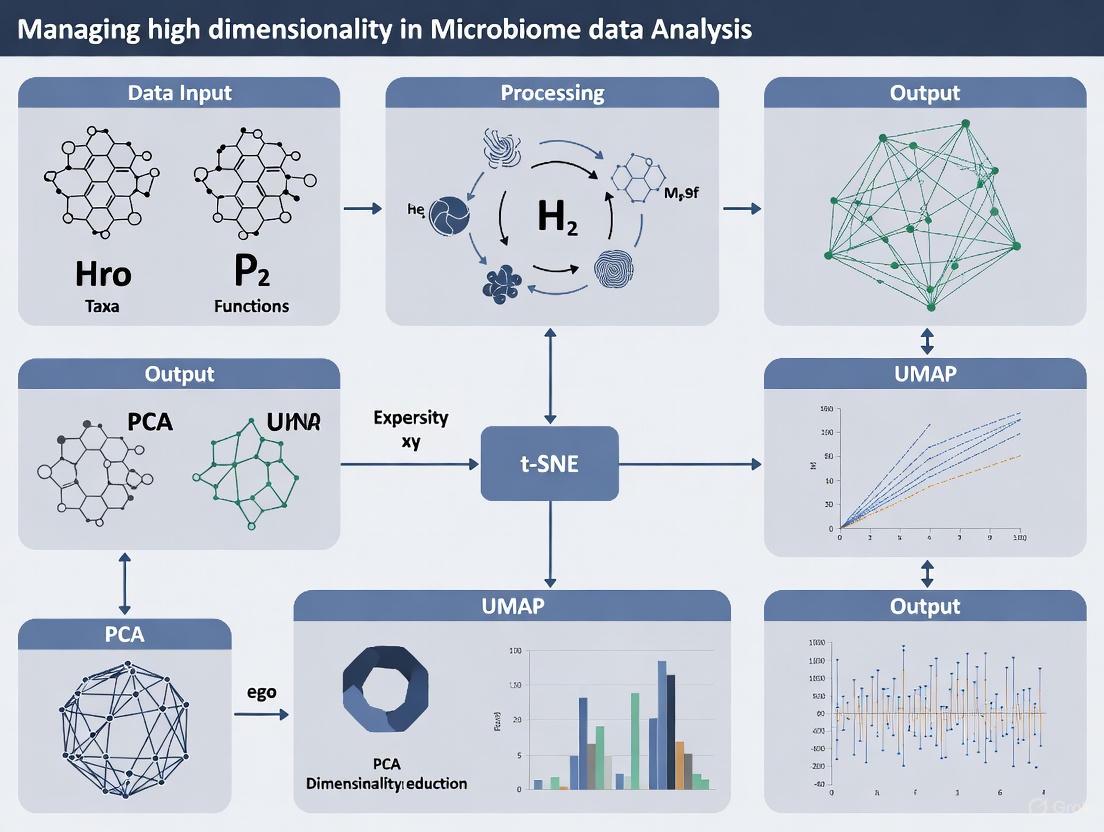
The analysis of microbiome data presents a unique set of computational and statistical challenges due to its high dimensionality, sparsity, compositionality, and complex dependencies.
Navigating the High-Dimensional Jungle: A Researcher's Guide to Microbiome Data Analysis
Abstract
The analysis of microbiome data presents a unique set of computational and statistical challenges due to its high dimensionality, sparsity, compositionality, and complex dependencies. This article provides a comprehensive guide for researchers and drug development professionals on managing these challenges effectively. We cover the foundational characteristics of microbiome data, explore a suite of methodological approaches from traditional statistics to advanced machine learning, outline best practices for troubleshooting and optimization, and provide a framework for the rigorous validation and comparison of analytical methods. The goal is to equip scientists with the knowledge to derive robust, reproducible, and biologically meaningful insights from complex microbiome datasets, thereby accelerating translational applications in biomedicine.
Understanding the Microbiome Data Landscape: Core Challenges and Initial Exploration
Frequently Asked Questions
1. What does the 'p >> n' problem mean in the context of microbiome research? The 'p >> n' problem, also known as the "large P, small N" problem or the curse of dimensionality, describes a scenario where the number of variables (p, e.g., microbial taxa or genes) is much larger than the number of samples or observations (n) [1] [2] [3]. For example, a study might have genomic data on thousands of bacterial taxa (p) collected from only dozens of patients (n) [1] [2].
2. What are the specific consequences of high dimensionality for my analysis? High-dimensional microbiome data exhibits several characteristics that violate the assumptions of classical statistical methods developed for smaller datasets [1] [3]:
- Sparsity and Distance distortion: Data points become distant from each other and tend to fall on the edges of the distribution, making reliable inference difficult [1].
- Overfitting: Predictive models can achieve deceptively high accuracy by fitting to noise rather than to true biological signals [1] [2].
- Compositionality: The data represents relative abundances (proportions) rather than absolute counts, meaning an increase in one taxon necessarily leads to a decrease in others [3].
- Zero-inflation: Many microbial features are rare and absent from most samples, resulting in datasets with a large number of zero values [3].
3. My model performs perfectly on my dataset. Could this be a problem? Yes, this is a classic symptom of overfitting in high-dimensional settings [1]. A model that appears to have near-perfect accuracy may be memorizing the noise in your specific dataset rather than learning generalizable patterns. This model will likely perform poorly on a new, independent dataset. It is crucial to use validation cohorts and penalized regression methods designed to avoid overfitting [2].
4. How should I approach the statistical analysis of my high-dimensional microbiome data? Given the exploratory nature of many high-throughput microbiome studies, your analysis strategy should prioritize interpretability and hypothesis generation [1]. Key approaches include:
- Data Reduction: Focus on biologically meaningful subsets of variables (e.g., specific metabolic pathways) rather than analyzing all variables at once [1].
- Specialized Methods: Employ statistical models designed for high-dimensional data, such as regularized regression ensembles (e.g., stability selection, Bayesian model averaging) [2] or methods that account for compositionality and zero-inflation [4] [3].
- Validation: Treat findings from initial analyses as hypotheses to be confirmed in follow-up, specifically designed experiments [1].
5. What are common confounding factors I need to control for in my study design? The microbiome is influenced by many factors. To avoid spurious associations, carefully document and control for confounders such as [5]:
- Demographics: Age, sex, and geography.
- Lifestyle: Diet, antibiotic use, and pet ownership.
- Technical Factors: DNA extraction kit batches, sequencing runs, and sample storage conditions [6] [5].
- Animal Studies: "Cage effects," where co-housed animals share similar microbiota, must be accounted for by housing multiple cages per study group [5].
Troubleshooting Guide
| Symptom | Possible Cause | Solution |
|---|---|---|
| Model is 100% accurate on training data but fails on new data. | Severe overfitting; the model is fitting to noise. | Use penalized/regularized regression (e.g., elastic net, spike-and-slab BMA) [2] and always validate results on a hold-out or independent dataset. |
| Statistical results are unstable; different subsets of data yield different significant taxa. | Instability due to high dimensionality and multicollinearity. | Implement ensemble methods like Bayesian Model Averaging (BMA) or stability selection that aggregate findings across many models [2]. |
| Unable to distinguish true biological signal from background. | High technical noise and/or low microbial biomass in samples. | Incorporate positive and negative controls in your laboratory workflow. For low-biomass samples, analyze controls to identify and subtract contaminating sequences [5]. |
| Strong batch effects are obscuring biological differences. | Unaccounted technical variation from different processing batches. | Record batch information (e.g., DNA extraction kit lot, sequencing run) and include it as a covariate in statistical models or use batch-correction algorithms [5] [7]. |
| Findings are biologically uninterpretable. | Using "black box" algorithms or analyzing too many variables at once. | Conduct focused analyses on subsets of variables selected based on biological knowledge (e.g., specific pathways like methionine degradation) [1]. |
Experimental Protocols for Managing High-Dimensional Data
Protocol 1: Focused, Biologically-Informed Subset Analysis This protocol avoids the pitfalls of analyzing all variables simultaneously by focusing on pre-defined, interpretable subsets [1].
- Define a Biological Question: Start with a specific hypothesis (e.g., "Is the methionine degradation pathway in the gut microbiome associated with insulin resistance?") [1].
- Select Variable Subset: Instead of using all thousands of microbial genes or taxa, select a small subset relevant to your hypothesis (e.g., the 4 genes in the methionine degradation pathway) [1].
- Apply Statistical Model: Use a regression model or other multivariate method (e.g., RLQ analysis) appropriate for the data type and your focused variable set [1].
- Interpret and Validate: Interpret the results in the context of the specific biology. Consider any significant findings as hypotheses to be tested in a future, confirmatory study [1].
Protocol 2: Ensemble-Based Regression for Robust Feature Selection This protocol uses ensemble methods to stabilize model selection and identify robust microbial signatures from high-dimensional data [2].
- Data Preprocessing: Log-transform relative abundances of microbial genera to ensure variables have a similar dynamic range [2].
- Model Training:
- Frequentist Approach (Stability Selection): Use bootstrap sampling of your data and fit a penalized regression model (e.g., elastic net) to each sample. Identify variables that are consistently selected across the bootstrap runs [2].
- Bayesian Approach (Spike-and-Slab BMA): Use Markov chain Monte Carlo (MCMC) algorithms to explore a large space of possible models. Average the results, weighting models by their posterior probability [2].
- Evaluate Performance: Assess the model's performance using metrics like predictive accuracy on held-out data and the stability of the selected features [2]. Studies suggest that Bayesian ensembles exploring larger model spaces often yield stronger performance with lower variability [2].
The Scientist's Toolkit: Research Reagent Solutions
| Item | Function in Microbiome Research |
|---|---|
| 16S rRNA Gene Primers | Target conserved regions of the 16S rRNA gene to amplify variable regions (e.g., V3-V4) for bacterial identification and profiling [6]. |
| DADA2 / QIIME 2 | Bioinformatic tools for processing raw 16S sequencing data, including denoising to obtain Amplicon Sequence Variants (ASVs) and taxonomic classification [3]. |
| Kraken 2 / MetaPhlAn 4 | Tools for quantifying taxonomic abundance from Whole Metagenome Shotgun (WMS) sequencing data [3]. |
| OMNIgene Gut Kit | A commercial collection kit designed to stabilize fecal microbiome samples at room temperature, useful for field studies or when immediate freezing is not possible [5]. |
| Positive Control Spikes | Non-biological DNA sequences or mock microbial communities added to samples to monitor technical performance and detect contamination throughout the sequencing workflow [5]. |
Pathway: Navigating High-Dimensional Microbiome Data
The following diagram illustrates the logical workflow and strategic decisions involved in tackling the 'p >> n' problem, from data characteristics to analytical solutions.
The table below summarizes the core characteristics of microbiome data that create analytical challenges and the corresponding methodological approaches to address them.
| Data Characteristic | Challenge | Recommended Analytical Approach |
|---|---|---|
| High Dimensionality (p >> n) [1] [2] [3] | Overfitting, unreliable predictions, and model instability. | Regularized/penalized regression (e.g., elastic net), ensemble methods (e.g., BMA), and exploratory analysis on variable subsets [1] [2]. |
| Compositionality [3] | Relative abundances are not independent; results are difficult to interpret on an absolute scale. | Use compositional data analysis (CoDA) methods, such as centered log-ratio (CLR) transformations, or models designed for compositional data [3]. |
| Zero-Inflation [3] | Many features are absent in most samples, complicating statistical testing. | Employ models specifically designed for zero-inflated count data (e.g., zero-inflated negative binomial models) or apply prevalence filtering [3]. |
| Tree-Structured Data [3] | Microbial features are related through taxonomic or phylogenetic trees. | Leverage tree-aware methods like phylogenetic principal coordinates analysis (PCoA) using UniFrac distances to incorporate evolutionary relationships [3]. |
| Longitudinal Instability [5] [8] | Microbial communities change over time, adding complexity to study design. | Use longitudinal analysis methods (e.g., EMBED, GLM-ASCA) that can model temporal dynamics and subject-specific effects [4] [8]. |
FAQ: Understanding the Core Challenges
What makes microbiome data analysis uniquely challenging? Microbiome data from high-throughput sequencing possesses three intrinsic characteristics that complicate statistical analysis: compositionality, sparsity, and overdispersion. If not properly accounted for, these properties can lead to biased results and false discoveries [9] [10].
What does "compositionality" mean in this context? Microbiome data, often from 16S rRNA gene sequencing, is typically summarized as relative abundances. Because these values sum to a constant (e.g., 1 or 100%), they are "compositional" [10]. This means the data resides in a simplex, and an increase in the relative abundance of one taxon will cause an artificial decrease in the relative abundance of others, making it difficult to infer true biological changes [9] [10].
Why is microbiome data so sparse? Sparsity, or "zero inflation," refers to the excess of zero counts in the data, where a large proportion of microbial taxa are not detected in a large proportion of samples [10]. This can be due to biological reasons (a taxon is genuinely absent) or technical reasons (insufficient sequencing depth) [9].
What is overdispersion? Overdispersion occurs when the variance in the observed count data is greater than what would be expected under a simple statistical model, such as a Poisson distribution. This is common in microbiome data due to the inherent heterogeneity of microbial communities across samples [4].
Troubleshooting Guide: Diagnosis and Solutions
Issue 1: Dealing with Compositional Data
- Problem: Your analysis is confounded by the relative nature of the data, leading to spurious correlations.
- Diagnosis: This is a fundamental property of all microbiome sequence count tables; you are likely dealing with compositional data if you are working with OTU (Operational Taxonomic Unit) or SV (Sequence Variant) tables from 16S or shotgun metagenomic sequencing [10].
- Solutions:
- Use Compositionally Aware Transformations: Apply transformations such as the Centered Log-Ratio (CLR) before using standard statistical or machine learning models [9].
- Employ Specialized Methods: Utilize differential abundance analysis methods designed for compositional data, such as ANCOM-II [10]. Another approach is to combine Generalized Linear Models (GLMs) with frameworks like ANOVA Simultaneous Component Analysis (ASCA), a method referred to as GLM-ASCA, which is explicitly designed to handle the characteristics of microbiome data within an experimental design [4].
Table: Summary of Methodologies for Handling Compositionality
| Method | Brief Description | Key Application |
|---|---|---|
| Centered Log-Ratio (CLR) | A log-ratio transformation that maps compositional data from a simplex to real space [9]. | Preprocessing for standard ML models (e.g., SVM, Random Forests). |
| ANCOM-II | A statistical framework that accounts for compositionality to identify differentially abundant taxa [10]. | Differential abundance analysis. |
| GLM-ASCA | Integrates Generalized Linear Models with ANOVA Simultaneous Component Analysis to model compositionality and other data properties within an experimental design [4]. | Analyzing multivariate data from complex experimental designs (e.g., with factors like treatment and time). |
Issue 2: Managing Data Sparsity (Excess Zeros)
- Problem: A high number of zeros in your dataset, especially for low-abundance taxa, is skewing your diversity estimates and statistical models.
- Diagnosis: Examine your feature table (OTU/SV table). If a large percentage (sometimes up to ~90%) of the entries are zero, your data is sparse [10].
- Solutions:
- Pseudo-counts: Add a small positive value (e.g., 1) to all counts before log-transformation. However, be aware that this is an ad-hoc solution and the results can be sensitive to the value chosen [10].
- Advanced Modeling: Use statistical models that explicitly account for zero-inflation, such as zero-inflated models, which can differentiate between different types of zeros (e.g., structural vs. sampling zeros) [10].
Table: Strategies for Handling Sparse Data
| Strategy | Approach | Considerations |
|---|---|---|
| Pseudo-count | Add a small constant (e.g., 0.5, 1) to all counts [10]. | Simple but ad-hoc; choice of constant can influence results. |
| Zero-inflated Models | Use probability models that distinguish between true absences and undetected taxa [10]. | More statistically sound but relies on the validity of underlying assumptions. |
| Rarefying | Subsample sequences to an even depth across all samples [10]. | Discards valid data and introduces artificial uncertainty; controversial for differential abundance testing. |
Issue 3: Addressing Overdispersion
- Problem: The variance in your count data is much larger than the mean, violating the assumptions of standard models like the Poisson regression.
- Diagnosis: Fit a simple model and check for a poor fit. Overdispersion is common in microbiome data due to biological and technical variability [4].
- Solutions:
- Generalized Linear Models (GLMs): Use models that are built for count data and can handle overdispersion. A Negative Binomial model is often a good choice for overdispersed count data, as it includes an extra parameter to model the excess variance [4].
- Integrated Frameworks: Implement pipelines like GLM-ASCA, which uses GLMs with an appropriate distribution (e.g., Negative Binomial) to model the overdispersed count data before applying multivariate analysis [4].
Table: Key Bioinformatics Tools for Microbiome Analysis
| Tool | Primary Function | Application in This Context |
|---|---|---|
| QIIME 2 [9] | A powerful, user-friendly platform for microbiome analysis from raw sequences to statistical analysis. | Provides access to various normalization methods and plugins for diversity analysis. |
| MetaPhlAn [11] [12] | A tool for profiling microbial community composition from metagenomic data using clade-specific marker genes. | Generates the taxonomic profiles that form the basis for subsequent analysis of sparsity and compositionality. |
| HUMAnN2 [12] | A tool for profiling the functional potential of microbial communities from metagenomic or metatranscriptomic data. | Allows researchers to move beyond taxonomy to understand community function, which is also subject to these data characteristics. |
| DADA2 [11] | A method for inferring exact amplicon sequence variants (SVs) from sequencing data. | Generates the high-resolution feature table that is the starting point for data analysis. |
| MaAsLin 2 [4] | A tool for finding associations between microbial metadata and community profiles. | Employs GLMs to account for the properties of microbiome data during association testing. |
Experimental Workflow for Managing High-Dimensional Data
The following diagram illustrates a robust analytical workflow that integrates solutions for compositionality, sparsity, and overdispersion.
Core Technology & Data Structure FAQ
What are the fundamental differences in the data generated by 16S rRNA and shotgun metagenomic sequencing?
The core difference lies in the scope and scale of the genetic material being sequenced. 16S rRNA sequencing is a targeted amplicon approach that selectively amplifies and sequences only the 16S ribosomal RNA gene, a ~1,500 bp genetic marker present in most prokaryotes. The resulting data structure is a table of counts for each unique 16S sequence variant (Amplicon Sequence Variants, ASVs) or clustered Operational Taxonomic Units (OTUs) per sample [13] [14]. In contrast, shotgun metagenomic sequencing fragments and sequences all DNA present in a sample—bacterial, viral, fungal, and host. Its data structure is a vast collection of short reads representing random fragments from all genomes in the community, which can be used to profile taxa (often at species or strain level) and simultaneously to reconstruct functional genetic potential [15] [16].
How do the resulting taxonomic profiles differ in practice?
While both methods can characterize community composition, their resolution and breadth differ significantly, as shown in the table below.
Table 1: Taxonomic and Functional Profiling Capabilities
| Feature | 16S rRNA Sequencing | Shotgun Metagenomic Sequencing |
|---|---|---|
| Typical Taxonomic Resolution | Genus level; species level is possible but can be unreliable [16] [17] | Species and strain-level resolution [16] [17] |
| Kingdom Coverage | Primarily Bacteria and Archaea [16] | Multi-kingdom: Bacteria, Archaea, Viruses, Fungi, Protists [16] |
| Functional Profiling | Indirect inference based on taxonomy [15] [16] | Direct characterization of functional genes and metabolic pathways [15] [16] |
| Impact of Host DNA | Minimal; host DNA is not amplified due to targeted PCR [16] | Significant; requires deeper sequencing or host DNA removal to detect microbial signal [15] [16] |
Which method is more sensitive in detecting low-abundance taxa?
Shotgun metagenomics generally has more power to identify less abundant taxa, provided a sufficient number of reads is available. A comparative study on chicken gut microbiota showed that when sequencing depth was high (>500,000 reads per sample), shotgun sequencing detected a statistically significant higher number of taxa, corresponding to the less abundant genera that were missed by 16S sequencing. These less abundant genera were biologically meaningful and able to discriminate between experimental conditions [18]. The 16S method can be limited by its reliance on primer binding and PCR amplification, which can introduce biases and reduce sensitivity for certain taxa [15].
Troubleshooting Experimental Design & Data Quality
How should I choose between 16S and shotgun sequencing for my specific sample type?
The optimal choice often depends on your sample's microbial biomass and the presence of non-microbial DNA.
Table 2: Method Selection Based on Sample Type and Research Goals
| Factor | 16S rRNA Sequencing is Preferred When: | Shotgun Metagenomic Sequencing is Preferred When: |
|---|---|---|
| Sample Type | Samples with low microbial biomass and/or high host DNA (e.g., skin swabs, environmental swabs, tissue biopsies) [16] [17] | Samples with high microbial biomass and low host DNA (e.g., stool) [16] [17] |
| Research Goal | Cost-effective, broad taxonomic profiling of bacterial communities is the primary goal [13] [16] | Strain-level resolution, functional potential, or multi-kingdom analysis is required [15] [16] |
| Budget | Budget is a major constraint [16] | Budget allows for higher sequencing costs and more complex bioinformatics [15] [17] |
| DNA Input | DNA input is very low (successful with <1 ng) [16] | Higher DNA input is available (typically ≥1 ng/μL) [16] |
My 16S data seems to miss key taxa mentioned in the literature for my disease model. Is this a technical artifact?
This is a common challenge. The 16S technique captures only a part of the microbial community, often giving greater weight to dominant bacteria [17]. Discrepancies can arise from several technical factors:
- Primer Bias: The choice of which hypervariable region (e.g., V3-V4, V4) to amplify significantly impacts which taxa can be detected and classified accurately [18] [19]. No single region can perfectly distinguish all species.
- Reference Database Limitations: Taxonomic assignment in 16S analysis depends on reference databases (e.g., SILVA, Greengenes). The classification can fail if the true organism is not well-represented in the database [13] [17].
- Sparsity: 16S data is often sparser (many zero counts) and shows lower alpha diversity than shotgun data from the same sample, which can affect the detection of rare taxa [18] [17]. If your research requires a comprehensive view of the community, particularly for identifying specific disease-associated species, shotgun sequencing is the more reliable choice [17].
Why does my shotgun metagenomic data show a different abundance for a genus compared to my 16S data from the same sample?
This is a known issue, primarily driven by the fundamental differences in the techniques. Key reasons include:
- Genome Characteristics: Shotgun sequencing quantifies based on the number of sequence reads originating from a genome. Organisms with larger genomes or higher 16S rRNA gene copy numbers may be overrepresented compared to their actual cellular abundance [17]. 16S data is also affected by copy number variation.
- Technical Biases: 16S data is subject to biases from DNA extraction, PCR amplification, and primer efficiency [18]. Shotgun data can be affected by the choice of reference database used for taxonomic binning and the level of host DNA contamination [15] [17].
- Database Disagreement: The reference databases for 16S (e.g., SILVA) and shotgun (e.g., RefSeq, GTDB) are different in size, content, and curation, leading to taxonomic assignment disagreements [17]. Despite this, when considering only taxa identified by both methods, their abundances are generally positively correlated [18] [17].
Managing High-Dimensionality in Downstream Analysis
How does the high-dimensionality of microbiome data from these methods impact analysis?
Both 16S and shotgun metagenomics produce data with far more features (e.g., ASVs, genes) than samples, a hallmark of high-dimensionality [20]. For example, a single study can contain hundreds of samples but tens or even hundreds of thousands of features [20]. This creates the "curse of dimensionality," which can lead to statistical overfitting, artifactual results, and runtime issues [20]. The high dimensionality is further complicated by data sparsity (most microbes are not found in most samples) and compositionality (the data conveys relative, not absolute, abundances) [20] [4]. Dimensionality reduction is thus a core, necessary step to make analysis tractable, both for creating human-interpretable visualizations and for further statistical analysis [20].
What are the recommended strategies for dimensionality reduction with these data types?
The choice of strategy should account for the specific characteristics of microbiome data.
Table 3: Dimensionality Reduction Methods for Microbiome Data
| Method | Brief Description | Key Characteristics for Microbiome Data |
|---|---|---|
| Principal Component Analysis (PCA) | A linear technique that finds orthogonal axes of maximum variance. | Assumes linearity and Euclidean distances; can produce "horseshoe" artifacts with gradient data [20]. |
| Principal Coordinates Analysis (PCoA) | Plots a distance matrix in low-dimensional space. | Highly flexible; can use ecological distances like Bray-Curtis or UniFrac (which incorporates phylogeny) [13] [20]. |
| ANOVA Simultaneous Component Analysis (ASCA/ASCA+) | Combines ANOVA-style effect partitioning with dimension reduction. | Powerful for complex experimental designs (e.g., time series, multiple factors) to separate sources of variation [4]. |
| Generalized Linear Models (GLM) with ASCA | Extends ASCA using GLMs instead of linear models. | Recommended for advanced users. Better handles count data, sparsity, and overdispersion inherent in microbiome sequences [4]. |
For standard beta-diversity analysis (comparing community composition between samples), PCoA with Bray-Curtis or UniFrac distances is the most widely adopted and robust approach [13] [20]. For more complex, multifactorial experiments, methods like GLM-ASCA are emerging as powerful tools to disentangle the effects of different experimental factors while respecting the nature of sequence count data [4].
Diagram 1: Comparative experimental workflows for 16S rRNA and shotgun metagenomic sequencing.
The Scientist's Toolkit: Essential Research Reagents & Materials
Table 4: Key Research Reagents and Computational Tools
| Item / Resource | Function / Application | Notes |
|---|---|---|
| NucleoSpin Soil Kit / DNeasy PowerLyzer Powersoil Kit | Standardized DNA extraction from complex samples like stool or soil [17]. | Critical for yield and reproducibility; choice can affect downstream results. |
| KAPA HiFi Hot Start DNA Polymerase | High-fidelity PCR amplification for 16S library preparation [21]. | Reduces PCR errors, crucial for generating accurate full-length 16S sequences. |
| SILVA Database | Curated database of ribosomal RNA genes for taxonomic assignment in 16S analysis [13] [17]. | A standard reference; requires periodic updating. |
| Greengenes2 Database | Alternative curated 16S rRNA gene database for taxonomic classification [13]. | |
| UHGG / GTDB Databases | Unified Human Gastrointestinal Genome & Genome Taxonomy Databases for shotgun metagenomic analysis [17]. | Essential for accurate species and strain-level binning of shotgun reads. |
| QIIME 2 | A powerful, extensible, and user-friendly bioinformatics platform for 16S rRNA analysis [13]. | Integrates denoising (DADA2), taxonomy assignment, and diversity analysis. |
| DADA2 / Deblur | Algorithms for inferring exact Amplicon Sequence Variants (ASVs) from 16S data [13] [21]. | Provides higher resolution than traditional OTU clustering. |
| Kraken2 / Bracken | System for fast taxonomic classification of shotgun metagenomic sequences and abundance estimation [17]. | |
| Phyloseq (R Package) | R package for the interactive analysis and graphical display of microbiome census data [13] [20]. | Integrates with core statistical functions in R. |
| ZymoBIOMICS Microbial Community Standard | Defined mock community of bacteria used as a positive control for both 16S and shotgun workflows [21]. | Essential for validating sequencing and bioinformatics protocols. |
Frequently Asked Questions (FAQs)
1. What is the fundamental difference between PCoA and NMDS? PCoA (Principal Coordinates Analysis) is an eigenanalysis-based method that aims to preserve the actual quantitative distances between samples in a lower-dimensional space [22] [23]. In contrast, NMDS (Non-metric Multidimensional Scaling) is a rank-based technique that focuses only on preserving the rank-order, or qualitative distances, between samples [24] [22]. While PCoA seeks a linear representation of the original distances, NMDS is better suited for nonlinear data relationships [22].
2. When should I choose PCoA over NMDS for my microbiome data? Choose PCoA when your analysis is tied to a specific, meaningful distance metric (like Bray-Curtis or UniFrac) and you want to visualize the actual quantitative dissimilarities [25] [22]. It is also the recommended accompaniment for PERMANOVA tests [23]. PCoA is generally less computationally demanding, making it more suitable for larger datasets [24].
3. How do I interpret the "stress" value in an NMDS plot? The stress value quantifies how well the ordination represents the original distance matrix. As a rule of thumb [24]:
- Stress > 0.2: The ordination is potentially suspect and should be interpreted with caution.
- Stress < 0.1: The representation is considered fair.
- Stress < 0.05: indicates a good fit.
4. My PCoA results show negative eigenvalues. What does this mean and how can I fix it? Negative eigenvalues occur when PCoA is applied to semi-metric distance measures (like Bray-Curtis) because the algorithm is attempting to represent non-Euclidean distances in a Euclidean space [23]. Two common corrections are [23]:
- Lingoes correction: Adds a constant to the squared dissimilarities.
- Cailliez correction: Adds a constant to the dissimilarities. These adjustments to the distance matrix help avoid negative eigenvalues.
5. What does it mean if points form tight, well-separated clusters in my ordination plot? Tight clusters of points that are well-separated from other clusters often indicate distinct sub-populations or groups within your data (e.g., microbial communities from different sample types or habitats) [24]. However, if a cluster is extremely dissimilar from the rest, the internal arrangement of its points may not be meaningful [24].
Troubleshooting Guides
Issue 1: High Stress in NMDS Ordination
Problem: The stress value of your NMDS ordination is above 0.2, making the visualization unreliable [24].
Solutions:
- Increase Dimensions: Allow the algorithm to ordinate in a higher number of dimensions (e.g., from 2 to 3) to reduce stress [24].
- Check Distance Metric: Ensure the chosen distance or dissimilarity measure (e.g., Bray-Curtis, Jaccard) is appropriate for your data and research question [22].
- Multiple Runs: Execute multiple NMDS runs with different random starting configurations to ensure the solution is stable and not trapped in a local optimum [24].
Issue 2: Ordination Plot Shows Unintelligible "Horseshoe" or "Arch" Pattern
Problem: The ordination plot exhibits a strong curved pattern, which can occur in PCA and, to a lesser extent, in PCoA, often when there is an underlying ecological gradient [20].
Solutions:
- Interpret with Caution: Recognize that this pattern may reflect a latent gradient in your data (e.g., pH, time). The arch can distort the true distances between points at the ends of the gradient.
- Switch to NMDS: Consider using NMDS, which is often more robust at handling such gradients due to its rank-based approach [24].
- Use Detrending: Some software packages offer detrending functions specifically designed to remove arch effects.
Issue 3: PCoA or NMDS Plot Fails to Show Expected Group Separation
Problem: Known groups in your data (e.g., treated vs. control) do not separate in the ordination plot.
Solutions:
- Verify Group Differences: Conduct a statistical test like PERMANOVA (for PCoA) or ANOSIM (for NMDS) to objectively test for significant group differences before relying on visual separation alone [24] [23].
- Re-evaluate Distance Metric: The chosen beta-diversity metric might not be sensitive to the specific community differences driving your grouping. Experiment with different distance measures (e.g., weighted vs. unweighted UniFrac) [22].
- Check for Confounding Factors: Investigate if technical artifacts (e.g., sequencing batch effects) or other confounding variables are obscuring the biological signal [20].
Essential Workflows and Protocols
Protocol 1: Standard Workflow for Conducting PCoA
The following workflow outlines the key steps for performing a Principal Coordinates Analysis, from data input to visualization [25] [23].
Detailed Steps:
- Input: Start with a feature table (e.g., species counts) or a pre-computed distance matrix [25].
- Distance Matrix Calculation: Compute a pairwise distance matrix using a metric appropriate for your data (e.g., Bray-Curtis for ecological community data) [25] [22].
- Double-Centering: Transform the squared distance matrix into a similarity matrix (matrix
B) using double-centering to place the origin at the centroid of the data [25]. - Eigendecomposition: Perform an eigen decomposition on the similarity matrix
Bto obtain eigenvalues and eigenvectors [25]. - Scaling: The principal coordinates are obtained by scaling the eigenvectors by the square root of their corresponding eigenvalues [25].
- Dimensionality Reduction: Select the top
kdimensions (e.g., 2 or 3) that explain the most variance for visualization [25].
Protocol 2: Iterative Workflow for Conducting NMDS
NMDS is an iterative process that requires careful evaluation to ensure a stable and meaningful solution [24].
Detailed Steps:
- Input & Ranking: Begin with a distance matrix. The algorithm substitutes the original distances with their ranks [24].
- Initial Configuration: The points (samples) are placed in the specified number of dimensions, often randomly. Using a PCoA result for initial placement can lead to a more stable solution [24].
- Iteration: The algorithm iteratively adjusts the positions of points in the low-dimensional space [24].
- Stress Calculation: In each iteration, a stress value (a measure of disagreement between the ordination distances and the original rank distances) is calculated [24].
- Convergence Check: The iterations continue until the stress value is minimized and stable. Multiple runs from different starting points are crucial to avoid local optima [24].
- Rotation: The final configuration is often rotated using PCA to maximize the scatter of points along the first axis, aiding interpretation [24].
- Interpretation: Interpret the final plot, where distances between points approximate the rank-order of their dissimilarities [24].
Comparative Analysis and Reagent Solutions
Method Comparison Table
The table below summarizes the key characteristics of PCoA and NMDS to guide method selection [22].
| Characteristic | Principal Coordinates Analysis (PCoA) | Non-metric Multidimensional Scaling (NMDS) |
|---|---|---|
| Input Data | Distance matrix [22] | Distance matrix [22] |
| Core Principle | Eigenanalysis; preserves quantitative distances [23] | Iterative optimization; preserves rank-order of distances [24] [22] |
| Handling of Distances | Attempts to represent actual distances linearly [23] | Preserves the order of dissimilarities; robust to non-linearity [24] |
| Output Axes | Axes have inherent meaning (eigenvalues); % variance explained can be calculated [23] | Axis scale and orientation are arbitrary; focus is on relative positions [24] |
| Best for | Visualizing patterns based on a specific, informative distance metric; larger datasets [24] [22] | Complex, non-linear data where the primary interest is in the relative similarity of samples [22] |
| Fit Statistic | Eigenvalues / Proportion of variance explained [25] | Stress value [24] |
Research Reagent Solutions: Key Software Packages
This table lists essential software tools for performing PCoA and NMDS, which are critical reagents for computational research in this field.
| Tool / Package | Function | Primary Environment | Key Citation/Resource |
|---|---|---|---|
| scikit-bio | pcoa() function for performing PCoA |
Python | [25] |
| vegan (R package) | metaMDS() for NMDS; wcmdscale() for PCoA |
R | [24] [23] |
| QIIME 2 | Integrated pipelines for PCoA with various beta-diversity metrics | Command-line / Python | [20] [26] |
| phyloseq (R package) | Integrates with vegan for ordination and visualization |
R | [20] [26] |
| Scikit-learn | Includes PCA and MDS (metric & non-metric) implementations | Python | [22] |
Frequently Asked Questions
What are the most common signs of batch effects in my microbiome data? The most common signs include samples clustering strongly by processing batch, rather than by biological group (e.g., disease state), in ordination plots like PCoA or NMDS. You might also see systematic differences in library sizes (total reads per sample) or in the abundance of specific taxa between batches. Statistical tests like PERMANOVA on batch labels can confirm if these group differences are significant [27] [28].
My data is from a case-control study. What is a simple, model-free method for batch correction? Percentile normalization is a non-parametric method well-suited for case-control studies. For each microbial feature (e.g., a taxon), the abundances in case samples are converted to percentiles of the equivalent feature's distribution in the control samples from the same batch. This uses the control group as an internal reference to mitigate technical variation, allowing data from multiple studies to be pooled for analysis [27].
How can I identify and remove contaminant sequences from my data? Contaminants can be detected using frequency-based or prevalence-based methods. Frequency-based methods require DNA concentration data and identify sequences that are more abundant in samples with lower DNA concentrations. Prevalence-based methods identify sequences that are significantly more common in negative control samples than in true biological samples. Tools like
decontamimplement these approaches [29].What should I do if my data has many samples with low library sizes? First, visualize the distribution of library sizes to identify clear outliers. You can then apply a filter to remove samples with library sizes below a certain threshold (e.g., the median or a pre-defined minimum) to ensure sufficient sequencing depth. After filtering, techniques like rarefaction or data transformations can be applied to control for the remaining differences in sampling depth across samples [29].
A batch effect is confounded with my biological variable of interest. What can I do? This is a challenging scenario. If the batches cannot be physically balanced by re-processing samples, advanced batch-effect correction methods that use a model to disentangle the effects may be necessary. However, caution is required, as over-correction can remove the biological signal. Methods like Conditional Quantile Regression (ConQuR) are designed to preserve the effects of key variables while removing batch effects [30] [28].
Troubleshooting Guides
Guide 1: Diagnosing and Correcting Batch Effects
Batch effects are technical variations that can lead to spurious findings and obscure true biological signals. They are notoriously common in large-scale studies where samples are processed across different times, locations, or sequencing runs [30] [28].
Protocol: A Workflow for Batch Effect Management
The following diagram outlines a logical workflow for handling batch effects in a microbiome study:
Assessment Techniques:
- Visual Inspection: Use ordination plots (e.g., PCoA, NMDS based on Bray-Curtis distance) to see if samples cluster by batch instead of by the biological condition of interest [27].
- Statistical Tests: Use PERMANOVA to test if the variance explained by the batch variable is significant.
- Library Size Analysis: Check for systematic differences in total read counts between batches using violin plots or histograms [29].
Correction Methods: The choice of correction method depends on your data and study design. The table below compares several common approaches.
| Method | Brief Description | Ideal Use Case | Key Considerations |
|---|---|---|---|
| Percentile Normalization [27] | Non-parametric; converts case abundances to percentiles of the control distribution within each batch. | Case-control studies; model-free approach for pooling data. | Relies on having a well-defined control group in each batch. |
| Conditional Quantile Regression (ConQuR) [30] | Uses a two-part quantile regression model to remove batch effects from zero-inflated count data. | General study designs; complex data where batch effects are not uniform across abundance levels. | Preserves signals of key variables; returns corrected read counts for any downstream analysis. |
| ComBat [31] [27] | Empirical Bayes method to adjust for location and scale batch effects. | Widely used; adapted for various data types. | Originally for normally distributed data; requires log-transformation of microbiome data, which may not handle zeros well. |
| limma [27] | Linear models to remove batch effects. | Microarray-style data; when batch is not confounded with biological variables. | Similar to ComBat, may require data transformation away from raw counts. |
Guide 2: Addressing Contamination and Low-Quality Samples
Identifying Contaminants:
As implemented in tools like decontam, there are two primary strategies [29]:
- Frequency-based: Requires DNA concentration data. Contaminants are identified by an inverse correlation between sequence frequency and sample DNA concentration.
- Prevalence-based: Compares the prevalence of sequences in true samples versus negative control samples. Contaminants are significantly more prevalent in negative controls.
Handling Low-Quality Samples:
- Calculate Library Size: Determine the total counts per sample [29].
- Visualize Distribution: Plot library sizes (e.g., histogram, violin plot) to identify outliers with unusually low counts [29].
- Apply Filter: Set a justified threshold (e.g., based on distribution or experimental knowledge) and remove samples below it.
- Control for Depth: Apply rarefaction or data transformations (e.g., CSS, log-transformations) to the remaining samples to account for uneven sequencing depth [31] [29].
The Scientist's Toolkit
Research Reagent Solutions
| Item | Function in Microbiome Research |
|---|---|
| Negative Control Samples | Contain no biological material (e.g., sterile water) and are processed alongside real samples to identify reagent and environmental contaminants. |
| Standardized DNA Extraction Kits | Ensure consistent lysis of microbial cells and recovery of genetic material across all samples in a study, minimizing batch effects from sample preparation. |
| Internal Standards/Spike-ins | Known quantities of foreign organisms or DNA added to samples before processing. Used to calibrate measurements and account for technical variation in sequencing efficiency. |
Experimental Protocol: Implementing ConQuR for Batch Effect Removal
ConQuR (Conditional Quantile Regression) is a comprehensive method for removing batch effects from microbiome read counts while preserving biological signals [30].
Protocol: The ConQuR Workflow
The methodology involves a two-step process for each taxon, as illustrated below:
Detailed Methodology:
- Input Preparation: Organize your data into a taxa count table, with information on batch ID, key biological variables, and other relevant covariates.
- Regression Step (Two-Part Model):
- Part 1 - Logistic Regression: Models the probability that a taxon is present (non-zero) in a sample, using batch, key variables, and covariates as predictors.
- Part 2 - Quantile Regression: Models the percentiles (e.g., median, quartiles) of the taxon's abundance distribution conditional on its presence, using the same set of predictors. This non-parametrically captures the entire conditional distribution without assuming a specific shape (e.g., Normal or Negative Binomial).
- Using these models, ConQuR estimates both the original conditional distribution for each sample and a batch-free distribution by setting the batch effect to that of a chosen reference batch [30].
- Matching Step: For each sample and taxon:
- The observed read count is located within the estimated original conditional distribution to find its corresponding percentile.
- The corrected read count is then selected as the value at that same percentile in the estimated batch-free distribution.
- Output: The result is a batch-corrected count table that retains the zero-inflated, over-dispersed nature of microbiome data, suitable for any subsequent analysis like diversity measures, differential abundance testing, or prediction [30].
Key Advantages:
- Robustness: Non-parametric modeling makes it suitable for complex microbiome count distributions.
- Thorough Correction: Corrects for batch effects in both presence-absence and abundance levels, addressing mean, variance, and higher-order effects.
- Signal Preservation: Designed to preserve the effects of key biological variables during correction [30].
Advanced Analytical Arsenal: From GLMs to Machine Learning
The analysis of microbiome data presents a unique set of statistical challenges that stem from the inherent nature of sequencing technologies. Microbiome datasets are typically high-dimensional, containing far more microbial features (e.g., Operational Taxonomic Units or ASVs) than samples, a phenomenon known as the "curse of dimensionality" [20] [26]. Furthermore, the data are compositional, meaning that individual microbial abundances represent relative proportions rather than absolute counts, and are characterized by zero-inflation and over-dispersion [32] [33]. Generalized Linear Models (GLMs) provide a flexible framework for modeling such data, but their successful application requires careful consideration of these special characteristics to avoid invalid inferences and draw robust biological conclusions. This guide addresses frequent challenges and provides troubleshooting advice for researchers analyzing high-dimensional microbiome count data.
Frequently Asked Questions (FAQs)
Q1: Why can't I use standard linear models (e.g., ANOVA) or Poisson GLMs on raw microbiome count data?
Standard linear models assume normally distributed, continuous data with constant variance, assumptions that are violated by microbiome counts which are discrete, non-negative, and often over-dispersed [33]. A standard Poisson GLM is also often inadequate because it assumes the mean and variance are equal, whereas microbiome data frequently exhibit variance greater than the mean (over-dispersion) and an excess of zero counts [32]. Using these models without modification can lead to biased estimates and incorrect conclusions.
Q2: My model fails to converge or produces unstable coefficient estimates. What is the likely cause and how can I address it?
This is a common symptom of high-dimensionality, where the number of microbial features (p) is comparable to or larger than the number of samples (n), making the model non-identifiable [34]. Solutions include:
- Implementing Regularization: Use penalized models (e.g., lasso, elastic net) or Bayesian models with sparsity-inducing priors like the regularized horseshoe prior to shrink the effects of irrelevant taxa toward zero [34] [35].
- Dimensionality Reduction: Employ methods like Principal Component Analysis (PCA) or its extensions to create a lower-dimensional set of features (latent variables) that can then be used in the GLM [35].
Q3: How should I handle the many zeros in my microbiome dataset?
Zeros can arise from true biological absence or technical undersampling. Simply replacing them with a small pseudo-count (e.g., 0.5) can be statistically problematic and bias results [32]. A more principled approach is to use a two-part model specifically designed for zero-inflated data, such as:
- Zero-Inflated Negative Binomial (ZINB) Model: This model combines a point mass at zero with a negative binomial distribution for the counts, effectively modeling the zero-inflation and over-dispersion simultaneously [32].
- Hurdle Models: These use one process to model the presence/absence of a taxon and a second, truncated count process (e.g., Poisson or Negative Binomial) to model the positive abundances.
Q4: How do I account for the compositional nature of microbiome data in a GLM?
Because microbial abundances are relative, they exist on a simplex (i.e., they sum to a constant). Applying a standard GLM directly can produce spurious correlations. The established solution is to use a log-contrast model [34]. This involves:
- Log-transforming the relative abundances (often after replacing zeros with a pseudo-count).
- Enforcing a sum-to-zero constraint on the regression coefficients associated with the microbial features. This ensures the model is invariant to the arbitrary scaling inherent in compositional data. This constraint can be implemented as a "soft-centering" through a prior in a Bayesian framework [34].
Q5: How can I incorporate complex experimental designs, such as repeated measures or multiple interacting factors?
For longitudinal studies or repeated measurements, you must account for the correlation between samples from the same subject. Generalized Linear Mixed Models (GLMMs) extend the GLM framework by including random effects (e.g., a random intercept for each subject) to model this within-subject correlation [34] [36]. For complex multifactorial designs, methods like GLM-ASCA (Generalized Linear Models–ANOVA Simultaneous Component Analysis) integrate GLMs with an ANOVA-like decomposition to separate and visualize the effects of different experimental factors and their interactions on the multivariate microbial community [4].
Troubleshooting Common Experimental & Analytical Issues
Problem 1: Inaccurate Inference Due to Over-dispersion and Skewness
- Symptoms: Poor model fit, confidence intervals that are too narrow, inflated Type I error rates.
- Diagnosis: Check if the variance of the counts is much larger than the mean. Examine the residuals for patterns that suggest a misspecified variance function.
- Solutions:
- Use a Negative Binomial GLM: This is a direct extension of the Poisson model that explicitly models over-dispersion via an additional dispersion parameter [33].
- Adopt a Quasi-Likelihood Approach: Instead of assuming a specific distribution (e.g., Poisson or Negative Binomial), model the mean and specify a flexible, smooth relationship between the variance and the mean. This is particularly useful when the distribution of the data is unknown or complex [33].
- Example Workflow for Flexible Quasi-Likelihood:
- Initialize coefficients
βby fitting a model with constant variance. - Estimate the unknown, smooth variance function
V(μ)using a method like P-splines. - Update
βusing the estimated variance function in a quasi-score equation. - Iterate steps 2 and 3 until convergence [33].
- Initialize coefficients
Problem 2: Integrating Multi-Omic Data with Microbiome Features
- Symptoms: Difficulty interpreting results from multiple, high-dimensional data types (e.g., metabolomics, metagenomics) analyzed separately.
- Diagnosis: Univariate analyses of each omic dataset fail to reveal synergistic or interactive effects.
- Solution (LIVE Framework):
- Dimensionality Reduction per Omic: For each data type (e.g., taxa, metabolites), perform sparse PLS-DA (sPLS-DA) or sparse PCA (sPCA) to extract a small number of latent variables (LVs) or principal components (PCs) that capture the major patterns.
- Integrated Modeling: Use the sample projections from these LVs/PCs as predictors in a GLM. Include interaction terms between LVs/PCs from different omics to model their synergistic effects.
- Model Refinement: Apply stepwise model selection based on criteria like AIC to identify the most parsimonious and predictive model [35].
Problem 3: Analyzing Longitudinal Microbiome Data with Irregular Sampling
- Symptoms: Inability to model continuous temporal trends, loss of statistical power due to discarding samples with missing time points.
- Diagnosis: Data collection times vary across subjects, leading to an unbalanced design.
- Solution (TEMPTED Method):
- Form a Temporal Tensor: Structure your data as a 3D tensor: Subjects × Features × Continuous Time.
- Tensor Decomposition: Decompose the tensor into low-rank components. Each component consists of: a) subject loadings, b) feature loadings, and c) a smooth temporal loading function, which treats time as continuous and can handle irregular sampling.
- Downstream Analysis: Use the subject loadings for phenotype classification or the feature loadings to construct dynamic microbial trajectories for analysis [36].
Model Selection Guide & Comparative Table
The table below summarizes key GLM-based approaches for handling specific data characteristics.
Table 1: A Guide to GLM-Based Models for Microbiome Count Data
| Model / Approach | Primary Use Case / Strength | Key Features to Address | Software/Package |
|---|---|---|---|
| Negative Binomial GLM [33] | Standard model for over-dispersed count data. | Over-dispersion | Built-in in R (glm.nb), DESeq2 |
| Zero-Inflated GLMs (ZINB) [32] | Data with a large excess of zero counts. | Zero-inflation, Over-dispersion | R packages pscl, glmmTMB |
| Bayesian Compositional GLMM (BCGLMM) [34] | High-dimensional data with phylogenetic structure and sample-specific effects. | Compositionality, High-dimensionality, Sparsity, Random effects | rstan (code available from publication) |
| Flexible Quasi-Likelihood (FQL) [33] | Data with complex, unknown mean-variance relationship and skewness. | Over-dispersion, Skewness, Heteroscedasticity | R package fql |
| GLM-ASCA [4] | Multivariate analysis for complex experimental designs (factors, interactions). | Experimental Design, Multivariate Structure | - |
| LIVE Modeling [35] | Integrative multi-omics analysis. | High-dimensionality, Multi-omic Integration | MixOmics R package |
| TEMPTED [36] | Longitudinal data with irregular or sparse time points. | Temporal Dynamics, Irregular Sampling | - |
The Scientist's Toolkit: Essential Research Reagents & Computational Materials
Table 2: Key Reagents and Resources for Microbiome Analysis Workflows
| Item Name | Function / Application |
|---|---|
| POD5/FASTQ Files [37] | Raw and basecalled sequencing data files, the starting point for all bioinformatic analysis. |
| BAM/CRAM Files [37] | Processed and aligned sequence data files, used for variant calling and storing methylation data. |
| Feature Table (OTU/ASV Table) [20] [26] | A matrix of counts per microbial feature (e.g., ASV) per sample; the primary input for statistical modeling. |
| Modified Cary-Blair Medium [38] | A transport medium used to preserve the viability of microbes in fecal samples during shipment. |
| Pseudo-count [34] [32] | A small value (e.g., 0.5) added to all counts to allow for log-transformation of zero values; use with caution. |
| Reference Genome (FASTA) [37] | A genomic sequence file used as a reference for aligning sequencing reads. |
| Structured Regularized Horseshoe Prior [34] | A Bayesian prior used for variable selection in high-dimensional settings, encouraging sparsity while accounting for potential correlations (e.g., phylogenetic). |
| ANOVA Simultaneous Component Analysis (ASCA) [4] | A framework for partitioning variance in multivariate data according to an experimental design, combined with GLMs in GLM-ASCA. |
Workflow Visualization: Navigating Model Selection for Microbiome Data
The following diagram outlines a logical decision pathway for selecting an appropriate modeling strategy based on the characteristics of your microbiome dataset.
Frequently Asked Questions (FAQs)
General Concepts and Methodology
Q1: What is GLM-ASCA, and how does it differ from standard ASCA?
GLM-ASCA is a novel method that combines Generalized Linear Models (GLMs) with ANOVA Simultaneous Component Analysis (ASCA). While standard ASCA uses linear models and is best suited for continuous, normally distributed data, GLM-ASCA extends this framework to handle the unique characteristics of microbiome and other omics data, such as compositionality, zero-inflation, and overdispersion [4]. It does this by fitting a GLM to each variable in the multivariate dataset and then performing ASCA on the working responses from the GLMs, allowing for a more appropriate modeling of count-based or non-normal data [4].
Q2: When should I consider using GLM-ASCA for my analysis?
You should consider GLM-ASCA when your data has the following characteristics:
- The data is multivariate high-dimensional (e.g., hundreds of microbial taxa or metabolites) [4] [39].
- The experimental design includes multiple factors (e.g., treatment, time, group) and their interactions [4].
- The response variables have properties that violate the assumptions of standard linear models, such as being count-based, compositional, sparse, or zero-inflated [4] [39].
- Your goal is to separate, visualize, and understand the effect of different experimental factors on the entire multivariate system [4].
Data Preprocessing and Normalization
Q3: My microbiome data is compositional and sparse. How should I preprocess it before using GLM-ASCA?
Microbiome data requires careful preprocessing. The following table summarizes common normalization methods that can be applied prior to analysis with methods like GLM-ASCA [39].
| Normalization Method Category | Example Method | Brief Description | Considerations for Microbiome Data |
|---|---|---|---|
| Ecology-based | Rarefying | Subsamples sequences to an even depth across all samples. | Can mitigate uneven sampling depth but discards data. |
| Traditional | Total Sum Scaling | Converts counts to relative abundances. | Simple but reinforces compositionality. |
| RNA-seq based | CSS, TMM, RLE | Adjusts for library size and composition using methods from RNA-seq. | May help with compositionality and differential abundance. |
| Microbiome-specific | Addressing zero-inflation, compositionality, or overdispersion. | Methods designed specifically for microbiome data characteristics. | Can be more powerful but method-dependent. |
For GLM-ASCA specifically, data is often log-transformed after adding a small pseudo-count (e.g., 0.5) to handle zeros before the GLM is fitted [34].
Model Fitting and Troubleshooting
Q4: I see strong patterns in my model's residual plots. What could be the cause and how can I fix it?
Patterns in residual plots suggest model misspecification. Common causes and solutions include [40]:
- Wrong Distribution: The chosen GLM distribution (e.g., Poisson) may not fit your data. For overdispersed count data, consider a Negative Binomial distribution instead [40].
- Wrong Model Structure: The model may ignore important data structures. If your data has repeated measures or a hierarchical structure (e.g., samples from the same subject), you may need to use a Generalized Linear Mixed Model (GLMM) to account for this non-independence. The related RM-ASCA+ framework is designed for such longitudinal data [41] [42].
- Inherent Sampling Bias: If your sampling method systematically excluded certain observations, the model may not be generalizable. Reconsider the scope of your inference.
- Zero-Inflated Data: An excess of zeros can cause patterns in residuals. In such cases, a zero-inflated model may be required [40].
Q5: How do I handle longitudinal or repeated measures data with GLM-ASCA?
For longitudinal studies with repeated measurements from the same subject, you should use an extension of the framework called Repeated Measures ASCA+ (RM-ASCA+) [41] [42]. This method uses repeated measures linear mixed models in the first step of ASCA+ to properly account for the within-subject correlation, which is a violation of the independence assumption in standard models. RM-ASCA+ can also handle unbalanced designs and missing data that are common in longitudinal studies [41].
RM-ASCA+ Workflow for Longitudinal Data
Interpretation and Visualization
Q6: After running a GLM-ASCA, how do I interpret the interaction effects?
In ASCA-based methods, the data variation is decomposed into matrices representing different factors (e.g., Time, Treatment) and their interactions (e.g., Time × Treatment) [4]. To interpret an interaction effect:
- Visualize the Score Plot: The PCA score plot for the interaction effect matrix shows how samples cluster based on the combined effect of the two factors. Look for separations or trajectories that are unique to specific factor-level combinations.
- Examine the Loading Plot: The corresponding loading plot identifies which variables (e.g., microbial taxa) are driving the patterns seen in the score plot. Variables located in the direction of a particular sample group are influential for that group.
- Validate the Model: Use permutation tests to assess the statistical significance of the interaction effect to ensure the observed pattern is not due to chance [4].
Experimental Design and Advanced Applications
Q7: How does experimental design (randomized vs. non-randomized) affect my GLM-ASCA model?
The study design critically influences how you specify your model, particularly regarding baseline adjustment. This is important for avoiding spurious conclusions from a phenomenon known as Lord's paradox [41] [42].
- In randomized controlled trials, groups are equal at baseline by design. Adjusting for baseline values of the response variable is recommended, as it improves the precision of the treatment effect estimate. This can be done by using a model that constrains group means to be equal at baseline [42].
- In non-randomized studies, groups may differ systematically before the intervention starts. Adjusting for baseline in this context can introduce bias. Therefore, an unadjusted model is often more appropriate [42].
Q8: Are there Bayesian alternatives to GLM-ASCA for predictive modeling with microbiome data?
Yes, Bayesian methods offer a powerful alternative, especially for prediction. For example, the Bayesian Compositional Generalized Linear Mixed Model (BCGLMM) is designed for disease prediction using microbiome data [34]. It uses a sparsity-inducing prior to identify key taxa with moderate effects and a random effect term to capture the cumulative impact of many minor taxa, often leading to higher predictive accuracy [34].
BCGLMM Model Components for Prediction
The Scientist's Toolkit: Essential Materials and Reagents
The following table lists key resources for conducting a microbiome study analyzed with frameworks like GLM-ASCA.
| Item | Function / Application in Analysis |
|---|---|
| 16S rRNA Gene Sequencing | Standard amplicon sequencing technique for taxonomic profiling of microbial communities [4] [39]. |
| Shotgun Metagenomic Sequencing | Technique for assessing the collective genomic content of a microbial community, allowing for functional analysis [39]. |
| Pseudo-counts (e.g., 0.5) | Small values added to zero counts in the data matrix to allow for log-transformation, a common step in modeling compositional data [34]. |
| Reference Databases (e.g., Greengenes, SILVA) | Curated databases used for taxonomic assignment of 16S rRNA sequence reads [39]. |
| Negative Binomial Model | A type of GLM used for overdispersed count data, often more appropriate for microbiome data than Poisson [40]. |
| R or Python Software Environments | Primary computational environments with packages for implementing GLMs, PCA, and custom scripts for ASCA-based frameworks [4]. |
FAQs: Choosing and Applying Dimensionality Reduction Methods
Q1: What are the fundamental differences between PCA, PCoA, NMDS, and NMF?
The core differences lie in their input data requirements, underlying distance measures, and ideal application scenarios, as summarized in the table below.
Table 1: Key Characteristics of Dimensionality Reduction Methods
| Characteristic | PCA | PCoA | NMDS | NMF |
|---|---|---|---|---|
| Input Data | Original feature matrix (e.g., species abundance) [22] | Distance matrix (e.g., Bray-Curtis, UniFrac) [22] | Distance matrix [22] | Non-negative feature matrix [43] |
| Distance Measure | Covariance/Correlation matrix (Euclidean) [22] | Any ecological distance (Bray-Curtis, Jaccard, UniFrac) [22] | Rank-order of distances [22] | Kullback-Leibler divergence or Euclidean distance [43] |
| Core Principle | Linear transformation to find axes of maximum variance [22] | Projects a distance matrix into low-dimensional space [22] | Preserves rank-order of dissimilarities between samples [22] | Factorizes data into two non-negative matrices (W & H) [43] |
| Best for Data Structure | Linear data distributions [22] | Inter-sample relationships based on a chosen distance [22] | Complex, non-linear data; robust to outliers [22] | Data where components are additive (e.g., count data) [43] |
Q2: How do I know if my microbiome data is suited for PCA or if I need PCoA/NMDS?
Choose based on your data's characteristics and research question:
- Use PCA if your data has a linear structure and you want to use the original feature matrix (e.g., species abundance) with a Euclidean distance. It is ideal for feature extraction and reducing dataset dimensionality before further analysis [22].
- Use PCoA or NMDS when your analysis is based on a specialized ecological distance (e.g., Bray-Curtis, Jaccard, or UniFrac), which are better suited for capturing compositional similarities between microbial communities [22] [43]. PCoA is excellent for visualizing these inter-sample relationships [22], while NMDS is more robust for complex, non-linear data where preserving the exact distance is less critical than the rank-order [22].
Q3: I ran a PCoA and see a "horseshoe" or "arch" effect. What does this mean, and is it a problem?
The arch effect occurs when samples are arranged along a single, strong environmental gradient [44]. This artifact can appear with several distance metrics and methods, including Euclidean distance in PCA and PCoA [44]. While it confirms the presence of a major gradient, it can distort the spatial representation of samples. If you suspect multiple gradients, consider methods like NMDS, which may handle this better, though no method is entirely free from this effect [44].
Q4: My NMDS stress value is high. What should I do?
The stress value indicates how well the low-dimensional plot represents the original high-dimensional distances. Generally:
- Stress > 0.2: Potentially poor representation, interpret with caution.
- Stress < 0.1: Good representation.
- Stress < 0.05: Excellent representation. If stress is high, you can:
- Increase the number of dimensions (k): Run the NMDS with a higher k (e.g., k=3 instead of k=2) and check if the stress drops to an acceptable level.
- Check your distance measure: Ensure the chosen distance metric (Bray-Curtis, Jaccard, etc.) is appropriate for your biological question.
- Increase iterations: Allow the algorithm more iterations to converge on a stable, low-stress solution [22].
Troubleshooting Guides
Issue: Poor Separation of Sample Groups in Ordination Plot
Potential Causes and Solutions:
- Weak Biological Effect: The actual differences in microbial composition between your experimental groups may be subtle. Solution: Use statistical methods like PERMANOVA to test if the group differences are significant, even if not visually obvious in the plot.
- Inappropriate Distance Metric: The chosen distance measure may not be sensitive to the biologically relevant differences in your study. Solution: Experiment with different distance measures. For instance, if you are interested in phylogenetic differences, use UniFrac distance instead of Bray-Curtis [22] [43].
- High Within-Group Variation: Technical noise or high biological variability can mask group patterns. Solution: Ensure proper data preprocessing, including filtering low-abundance taxa to reduce noise [45]. Techniques like Centered Log-Ratio (CLR) transformation can help manage compositionality [46].
Issue: Dimensionality Reduction is Overwhelmed by a Single, Strong Factor
Potential Causes and Solutions:
- Dominant Batch Effect: A strong technical batch effect can be the primary driver of variance. Solution: Apply batch effect correction methods, such as the "ComBat" function from the
svaR package, before conducting the dimensionality reduction analysis [45]. - Dominant Biological Factor: A single, overpowering biological factor (e.g., health vs. disease state) might obscure the signal of a secondary factor you are interested in (e.g., treatment response). Solution: Use a method that can account for experimental design, such as GLM-ASCA, which can separate the effects of multiple factors [4].
Table 2: Troubleshooting Common Problems and Solutions
| Problem | Potential Cause | Recommended Solution |
|---|---|---|
| Poor group separation | Inappropriate distance metric | Switch from Euclidean/PCA to a ecological distance (e.g., Bray-Curtis) in PCoA/NMDS [22] [44] |
| High stress in NMDS | Too few dimensions | Re-run NMDS with a higher k (number of dimensions) [22] |
| Arch/Horseshoe effect | Single, strong environmental gradient | Acknowledge the gradient; use NMDS; or explore constrained ordination methods [44] |
| Uninterpretable components | High sparsity and noise in data | Filter low-abundance taxa prior to analysis [45] |
| Misleading patterns from compositionality | Relative nature of microbiome data | Apply CLR or ILR transformation before using Euclidean-based methods like PCA [46] |
Detailed Experimental Protocols
Protocol: Executing Principal Coordinate Analysis (PCoA) for Beta-Diversity Visualization
This protocol outlines the steps to perform PCoA using common ecological distances to visualize differences in microbial community composition (beta-diversity) between samples.
Key Research Reagent Solutions:
- Software Environment: R statistical software with
vegan,phyloseq, andapepackages. - Distance Matrices: Bray-Curtis Dissimilarity (quantitative, abundance-weighted), Jaccard Index (qualitative, presence-absence), UniFrac Distance (phylogenetic, weighted or unweighted).
- Normalization Method: For amplicon data, use a standardized subsampling (rarefaction) to even sequencing depth before calculating distances, or use a compositionally robust method like Centered Log-Ratio (CLR) transformation.
Methodology:
- Data Preprocessing: Start with a feature table (OTU/ASV table). Filter out low-abundance taxa (e.g., those with a mean relative abundance below 0.01%) to reduce noise [43] [45]. Normalize the data, for example, by rarefying or using a CLR transformation.
- Calculate Distance Matrix: Using the normalized feature table, compute a pairwise distance matrix between all samples. For microbial ecology, Bray-Curtis is a common and robust starting point.
- Perform PCoA: Use the calculated distance matrix to run the PCoA ordination.
- Visualize Results: Extract the PCoA axes (e.g.,
pcoa_result$points) and plot them using a scatter plot, coloring the points by your experimental groups (e.g., disease state, treatment). - Interpretation: The percent variance explained by each principal coordinate is typically found in
pcoa_result$eig. Closer points on the plot represent samples with more similar microbial communities.
The following diagram illustrates the logical workflow for this PCoA protocol.
Protocol: Benchmarking Integrative Strategies for Microbiome-Metabolome Data
This protocol is based on a systematic benchmark study that evaluated methods for integrating two omic layers, such as microbiome and metabolome data [46].
Key Research Reagent Solutions:
- Simulation Framework: Normal to Anything (NORtA) algorithm to generate data with arbitrary marginal distributions and correlation structures based on real data templates.
- Data Transformations: Centered Log-Ratio (CLR), Isometric Log-Ratio (ILR) for compositional microbiome data; log transformation for metabolomics data.
- Method Categories: Global association (Procrustes, Mantel test), Data summarization (CCA, PLS, MOFA2), Individual associations (Sparse CCA/PLS), Feature selection (LASSO).
Methodology:
- Data Simulation: Use a realistic simulation approach like the NORtA algorithm to generate paired microbiome and metabolome datasets. Use real datasets (e.g., from diseases like Konzo or CRC) as templates to capture realistic correlation structures and marginal distributions (e.g., negative binomial for microbiome, Poisson or log-normal for metabolome) [46].
- Define Analysis Goals: Categorize the research question into one of four aims:
- Global Association: Test for an overall association between the two datasets.
- Data Summarization: Find low-dimensional representations that summarize shared variance.
- Individual Associations: Identify specific microbe-metabolite pairs.
- Feature Selection: Pinpoint the most relevant, non-redundant features across datasets.
- Apply Integrative Methods: For each aim, apply a suite of methods. For example, for global association, apply Procrustes analysis and the Mantel test. For data summarization, apply Canonical Correlation Analysis (CCA) or Partial Least Squares (PLS) [46].
- Performance Benchmarking: Evaluate methods based on power, robustness, and interpretability. Use metrics like correlation quality for gradients, cluster separation for discrete groups, and sensitivity/specificity for association detection against the known ground truth from simulations [46] [44].
- Validation on Real Data: Apply the top-performing methods identified in the simulation to a real paired microbiome-metabolome dataset to uncover biological insights.
Table 3: Key Research Reagent Solutions for Dimensionality Reduction Analysis
| Item | Function/Description | Example Tools / Packages |
|---|---|---|
| Ecological Distance Metrics | Quantify dissimilarity between microbial communities based on composition or phylogeny. | Bray-Curtis, Jaccard, UniFrac [22] [43] |
| Compositional Data Transformations | Mitigate the artifacts arising from the relative nature of microbiome data. | Centered Log-Ratio (CLR), Isometric Log-Ratio (ILR) [46] |
| Batch Effect Correction Tools | Remove unwanted technical variation to reveal true biological signal. | ComBat (from sva R package) [45] |
| Machine Learning Algorithms | Build predictive models or perform feature selection on high-dimensional microbiome data. | Ridge Regression, Random Forest, LASSO [45] |
| Specialized R Packages | Provide integrated workflows for microbiome data analysis and visualization. | vegan, phyloseq, mare [20] |
| Simulation Frameworks | Generate synthetic data with known ground truth for method benchmarking. | NORtA algorithm [46] |
Troubleshooting Guides and FAQs
Data Preprocessing and Normalization
Q: My microbiome classification model's performance is poor. Could the issue be with how I've normalized my data?
A: Poor performance can often be traced to inappropriate data normalization. Microbiome data is compositional, high-dimensional, and sparse, which requires specific normalization approaches [47] [48] [49]. The best normalization technique can depend on your chosen classifier.
Investigation Steps:
- Systematically compare the performance of different normalization methods on your validation set.
- For tree-based models like Random Forest, start with simpler transformations like Relative Abundance (Total Sum Scaling) or even Presence-Absence transformation, which have been shown to perform well [47] [48].
- For linear models like Logistic Regression or Support Vector Machines, try the Centered Log-Ratio (CLR) transformation, which can improve performance by addressing compositionality [47].
- Avoid using Robust CLR (rCLR) for machine learning tasks, as it has been shown to lead to significantly worse performance [48].
Solution: Implement a preprocessing pipeline that allows you to easily switch between normalization methods. The following table summarizes findings from recent benchmarks to guide your choice:
Table 1: Comparison of Normalization Techniques on Classifier Performance
| Normalization Technique | Description | Best-Suited Classifier(s) | Key Considerations |
|---|---|---|---|
| Presence-Absence (PA) | Converts abundances to binary (0/1) indicators. | Random Forest, XGBoost [47] [48] | Achieves performance comparable to abundance-based methods, offers robustness. |
| Relative Abundance (TSS) | Normalizes counts to sum to 1 (or 100%). | Random Forest, XGBoost [47] [48] | Simple and effective for tree-based models. |
| Centered Log-Ratio (CLR) | Log-transforms abundances relative to geometric mean. | Logistic Regression, SVM [47] | Handles compositionality; improves linear model performance. |
| Arcsine Square Root (aSIN) | Variance-stabilizing transformation. | Elastic Net [48] | Intermediate performance in some studies. |
| Robust CLR (rCLR) | CLR with improved zero-handling. | - | Often leads to inferior classification performance [48]. |
Feature Selection and High Dimensionality
Q: My model is likely overfitting due to the huge number of microbial features. What are the most effective feature selection methods for microbiome data?
A: Overfitting is a major challenge in microbiome analysis due to the "curse of dimensionality," where the number of features (OTUs/ASVs) far exceeds the number of samples [47] [50]. Feature selection is a critical step to improve model focus and robustness.
Investigation Steps:
- Check if your model's performance on the training set is much higher than on the validation set, a classic sign of overfitting.
- Evaluate the number of features in your dataset versus the number of samples.
Solution: Integrate a robust feature selection step into your ML pipeline. Multivariate feature selection methods that account for interactions between features are generally more effective than univariate filters.
Table 2: Effective Feature Selection Methods for Microbiome Data
| Method | Type | Key Advantage | Application Note |
|---|---|---|---|
| Minimum Redundancy Maximum Relevancy (mRMR) | Multivariate | Identifies compact, informative feature sets with low redundancy [47]. | Provides a good balance of performance and interpretability. |
| LASSO | Embedded (in linear models) | High performance with lower computation time [47]. | Effective for linear models; feature importance is inherent. |
| Statistically Equivalent Signatures (SES) | Multivariate | Effective in reducing classification error and providing accurate performance estimates [49]. | A powerful method for discovering robust biomarkers. |
| Mutual Information | Filter | Measures dependency between features and target. | Can suffer from redundancy in selected features [47]. |
| Autoencoders | Dimensionality Reduction | Learns a non-linear, compressed representation (embedding) of the data [50]. | Lacks interpretability and often requires large latent spaces to perform well [47]. |
Model Selection and AutoML
Q: With many machine learning algorithms available, how do I choose the right one for my microbiome dataset, and can AutoML help?
A: The choice of algorithm depends on your data characteristics and the goal of your analysis (e.g., maximum accuracy vs. interpretability). AutoML can streamline this selection process.
Investigation Steps:
- Define your primary goal: Is it pure prediction accuracy, or is identifying key microbial biomarkers also important?
- Run a baseline comparison of several classifier types on your dataset using a robust validation method like nested cross-validation.
Solution:
- For a strong balance of performance and robustness, Random Forest is a reliable choice, especially with relative abundance or presence-absence data [47] [48] [49].
- For interpretable models where you need to understand the contribution of each feature, Logistic Regression with LASSO regularization is excellent [47] [49].
- AutoML frameworks can automate the search for the optimal pipeline, including data preprocessing, feature selection, model selection, and hyperparameter tuning. This is highly valuable for optimizing predictive performance without manual iteration [49].
Generalization and Benchmarking
Q: My model works well on one dataset but fails to generalize to others. How can I improve its external validity?
A: Poor generalization is common in microbiome studies due to population-specific microbial signatures, batch effects, and technical variations in sequencing [51] [48].
Investigation Steps:
- Perform a leave-one-dataset-out (LODO) cross-validation if you have multiple cohorts, instead of relying on a single train-test split [48].
- Check if the important features in your model are stable across different random splits of your data or different subsamples.
Solution:
- Data: Prioritize using large, diverse cohorts from multiple populations to build more generalizable models [51].
- Validation: Always use a strict nested cross-validation protocol to avoid over-optimistic performance estimates and ensure that all steps, especially feature selection, are performed within the training fold of each split [47] [49].
- Biomarker Discovery: Be cautious when interpreting "most important" features, as they can vary significantly with different data transformations, even when classification performance remains stable [48].
Experimental Protocol for Benchmarking ML Pipelines on Microbiome Data
This protocol is adapted from methodologies used in large-scale comparative studies [47] [48].
1. Data Collection and Preprocessing:
- Obtain multiple 16S rRNA or shotgun metagenomics datasets from public repositories (e.g., MicrobiomeHD, MLRepo, curatedMetagenomicData).
- Apply quality control and rarefaction (if used) uniformly across all datasets.
- For each dataset, generate different normalized versions using the key techniques listed in Table 1 (e.g., PA, TSS, CLR).
2. Feature Selection:
- Apply several feature selection methods (e.g., mRMR, LASSO, SES) to each normalized dataset to create reduced feature sets.
3. Model Training and Validation:
- For each combination of dataset, normalization method, and feature set, train multiple classifiers (e.g., Random Forest, Logistic Regression, XGBoost).
- Evaluate model performance using a nested cross-validation approach:
- Inner Loop: Optimize model hyperparameters.
- Outer Loop: Estimate the generalization performance of the optimized model using the Area Under the Receiver Operating Characteristic Curve (AUROC).
4. Analysis:
- Compare AUROC scores across different pipelines to determine the optimal combination of normalization, feature selection, and classifier for your specific data and problem.
Workflow Diagram
The following diagram illustrates the structured workflow for a robust microbiome machine learning analysis, incorporating nested cross-validation to ensure reliable results.
Table 3: Key Computational Tools and Data Resources for Microbiome ML
| Item | Type | Function/Purpose |
|---|---|---|
| scikit-learn | Software Library | Provides a wide array of ML models (RF, SVM, LASSO), feature selection methods, and preprocessing tools for building pipelines in Python [47]. |
| curatedMetagenomicData | Data Resource | An R package providing uniformly processed and curated human microbiome datasets from multiple studies, facilitating robust benchmarking [48]. |
| QIIME 2 / DADA2 | Bioinformatics Pipeline | Standard tools for processing raw 16S rRNA sequencing data into Amplicon Sequence Variant (ASV) tables, which serve as the feature input for ML [49]. |
| MetaPhlAn | Bioinformatics Tool | A tool for profiling microbial composition from shotgun metagenomic sequencing data, producing taxonomic abundance tables [48]. |
| AutoML Frameworks | Software Library | Platforms like JADBio or TPOT can automate the process of pipeline optimization, including model and feature selection [49]. |
| Nested Cross-Validation | Methodology | A critical validation protocol to obtain unbiased performance estimates when performing feature selection and hyperparameter tuning [47] [49]. |
Frequently Asked Questions (FAQs)
FAQ 1: What is compositionality and why is it a problem in microbiome analysis? Microbiome sequencing data are compositional because they carry only relative information. The data are constrained—they sum to a total (like 100% or 1)—meaning that a change in the absolute abundance of one taxon creates an apparent, but not necessarily real, change in the relative abundances of all other taxa in the sample. If ignored, this property can lead to spurious correlations and significantly biased statistical results [52] [53].
FAQ 2: How does the CLR transformation address compositionality? The Centered Log-Ratio (CLR) transformation is a compositional data analysis (CoDA) technique that mitigates compositionality bias. It transforms the data by taking the logarithm of the ratio between each taxon's abundance and the geometric mean of all taxa abundances in that sample. This process centers the data and brings it onto a logarithmic scale, enhancing the comparability of relative differences between samples [52] [54]. It effectively reframes the analysis to focus on the log-ratios within a sample.
FAQ 3: When should I use CLR over simpler transformations like Total Sum Scaling (TSS)? While TSS (converting counts to proportions) is a common normalization, it does not correct for compositionality. CLR is particularly advantageous when your research question concerns log-fold changes in abundance and you need to account for the relative nature of the data. However, if your question is specifically about changes in relative abundance itself, then TSS may be appropriate. Benchmarking studies suggest that for differential abundance analysis, methods using CLR (like ALDEx2) can produce more consistent results [55] [54].
FAQ 4: How should I handle zeros in my data before applying a CLR transformation? The standard CLR transformation cannot be applied to zero values, as the logarithm of zero is undefined. A common solution is to add a small pseudocount to all values before transformation. However, this can introduce bias. A recommended alternative is the robust CLR (rCLR) transformation, which uses the geometric mean of only the non-zero taxa in a sample, thus avoiding the need for pseudocounts and making it more suitable for sparse microbiome data [52].
FAQ 5: I'm using machine learning for classification. Does the choice of transformation matter? Yes, but primarily for feature selection, not necessarily for final classification accuracy. Recent large-scale benchmarking has shown that simple Presence-Absence (PA) transformation can perform as well as or even better than abundance-based transformations like CLR or TSS in classification tasks. However, the most important features (potential biomarkers) identified by the model can vary drastically depending on the transformation used. Therefore, caution is advised when using machine learning for biomarker discovery [48].
Troubleshooting Guides
Issue 1: High False Discovery Rates in Differential Abundance Analysis
Potential Cause: Ignoring the compositional nature of the data during analysis can lead to spurious findings and inflated false discovery rates.
Solution:
- Apply CoDA Methods: Use tools that inherently address compositionality, such as those based on log-ratio transformations.
- Consider a Consensus Approach: Given that different differential abundance methods can yield varying results, a robust strategy is to employ a consensus approach based on multiple methods. Systematic evaluations have shown that ALDEx2 (using CLR) and ANCOM-II are among the most consistent performers [54].
- Avoid Inappropriate Methods: Be cautious when using standard statistical tests designed for absolute abundances (e.g., t-test, Wilcoxon on rarefied counts) without accounting for compositionality [54].
Issue 2: Errors When Applying CLR Transformation Due to Zeros
Potential Cause: The presence of zero values in the dataset, which is common in microbiome data, prevents the calculation of logarithms.
Solution:
- Use rCLR: Implement the robust CLR transformation, which is designed to handle zeros without imputation [52].
- Pseudocount Addition: If using standard CLR, add a uniform pseudocount to all values. The value should be chosen carefully (e.g., smaller than the minimum non-zero abundance) as it can influence the results. Some tools perform sensitivity analyses with multiple pseudocount values [52].
- Data Filtering: Prior to transformation, filter out extremely rare taxa that are below a pre-defined prevalence threshold to reduce sparsity.
Issue 3: Inconsistent Biomarker Selection in Machine Learning Models
Potential Cause: The identified important features (biomarkers) are highly sensitive to the data transformation applied before model training.
Solution:
- Benchmark Transformations: Do not rely on a single transformation for feature importance. Test multiple transformations (e.g., PA, TSS, CLR) and compare the stability of the selected features across them [48].
- Prioritize PA for Classification: If the primary goal is classification accuracy and not specific abundance interpretation, a Presence-Absence transformation can be a robust and high-performing choice, simplifying the model and avoiding compositionality issues [48].
- Use Log-Ratio Based Models: For a compositionally-valid approach to signature discovery, consider methods like
coda4microbiome, which uses penalized regression on all possible pairwise log-ratios to identify a predictive microbial signature [56].
Experimental Protocols & Data Presentation
Protocol 1: Standard CLR Transformation Workflow
This protocol describes the steps to perform a CLR transformation on a microbiome count table.
1. Preprocessing:
- Input: A taxa (rows) x samples (columns) count table.
- Normalization: It is often recommended to first normalize the counts to relative abundances (proportions) using Total Sum Scaling (TSS). Some tools perform TSS and CLR sequentially [55].
- Handling Zeros: Add a pseudocount (e.g., 1) to all counts in the dataset. Alternatively, use the rCLR method to skip this step.
2. Transformation:
- For each sample, calculate the geometric mean of all taxon abundances (pseudocount included).
- For each taxon in the sample, apply the formula:
CLR(taxon) = log( taxon_abundance / geometric_mean_of_sample ) - The output is a CLR-transformed matrix where values are log-ratios and are approximately centered around zero.
3. Downstream Analysis:
- The transformed data can now be used in multivariate statistics (e.g., PCA), differential abundance analysis with appropriate tools (e.g., ALDEx2), or machine learning algorithms.
The following diagram illustrates this workflow and its role in a broader analysis pipeline.
Comparative Analysis of Common Transformations
The table below summarizes key transformations used to address compositionality and other data characteristics.
Table 1: Comparison of Microbiome Data Transformations and Analysis Methods
| Method | Core Principle | How it Addresses Compositionality | Pros | Cons | Common Tools |
|---|---|---|---|---|---|
| CLR [52] [54] | Log-ratio with geometric mean of all taxa as denominator. | Yes. Uses an internal sample-specific reference. | Enhances sample comparability; Reduces skewness. | Sensitive to zeros; Requires pseudocounts. | ALDEx2, mia::transformAssay |
| rCLR [52] | CLR using geometric mean of only non-zero taxa. | Yes. | Handles zeros without pseudocounts; Robust to sparsity. | Less established in some benchmarks. | mia::transformAssay |
| ALR [52] [54] | Log-ratio with a single reference taxon as denominator. | Yes. | Simple interpretation. | Results depend on choice of reference taxon. | ANCOM, ANCOM-II |
| TSS [52] [55] | Normalization to proportions (sum to 1). | No. Does not address compositionality. | Simple; Intuitive (relative abundance). | Can induce spurious correlations. | MaAsLin2 (default norm) |
| Presence-Absence (PA) [52] [48] | Ignores abundance, focuses on detection. | Avoids the issue by ignoring abundance. | Robust; Performs well in ML classification. | Loses abundance information. | Common in ecological studies |
Table 2: Selection Guide for Differential Abundance (DA) Methods
| Tool Name | Underlying Method / Transformation | Key Features | Considerations |
|---|---|---|---|
| ALDEx2 [54] [56] | CLR on Monte-Carlo Dirichlet instances. | Models uncertainty; Good consistency and FDR control. | Can have lower statistical power. |
| ANCOM-II [54] [56] | Additive Log-Ratio (ALR). | Allows for complex study designs with covariates. | Requires a stable reference taxon; Computationally intensive. |
| MaAsLin2 [55] [54] | Default: TSS + LOG. Optional: CLR. | Handles fixed and random effects; Flexible model. | Default TSS+LOG does not fully correct for compositionality. |
| DESeq2 / edgeR [54] | Negative Binomial model (on counts). | High power for RNA-seq; Models overdispersion. | Not designed for compositionality; Can have high FDR in microbiome DA. |
| coda4microbiome [56] | Penalized regression on all pairwise log-ratios. | Designed for prediction; Identifies microbial signatures. | Output is a balance, not a single taxon list. |
The Scientist's Toolkit: Research Reagent Solutions
Table 3: Essential Tools and Packages for Compositional Analysis
| Tool / Package Name | Primary Function | Key Application in Addressing Compositionality |
|---|---|---|
| mia package (R) [52] | Microbiome data analysis and management. | Provides transformAssay() function for easy application of CLR, rCLR, ALR, and other transformations within a tidy data framework. |
| ALDEx2 (R) [54] [56] | Differential abundance analysis. | Uses a Bayesian approach to estimate the CLR-transformed abundances and performs robust significance testing, directly addressing compositionality. |
| ANCOM-II / ANCOM-BC (R) [54] [56] | Differential abundance analysis. | Implements the Additive Log-Ratio (ALR) framework to test for differentially abundant taxa relative to a baseline. |
| coda4microbiome (R) [56] | Microbial signature identification. | Uses penalized regression on all pairwise log-ratios for prediction tasks, providing a compositionally-valid model for biomarker discovery. |
| MaAsLin2 / MaAsLin3 (R) [55] [57] | Multivariable association analysis. | Offers CLR as a transformation option, allowing users to incorporate compositional thinking into linear models with complex metadata. |
| zCompositions (R) [53] | Imputation of missing data. | Provides methods for imputing zeros in compositional data sets, which can be a necessary pre-processing step before log-ratio analysis. |
Pitfalls and Best Practices: Optimizing Your Analysis Workflow
Frequently Asked Questions
About Confounders & High-Dimensional Data
Q1: Why is controlling for confounders particularly critical in high-dimensional microbiome studies?
High-dimensional microbiome data, which features thousands of microbial taxa per sample, is uniquely susceptible to false discoveries. Spurious associations can easily arise if case and control groups are unevenly distributed for host variables that independently influence microbial composition. Studies have demonstrated that failing to match participants for key confounders can create the illusion of significant microbiota-disease associations where none exist, or obscure true signals. For example, the apparent gut microbiota signature for Type 2 Diabetes was substantially reduced or disappeared entirely after cases and controls were matched for confounding variables like alcohol consumption, BMI, and age [58]. Proper confounder control is therefore not just a statistical formality but a fundamental requirement for deriving biologically meaningful insights from complex microbiome datasets.
Q2: Which host variables are the most potent confounders in human microbiome studies?
Research using large datasets and machine learning has identified several host variables that exert a strong influence on gut microbiota composition. If these variables are unevenly distributed between your study groups, they pose a high risk of confounding.
Table 1: High-Impact Confounding Variables in Human Microbiome Studies
| Variable Category | Specific Variables | Evidence of Microbiome Impact |
|---|---|---|
| Gastrointestinal Physiology | Transit time (often proxied by stool moisture/content) [59], Bowel Movement Quality [58] | Among the strongest explanatory factors for overall gut microbiota variation [59] [58]. |
| Host Metabolism | Body Mass Index (BMI) [59] [58] | A primary microbial covariate that can supersede variance explained by disease status [59]. |
| Inflammation | Fecal Calprotectin [59] | Level of intestinal inflammation is a major driver of microbiota shifts, independent of disease [59]. |
| Diet & Lifestyle | Alcohol Consumption Frequency [58], Dietary Patterns (e.g., fiber, whole grain, vegetable intake) [60] [58] [61] | Alcohol shows a dose-dependent effect on microbiota [58]. Diet rapidly and profoundly alters community structure [60] [61]. |
| Demographics | Age [58] [62] [5], Sex [5] | Microbiome composition evolves throughout life and can differ between sexes. |
| Medications | Antibiotics [5], Proton-Pump Inhibitors [5], Metformin [58] | Numerous prescription drugs significantly alter gut microbiome composition and function. |
Host Physiology & Lifestyle
Q3: How do I control for transit time and bowel movement quality?
Challenge: Transit time is a major driver of microbiota composition, but it is difficult to measure directly in large cohorts. Solutions:
- Proxy Measurement: Use stool moisture content or Bristol Stool Scale type as a practical proxy for transit time in observational studies [59] [58].
- Statistical Control: Include these variables as covariates in your statistical models. When studying diseases like IBS or CRC, where transit time is inherently part of the pathology, measuring and controlling for it is absolutely essential to isolate other effects. Troubleshooting: If you see a strong study group effect, check if groups differ significantly in stool consistency. A significant difference may indicate that the microbiota signal is driven by transit time rather than the disease itself.
Q4: What is the best practice for accounting for diet in my study design?
Challenge: Diet is a primary modulator of the gut microbiome, but its high variability and complexity make it difficult to capture. Solutions:
- Detailed Dietary Data: Collect multiple days of dietary records (e.g., 24-hour recalls or food diaries) prior to microbiome sampling, as acute dietary effects can be observed within days [60].
- Controlled Feeding: For interventional studies, a controlled feeding paradigm is the gold standard. A "Microbiome Enhancer Diet" (high in fiber, resistant starch) can be directly compared to a control Western diet to quantify diet-induced changes in host metabolizable energy and microbial biomass [61].
- Matching or Covariates: In case-control studies, match participants based on major dietary patterns (e.g., high fiber vs. high protein) or use dietary indices as covariates in models.
The following workflow outlines a systematic approach to managing confounders in microbiome research:
Medication & Study Design
Q5: Which medications should I be most concerned about?
Challenge: Many commonly prescribed drugs have off-target effects on the gut microbiome. Key Medications to Document and Control For:
- Antibiotics: Cause profound and sometimes long-lasting alterations to microbial community structure. Establish a washout period (often 2-3 months) before sampling [5].
- Proton-Pump Inhibitors (PPIs): Alter stomach pH, allowing upper GI microbes to colonize the lower gut, changing composition [5].
- Metformin: A first-line therapy for Type 2 Diabetes, this drug has a significant and independent effect on the microbiome. Studies comparing diabetics to controls must account for metformin use to avoid conflating drug effects with disease signatures [58].
- Antipsychotics and other drugs have also been linked to microbiota shifts and weight gain [5]. Protocol: In all human studies, collect exhaustive data on current and recent medication use, including over-the-counter drugs. This information is non-negotiable for accurate interpretation.
Q6: What are the critical considerations for animal model microbiome studies?
Challenge: The well-controlled environment of animal studies introduces its own unique set of confounders. Solutions:
- The Cage Effect: Mice or other animals housed in the same cage develop similar microbiomes through coprophagy. Never house all animals in one experimental group in a single cage.
- Protocol: Design studies with multiple cages per experimental group (e.g., 2-3 animals per cage, several cages per group). Statistically treat "cage" as a random effect or blocking factor in your models [5].
- Longitudinal Instability: While the gut microbiome of healthy adult humans is relatively stable, other body sites and animal models can show significant short-term variation.
- Protocol: For new sample types or animal models, conduct pilot studies to understand baseline temporal variation. Collect multiple consecutive samples per timepoint where feasible [5].
- Reagent Batch Effects: Different batches of DNA extraction kits can introduce technical variation.
- Protocol: Purchase all necessary kits at the study's outset, or store samples and perform all extractions in a single, batch-controlled session [5].
Analytical Approaches
Q7: What statistical methods can I use to manage confounders in my data analysis?
Even with careful design, statistical control is essential. Methods must account for the compositionality, zero-inflation, and high-dimensionality of microbiome data.
- Generalized Linear Models (GLMs): Extensions like GLM-ASCA (Generalized Linear Models – ANOVA Simultaneous Component Analysis) are powerful for complex experimental designs. GLM-ASCA can model non-normal count data while separating the effects of multiple experimental factors (e.g., treatment, time, and their interactions) in a multivariate framework [4].
- Linear Mixed Effects Models: Tools like MaAsLin2 (Multivariable Association with Linear Models 2) or LinDA (Linear Models for Differential Abundance) can incorporate both fixed effects (e.g., disease status, age) and random effects (e.g., cage, subject) to identify robust associations [62] [3].
- Covariate Adjustment: Standard practice is to include key confounding variables as covariates in your regression or PERMANOVA models. However, note that statistical adjustment may not be as effective as careful subject matching at eliminating spurious signals derived from strong confounders [58].
Table 2: Essential Research Reagent Solutions for Confounder Management
| Reagent / Material | Primary Function | Application in Confounder Control |
|---|---|---|
| OMNIgene Gut Kit / 95% Ethanol | Sample preservation at ambient temperatures | Standardizes initial sample state; critical for field studies or when immediate freezing is impossible [5]. |
| Polyethylene Glycol (PEG) | Non-absorbable, non-digestible marker | Enables normalization of fecal energy output to 24-hour periods in controlled feeding studies, allowing precise calculation of host metabolizable energy [61]. |
| DNA Extraction Kit (single batch) | Microbial DNA isolation | Using a single batch for an entire study minimizes technical variation and batch effects, a key confounder in longitudinal work [5]. |
| Synthetic DNA Spike-Ins | Positive controls for sequencing | Helps monitor technical performance and identify contamination, which is a critical confounder in low-biomass samples [5]. |
| Fecal Calprotectin Test | Quantification of intestinal inflammation | Measures a major microbial covariate that can be a confounder or a mediator in disease studies (e.g., CRC) [59]. |
Microbiome sequencing data present unique analytical challenges due to their inherent high-dimensionality, where the number of measured features (taxa or genes) vastly exceeds the number of samples. This "large P, small N" problem necessitates robust preprocessing strategies to ensure valid biological conclusions. Microbiome data are characterized by several key properties: they are compositional (relative abundances sum to a constant), sparse (contain many zeros), over-dispersed (variance exceeds mean), and heterogeneous across studies [39] [31]. Effective preprocessing through normalization, filtering, and batch effect correction is therefore essential for managing this high dimensionality and extracting meaningful biological signals.
Frequently Asked Questions (FAQs)
1. Why is normalization necessary for microbiome data, and which method should I choose?
Normalization is required to correct for uneven sampling depths (library sizes) across samples, which if uncorrected, can lead to spurious findings in downstream analyses [39] [31]. The choice of method depends on your data type and analytical goal. For a general workflow, rarefying is commonly used in community-level analyses, whereas CSS is specifically designed for microbiome data, and TMM or RLE are effective for differential abundance analysis [31] [63] [64]. For time-course studies, specialized methods like TimeNorm are recommended [65].
2. How should I handle the excessive zeros in my microbiome dataset?
Zeros in microbiome data can represent either true biological absence or technical undersampling. Initial filtering to remove low-abundance or low-prevalence taxa can reduce uninformative zeros [31] [64]. For subsequent analysis, the optimal approach depends on whether the zeros are believed to be technical or biological. If modeling is required, methods employing zero-inflated models (e.g., DESeq2-ZINBWaVE) are appropriate for handling zero-inflation, while penalized likelihood methods (e.g., standard DESeq2) can address the issue of "group-wise structured zeros" where a taxon is absent in an entire experimental group [66].
3. My study integrates samples from different batches or sequencing runs. How can I correct for batch effects?
Batch effects are systematic technical variations that can obscure true biological signals. For microbiome data, which are typically zero-inflated and over-dispersed, standard genomic correction tools like ComBat are suboptimal. Instead, use methods specifically designed for microbiome data, such as ConQuR, which uses conditional quantile regression to remove batch effects from read counts while preserving biological signals [30]. Other effective methods include Harmony and MMUPHin [31] [63].
4. What is the minimal read count or sample prevalence for filtering an OTU/ASV?
There is no universal threshold, but a common strategy is to retain features that meet a minimum count in at least a certain percentage of samples. For example, one workflow suggests keeping OTUs with at least 2 counts in at least 11% of samples [64]. This removes rare features likely arising from sequencing errors while preserving potentially meaningful taxa. The specific thresholds should be chosen considering your total number of samples and the biological context.
5. How does the compositional nature of microbiome data impact my analysis?
Because microbiome data are compositional, an increase in the relative abundance of one taxon necessarily causes a decrease in others. This can lead to false positive correlations in taxon-taxon association analyses [39]. Analytical strategies that account for compositionality include using log-ratio transformations (CLR, ILR) [67] or employing compositionally aware differential abundance tools like ALDEx2 or ANCOM [66].
Troubleshooting Guides
Problem: Poor Cross-Study Prediction Performance
- Symptoms: A machine learning model trained on one microbiome dataset performs poorly when validated on another dataset from a different population or study.
- Potential Cause: High heterogeneity in background microbial distributions between studies (population effects) and/or strong technical batch effects [63].
- Solutions:
- Apply Robust Normalization: Use normalization methods that maintain performance under heterogeneity, such as TMM or RLE [63].
- Implement Batch Correction: Apply a comprehensive batch effect removal method like ConQuR or BMC [30] [63].
- Use Appropriate Data Transformations: Transformations that promote normality, such as Blom or NPN, can improve alignment of data distributions across different populations [63].
Problem: Inflated False Discoveries in Differential Abundance Analysis
- Symptoms: An unrealistically high number of differentially abundant taxa are identified, many of which may be false positives.
- Potential Causes:
- Solutions:
- Correct for Batch Effects: Include batch as a covariate in your model or use a pre-processing batch correction method [30].
- Choose a Proper Method: Select a differential abundance tool that is appropriate for your data's characteristics. For data with many zeros, a combined approach using DESeq2-ZINBWaVE (for zero-inflation) and DESeq2 (for group-wise structured zeros) has been proposed as an effective strategy [66].
- Filter Low-Abundance Taxa: Prune obviously uninformative taxa before testing to reduce the multiple-testing burden [64].
Problem: Unstable Results from Dimensionality Reduction
- Symptoms: Principal Coordinates Analysis (PCoA) plots are dominated by a few samples or show patterns that are clearly driven by technical groups (e.g., sequencing run) rather than biology.
- Potential Causes:
- Dominant influence of a few highly abundant taxa.
- Strong technical batch effects.
- Inappropriate distance metric or normalization for the research question.
- Solutions:
- Apply Filtering: Remove low-abundance taxa that contribute mostly noise [64].
- Apply Robust Normalization: Use a normalization method like CSS or rarefying that mitigates the influence of library size on beta-diversity metrics [39] [64].
- Correct for Batch Effects: Use ConQuR or a similar method to obtain batch-corrected counts before calculating diversity metrics [30].
Experimental Protocols
Protocol 1: Standard Preprocessing Workflow for 16S rRNA Data
This protocol outlines a typical workflow for preprocessing 16S rRNA amplicon sequencing data prior to downstream statistical analysis [31] [64].
- Quality Filtering and OTU/ASV Picking: Process raw FASTQ files using a pipeline like QIIME2 or mothur to generate an OTU/ASV table. This includes steps for denoising, chimera removal, and taxonomic assignment [31].
- Data Filtering: Filter the OTU/ASV table to reduce noise. A common approach is to remove any OTU/ASV that does not have at least 2 counts (or a minimum of your choosing) in at least a specified percentage of samples (e.g., 10-20%) [64].
- Normalization: Choose a normalization method to correct for variable sequencing depth. Common choices include:
- Rarefying: Subsampling all samples to the same read depth without replacement [39] [64].
- CSS (Cumulative Sum Scaling): Scaling counts by the cumulative sum of counts up to a data-driven percentile [31].
- TMM (Trimmed Mean of M-values): Using a weighted trimmed mean of log-ratics between samples [63].
- Batch Effect Correction (if applicable): If samples were processed in multiple batches, apply a batch effect correction method like ConQuR [30].
- Data Transformation (for specific analyses): For methods assuming normality (e.g., linear models), apply a transformation like Centered Log-Ratio (CLR) [67].
Protocol 2: Batch Effect Correction Using ConQuR
ConQuR (Conditional Quantile Regression) is a non-parametric method designed to remove batch effects from zero-inflated microbiome count data [30].
- Input Preparation: Prepare your taxon count table (samples × taxa) and a metadata table that includes the batch ID, the key variable of interest (e.g., disease status), and other relevant covariates (e.g., age, BMI).
- Model Fitting (Regression Step):
- For each taxon, a two-part model is fitted.
- A logistic regression model is used to model the probability of the taxon being present (non-zero) based on batch, key variables, and covariates.
- A quantile regression model is used to model the percentiles of the non-zero read counts, conditional on the same set of variables.
- Batch Effect Removal (Matching Step):
- For each taxon and sample, the observed count is located within its estimated original distribution.
- The value at the same percentile in the estimated batch-free distribution (with batch effect removed) is assigned as the corrected count.
- Output: The result is a batch-corrected count table that can be used for all subsequent downstream analyses, such as differential abundance testing or dimensionality reduction [30].
Method Comparison Tables
Table 1: Comparison of Common Normalization Methods
| Method | Category | Brief Description | Key Assumptions | Best Use Cases |
|---|---|---|---|---|
| Rarefying [39] [64] | Ecology-based | Random subsampling to the smallest library size. | None. | Community-level analysis (alpha/beta diversity). |
| Total Sum Scaling (TSS) [31] | Scaling | Converts counts to proportions by dividing by library size. | None. | Simple exploratory analysis; input for some transformations. |
| CSS [31] | Microbiome-based | Scales by cumulative sum of counts up to a reference percentile. | Count distribution is stable up to a quantile. | Differential abundance with metagenomeSeq. |
| TMM [63] | RNA-seq-based | Weighted trimmed mean of log-ratios between samples. | Most features are not differentially abundant. | Differential abundance analysis; cross-study prediction [63]. |
| RLE [63] | RNA-seq-based | Scaling factor is median ratio of counts to geometric mean. | Most features are not differentially abundant. | Differential abundance analysis (used in DESeq2). |
| GMPR [65] | Microbiome-based | Geometric mean of pairwise ratios, improved for zeros. | Mitigates the effect of zero-inflation in RLE. | Zero-inflated datasets. |
| TimeNorm [65] | Microbiome-based (Longitudinal) | Normalizes within and across time points using stable features. | Most features are non-differential at baseline and between adjacent times. | Time-course microbiome studies. |
Table 2: Performance of Normalization Methods in Cross-Study Prediction
This table summarizes the performance of different normalization categories when training a model on one population and testing on another with heterogeneous background distributions, based on findings from [63].
| Method Category | Example Methods | Performance under Heterogeneity | Key Strengths | Key Limitations |
|---|---|---|---|---|
| Scaling Methods | TMM, RLE | Good/Consistent. TMM maintains better AUC and accuracy as population effects increase [63]. | Robust to population differences; good for general use. | Performance still declines with large heterogeneity. |
| Compositional Transformations | CLR, ILR | Mixed. Performance can decrease with increasing population effects [63]. | Accounts for compositional nature of data. | May not be sufficient for cross-study prediction alone. |
| Distribution-Transforming Methods | Blom, NPN, STD | Promising. Effectively align distributions across populations, improving AUC [63]. | Handles skewness, unequal variances, and extreme values. | May require careful implementation to avoid data leakage. |
| Batch Correction Methods | BMC, Limma, ConQuR [30] | Excellent. Consistently outperform other approaches in cross-study prediction [63]. | Specifically designed to remove technical variation. | May inadvertently remove biological signal if not applied correctly. |
Workflow Diagrams
Microbiome Data Preprocessing Workflow
Strategy for Handling Sparse Data with Structured Zeros
The Scientist's Toolkit: Essential Research Reagent Solutions
Table 3: Key Software Tools for Microbiome Preprocessing
| Tool / Package Name | Primary Function | Brief Explanation of Role | Reference |
|---|---|---|---|
| QIIME2 & mothur | Sequence Processing | Full pipelines for processing raw 16S rRNA sequences into OTU/ASV tables, including quality control, chimera removal, and taxonomic assignment. | [31] |
| MetaPhlAn | Taxonomic Profiling (Shotgun) | A tool for profiling the composition of microbial communities from whole-metagenome shotgun sequencing data. | [31] |
| phyloseq (R) | Data Handling & Analysis | An R package that provides a powerful, integrated data structure and functions for the analysis of microbiome census data. | [64] |
| DESeq2 & edgeR | Normalization & DA | R packages designed for RNA-seq data that are widely used for normalization (RLE, TMM) and differential abundance analysis of microbiome data. | [63] [66] |
| metagenomeSeq | Normalization & DA | An R package that uses the CSS normalization method, specifically designed for sparse microbiome data. | [31] |
| ConQuR | Batch Effect Correction | An R implementation for removing batch effects from microbiome count data using conditional quantile regression. | [30] |
| ZINB-WaVE | Weighting for Zeros | Provides weights for zero-inflated counts, which can be used to improve the performance of standard DA tools like DESeq2 and edgeR. | [66] |
Frequently Asked Questions
1. What makes microbiome data zero-inflated, and why is this a problem for standard statistical models? Microbiome data are zero-inflated because many microbial features (e.g., specific bacteria) are absent from most samples and only present in a few. This results in an abundance table with an excessive number of zero values. Standard models like Poisson regression assume the variance equals the mean, but real microbiome data often have variance greater than the mean (overdispersion). Using standard models leads to poor fit, incorrect inferences, and underestimation of uncertainty [68] [3].
2. What is the fundamental difference between a Zero-Inflated model and a Hurdle model? The key difference lies in how they treat zero values. Zero-Inflated models (like ZIP and ZINB) assume that zeros come from two distinct processes: "structural zeros" (a feature is genuinely absent) and "sampling zeros" (a feature is present but undetected). Hurdle models, in contrast, treat all zeros as coming from a single process. The first part of a hurdle model determines whether the count is zero or not (a Bernoulli process), and the second part models the positive counts using a truncated distribution (e.g., a Poisson or Negative Binomial distribution truncated at zero) [69] [70].
3. How do I choose between a Zero-Inflated Poisson (ZIP) and a Zero-Inflated Negative Binomial (ZINB) model for my analysis? Choose based on the presence of overdispersion in your count data.
- Use the Zero-Inflated Poisson (ZIP) model if your count data (the non-structural zero part) approximately meet the assumption that the variance equals the mean.
- Use the Zero-Inflated Negative Binomial (ZINB) model when your count data show significant overdispersion (variance > mean), which is very common in real-world datasets like microbiome counts and health care demand. The ZINB model incorporates an additional parameter to account for this extra variability, often providing a better fit [68] [71].
4. My dataset has a complex experimental design with multiple factors and time points. Are there methods that can handle this along with zero-inflation? Yes, advanced methods are being developed for this purpose. For instance, GLM-ASCA (Generalized Linear Models–ANOVA Simultaneous Component Analysis) is a novel method designed to integrate experimental design elements (like treatment, time, and their interactions) within a multivariate framework. It uses generalized linear models to handle the characteristics of microbiome data, including zero-inflation, and then applies ANOVA-based partitioning to separate the effects of different experimental factors on microbial abundance [4].
5. What are the key steps for implementing a Zero-Inflated model in practice? A standard implementation involves:
- Model Fitting: Using an algorithm, such as Maximum Likelihood Estimation (MLE) or an Expectation-Maximization (EM) algorithm, to estimate the model's parameters.
- Variable Selection (optional): When dealing with many potential predictors, penalized regression methods like LASSO, SCAD, or MCP can be applied within the ZINB framework to select the most important variables for both the count and zero-inflation components [71].
- Software Implementation: Leveraging statistical software or packages (e.g.,
statsmodelsin Python,psclin R, or probabilistic programming frameworks like Stan) that support these models [69] [70].
Comparison of Statistical Models for Zero-Inflated Data
The table below summarizes the key characteristics of different models used for zero-inflated count data.
| Model Name | Underlying Distribution | Handling of Zeros | Key Advantage | Common Use Case |
|---|---|---|---|---|
| Poisson Regression | Poisson | Single process (count distribution) | Simple and standard baseline. | Ideal for count data where mean ≈ variance and there is no excess of zeros. |
| Negative Binomial (NB) Regression | Negative Binomial | Single process (count distribution) | Handles overdispersion via a dispersion parameter. | Suitable for overdispersed count data without a significant excess of zeros. |
| Zero-Inflated Poisson (ZIP) | Mixture of Poisson & Bernoulli | Two processes: structural zeros & Poisson sampling zeros | Explicitly models two sources of zeros. | Good for zero-inflated data where the count process is not overdispersed. |
| Zero-Inflated Negative Binomial (ZINB) | Mixture of Negative Binomial & Bernoulli | Two processes: structural zeros & Negative Binomial sampling zeros | Handles both zero-inflation and overdispersion. | The most robust choice for real-world, zero-inflated, and overdispersed microbiome or health care data [71]. |
| Hurdle Model | Mixture of Bernoulli & Truncated (e.g., Poisson/NB) | Single process for all zeros; separate process for positive counts | Intuitive two-part structure: "is it zero?" and "if not, how large?". | Useful when the zero and non-zero states are believed to be governed by different mechanisms. |
Detailed Experimental Protocol: Applying a ZINB Model
This protocol outlines the steps for analyzing zero-inflated count data using a Zero-Inflated Negative Binomial model, from data preparation to interpretation.
1. Data Preprocessing and Exploration
- Filtering: Remove features (e.g., bacterial taxa) that are too rare. A common filter is to keep only features present in at least 10-25% of samples to reduce noise [3].
- Normalization: Account for differences in library sizes (total sequence counts per sample) if necessary, as microbiome data is compositional.
- Exploratory Data Analysis: Visualize the distribution of counts for key features. Confirm the presence of zero-inflation and overdispersion by checking if the variance is significantly larger than the mean for many features.
2. Model Formulation and Fitting A ZINB model has two linked components:
- The Count Component: Models the abundance counts using a Negative Binomial distribution. Its mean (μ) is linked to predictors via a log-link:
log(μ) = Xβ. - The Zero-Inflation Component: Models the probability of a structural zero (p) using a Bernoulli distribution, typically with a logit-link:
logit(p) = Vζ.
Software Commands (Python Example using statsmodels):
3. Model Diagnostics and Interpretation
- Check Convergence: Ensure the model fitting algorithm has converged.
- Interpret Coefficients:
- Count Model Coefficients (β): A one-unit change in the predictor is associated with a
exp(β)multiplicative change in the mean count, for the subpopulation that can have counts. - Zero-Inflation Model Coefficients (ζ): A one-unit change in the predictor is associated with a
exp(ζ)multiplicative change in the odds of being an structural zero. A positive ζ increases the probability of a structural zero.
- Count Model Coefficients (β): A one-unit change in the predictor is associated with a
- Compare with Simpler Models: Use information criteria (AIC or BIC) or likelihood ratio tests to verify that the ZINB model provides a significantly better fit than a simpler ZIP or NB model.
Workflow Diagram for Model Selection
This diagram outlines the logical decision process for choosing an appropriate model for your count data.
The Scientist's Toolkit: Essential Research Reagents & Software
The following table lists key materials and tools used in the analysis of high-dimensional, zero-inflated data, particularly in microbiome research.
| Item / Tool Name | Type | Function / Explanation |
|---|---|---|
| 16S rRNA Sequencing | Laboratory Technique | A targeted sequencing approach to profile and identify bacterial populations in a sample, generating the raw count data [3]. |
| Whole Metagenome Sequencing (WMS) | Laboratory Technique | An untargeted sequencing approach to profile all genetic material in a sample, allowing for taxonomic and functional analysis [3]. |
| GLM-ASCA | Statistical Method / Algorithm | A multivariate analysis method that combines Generalized Linear Models (GLM) with ANOVA-simultaneous component analysis to model complex experimental designs and data characteristics like zero-inflation [4]. |
| statsmodels (Python library) | Software Library | A comprehensive Python module for estimating and interpreting statistical models, including Zero-Inflated Poisson and Negative Binomial models [69]. |
| Stan | Software Platform | A probabilistic programming language for statistical modeling and high-performance statistical computation, offering flexible implementations of zero-inflated and hurdle models [70]. |
| LASSO / SCAD / MCP Penalties | Statistical Algorithm | Penalized regression methods used for variable selection within ZINB models to identify the most important predictors from a large set of candidates [71]. |
| Amplicon Sequence Variants (ASVs) | Bioinformatic Data Unit | High-resolution outputs from bioinformatic processing of 16S sequencing data, representing specific DNA sequences that serve as features in the abundance table [3]. |
This technical support center provides troubleshooting guides and frequently asked questions (FAQs) for researchers, scientists, and drug development professionals engaged in benchmarking computational methods for microbiome data analysis. The content is framed within the broader challenge of managing the high dimensionality inherent in microbiome data, which is characterized by far more features (e.g., microbial taxa, genes) than samples, leading to analytical hurdles like overfitting and spurious results [20]. Benchmarking is the critical process of impartially comparing the performance of different computational methods using a known ground truth, thereby establishing robust and reproducible analytical workflows [46] [72].
Frequently Asked Questions (FAQs)
1. Why is benchmarking especially important for microbiome data analysis? Microbiome data possesses unique characteristics—including high dimensionality, compositionality, and sparsity—that make the choice of analytical method crucial. Without benchmarking studies that use realistic simulations or standardized datasets, it is difficult to know which methods are most powerful and robust for a specific research goal, leading to potential irreproducibility [46] [20].
2. What are the key performance metrics in a benchmarking study? Common metrics depend on the analytical goal. For methods aimed at feature selection or identifying specific microbe-metabolite interactions, sensitivity (ability to detect true positives) and Positive Predictive Value (PPV) (proportion of identified positives that are true positives) are fundamental [72]. For predictive machine learning models, generalizability to unseen datasets is paramount and is often assessed via metrics like AUC (Area Under the Curve) in a leave-one-dataset-out (LODO) cross-validation framework [73].
3. How can I assess if my model will perform well on new, unseen data? To truly test generalizability, avoid simple cross-validation within a single dataset. Instead, use a leave-one-dataset-out (LODO) approach. In this method, a model is iteratively trained on all but one entire study dataset and then tested on the held-out study. This rigorously evaluates performance across different patient cohorts and technical batches [73].
4. What is a common pitfall when visualizing results for a publication? A common pitfall is relying solely on color (e.g., red/green) to convey critical information, which is problematic for the approximately 8% of men with color vision deficiency (CVD). This can render charts and graphs incomprehensible. Instead, use a colorblind-friendly palette (e.g., blue/orange), leverage patterns and textures, and add text labels or symbols to ensure accessibility for all audiences [74] [75].
Troubleshooting Guides
Problem 1: Low Model Generalizability to New Datasets
Symptoms: Your machine learning model performs well on the data it was trained on but shows a significant drop in performance when applied to a new cohort of samples from a different study.
Solutions:
- Apply Batch Effect Correction: Use methods like naive zero-centering, ComBat-seq, or MMUPHin to remove non-biological technical variability introduced by different wet-lab protocols or sequencing runs [73].
- Use Compositional Data Transformations: Apply transformations like Centered Log-Ratio (CLR) to properly handle the compositional nature of microbiome data before model training [46] [73].
- Adopt LODO Validation: Implement LODO cross-validation during model development to get a realistic estimate of how your model will perform on future, unseen datasets [73].
Problem 2: Inability to Detect True Positive Associations
Symptoms: Your statistical or computational method fails to identify known relationships between microorganisms and metabolites (or other variables) in simulated data where the ground truth is known.
Solutions:
- Benchmark Multiple Methods: Systematically test a suite of methods designed for your specific goal (e.g., global association, individual association, feature selection). Realistic simulations have shown that no single method outperforms all others in every scenario [46].
- Check Data Preprocessing: Ensure that the unique properties of microbiome data are addressed. This includes using appropriate normalization and transformation methods (e.g., CLR, ILR) for compositional data and choosing methods that are robust to sparsity and high collinearity [46] [20].
- Validate on Real Data: After simulation studies, validate the top-performing methods on real-world datasets to confirm that they uncover biologically plausible results [46].
Problem 3: Interpreting Results from Dimensionality Reduction Plots
Symptoms: Ordination plots (e.g., from PCoA) show strange patterns, such as "horseshoes" or "spikes," making it difficult to discern true biological clusters.
Solutions:
- Understand Artifacts: Recognize that certain patterns can be artifacts of the data or method. A "horseshoe" can occur with ecological gradients, while a "spike" is often a characteristic of PCA on sparse, high-dimensional data and can be caused by outliers [20].
- Try Robust Methods: Experiment with different distance metrics (e.g., Bray-Curtis, UniFrac) or dimensionality reduction techniques more suited to microbiome data, such as Robust Principal Component Analysis (RPCA), which can better handle outliers [20].
Experimental Protocols & Data Presentation
Key Benchmarking Workflow for Microbiome Methods
The following diagram illustrates a generalized, rigorous workflow for conducting a benchmarking study of computational methods for microbiome data.
Performance Comparison of Microbiome Detection Tools
The table below summarizes the performance of various bioinformatics tools for detecting microbial sequences from RNA-seq data, as reported in a benchmarking study. Sensitivity and Positive Predictive Value (PPV) are key metrics for evaluating performance [72].
Table 1: Benchmarking Results for Microbiome Detection Tools on RNA-seq Data
| Tool | Type | Algorithm Basis | Average Sensitivity | Average Positive Predictive Value (PPV) | Key Characteristics |
|---|---|---|---|---|---|
| GATK PathSeq | Binner | Three subtractive filters | Highest | Not Specified | High sensitivity but slow runtime [72]. |
| Kraken2 | Binner | Exact k-mer alignment | Second-best (competitive) | Not Specified | Fastest tool; performance varies by species [72]. |
| MetaPhlAn2 | Classifier | Marker genes | Lower than Kraken2 | Not Specified | Sensitivity affected by total sequence number [72]. |
| DRAC | Binner | Coverage score | No significant difference from others | Not Specified | Sensitivity affected by sequence quality and length [72]. |
| Pandora | Classifier | Assembly-based | No significant difference from others | Not Specified | Sensitivity affected by total sequence number [72]. |
Categorization of Integrative Methods for Multi-Omic Analysis
This diagram classifies different statistical methods for integrating microbiome and metabolome data, helping researchers select the right tool based on their specific research question [46].
Table 2: Key Software Tools and Resources for Microbiome Data Analysis and Benchmarking
| Item Name | Type | Primary Function | Reference |
|---|---|---|---|
| QIIME 2 | Software Pipeline | An extensible, decentralized platform for comprehensive microbiome data analysis from raw sequences to statistical results and visualizations. | [20] [73] |
| phyloseq | R Package | An R package specifically designed for the import, storage, analysis, and graphical display of microbiome census data. | [20] [76] |
| MetaPhlAn2 | Bioinformatics Tool | A classifier tool that uses unique clade-specific marker genes for fast and accurate profiling of microbial composition from metagenomic shotgun data. | [72] |
| Kraken2 | Bioinformatics Tool | A binner tool that uses exact k-mer alignment to assign taxonomic labels to metagenomic sequencing reads rapidly. | [72] |
| PICRUSt2 | Bioinformatics Tool | Infers the functional potential of a microbiome based on 16S rRNA gene sequencing data and a reference genome database. | [73] |
| NORtA Algorithm | Statistical Method | A simulation algorithm (Normal to Anything) used to generate synthetic microbiome and metabolome data with arbitrary marginal distributions and correlation structures for benchmarking. | [46] |
| SpiecEasi | Statistical Tool / R Package | Used for inferring microbial ecological interaction networks from microbiome datasets, and can be used to estimate correlation structures for simulations. | [46] [76] |
Power Analysis and Sample Size Considerations for Robust Discovery
Frequently Asked Questions (FAQs)
General Power Analysis Concepts
1. Why is power analysis essential for designing a robust microbiome study? Power analysis is crucial because it ensures your study has a high probability of correctly detecting a true effect, such as a difference in microbial communities between groups. A study with low power may fail to identify genuine biological signals, leading to wasted resources and false negative conclusions. Performing a priori power analysis helps determine the necessary sample size to obtain valid, generalizable conclusions [77].
2. What are Type I and Type II errors in the context of microbiome statistics?
- Type I Error (False Positive): Concluding that an effect or difference exists when it actually does not. The probability of a Type I error is denoted by α (alpha), and it is typically set at 1% or 5% [77].
- Type II Error (False Negative): Failing to detect a true effect or difference. The probability of a Type II error is denoted by β (beta). Statistical power is defined as 1 - β, representing the probability of correctly detecting a true effect. A common threshold for power is 80% (β=20%) [77].
3. What key parameters do I need to estimate for a sample size calculation? You need to define three key parameters [77]:
- Type I Error (α): Your tolerance for false positives.
- Power (1 - β): Your desired chance of detecting a true effect.
- Effect Size: The magnitude of the difference or association you expect to find. This often requires estimates of variability from prior similar studies or pilot data.
Microbiome-Specific Considerations
4. How do I calculate sample size for beta-diversity analyses (e.g., using PERMANOVA)?
Sample size calculation for beta-diversity analyses relies on simulating or estimating the distribution of pairwise distances between samples. The power of PERMANOVA depends on the within-group variability of distances, the effect size (the difference between groups), the number of groups, and the number of subjects per group. Methods have been developed to simulate distance matrices that model these parameters for power estimation, implemented in tools like the micropower R package [78].
5. My dataset has many zeros and is compositional. How does this affect power? The high dimensionality, compositionality, and zero-inflation of microbiome data increase variability and can severely reduce statistical power. Standard methods that assume normally distributed data are often not appropriate. Methods that use Generalized Linear Models (GLMs) designed for count data, such as those implemented in MaAsLin2 or LinDA, or multivariate frameworks like GLM-ASCA, are better suited to handle these characteristics and can provide more accurate power estimates [4].
6. Where can I find realistic effect sizes and variance estimates for my power analysis? The best source is previous studies of similar design and scale that investigated comparable hypotheses. If such studies are not available, you may need to conduct a pilot study. Some statistical frameworks for power analysis, like those for beta-diversity, allow you to use published distance matrices or summary statistics as input for simulation [77] [78].
Troubleshooting Guides
Problem 1: Inadequate Power for Beta-Diversity Comparison
Symptom: A PERMANOVA analysis finds no significant difference between groups (e.g., treatment vs. control), but you have a strong biological reason to believe a difference exists.
Investigation and Resolution:
| Step | Action | Key Considerations |
|---|---|---|
| 1. Identify | Confirm the PERMANOVA result is non-significant (p > α) and check the effect size (e.g., ω²). | A small effect size with a non-significant p-value suggests low power, not a true absence of effect [78]. |
| 2. List Causes | Possible reasons: a) Sample size too small. b) Within-group variation too high. c) Effect size is smaller than anticipated. d) Inappropriate distance metric [77] [78]. | |
| 3. Collect Data | Re-examine your data. Calculate the dispersion of within-group distances. Review prior literature for expected effect sizes and variances [77]. | |
| 4. Eliminate & Experiment | If possible, re-run the power analysis using the observed variability from your data. Consider a more powerful distance metric (e.g., weighted vs. unweighted UniFrac) if biologically justified [78]. | |
| 5. Identify Cause & Solution | The most common cause is a small sample size combined with high variability. Solution: Plan a new, larger study based on the updated power analysis. If a larger study is not feasible, consider focusing on specific, highly abundant taxa where effect sizes may be larger [77]. |
Problem 2: Unreliable Power Estimates for Differential Abundance
Symptom: Power analysis for a differential abundance test yields an unrealistically small sample size, or results from a powered study cannot be replicated.
Investigation and Resolution:
| Step | Action | Key Considerations |
|---|---|---|
| 1. Identify | The calculated sample size seems too low (e.g., < 5 per group) or the study results are highly variable. | This often stems from an overestimated effect size or underestimated data variability [77]. |
| 2. List Causes | Possible reasons: a) Effect size guess is too optimistic. b) Model used for power analysis does not account for microbiome data characteristics (zero-inflation, compositionality). c) Pilot data was too small to estimate variance reliably [77] [4]. | |
| 3. Collect Data | Re-assess the assumed effect size. Was it based on a single, small pilot study or an overfitted model? Look for larger published studies to inform your parameters [77]. | |
| 4. Eliminate & Experiment | Re-perform the power analysis using a more conservative (smaller) effect size. Use power analysis tools designed for high-dimensional count data (e.g., based on negative binomial models) instead of tools for normal data [4]. | |
| 5. Identify Cause & Solution | The primary cause is an inaccurate a priori parameter specification. Solution: Use conservative, biologically plausible effect sizes derived from meta-analyses or large public datasets. Employ statistical methods like GLM-ASCA that are built for the specific challenges of microbiome data [4]. |
Problem 3: Managing High Dimensionality in Power Analysis
Symptom: Power analysis becomes computationally intractable due to the thousands of microbial features (OTUs, ASVs), or you are unsure how to define an effect for the entire community.
Investigation and Resolution:
| Step | Action | Key Considerations |
|---|---|---|
| 1. Identify | You cannot run a standard power analysis because the hypothesis involves the entire high-dimensional community, not a single feature. | Standard univariate power analysis methods are not directly applicable to multivariate community questions [77] [79]. |
| 2. List Causes | The analysis is hindered by the high dimensionality and correlation structure of the data. A single, overall community-level effect is difficult to parameterize [79]. | |
| 3. Collect Data | Use dimensionality reduction techniques (e.g., PCoA, EMBED) on existing data to visualize group separations. The observed distance between group centroids in the reduced space can inform effect size [79]. | |
| 4. Eliminate & Experiment | Focus on a composite outcome. For example, use the top principal component (PC) or an Ecological Normal Mode (ECN) from EMBED as a continuous outcome variable in a standard power calculation [79]. | |
| 5. Identify Cause & Solution | The cause is the multivariate nature of the hypothesis. Solution: Use a multivariate power analysis framework. For beta-diversity, this involves PERMANOVA-based power simulations. Alternatively, use a simplified outcome based on dimensionality reduction that captures the major sources of community variation [78] [79]. |
Essential Workflows and Visualizations
Microbiome Study Power Analysis Workflow
This diagram outlines the decision process for selecting an appropriate power analysis method based on your study's primary hypothesis.
PERMANOVA Power Estimation Methodology
This diagram details the simulation-based methodology for estimating power for a beta-diversity study analyzed with PERMANOVA.
Quantitative Data and Standards
Commonly Used Effect Size Benchmarks
Table: Reference values for interpreting effect sizes in microbiome research [77].
| Metric Type | Effect Size | Magnitude |
|---|---|---|
| Correlation (r) | ~ 0.1 | Small |
| ~ 0.3 | Medium | |
| ≥ 0.5 | Large | |
| Standardized Mean Difference | Varies by taxon and study | Must be derived from prior literature or pilot data. |
Key Parameters for Sample Size Formulae
Table: Summary of common statistical scenarios and their corresponding sample size formula inputs [77].
| Analysis Goal | Outcome Variable | Key Formula Inputs |
|---|---|---|
| Compare two groups | Continuous (e.g., Alpha-diversity) | Standardized mean difference, α, power |
| Compare two groups | Binary (e.g., Taxon presence) | Difference in proportions, α, power |
| Assess association | Community vs. Continuous variable | Correlation coefficient (r), α, power |
| Compare >2 groups | Community (Beta-diversity) | Within- & between-group distances, α, number of groups [78] |
The Scientist's Toolkit: Research Reagent Solutions
Statistical Software and Packages for Power Analysis
Table: Essential computational tools for planning microbiome studies.
| Tool / Package | Function | Key Application |
|---|---|---|
micropower R package [78] |
Simulates distance matrices for PERMANOVA power analysis. | Estimating power for beta-diversity comparisons. |
| GLM-ASCA [4] | Generalized Linear Models combined with ANOVA. | Power estimation for differential abundance in complex designs. |
| EMBED [79] | Dimensionality reduction for longitudinal data. | Identifying low-dimensional dynamics for power analysis. |
| MaAsLin2 / LinDA [4] | Differential abundance analysis. | Informing effect sizes for single-taxon hypotheses from pilot data. |
Ensuring Robustness: Validation, Comparison, and Interpretation
Frequently Asked Questions (FAQs)
What are the primary objectives of a benchmarking study for computational methods?
The primary objectives are to rigorously compare the performance of different methods using well-characterized benchmark datasets to determine their strengths and weaknesses, and to provide data-driven recommendations for method selection [80]. Benchmarking helps validate a method's reliability, identify performance bottlenecks, and ensure that the chosen method is suitable for the specific data characteristics and research questions at hand, which is crucial in fields like microbiome research with high-dimensional data [81] [82].
How do I select appropriate performance metrics for my benchmark?
Performance metrics should be selected based on the benchmark's purpose and the method's intended application. It is essential to use multiple metrics to provide a balanced view of performance. The table below summarizes key metric categories and examples.
| Category | Specific Metrics | Purpose |
|---|---|---|
| Accuracy & Statistical Power | Sensitivity (True Positive Rate), Specificity (True Negative Rate), False Discovery Rate (FDR) [81] | Measures the ability to correctly identify true signals and control false positives. |
| Speed & Efficiency | Execution Time, Memory Consumption, CPU Utilization [83] [84] | Evaluates computational resource requirements and scalability. |
| Data Fidelity | Ability to recover known ground truth, Concordance with real-data characteristics [81] [82] | Assesses how well method outputs or simulations match expected or real-world data properties. |
What types of test data should I use in a benchmarking study?
A robust benchmark should incorporate a variety of test data to evaluate methods under different conditions. The main types of data and their purposes are outlined below.
| Data Type | Description | Advantages | Disadvantages |
|---|---|---|---|
| Simulated Data | Data generated algorithmically with a known ground truth [80] [82]. | Allows for precise calculation of performance metrics (e.g., sensitivity). | May not fully capture the complexity of real-world data. |
| Real Experimental Data | Data collected from actual experiments [46] [80]. | Represents true biological complexity and noise. | Lack of a known ground truth makes absolute performance validation difficult. |
| Semi-Synthetic Data | Real data that has been systematically altered to introduce a known signal [81] [82]. | Combines real-data complexity with a known ground truth for validation. | The process of introducing a known signal can inadvertently create artifacts. |
What are common challenges in benchmarking for high-dimensional microbiome data and how can I overcome them?
Microbiome data presents specific challenges including compositionality (data is relative, not absolute), zero-inflation (many missing values), high dimensionality (more features than samples), and over-dispersion [4] [46] [85]. To overcome these:
- Address Compositionality: Use appropriate transformations like Centered Log-Ratio (CLR) or Isometric Log-Ratio (ILR) before applying standard statistical methods [46].
- Handle Zero-Inflation: Employ models specifically designed for count data (e.g., Negative Binomial) or use zero-inflated models that distinguish between technical and biological zeros [4] [85].
- Ensure Representative Data: Use a wide variety of benchmark datasets that cover different sample sizes, sparsity levels, and effect sizes to ensure the results are generalizable [81] [80].
Can you provide a standard protocol for conducting a benchmarking study?
A rigorous benchmarking study follows a structured workflow to ensure fairness and reproducibility.
Phase 1: Define Purpose and Scope Clearly state the benchmark's goals. Is it a "neutral" comparison of existing methods or to demonstrate a new method's advantage? Define the specific analysis task (e.g., differential abundance analysis) [80].
Phase 2: Select Methods and Datasets
- Methods: Select all relevant methods or a representative subset based on pre-defined criteria (e.g., software availability, popularity). Justify exclusions [80].
- Datasets: Choose a mix of simulated (for ground truth) and real experimental datasets. The datasets should be diverse in size, complexity, and data characteristics (e.g., sparsity) to test method robustness [81] [80].
Phase 3: Establish Metrics and Configure Environment
- Metrics: Define quantitative metrics aligned with the study's purpose (see FAQ #2) [80].
- Environment: Standardize the hardware and software environment. Use consistent versioning for all software and methods. Decide on a parameter-tuning strategy (e.g., use default parameters for all to ensure fairness) [80].
Phase 4: Execution and Analysis
- Execution: Run the benchmark tests, ensuring each method is evaluated on all datasets and metrics.
- Analysis: Collect raw results. Use statistical analyses and visualizations to compare method performance. Rankings can help identify top performers, but also explore trade-offs between metrics (e.g., speed vs. accuracy) [80].
Phase 5: Interpretation and Reporting Summarize findings in the context of the original purpose. Provide clear guidelines for method users and highlight limitations. Ensure all code, data, and results are published to enable reproducibility [80].
The Scientist's Toolkit: Essential Reagents for Benchmarking
| Reagent / Resource | Function in Benchmarking |
|---|---|
| Simulation Tools (e.g., metaSPARSim, sparseDOSSA2) | Generates synthetic microbiome count data with a known ground truth for validating method accuracy [81] [82]. |
| Real Microbiome Datasets | Provides a template for simulations and serves as a test bed for evaluating method performance on real-world complexity [46] [81]. |
| Benchmarking Framework (e.g., Google Benchmark) | Provides a standardized software platform for implementing and executing performance tests, ensuring consistent measurement of metrics like runtime [83]. |
| Containerization (e.g., Docker, Singularity) | Packages methods and their dependencies into a portable, reproducible environment, eliminating installation conflicts and ensuring consistent results across platforms [80]. |
| CLR/ILR Transformation Code | Pre-processes raw microbiome data to account for its compositional nature, a critical step before applying many statistical methods [46]. |
Frequently Asked Questions (FAQs)
Q1: My microbiome dataset has many more microbial features than samples (high dimensionality). What are the main analytical challenges this creates, and which tools are designed to handle this?
High-dimensional data can lead to overfitting, where models perform well on your specific dataset but fail to generalize. The compositionality of the data (where abundances are relative, not absolute) also means that a change in one feature's abundance artificially changes the apparent abundance of all others, potentially creating false correlations [86].
Tools like GLM-ASCA are specifically designed for this context. It combines Generalized Linear Models (GLMs) to handle data characteristics like overdispersion and zero-inflation with ANOVA-like decomposition to separate the effects of different experimental factors (e.g., treatment, time) in a multivariate framework [4]. For co-occurrence network analysis in high-dimensional settings, compositionally-aware methods like SPIEC-EASI are recommended over traditional correlation measures to mitigate spurious associations [86].
Q2: I am using co-occurrence networks to study dysbiosis. How can I avoid spurious correlations caused by the compositional nature of my data?
The compositionality of microbiome data violates the assumptions of standard correlation metrics. To avoid spurious results, you should:
- Use compositionally-aware methods: Employ tools like SparCC, CCLasso, or SPIEC-EASI that are designed to account for the constant-sum constraint in relative abundance data [86].
- Be cautious with traditional methods: Note that traditional correlation methods (e.g., Pearson, Spearman) remain widely used but are susceptible to these compositional effects. The adaptation of more robust methods has been slowed by higher computational demands and legacy practices [86].
- Follow rigorous preprocessing: Implement preprocessing steps to mitigate other challenges like data sparsity (zero-inflation), which can further confound correlation analyses [86].
Q3: For a study on disease-associated microbiomes, when should I choose shotgun metagenomic sequencing over 16S amplicon sequencing?
The choice depends on the research question and the level of taxonomic or functional resolution required [87].
- 16S Amplicon Sequencing is suitable for:
- Prokaryotic (bacterial and archaeal) taxonomic profiling at the genus level.
- Studies focused on alpha and beta diversity.
- Cases where cost-effectiveness is a priority.
- Shotgun Metagenomic Sequencing is beneficial when you need:
- Species-level or strain-level taxonomic identification.
- Insights into the functional potential of the microbiome (e.g., identifying genes and metabolic pathways).
- To profile all DNA in a sample, including non-bacterial components (note: it is not optimized for virome analysis without specific adjustments) [87].
Q4: My samples have very low microbial biomass. What special considerations are needed during collection and analysis?
Low-biomass samples are prone to issues with inhibition and contamination. To improve success:
- Collection: For swabs, ensure vigorous collection (e.g., 30 seconds for skin, 3 minutes for oral cavity). If possible, send a larger sample mass to account for troubleshooting needs [87].
- DNA Extraction and QC: Use extraction kits with bead-beating steps for robust lysis. Laboratories often perform DNA quantification with fluorescent assays (e.g., Qubit) and test multiple PCR dilutions to overcome carry-over inhibition [87].
- Sequencing: Samples with low biomass are often run on sequencing plates with fewer samples to allocate more sequencing reads per sample, improving the chance of detection [87].
Troubleshooting Guides
Issue 1: Handling Sparse, Zero-Inflated Data in Differential Abundance Analysis
Problem: A significant number of zero values in your abundance matrix is causing models to fail or produce unreliable results.
Solution:
- Tool Selection: Choose tools that explicitly model count data and zero-inflation. GLM-ASCA uses Generalized Linear Models (GLMs), which can be specified with distributions like Negative Binomial to handle overdispersion and can be a suitable approach [4].
- Methodology: The GLM-ASCA framework fits a GLM to each microbial feature and operates on a "working response" matrix derived from the models, which is more stable for downstream multivariate analysis than the raw, zero-inflated count data [4].
- Validation: If using other univariate tools, ensure they are designed for microbiome data. Tools like MaAsLin2 and LinDA also implement GLMs for differential abundance analysis and can be more robust than standard linear models [4].
Issue 2: Integrating Complex Experimental Designs in Multivariate Analysis
Problem: Your experiment includes multiple factors (e.g., treatment, time, patient group) and you want to understand how each factor and their interactions shape the entire microbiome community, not just individual taxa.
Solution:
- Apply a Factorial Model: Use a method like GLM-ASCA or ASCA+ that is built for complex designs [4].
- Decompose Variation: These methods work by mathematically decomposing the total variation in your dataset into separate effect matrices for each factor in your experimental design (e.g., one matrix for the "treatment" effect, another for the "time" effect, and another for the "treatment × time" interaction) [4].
- Visualize and Interpret: Each effect matrix is then analyzed using a dimension-reduction technique like Principal Component Analysis (PCA). This allows you to produce separate, interpretable score plots for the main effect of treatment, the main effect of time, and their interaction, revealing the multivariate microbial community patterns associated with each experimental factor [4].
Issue 3: Differentiating Direct from Indirect Associations in Microbial Networks
Problem: A co-occurrence network analysis reveals a dense web of correlations, but you suspect many are indirect associations driven by a few dominant species or other confounding factors.
Solution:
- Use Conditional Dependence Methods: Opt for network inference tools that estimate conditional dependencies rather than simple pairwise correlations. SPIEC-EASI is one such method that tries to infer a microbial association network where edges represent direct interactions, helping to filter out spurious indirect links [86].
- Preprocessing: Prior to network inference, apply appropriate data filtering and normalization to reduce the impact of technical noise and extreme outliers [86].
- Meta-Analysis: If possible, compare your network to a collection of networks from similar studies (meta-analysis) to identify consistently preserved interactions across datasets, which are more likely to be biologically robust [86].
Experimental Protocols for Key Analyses
Protocol 1: Analyzing a Multi-Factor Microbiome Experiment with GLM-ASCA
This protocol is for a balanced experimental design (e.g., a full factorial design) where you have factors like Disease State (Healthy vs. Disease) and Time (Pre-treatment vs. Post-treatment).
1. Input Data Preparation:
- Abundance Table: A feature (e.g., ASV, species) × sample count table. Do not center-log-ratio (CLR) transform the data, as the GLM will handle the count nature.
- Metadata File: A table specifying the experimental factors (Disease State, Time, etc.) for each sample.
2. Model Fitting:
- For each microbial feature, a GLM (e.g., with a Negative Binomial distribution and a log link function) is fitted using the experimental design. The model for a feature could be specified as:
Count ~ Disease_State + Time + Disease_State:Time. - The algorithm uses Iteratively Reweighted Least Squares (IRLS) to obtain maximum likelihood estimates for the model parameters [4].
3. Effect Decomposition:
- The estimated parameters from all GLMs are collected into a matrix.
- The "working response" matrix is calculated, which linearizes the model-based predictions.
- The total variation in the working response matrix is orthogonally decomposed into separate effect matrices for the intercept, the main effect of Disease State, the main effect of Time, and the Disease State × Time interaction [4].
4. Multivariate Visualization (ASCA):
- Each effect matrix (e.g., the "Disease State effect" matrix) is processed using Principal Component Analysis (PCA).
- This generates a score plot showing how samples are separated based only on the Disease State effect, removing the variation from Time and the interaction.
5. Interpretation:
- Examine the score plots for each effect to see which experimental factors cause significant separation in the microbial community.
- Identify the microbial features that load highly on the components driving the separation.
Protocol 2: Constructing a Compositionally-Robust Co-occurrence Network
This protocol outlines steps to infer a microbial association network from species-level relative abundance data using a pipeline like SPIEC-EASI.
1. Data Acquisition and Preprocessing:
- Data Source: Obtain or generate whole-genome shotgun metagenomic data. Using a standardized preprocessing pipeline (e.g., with Kraken2/Bracken for taxonomic profiling) across all samples ensures comparability [86].
- Quality Control: Remove low-quality reads and filter out host DNA (e.g., by mapping to the human genome with Bowtie2) [86].
- Species Abundance Table: Generate a species × sample relative abundance table.
2. Data Filtering:
- Filter out species that are extremely low abundance or present in only a very small fraction of samples to reduce noise. The specific thresholds are study-dependent.
3. Network Inference with SPIEC-EASI:
- Input: The filtered species abundance table.
- Method: Use the SPIEC-EASI pipeline, which involves:
- Compositional Transformation: Applying a centered log-ratio (CLR) transformation to the data.
- Sparsity Estimation: Using a method like the Graphical Lasso to estimate a sparse inverse covariance matrix (also known as the precision matrix). A zero in the precision matrix indicates conditional independence between two species, given all other species in the network [86].
- Output: An undirected network where nodes represent microbial species and edges represent significant conditional dependencies.
4. Network Analysis and Comparison:
- Calculate network properties (e.g., connectivity, modularity).
- Compare networks (e.g., healthy vs. diseased) to identify differences in overall structure (topology) or specific interactions using meta-analysis approaches [86].
Quantitative Data and Tool Comparison
Table 1: Overview of Microbiome Analysis Tools for High-Dimensional Data
| Tool / Method Name | Primary Analysis Type | Key Strength for High Dimensionality | Handles Compositionality? | Case Study / Application |
|---|---|---|---|---|
| GLM-ASCA [4] | Multivariate, Experimental Design | Decomposes multivariate response by experimental factors; uses GLMs for count data. | Yes, via the GLM framework. | Analysis of tomato root microbiome under nitrogen deficiency; identified beneficial nitrogen-fixing bacteria [4]. |
| SPIEC-EASI [86] | Network Inference (Co-occurrence) | Infers conditional dependence networks to differentiate direct from indirect associations. | Yes, uses CLR transformation. | Meta-analysis of gut microbiomes; revealed enriched Proteobacteria interactions in diseased networks [86]. |
| METAREP [88] | Data Exploration & Comparison | High-performance data warehouse for comparing annotations across hundreds of samples. | N/A (Platform for visualization/comparison) | NIH Human Microbiome Project; analyzed >400M annotations from 14B reads to compare body habitats [88]. |
| SparCC, CCLasso [86] | Network Inference (Correlation) | Correlation-based methods designed to be compositionally robust. | Yes. | Used in various studies for microbial co-occurrence network construction [86]. |
Table 2: Essential Research Reagent Solutions for Microbiome Studies
| Reagent / Material | Function in Microbiome Research | Example Use Case / Note |
|---|---|---|
| MO BIO Powersoil DNA Kit [87] | DNA extraction from complex biological samples (stool, soil, swabs). | Considered a standard for microbiome DNA extraction; often optimized with an additional bead-beating step for robust lysis of tough microorganisms [87]. |
| BBL CultureSwab EZ II [87] | Sample collection and transport for swab-based sampling (skin, oral). | A double-swab encased in a rigid, non-breathable transport tube. |
| SequalPrep Normalization Plate Kit [87] | High-throughput cleanup and normalization of PCR products before pooling for sequencing. | Enables multiplexing of up to 384 samples per sequencing run. |
| KAPA qPCR Library Quant Kit [87] | Accurate quantification of sequencing libraries before sequencing. | Ensures balanced representation of samples in the sequencing pool. |
| Live Bacterial Therapeutics [89] | As investigational therapeutic agents derived from microbiome research. | Defined bacterial mixes (e.g., MB097, MB310) are being developed for diseases like Ulcerative Colitis and to improve cancer immunotherapy response [89]. |
Frequently Asked Questions (FAQs) on Validation Cohorts
What is the primary purpose of a validation cohort in microbiome research? The primary purpose is to verify that the microbial signatures, prognostic models, or biological findings discovered in an initial (training) dataset hold true in a separate, independent group of subjects. This process tests the generalizability of your results and ensures they are not specific to the single cohort in which they were first identified [90] [91].
Why is independent validation particularly challenging for high-dimensional microbiome data? Microbiome data is compositional, high-dimensional, and suffers from zero-inflation. Furthermore, distribution of microbial data can vary substantially between studies due to differences in cohort demographics, geography, diet, sequencing protocols, and DNA extraction methods. A model trained on one dataset may fail on another if these technical and biological variations are not accounted for [91] [92] [93].
What is the difference between internal and external validation?
- Internal Validation: Uses data from the same study as the training data, often through techniques like cross-validation or bootstrapping. It is useful for model development but does not fully assess generalizability.
- External Validation: Uses data from a completely independent study or population. This is the gold standard for demonstrating that a finding is robust and applicable beyond the original study conditions [91] [92].
How can I design a study to facilitate future validation? Plan for validation from the beginning. Whenever possible, design your study to include a distinct validation cohort from a different location or collected at a different time. If this is not feasible, proactively identify publicly available datasets that could be used for validation and ensure your data processing pipeline can be exactly replicated on them [90] [91].
Troubleshooting Guides
Problem: Model Fails in an Independent Validation Cohort
Potential Cause 1: Batch Effects and Technical Variation Technical differences between the training and validation cohorts (e.g., sequencing center, reagent lot, DNA extraction kit) can introduce strong signals that overwhelm true biological signals.
- Solution:
- Pre-Planning: If pooling data, use harmonized laboratory protocols across collection sites [93].
- Statistical Correction: For summary-level meta-analysis, use frameworks like Melody that are designed to harmonize summary statistics without requiring raw data pooling, thus avoiding the risks of batch effect correction [91].
- Algorithm Selection: Employ methods that explicitly account for study-specific effects. For instance, the blocked Wilcoxon test can be used during analysis by specifying the study as a block [91].
Potential Cause 2: Underpowered Validation Cohort The validation cohort may be too small or lack the necessary clinical or phenotypic diversity to properly test the initial findings.
- Solution:
- Power Calculation: Perform sample size and power calculations during the study design phase, specifically for the validation stage.
- Meta-Analysis: If a single validation cohort is insufficient, consider a meta-analytic approach across multiple smaller cohorts. Frameworks like Melody are designed for this purpose, robustly combining information from several studies to identify generalizable microbial signatures [91].
Potential Cause 3: Compositional Data Structure Ignored Microbiome data is compositional, meaning that the abundance of one feature is not independent of others. Models that ignore this property may identify spurious associations that do not replicate.
- Solution: Utilize compositionally-aware methods. For differential abundance analysis, use tools like ANCOM-BC2, LinDA, or Melody which explicitly model or correct for compositional effects [91]. For clustering, consider methods based on Dirichlet Multinomial Mixtures (DMM) [94].
Problem: Excessive Zeros in Data Hinder Validation
Potential Cause: Different Zero-Generation Processes The patterns of zero counts (from true absence or undersampling) may differ significantly between the training and validation cohorts.
- Solution:
- Sensitive Modeling: Use statistical models designed for zero-inflated data, such as beta-binomial or negative binomial regression, as implemented in tools like corncob and LinDA [4] [76].
- Advanced Transformation: Apply data transformations that can handle zeros natively. The square root transformation can map compositional data to a hypersphere, allowing for the analysis of data with exact zeros without the need for imputation [85].
- Cautious Imputation: If imputation is necessary, use model-based approaches like Bayesian multiplicate replacement (e.g., the
cmultReplfunction in the R packagezCompositions) rather than simple replacement with a small value [85].
Experimental Protocols for Validation
This protocol is designed for validating microbial signatures across multiple studies without sharing individual-level data.
- Generate Summary Statistics: For each study (including your own), independently analyze the microbiome count data against the covariate of interest using a quasi-multinomial regression model. This produces study-specific estimates of RA (Relative Abundance) association coefficients and their variances [91].
- Harmonize Statistics: Feed the RA summary statistics from all studies into the Melody framework. Melody harmonizes these statistics by estimating study-specific shift parameters (δℓ) to recover Absolute Abundance (AA) association coefficients [91].
- Identify Sparse Meta-Effects: Melody frames the meta-analysis as a best subset selection problem with a cardinality constraint (s). It jointly tunes the hyperparameters s and δℓ's using the Bayesian Information Criterion (BIC) to find the sparsest set of microbial features consistently associated with the covariate across all studies—the "driver signatures" [91].
- Validate and Predict: The resulting Melody model, built on the generalizable driver signatures, can be used for prediction and validation in new datasets.
Protocol 2: Multi-Omics Subtype Validation using NTP/PAM
This protocol validates molecular subtypes identified in a training cohort (e.g., via multi-omics clustering) in one or more independent validation cohorts.
- Define Subtype Templates: In the training cohort, perform multi-omics integrative clustering (e.g., using the
MOVICSR package) to identify distinct molecular subtypes (e.g., CS1 and CS2). Extract a feature template for each subtype, which typically consists of the most discriminatory genes or omics features [90]. - Assign Subtype Labels: Apply a supervised classification method to the validation cohort(s) using the templates from Step 1. Two common methods are:
- Nearest Template Prediction (NTP): A distance-based method that assigns each sample in the validation set to the closest subtype template.
- Prediction Analysis for Microarrays (PAM): A centroid-based classifier that uses shrunken centroids for prediction [90].
- Assess Agreement: Evaluate the concordance between the subtyping methods using a statistic like Cohen's kappa. A kappa value > 0.6 is typically considered to indicate substantial agreement [90].
- Validate Clinically: Perform survival analysis (e.g., Kaplan-Meier curves) or association tests on the validated subtypes in the independent cohort to confirm that they recapitulate the clinical differences (e.g., survival, treatment response) observed in the training cohort [90].
Key Data and Method Comparisons
Table 1: Comparison of Validation Cohort Strategies
| Strategy | Description | Key Advantages | Commonly Used Tools / Methods |
|---|---|---|---|
| External Validation Cohort | Using a completely independent dataset from a different study or population. | Gold standard for assessing generalizability to real-world conditions. | Applying trained models to datasets from GEO, ENA, or other repositories [90]. |
| Meta-Analysis | Combining summary statistics or data from multiple independent studies. | Increases statistical power and tests robustness across heterogeneous populations. | Melody [91], MMUPHin [91]. |
| Cross-Validation | Splitting a single dataset into training and testing sets repeatedly. | Useful for internal model tuning and performance estimation; computationally efficient. | k-fold Cross-Validation, Leave-One-Out Cross-Validation (LOOCV). |
| Bootstrap Validation | Repeatedly sampling with replacement from the original dataset to create training and test sets. | Provides a measure of model stability and estimation uncertainty. | .632 Bootstrap, .632+ Bootstrap. |
Table 2: Essential Research Reagent Solutions for Microbiome Studies
| Reagent / Resource | Function | Considerations for Validation |
|---|---|---|
| DNA Extraction Kits | Isolates total genomic DNA from samples. | A major source of batch effects. Using the same kit across training and validation is ideal. If not possible, include control samples to quantify the effect [93]. |
| 16S rRNA Gene Primers | Amplifies target regions for taxonomic profiling. | Primer choice biases community representation. Validation cohorts using different primers may require sophisticated normalization or re-analysis of raw sequences [93]. |
| Reference Databases (e.g., SILVA, GREENGENES) | Provides taxonomic labels for sequence variants. | Consistency in the database and version used is critical for ensuring taxonomic calls are comparable between cohorts [95]. |
| Quality Control Tools (e.g., QIIME2, DADA2) | Processes raw sequencing reads into OTUs/ASVs and performs initial QC. | The exact parameters and pipelines must be documented and replicated to ensure analytical consistency during validation [94] [93]. |
| Standardized Metadata | Structured information about samples, subjects, and protocols. | Absolutely essential for interpreting validation results and identifying confounders. Should include diet, medication, clinical variables, and sample processing details [96] [93]. |
Workflow Diagrams
Meta-analysis validation process
Diagram 2: Independent Multi-Omics Subtype Validation
Multi-omics subtype validation process
The Role of Independent Benchmarks and Community Challenges
Frequently Asked Questions (FAQs)
General Concepts
Q1: What makes microbiome data "high-dimensional," and what are the main analytical challenges this introduces? Microbiome data is considered high-dimensional because it typically contains hundreds to thousands of microbial features (e.g., OTUs, ASVs, or species) measured per sample, far exceeding the number of samples. This characteristic introduces several major analytical challenges, including compositionality (data sums to a total, making values relative), zero inflation (many features have zero counts), overdispersion, and non-normality. These properties violate the assumptions of many traditional statistical tests and can lead to model overfitting, where a model fits the noise in the data rather than the true biological signal [4] [94].
Q2: What is the purpose of dimensionality reduction in microbiome analysis? Dimensionality reduction techniques aim to project the high-dimensional microbiome data onto a lower-dimensional manifold (a set of key components or latent variables). This process helps to filter out small, potentially unimportant fluctuations and noise, revealing the underlying collective behaviors and structures within the microbial community. It simplifies data visualization, enhances the detection of biologically meaningful patterns, and can improve the performance of downstream statistical and machine learning models [79].
Method Selection and Comparison
Q3: How do I choose between different dimensionality reduction methods like PCA, t-SNE, UMAP, and EMBED? The choice of method depends on your data type and research goal. The table below summarizes the key characteristics and best-use cases for several common techniques.
| Method | Key Principle | Best for Data Type | Strengths | Weaknesses/Limitations |
|---|---|---|---|---|
| PCA [97] | Linear projection maximizing variance | Continuous, normally distributed data; Hellinger-transformed abundance data [62] | Computationally efficient; simple to interpret | Poor performance on sparse, count-based microbiome data [97] |
| t-SNE [97] | Non-linear; preserves local similarities | High-dimensional count data (uses Jaccard distance) | Excellent at revealing local cluster structure | Computationally slow; loses global structure; results sensitive to perplexity parameter |
| UMAP [97] | Non-linear; preserves both local and global structure | High-dimensional, sparse metagenomic data | Faster than t-SNE; better preservation of global data structure | Requires tuning of n_neighbors and min_dist parameters |
| EMBED [79] | Probabilistic non-linear tensor factorization | Longitudinal (time-series) relative or absolute abundance data | Models dynamics; infers latent "Ecological Normal Modes" (ECNs); accounts for noise | Designed specifically for temporal data |
| GLM-ASCA [4] | Combines Generalized Linear Models (GLMs) with ANOVA-style decomposition | Data from designed experiments (e.g., with treatment, time factors) | Accounts for compositionality, zero-inflation; integrates experimental design |
Q4: My dataset is massive (e.g., >50,000 species). Which methods can handle this computationally? Massive dimensionality requires methods designed for computational efficiency. Stochastic Variational Variable Selection (SVVS) is a method specifically highlighted for its ability to analyze high-dimensional microbial data with more than 50,000 species and 1,000 samples, achieving significantly faster computation than traditional Dirichlet Multinomial Mixture (DMM) models [94]. UMAP is also noted for its marked improvement in speed over t-SNE when working with large datasets [97].
Experimental Design and Data Quality
Q5: What are the critical steps in study design to ensure robust and interpretable results? A meticulous study design is the foundation of meaningful microbiome research [62]. Key steps include:
- Define Hypothesis and Objectives: Clearly state whether the study is exploratory or hypothesis-driven [7].
- Choose Appropriate Design: Select from cross-sectional, case-control, longitudinal, or randomized controlled trial (RCT) designs based on your research question [62].
- Detailed Participant/Sample Metadata: Report comprehensive metadata, including participant demographics, diet, health status, medication use (especially antibiotics), and collection dates. This is essential for identifying confounders [7].
- Incorporate Controls: Use both negative and positive controls to improve reliability and account for technical noise [62].
- Plan for Replication: Ensure sufficient sample size and, if possible, include a replication cohort to validate key findings [98].
Q6: What are the most common barriers to reusing public microbiome data, and how can I avoid them in my own studies? A community survey identified the top barriers to data reuse, which also serve as a checklist for improving your own data submissions [99]:
- Poor Metadata: Missing, incorrect, or non-standardized metadata was the most frequently reported challenge (22% of responses).
- Processing and Bioinformatics Challenges: Issues with data interoperability, formatting, and a lack of standardized workflows (16% of responses).
- Difficulty with Data Repository Submission: Problems during the process of submitting data to public repositories.
To avoid these issues, adhere to the STORMS (Strengthening The Organization and Reporting of Microbiome Studies) checklist, which provides comprehensive guidelines for reporting microbiome research, including metadata, laboratory, and bioinformatics protocols [7]. Always use established ontologies and submit data to recommended repositories with complete and accurate sample information.
Troubleshooting Analysis and Interpretation
Q7: My dimensionality reduction plot shows no clear separation between groups. What could be wrong? A lack of separation can stem from several issues:
- High Within-Group Variability: Biological variability might be larger than the effect of your factor of interest. Consider if other unaccounted factors (e.g., diet, batch effects) are dominating the signal [7].
- Incorrect Method or Distance Metric: Ensure you are using a method appropriate for microbiome data (e.g., avoid PCA on raw counts) and a suitable distance metric (e.g., Bray-Curtis, Jaccard, UniFrac) [62] [97].
- Weak Biological Effect: The experimental factor under investigation may genuinely have a minimal impact on the overall microbial community structure.
- Technical Noise: Technical variation from sequencing or sample processing can obscure biological signals. Methods like EMBED are designed to be robust to such noise [79].
Q8: How can I identify which microbial features are driving the patterns seen in my dimensionality reduction? Most advanced dimensionality reduction methods provide loadings or contribution scores for features.
- GLM-ASCA and EMBED explicitly model the contribution of individual taxa (loadings) to the inferred components or ecological modes, allowing you to identify the key drivers [4] [79].
- SVVS includes a variable selection component that identifies a minimal core set of representative microbial species that substantially contribute to the differentiation among clusters [94].
- Statistical tests like differential abundance analysis (e.g., using MaAsLin2, LinDA) can be applied post-hoc to identify features significantly associated with your groups of interest [4].
The Scientist's Toolkit: Research Reagent Solutions
The following table details key analytical tools and resources for managing high-dimensional microbiome data.
| Tool/Resource | Category | Primary Function | Key Application in High-Dimensional Data Analysis |
|---|---|---|---|
| QIIME 2 [62] [94] | Bioinformatics Pipeline | End-to-end platform for processing raw sequencing data into biological insights | Transforms raw sequence data into an OTU/ASV table; performs initial diversity analysis and dimensionality reduction (e.g., PCoA). |
| GLM-ASCA [4] | Statistical Model | Integrates experimental design into a multivariate framework for analyzing microbiome data. | Models count data properties (compositionality, zero-inflation) while separating effects of multiple experimental factors (e.g., treatment, time). |
| EMBED [79] | Dimensionality Reduction / Model | Probabilistic non-linear tensor factorization for longitudinal data. | Infers "Ecological Normal Modes" (ECNs) to provide a low-dimensional description of community and individual taxon dynamics over time. |
| SVVS [94] | Clustering & Variable Selection | Stochastic variational inference for Dirichlet multinomial mixture models. | Enables fast clustering of thousands of samples and identification of a minimal core set of representative (driver) microbial species from >50,000 features. |
| STORMS Checklist [7] | Reporting Guideline | A 17-item checklist for reporting human microbiome research. | Ensures complete and reproducible reporting of all study aspects, from design to analysis, which is critical for interpreting complex high-dimensional studies. |
| UMAP [97] | Dimensionality Reduction | Non-linear projection for visualization and clustering. | Effectively visualizes high-dimensional, sparse metagenomic data, preserving more global structure than t-SNE. |
Experimental Protocols and Workflows
Protocol 1: Workflow for Analyzing a Designed Experiment with GLM-ASCA
This protocol is adapted from the study combining Generalized Linear Models with ANOVA Simultaneous Component Analysis [4].
1. Problem Definition: Formulate a research question where the effect of specific, controlled factors (e.g., nitrogen treatment on tomato plants over time) on the entire microbiome is of interest.
2. Experimental Design:
- Implement a balanced factorial design (e.g., full factorial).
- Ensure adequate replication and randomization.
- Collect and record comprehensive metadata for all samples as per the STORMS checklist [7].
3. Data Preprocessing:
- Process raw sequencing reads through a pipeline like QIIME 2 to generate an ASV/OTU count table [94].
- Do not use rarefaction or other normalizations that invalidate the GLM's error structure. The GLM will handle the data distribution directly.
4. Model Fitting:
- Fit a univariate GLM (e.g., Negative Binomial for overdispersed count data) to each microbial feature (ASV/OTU) in the response matrix
Y, using the design matrixXthat encodes your experimental factors. - The GLM accounts for data characteristics like compositionality, zero-inflation, and overdispersion.
5. Effect Decomposition (ASCA):
- The estimated parameters from all GLMs are collected into a matrix.
- ANOVA-style decomposition is applied to separate the total variability in the data into contributions from the intercept, main effects (e.g., Treatment, Time), and interaction effects (e.g., Treatment × Time).
6. Interpretation and Visualization:
- The result of the decomposition is a set of components for each effect. These can be visualized in score plots to see how samples separate based on each factor.
- Loadings plots reveal which microbial features drive the separation for each effect.
- Follow-up hypothesis testing can be performed on significant features identified by the model.
The following diagram illustrates the logical flow of the GLM-ASCA protocol:
Protocol 2: Workflow for Dynamic Analysis of Longitudinal Data with EMBED
This protocol is adapted from the EMBED (Essential MicroBiomE Dynamics) methodology paper [79].
1. Problem Definition: The research goal is to understand how a microbial community changes over time in response to a perturbation (e.g., antibiotic administration, dietary shift) across multiple subjects.
2. Data Requirements:
- Collect longitudinal abundance data (OTU/ASV counts or absolute abundances) from multiple subjects over a series of time points.
- Record the total read count
N_stfor each subjectsat each time pointt.
3. Model Specification:
- Model the observed count data
n_os(t)for OTUo, subjects, and timetas arising from a multinomial distribution. - The multinomial probabilities
q_os(t)are modeled using a Gibbs-Boltzmann (logistic) equation:q_os(t) = exp(-Σ z_tk * θ_kos) / Ω_st. - Here,
z_tkare the time-specific latents shared by all OTUs and subjects (the ECNs), andθ_kosare the OTU- and subject-specific loadings.
4. Parameter Inference:
- Use log-likelihood maximization to infer the parameters
z_tkandθ_kos. - The number of latents
Kis chosen to be much smaller than the number of OTUs and time points (K << O, T) to achieve a reduced-dimensional description.
5. Reorientation to Ecological Normal Modes (ECNs):
- Fit a linear dynamical model to the inferred latents:
z_{t+1} = A z_t + u + ε. - Diagonalize the interaction matrix
Ato obtain orthonormal ECNs (y_t = v z_t). These ECNs represent statistically independent, orthogonal modes of collective abundance fluctuation.
6. Interpretation:
- ECNs: Represent latent drivers of the ecosystem, reflecting environmental perturbations and inherent microbiome dynamics.
- Loadings (
θ_kos): Quantify the contribution of each ECN to the dynamics of each taxon in each subject. This allows identification of universal and subject-specific dynamical behaviors.
The following diagram illustrates the core data flow and structure of the EMBED model:
Conclusion
Effectively managing high dimensionality is paramount for unlocking the biological and clinical potential hidden within microbiome data. A successful strategy requires a holistic approach that begins with a deep understanding of the data's inherent characteristics, leverages a diverse toolkit of statistical and machine learning methods, rigorously adheres to optimization and benchmarking practices, and culminates in robust validation. Future directions point toward greater method standardization, the integration of multi-omics data, the application of explainable AI for better model interpretation, and the development of methods that can handle longitudinal and interventional study designs. By embracing these comprehensive analytical frameworks, researchers can transform high-dimensional data from a formidable obstacle into a powerful engine for discovery, paving the way for novel diagnostics, therapeutics, and a deeper understanding of host-microbiome interactions in health and disease.
References
- 1. Big p , little n data analysis using the microbiome | Domino Data Lab [https://domino.ai/blog/analyzing-large-p-small-n-data-examples-from-microbiome]
- 2. A systematic evaluation of high - dimensional , ensemble-based... [https://bmcbioinformatics.biomedcentral.com/articles/10.1186/s12859-015-0467-6]
- 3. Analysis of Microbiome Data - PMC - PubMed Central [https://pmc.ncbi.nlm.nih.gov/articles/PMC11218911/]
- 4. Analysis of microbiome high-dimensional experimental ... [https://www.frontiersin.org/journals/microbiomes/articles/10.3389/frmbi.2025.1584516/full]
- 5. Optimizing methods and dodging pitfalls in microbiome research [https://microbiomejournal.biomedcentral.com/articles/10.1186/s40168-017-0267-5]
- 6. Current challenges and best-practice protocols for ... [https://pmc.ncbi.nlm.nih.gov/articles/PMC7820839/]
- 7. Reporting guidelines for human microbiome research [https://www.nature.com/articles/s41591-021-01552-x]
- 8. EMBED: Essential MicroBiomE Dynamics, a dimensionality ... [https://www.nature.com/articles/s41540-023-00285-6]
- 9. Compositionality, sparsity, spurious heterogeneity, and ... [https://pmc.ncbi.nlm.nih.gov/articles/PMC9925409/]
- 10. a review of normalization and differential abundance analysis [https://www.nature.com/articles/s41522-020-00160-w]
- 11. Tools for Analysis of the Microbiome - PMC [https://pmc.ncbi.nlm.nih.gov/articles/PMC7598837/]
- 12. Beginner's Guide to Bioinformatics Tools for Analyzing ... [https://gencore.bio.nyu.edu/beginners-guide-to-bioinformatic-tools-for-analyzing-microbiome-data/]
- 13. 16S rRNA Methodology and Analysis Guide [https://cores.emory.edu/eicc/_includes/documents/sections/resources/16s_methodology_2024-01-24.html]
- 14. Analyses of metagenomics data - The global picture [https://training.galaxyproject.org/training-material/topics/microbiome/tutorials/general-tutorial/tutorial.html]
- 15. An introduction to the analysis of shotgun metagenomic data [https://pmc.ncbi.nlm.nih.gov/articles/PMC4059276/]
- 16. 16S vs Metagenomics: What's the Difference? [https://www.cosmosid.com/blog/16s-vs-metagenomics-whats-the-difference/]
- 17. Comparison between 16S rRNA and shotgun sequencing in ... [https://bmcgenomics.biomedcentral.com/articles/10.1186/s12864-024-10621-7]
- 18. Comparison between 16S rRNA and shotgun sequencing ... [https://www.nature.com/articles/s41598-021-82726-y]
- 19. Evaluation of 16S rRNA gene sequencing for species and ... [https://www.nature.com/articles/s41467-019-13036-1]
- 20. Applications and Comparison of Dimensionality Reduction ... [https://www.frontiersin.org/journals/bioinformatics/articles/10.3389/fbinf.2022.821861/full]
- 21. High-throughput amplicon sequencing of the full-length ... [https://pmc.ncbi.nlm.nih.gov/articles/PMC6765137/]
- 22. PCA vs PCoA vs NMDS: Key Differences, Applications, and ... [https://www.cd-genomics.com/blog/pca-pcoa-nmds-differences-applications/]
- 23. PCoA – Applied Multivariate Statistics in R [https://uw.pressbooks.pub/appliedmultivariatestatistics/chapter/pcoa/]
- 24. GUSTA ME - Non-metric multidimensional scaling [https://sites.google.com/site/mb3gustame/dissimilarity-based-methods/non-metric-multidimensional-scaling]
- 25. Principal Coordinates Analysis (PCoA): A Comprehensive Guide - GeeksforGeeks [https://www.geeksforgeeks.org/machine-learning/principal-coordinates-analysis-pcoa-a-comprehensive-guide/]
- 26. Applications and Comparison of Dimensionality Reduction ... [https://pmc.ncbi.nlm.nih.gov/articles/PMC9580878/]
- 27. Correcting for batch effects in case-control microbiome studies [https://pmc.ncbi.nlm.nih.gov/articles/PMC5940237/]
- 28. Assessing and mitigating batch effects in large-scale omics ... [https://genomebiology.biomedcentral.com/articles/10.1186/s13059-024-03401-9]
- 29. 9 Exploration & quality control - miaverse [https://microbiome.github.io/OMA/docs/devel/pages/quality_control.html]
- 30. Batch effects removal for microbiome data via conditional ... [https://www.nature.com/articles/s41467-022-33071-9]
- 31. Data pre-processing for analyzing microbiome data [https://pmc.ncbi.nlm.nih.gov/articles/PMC10569954/]
- 32. A GLM-based zero-inflated generalized Poisson factor ... [https://www.frontiersin.org/journals/microbiology/articles/10.3389/fmicb.2024.1394204/full]
- 33. A flexible quasi-likelihood model for microbiome abundance ... [https://pmc.ncbi.nlm.nih.gov/articles/PMC11045296/]
- 34. Bayesian compositional generalized linear mixed models for ... [https://bmcbioinformatics.biomedcentral.com/articles/10.1186/s12859-025-06114-3]
- 35. A framework for predictive modeling of microbiome multi- ... [https://pmc.ncbi.nlm.nih.gov/articles/PMC12042529/]
- 36. TEMPTED: time-informed dimensionality reduction for ... [https://genomebiology.biomedcentral.com/articles/10.1186/s13059-024-03453-x]
- 37. a beginner's guide to file formats [https://nanoporetech.com/blog/analysing-oxford-nanopore-data-a-beginners-guide-to-file-formats]
- 38. Getting Started with Microbiome Analysis: Sample Acquisition ... [https://pmc.ncbi.nlm.nih.gov/articles/PMC4383038/]
- 39. Statistical normalization methods in microbiome data with ... [https://pmc.ncbi.nlm.nih.gov/articles/PMC10461514/]
- 40. Common GLM Problems [https://bedeffinianrowedavies.com/statisticstutorials/problematicglms]
- 41. Repeated measures ASCA+ for analysis of longitudinal ... [https://pmc.ncbi.nlm.nih.gov/articles/PMC8604364/]
- 42. Repeated measures ASCA+ for analysis of longitudinal ... [https://www.medrxiv.org/content/10.1101/2020.12.03.20243097v1.full-text]
- 43. Dimension reduction of microbiome data linked ... [https://pmc.ncbi.nlm.nih.gov/articles/PMC10995140/]
- 44. Microbial community resemblance methods differ in their ... [https://pmc.ncbi.nlm.nih.gov/articles/PMC2948603/]
- 45. Best practices for developing microbiome-based disease ... [https://pmc.ncbi.nlm.nih.gov/articles/PMC11980492/]
- 46. A systematic benchmark of integrative strategies for ... [https://www.nature.com/articles/s42003-025-08515-9]
- 47. Exploring the role of normalization and feature selection in ... [https://pmc.ncbi.nlm.nih.gov/articles/PMC12402773/]
- 48. Effects of data transformation and model selection on feature ... [https://microbiomejournal.biomedcentral.com/articles/10.1186/s40168-024-01996-6]
- 49. Machine learning approaches in microbiome research [https://www.frontiersin.org/journals/microbiology/articles/10.3389/fmicb.2023.1261889/full]
- 50. Machine learning and deep learning applications in ... [https://www.nature.com/articles/s43705-022-00182-9]
- 51. Analyzing human gut microbiome data from global populations [https://pubmed.ncbi.nlm.nih.gov/40483188/]
- 52. 12 Transformation – Orchestrating Microbiome Analysis [https://microbiome.github.io/OMA/docs/devel/pages/transformation.html]
- 53. Compositional data analysis of the microbiome [https://www.sciencedirect.com/science/article/abs/pii/S1047279716300722]
- 54. Microbiome differential abundance methods produce ... [https://pmc.ncbi.nlm.nih.gov/articles/PMC8763921/]
- 55. Questions about normalization method CLR vs TSS [https://forum.biobakery.org/t/questions-about-normalization-method-clr-vs-tss/4352]
- 56. coda4microbiome: compositional data analysis for ... [https://bmcbioinformatics.biomedcentral.com/articles/10.1186/s12859-023-05205-3]
- 57. CLR normalization and min_abundance in MaAsLin3 [https://forum.biobakery.org/t/clr-normalization-and-min-abundance-in-maaslin3/7913]
- 58. Host variables confound gut microbiota studies of human ... [https://pmc.ncbi.nlm.nih.gov/articles/PMC7677204/]
- 59. Microbiome confounders and quantitative profiling ... [https://www.nature.com/articles/s41591-024-02963-2]
- 60. A Guide to Diet-Microbiome Study Design - PMC [https://pmc.ncbi.nlm.nih.gov/articles/PMC7303276/]
- 61. Host-diet-gut microbiome interactions influence human ... [https://www.nature.com/articles/s41467-023-38778-x]
- 62. A guide to human microbiome research: study design ... [https://pmc.ncbi.nlm.nih.gov/articles/PMC7469990/]
- 63. Comparison of the effectiveness of different normalization ... [https://www.nature.com/articles/s41598-024-57670-2]
- 64. Data filtering and normalisation - GitHub Pages [https://scienceparkstudygroup.github.io/microbiome-lesson/05-data-filtering-and-normalisation/index.html]
- 65. TimeNorm: a novel normalization method for time course ... [https://www.frontiersin.org/journals/genetics/articles/10.3389/fgene.2024.1417533/full]
- 66. A strategy for differential abundance analysis of sparse ... [https://www.nature.com/articles/s41598-024-62437-w]
- 67. Overview of data preprocessing for machine learning ... [https://www.frontiersin.org/journals/microbiology/articles/10.3389/fmicb.2023.1250909/full]
- 68. Understanding Zero-Inflated Models: A Guide for Data ... [https://medium.com/@himanshuy0910/understanding-zero-inflated-models-a-guide-for-data-scientists-85c36da9d52e]
- 69. Zero-Inflated Data: A Comparison of Regression Models [https://towardsdatascience.com/zero-inflated-data-comparison-of-regression-models/]
- 70. 5.6 Zero-Inflated and Hurdle Models - Stan User's Guide [https://mc-stan.org/docs/2_18/stan-users-guide/zero-inflated-section.html]
- 71. Variable selection for zero-inflated and overdispersed data ... [https://pmc.ncbi.nlm.nih.gov/articles/PMC5525141/]
- 72. Benchmarking of microbiome detection tools on RNA-seq ... [https://pmc.ncbi.nlm.nih.gov/articles/PMC9976984/]
- 73. Benchmark of Data Processing Methods and Machine ... [https://pmc.ncbi.nlm.nih.gov/articles/PMC8895431/]
- 74. 5 Tips on Designing Colorblind-Friendly Visualizations [https://www.tableau.com/blog/examining-data-viz-rules-dont-use-red-green-together]
- 75. How to design for color blindness accessibility [https://coaxsoft.com/blog/how-to-design-for-color-blindness-accessibility]
- 76. Tools for microbiome anlaysis - Sudarshan [https://microsud.github.io/Tools-Microbiome-Analysis/]
- 77. power and sample size calculation for microbiome studies [https://www.nature.com/articles/s41385-022-00548-1]
- 78. Power and sample-size estimation for microbiome studies ... [https://pmc.ncbi.nlm.nih.gov/articles/PMC4514928/]
- 79. EMBED: Essential MicroBiomE Dynamics, a dimensionality ... [https://pmc.ncbi.nlm.nih.gov/articles/PMC10282069/]
- 80. Essential guidelines for computational method benchmarking [https://pmc.ncbi.nlm.nih.gov/articles/PMC6584985/]
- 81. Benchmarking Differential Abundance Tests for 16S ... [https://pmc.ncbi.nlm.nih.gov/articles/PMC12088514/]
- 82. Semisynthetic simulation for microbiome data analysis - PubMed [https://pubmed.ncbi.nlm.nih.gov/39927858]
- 83. Algorithm Benchmarking Methods [https://www.meegle.com/en_us/topics/algorithm/algorithm-benchmarking-methods]
- 84. 23 Key Performance Testing Metrics You Should Track in ... [https://www.globalapptesting.com/blog/performance-testing-metrics]
- 85. Zero inflated high dimensional compositional data with ... [https://journals.plos.org/plosone/article?id=10.1371/journal.pone.0320832]
- 86. Meta-analysis of microbiome association networks reveal ... [https://www.nature.com/articles/s41598-022-22541-1]
- 87. Frequently Asked Questions [https://microbiomeinsights.com/faq/]
- 88. A Case Study for Large-Scale Human Microbiome Analysis ... [https://pmc.ncbi.nlm.nih.gov/articles/PMC3374610/]
- 89. Microbiotica: CASE STUDY - Wellcome Sanger Institute Blog [https://sangerinstitute.blog/2024/12/01/microbiotica-case-study/]
- 90. Integrative analysis of multi-omics data and gut microbiota ... [https://www.nature.com/articles/s41598-025-08915-1]
- 91. Melody: meta-analysis of microbiome association studies for ... [https://genomebiology.biomedcentral.com/articles/10.1186/s13059-025-03721-4]
- 92. Unlocking the healthy human microbiome: Redefining core ... [https://pmc.ncbi.nlm.nih.gov/articles/PMC11959916/]
- 93. A comprehensive overview of microbiome data in the light ... [https://pmc.ncbi.nlm.nih.gov/articles/PMC10900530/]
- 94. Stochastic variational variable selection for high-dimensional ... [https://microbiomejournal.biomedcentral.com/articles/10.1186/s40168-022-01439-0]
- 95. A Review and Tutorial of Machine Learning Methods ... [https://pmc.ncbi.nlm.nih.gov/articles/PMC6603228/]
- 96. A Guide to Diet-Microbiome Study Design [https://www.frontiersin.org/journals/nutrition/articles/10.3389/fnut.2020.00079/full]
- 97. Visualizing High - Dimensional Data | Medium Microbiome [https://medium.com/data-science/visualizing-high-dimensional-microbiome-data-eacf02526c3a]
- 98. Gut Microbiome Influences Proteins That Drive Aging and ... [https://www.aging-us.com/news-room/gut-microbiome-influences-proteins-that-drive-aging-and-disease]
- 99. A cost and community perspective on the barriers to ... [https://www.frontiersin.org/journals/bioinformatics/articles/10.3389/fbinf.2025.1585717/full]